All Activity
- Today
-
This is a common apologetic but it is a made up excuse with no data behind it. It makes sense intuitively but it doesn’t explain why dead animals are in places they would have lived on this Earth. Did God make the planet out of preexisting materials and carefully locate all the old fossils where they would be if the earth was older? Why? The flood reasoning is even more silly and creates more problems than it solves. Marcus R. Ross only graduated because he ignored his creationist beliefs in his phd thesis. He knows (or at least knew) how to do real science. He just chooses not to.
-
Sometimes it's not the years, it's the mileage.
-
"My first question for you is this: do you believe the inheritors of the telestial kingdom will need to obtain a remission of their sins through Christ prior to receiving their salvation in the telestial kingdom of glory?" That is a reasonable question, and my first gut reaction is no. I'll try not to be too long winded. "Remission of Sins See also Atone, Atonement; Forgive; Jesus Christ; Repent, Repentance Forgiveness for wrongdoing upon condition of repentance. Remission of sins is made possible by the Atonement of Jesus Christ. A person obtains a remission of his sins if he has faith in Christ, repents of his sins, receives the ordinances of baptism and laying on of hands for the gift of the Holy Ghost, and obeys God’s commandments." https://www.churchofjesuschrist.org/study/scriptures/gs/remission-of-sins?lang=eng According to this, receiving a remission of our sins requires faith, repentance, ordinances, and obedience. Those in the telestial world definitely do not receive a remission because they do not receive the gospel of Christ, or the testimony of Jesus (D&C 76:82). That is the short answer. The longer answer pertains to the terrestrial kingdom. D&C 76:52 and 3 Nephi 27:16-20 make it clear that only those who repent of all their sins, and endure to the end in obeying the commandments will have washed their garments clean in the blood of the Lamb. All others (terrestrial/telestial/Sons of Perdition) fall short of obtaining a remission of their sins, which logically explains why they go to spirit prison to suffer. Those who are not valiant in their testimony of Jesus have some unrepentant sin that prevents them from obtaining celestial glory, and keeps them from coming forth in the morning of the first resurrection. Because they are not celestial heirs, there is at least some sin for which they don't receive a remission, and they must wait until the afternoon of the first resurrection. They must suffer the penalty for their sins because they are not washed clean by the blood of the Lamb like those in the celestial kingdom. Those in the telestial kingdom remain completely unrepentant, destined for the second resurrection, again suffering the penalty of their sins rather than receiving a remission. However, in 3 Nephi 27:17, Jesus says that those who do not endure to the end, they go into the fire from whence they can no more return. 3 Nephi 27:16 And it shall come to pass, that whoso repenteth and is baptized in my name shall be filled; and if he endureth to the end, behold, him will I hold guiltless before my Father at that day when I shall stand to judge the world. 17 And he that endureth not unto the end, the same is he that is also hewn down and cast into the fire, from whence they can no more return, because of the justice of the Father. 18 And this is the word which he hath given unto the children of men. And for this cause he fulfilleth the words which he hath given, and he lieth not, but fulfilleth all his words. 19 And no unclean thing can enter into his kingdom; therefore nothing entereth into his rest save it be those who have washed their garments in my blood, because of their faith, and the repentance of all their sins, and their faithfulness unto the end. Because of the justice of God, if you do not repent of all our sins and endure to the end, when we stand before him when he judges the world, we will be cast down into the fire from whence we can no more return. In trying to reconcile these words in 3 Nephi 27 with D&C 76, I initially posited that entering into his kingdom and entering into his rest are synonymous with the celestial kingdom, and not the lower two degrees of glory, but the ultimate fate of being cast into the fire and not being able to return from that judgment seems to preclude that reconciliation. I am not sure how your reconcile the words of Jesus in 3 Nephi 27 with D&C 76, but I do not see how those who are not valiant in enduring to the end can be cast into the fire from whence they can no more return, and also inherit a lower level of heaven without meeting the plan of redemption's condition of repentance and being washed clean by the blood of the Lamb.
-
.thumb.png.a8fec09ea72f7f63225be68234db1073.png)
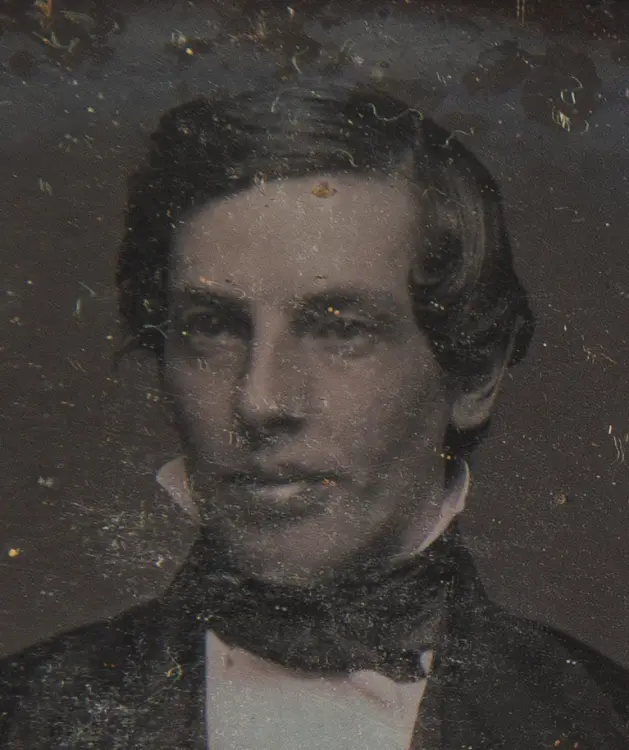
Who does this look like to you?
AnchoredinChrist replied to AnchoredinChrist's topic in General Discussions
I happen to think the locket photo is more likely to be Hyrum Smith, and when I looked to see if anyone else had thought so too I found this analysis of it that I thought was really compelling: https://josephsmithjrphoto.blogspot.com/2023/07/hyrum-smiths-identity-through.html?m=1 I know many think the locket photo to be depicting a man too old to be Joseph Smith, as he died at 38 and many people think the locket picture to be of a man in his 40s. -
My guess is this is what Meldrum (Iknew he was young earth and hoped he mentioned it somewhere) believes because he dismisses the age scientists give for fossils because fossilization over long periods of time has never been observed directly, in the lab or out of it. https://scholarsarchive.byu.edu/cgi/viewcontent.cgi?article=1808&context=msr Also AI (this is an accurate summary according to the ideas I have seen from this very unfortunate model:
-
This is the one I heard growing up.
-

A thread for sharing Carol Lynn Pearson poems
Calm replied to AnchoredinChrist's topic in Social Hall
I take it you really like her. -
I think it's great for members to feel free to wear a cross without judgement among the Latter-Day Saints. And for the sleeveless tops too. The youth or those that work out their biceps can show them off a little more. I of course, would prefer to cover my flabby arms. Thanks for asking.
- Yesterday
-
I've met a few members that believe this. The most common answer is that the earth was formed from material that had been used in previous planets and so the bones from those planets ended up in earth. If you go outside of the church to those who are young-earthers, they have quite a lot of ways to explain it away. A common way is to say that the flood triggered the fossils by burying them and that the process to fossilize is actually much faster than what mainstream scientists say. There's even a paleontologist who is a young-earther - https://en.wikipedia.org/wiki/Marcus_R._Ross.
-
Interesting. I hope the author of the blog post does more investigation. I think the locket picture has much better provenance since it is in the family but this one is interesting as well.
-
I understand the skepticism about legislative motives. Politicians of every stripe mix principle, politics, and constituency pressure, and it is fair to question whether a particular bill is primarily about child protection or about "signaling." That said, the comparison to R-rated movies watched with parents does not seem to work. An R-rated film is a recorded work that parents can preview, control, and contextualize in private. A live performance in a commercial or public venue is different in setting, immediacy, and the degree of parental control once the child is present. Existing law already treats live adult entertainment, obscenity, and age-restricted venues differently from private viewing of movies for related reasons. A person can criticize the Florida statute as poorly drafted, politically timed, or broader than necessary, but I think he could do that without treating every age-based limit on sexualized live performances as illegitimate religious lawfare. However, the reverse is also true: existing gaps or inconsistencies in how other forms of content are regulated do not automatically prove that any restriction in this area is pretextual. I would be interested in your responses to the questions I posed above: Do you believe there should be any age-based legal limits on the sexual content of live performances that minors can attend, or is your position that parental consent should be the sole and final authority in every case? If Florida’s prior obscenity and harmful-to-minors statutes already fully solved the problem, why do similar age restrictions exist in many other states and localities for adult entertainment venues, strip clubs, and certain performances? Are those also unnecessary? CB compared this law to forcing children to read the Bible. What is the closest real-world parallel you see: is restricting minors from a sexualized stage performance more like compelled religious exercise, or more like existing limits on minors’ access to pornography, alcohol, or adult businesses? Thank you for your participation. -Smac
-

Pronoun/Gender Wars Continue Apace
SeekingUnderstanding replied to smac97's topic in General Discussions
I'm sorry, but I don't think that the Florida legislature is acting in good faith. Instead they are threatening lawfare to rein in acts that go against their religious principles. If they were really concerned about lewd conduct and "grooming" why have they done nothing to prevent children from watching rated R movies with their parents? -
I don’t really know of too many people that are members of the church who believe that the garden story occurred 6000 years ago. I’m sure they’re out there. I’m just never run into One and got to have a conversation with them. I think mostly they just believe that the fossil record is a hoax somehow. I’ve enjoyed reading the words of Leaders in the church who accepted the fossil record as accurate, and also accepted Adam and Eve as a literal people. Those were the people that I was speaking about in my earlier post to you.
-
I can't tell whether you want to have a serious conversation about this. I do want to have a serious conversation. Could you explain what part(s) of my comments are causing confusion on this point? Existing laws against obscenity and harmful material to minors are relevant, and it’s fair to ask whether a new statute is necessary or carefully drawn. Legislatures sometimes pass overlapping or politically timed measures; that criticism is not unique to this issue. That said, equating a law that restricts minors’ access to performances meeting a statutory definition of sexual or lewd content with a proposal about litter boxes in schools is a category error. One involves regulating adult-oriented sexualized performances in the presence of children. The other addresses a largely anecdotal or satirical claim that never reflected widespread policy. Treating them as the same kind of “made-up problem” collapses distinct questions into a single partisan narrative. I am willing to examine whether this particular statute is vague, overbroad, or redundant with prior law. I am less persuaded by the claim that any effort to set age-based limits on sexualized live performances must be dismissed as pure identity politics. Consequently, please identify which preexisting Florida statutes which you think already cover the same ground as the above-referenced statute covers. The underlying interest—limiting children’s exposure to certain sexual content in public or commercial settings—is not new, and it is a legitimate governmental objective. Children really are being exposed to highly sexualized content. While reasonable disagreement exists about the means and the drafting of the statute, that is different from saying the entire subject is imaginary. That’s a fair description of the procedural history. The district court and a majority of the original panel found a substantial likelihood of success on the vagueness and overbreadth claims and issued a broad injunction. Five judges on the en banc court agreed with that view in dissent. The en banc majority of eight, however, disagreed. It held that the statute’s use of “lewd,” as construed under existing Florida law, and its age-variable standard did not render the Act facially unconstitutional, and it vacated the injunction. Close divisions among judges are common on difficult First Amendment questions; they do not themselves establish that the losing side’s position is the correct one. The controlling decision at this stage is the en banc majority’s. That is a legitimate policy question, and it is distinct from the constitutional one the en banc court decided. I don't think I have claimed that the statute was the only possible way to address the issue, or that Florida’s prior obscenity and harmful-to-minors laws were a complete nullity. Legislatures often add overlapping or more specific tools when they conclude existing provisions are hard to apply to live performances, slow to enforce, or uncertain in scope when the event is marketed as entertainment rather than explicit adult material. Whether this particular law was necessary is a judgment call about legislative priorities and drafting. Reasonable people can conclude it was redundant, poorly tailored, or politically motivated. My point has been narrower: the underlying interest in setting some age-based limits on sexualized live performances is not inherently illegitimate, and the en banc court found the statute survived the facial constitutional challenge that was brought. Necessity and constitutionality are related but not identical questions. I am open to arguments that better-drafted or more targeted tools would have been preferable. Those are reasonable criteria for evaluating any statute. I'm not sure the statute in question scores perfectly on all of them. Clearer definitions and tighter tailoring are almost always preferable. Age-variable standards can create practical uncertainty for venues. Parental autonomy deserves due weight and deference (due, but not unlimited). Any law that touches expressive conduct needs safeguards against selective or viewpoint-driven enforcement. The dissent emphasized these concerns, and they are worth taking seriously in application. My position is not that the statute is a model of legislative craftsmanship. Rather, I think the state has a legitimate interest in placing some outer limits on sexualized live performances involving minors. I also think that existing - and constitutionally valid - categories of regulation (obscenity, harmful-to-minors material, age restrictions on adult entertainment) already reflect that interest, and that the en banc court found the facial constitutional challenge unlikely to succeed. One can accept those points while still preferring narrower drafting, stronger definitional clarity, or greater deference to parental decision-making in close cases. So while criticizing the law's language or design is fair, but I think that treating the entire subject as illegitimate or imaginary is a different claim. A few questions for you: Do you believe there should be any age-based legal limits on the sexual content of live performances that minors can attend, or is your position that parental consent should be the sole and final authority in every case? If Florida’s prior obscenity and harmful-to-minors statutes already fully solved the problem, why do similar age restrictions exist in many other states and localities for adult entertainment venues, strip clubs, and certain performances? Are those also unnecessary? CB compared this law to forcing children to read the Bible. What is the closest real-world parallel you see: is restricting minors from a sexualized stage performance more like compelled religious exercise, or more like existing limits on minors’ access to pornography, alcohol, or adult businesses? This is an important and difficult topic. I appreciate your efforts to treat it seriously. Thanks, -Smac
-
I can't tell whether you want to have a serious conversation about this. Florida already had lots of laws that protect children from the things you find objectionable. This new law is clearly about identity politics and throwing red meat to voters who get worked up over imagined social issues. This law is in the same broad category as the proposed F.U.R.R.I.E.S Act in Texas that makes it illegal for school kids to use a litter box--it is addressing made-up problems that are used to manipulate voters. Hamburger Mary’s, a venue that hosts both adult-only and family-friendly drag performances, challenged the constitutionality of the Florida law. The district court, two of the three judges on the original appellate panel, and five judges in the later en banc dissent concluded that Hamburger Mary’s had shown a substantial likelihood of success on the merits and that enforcement should therefore be enjoined while the case was litigated. Those judges identified serious concerns involving vagueness, an unworkable age-specific standard, overbreadth, a severe chilling effect on protected expression, and broad regulatory discretion that could permit arbitrary or viewpoint-selective enforcement. So here is what I would like to hear from you: Was this law actually necessary? What concrete deficiency in Florida’s existing laws did it fix? And do you think it is well crafted when judged by ordinary standards for sound legislation: a real and identifiable problem, clear definitions, workable age calibration, proportional penalties, appropriate respect for parental autonomy, and safeguards against viewpoint-selective enforcement?
-
Do you find it troubling at all when the state starts to take over and decide what is appropriate or not appropriate rather than let the parents of their own children decide how they raise their children? I do think parental authority should be the default, and state intervention in family decisions deserves close scrutiny. Neither of these considerations is absolute. We as a society already accept a number of limits that apply even when parents might consent: Minimum age for alcohol Restrictions on tattoos and certain body modifications Child labor laws? Prohibitions on exposing minors to obscenity or pornography Do you agree or disagree with these other instances of the state "tak{ing} over and decid{ing} what is appropriate or not appropriate" for children "rather than let the parents ... decide"? I would assume you agree with them, but I am open to correction. In any event, the debate seems to really be about where the line belongs, not whether any line can exist. I am open to arguments that this particular statute is drawn too broadly or too vaguely. I just do not accept the premise that the state must stay entirely out of the question of what sexualized content is appropriate for children in public or commercial settings. I would be interested in hearing more from you about this topic. That’s a useful test of the principle, so let’s take it seriously. Forcing children to read the Bible (or any religious text), or "anti-Mormon literature," either of which being against their parents’ beliefs, would be a clear establishment of religion and a direct violation of both parental rights and the Free Exercise Clause. The state would be affirmatively compelling a particular religious practice or viewpoint. Restricting minors’ access to sexualized live performances is a different category. It does not compel anyone to adopt a belief, practice a religion, or consume any particular content. It sets a boundary on what commercial or public adult-oriented sexual material may be presented to children. That kind of age-based restriction already exists in many areas (obscenity laws, pornography, alcohol, tobacco, certain performances) without being treated as equivalent to compelled religious instruction. One can consistently support parental primacy on matters of religious upbringing while also supporting some outer limits on the sexual content to which children can be exposed in public or commercial settings. The two are not the same exercise of state power. Respectfully, no, I am not advocating for that. I am not advocating a “takeover” of parenting. I am defending the idea that the state may set some outer limits on the sexual content to which children can be exposed in public or commercial settings—just as it already does with obscenity, pornography, alcohol, and certain performances. Parental judgment remains primary in most areas, but that does not mean it is the only consideration when the question is what adults may present to other people’s children in shared spaces. The law in question is not limited to “drag shows.” It targets all live performances (not just drag shows) that meet a statutory definition involving nudity, sexual conduct, lewdness, etc., when those performances are deemed unsuitable for the age of the child present. Some events marketed as family-friendly have included highly sexualized elements; others have not. Treating every drag performance as identical is no more accurate than treating every restriction as a ban on two moms in a picture book. Could you clarify your perspective? If a drag show does not violate the statute, then the statute would not apply. Do you therefore endorse drag shows which do violate the statute? Drag shows depicting or simulating: Nudity Sexual conduct Sexual excitement Specific sexual activities (as defined under Florida law) Lewd conduct Lewd exposure of prosthetic or imitation genitals or breasts? Or putting aside specific endorsement, do you think children should be exposed to these behaviors? Or is your perspective more about leaving such matters to parents? If so, what are the parameters you envision? Are parental rights inviolate in your view? If not, what limitations do you think can or should exist? As for quantified “proven harm” from every possible exposure: that is a high bar that we do not require in most other areas of child-protection law. We do not demand a precise body count of damaged children before restricting minors’ access to pornography, strip clubs, or other adult sexual material. The question is whether the state may draw any age-based line around sexualized live performances at all. I think it may. Reasonable minds can disagree about where exactly that line should sit and how clearly a statute must define it. Thank you for sharing your perspective. Thanks, -Smac
-
Thanks to all that answered my question, but I guess I was not clear in what specifically I was asking. I realize that people can choose to read the story of the Garden of Eden literally or as an allegory. That really wasn't my question. What I wanted to understand better is how people who hold the belief that the Garden of Eden was a truthful account that supposedly occurred about 6,000 years ago as a truthful account on how mankind came in to existence is able to dismiss the fossil records that show humans living milllenials living and dying long before the Garden of Eden takes place.
-
Do you find it troubling at all when the state starts to take over and decide what is appropriate or not appropriate rather than let the parents of their own children decide how they raise their children? For example should the state force children to read the Bible even if the parents find that to be inappropriate and goes against their own religious beliefs? How about forcing children to read anti-Mormon literature because the state thinks that Joseph Smith was grooming children and forcing high school girls to marry him. Would you find that offensive for your own children to experince attacks on your own moral and religious beliefs? Or is it only appropriate when it agrees with your own way you choose to raise your children. THIS is what you are advocating for. The take over of the state on issues that are best left to parents to decide what is appropriate for their children and what is actually a sexualized event. Do you have ANY REAL DATA that does show children are being sexualized by drag shows? What actually is the result of a child seeing a drag show or a drag queen reading a book in the library on a child? Just how many children have had proven harm witnessing such events and what does that harm even look like?
-
Who does this look like to you?
AnchoredinChrist replied to AnchoredinChrist's topic in General Discussions
When I first saw this photo last week it was from someone who said they had previously received a visitation from Joseph Smith and had seen his face. They said that they consider this purported photograph of him to be a real one. The provenance of this photograph is WILD and an interesting story all on its own. It was first noticed by a church member (who has a blog) in a catalogue of old photographs in Brazil of all places. The original cataloguer had gotten the photograph from New York and brought it to South America. They had estimated the photograph to have been developed in 1845. Coincidentally, Joseph Smith wrote in his diary in 1844 of having his picture taken in New York. So he perhaps got the photo for his presidency campaign but died before it was sent back to Nauvoo. The church member in South America who found it in a random book of pictures decided to investigate it solely because they thought it looked like Joseph Smith. -
That’s a fair question about definitions. Vague or elastic terms in any criminal or regulatory statute are worth scrutinizing, because the people enforcing them will not always share our priorities or judgment. Nevertheless, the existence of hard cases or bad-faith actors does not mean we abandon the underlying category. That a concept cannot be defined with exacting precision does not mean it cannot be defined at all. We already have legal concepts like “obscenity,” “harmful to minors,” “indecent exposure,” and age-based restrictions on alcohol, tobacco, and certain performances. Those terms are also contested at the margins, yet most people still accept that some line exists between material appropriate for adults and material that should not be presented to children in public or commercial settings. The examples you raise (books depicting same-sex parents, or a same-sex kiss in Lightyear) are not the same as sexually explicit or lewd live adult performances. Conflating ordinary representation of gay people with adult sexual content is, I think, a category error that makes productive disagreement harder. One can support age restrictions on sexualized entertainment without supporting the removal of books that simply show two moms or two dads. Here is a copy of the en banc decision from the 11th Circuit Court of Appeals. Here is a Grok summary of its treatment of the two phrases you referenced: I am happy discuss where the line should be drawn and how clearly the statute defines it. I am less persuaded that the risk of overreach by “the wrong people” means there should be no enforceable line at all when it comes to minors and sexual content. Thank you for sharing your perspective. -Smac
-
Who does this look like to you?
AnchoredinChrist replied to AnchoredinChrist's topic in General Discussions
There is a super long and detailed analysis of the photograph here: https://theology.science.blog/2024/09/15/is-this-photograph-finally-joseph-smith/ Of all the points of argument, one that is really compelling to me is what the writer calls, “Apparent hypertrophy of the left orbicularis oris muscle, due possibly to forceful speaking (the outdoor preaching venues in Nauvoo were notorious for requiring loud speaking)”: This “hypertrophy” of the left side of his mouth is visible on his death mask both when the light on the mask is shining from the side or from the front: I also think the ear to be very distinctly compelling as well, what the writer of the article calls a "detached lobule":


-
Pronoun/Gender Wars Continue Apace
SeekingUnderstanding replied to smac97's topic in General Discussions
Who gets to define these terms? Given the uproar from conservative wackadoodles over books that show two moms or dads, as well as the uproar and outright ban of the movie "Lightyear" over it's inclusion of a kiss, then yes, I absolutely have a problem letting those kinds of people enforce laws over this kind of stuff. -
Maybe this photo has already been circulated on this site before, but I couldn't find it in a quick search and I hadn't seen it myself until last week so I thought I'd share. Whose name comes to mind when you see this photograph?
-
The parents bringing there own children with the correct guidance is correct and proper. The problem I find, is when government laws and regulations are enforced in away that the parents are not comfortable with but are expected to bring them in accordance with the law, that they had parents are not comfortable with.
-
Emma had serious disagreements with Brigham Young, particularly over Church leadership and property after Joseph's death. She would join the Reorganized Church of Jesus Christ of Latter Day Saints, led by her son Joseph Smith III More about her can be found here. "Emma struggled deeply with the principle of plural marriage. Joseph introduced the practice carefully and incrementally, marrying many additional wives, each of whom vowed to keep their participation confidential. Nevertheless, it is apparent that Joseph withheld knowledge of some of these relationships from Emma. In early 1843, Emma appears to have accepted plural marriage and personally consented to and witnessed Joseph’s marriages to four women. But by July, her attitude toward the practice had shifted again, and she burned a manuscript copy of the revelation on plural marriage now found in Doctrine and Covenants 132".