manol
-
Posts
1,396 -
Joined
-
Last visited
Everything posted by manol
-

Why does life make it so hard to trust God?
manol replied to bluebell's topic in General Discussions
That is wonderful, and I am very happy for you! I can't explain such things either. Maybe that particular "isometric exercise" stage was over? -
Why does life make it so hard to trust God?
manol replied to bluebell's topic in General Discussions
^^This^^ has been true for me. For better or for worse, I tend to see what I'm looking for... one implication being that, to a certain extent, I am my own jailer; but on the other hand, the key is in my own pocket. If I give my intellect (limited as it may be) the task of finding all the injustices a decent God would never have allowed and/or could have prevented, my intellect will deliver in abundance. I have not found that to be the path of greatest light for me. But it may well be for someone else - who am I to judge? Perhaps the brightest path for some is to make sure that God (or at least what we've been led to believe about God) gets called out for not living up to expectations. If that is what works for you, carry on! Personally, I think Viktor Frankl figured this stuff out. Here are a few relevant quotes: "Forces beyond your control can take away everything you possess except one thing, your freedom to choose how you will respond to the situation." "Between stimulus and response there is a space. In that space is our power to choose our response. In our response lies our growth and our freedom." "Our greatest freedom is the freedom to choose our attitude." Here's another take on the same basic concept, that of claiming and acting upon our freedom to choose our response and our attitude in the face of whatever circumstances present, this time not from a concentration-camp survivor but from a zombie: "Choose love in spite of all you see in the world. Choose love regardless of what you're going through. It does not matter how much you're suffering, the choice for love is still there. It never goes away despite any circumstance, despite any temperature in the world, despite any war, despite any famine, despite how wealthy you are, despite how happy you are, how sad you are, how depressed you are, the choice to remember to choose love never ever goes away. Regardless of whether the world is perfect or is going through the absolute fires of who knows what, the choice is still there. Be strong enough to make that choice. That's what it's about, to make [that choice] regardless." - near-death experiencer Jonathan Ashford That is what I aspire to, and I have a very long ways to go. Edited to add: This morning my YouTube feed fed me this short video, I have no idea who this guy is, but his message is to deliberately choose one's focus rather than trying to battle one's mind over every single thought. It's an imo very practical application of what @MustardSeed said, namely that we do find what we seek. Here it is, cued up to his core message, which he gets across in less than a minute and a half: https://www.youtube.com/watch?v=dp9lIUHWyFc&t=263s -
Sacrament Renews All Covenants? Anyone ever hear this?
manol replied to Stargazer's topic in General Discussions
Agreed! So, here's the thing: Can you expand your paradigm beyond what the scriptures and the Sunday School manual explicitly give you permission to believe and embrace? (This is a rhetorical question; I'm pretty sure I've seen you do so.) Some version of the vending machine approach arguably has a place in a paradigm where outcomes not only matter, but are pretty much the only thing that really matters. Which kingdom are you and those you love going to wind up in? That would be an outcome which matters. The vending machine approach is, at least theoretically, about being able to control outcomes, including that one. And I would have a really hard time arguing from the LDS canon that we don't need to worry about outcomes. Such is my opinion, and imo such is the unarticulated truth behind the oft-repeated injunction to “fear not”, but there are far more scriptures giving reasons to be fearful than giving reasons not to be. Personally, I think this sort of thing is by design. I think there comes an intentional point where circumstances call upon a person to apply what they've learned about how to recognize truth. Sort of like, “you've passed the lecture part of the course, now here's the lab where you put it into practice.” And of course I could be wrong. Thanks! Me too. Sometimes I can go straight "there" just by having the intention, but most of the time I have to consciously and deliberately choose thoughts which “tune me in” to that particular “radio station”. -
Sacrament Renews All Covenants? Anyone ever hear this?
manol replied to Stargazer's topic in General Discussions
Then there are people who have done A in full faith that the result would be B and it didn't work out that way. For years I structured my life around that concept as advocated and expounded upon by the book "Drawing on the Powers of Heaven" by Grant Von Harrison. It didn't "work". Yes at the time it felt wonderful to "know" that the outcome I desired was going to happen, but then it didn't. So I now think it's a mistake to be focused on outcomes. I don't think we get to control outcomes, and that is probably a very good thing. Imo rituals and sacraments and ordinances and priesthoods are tools, and they can be very powerful tools if one has faith in them. They can even facilitate a person entering into the state of being filled with the pure love of Christ. They give permission where we might otherwise think we don't have permission. But they are not, in and of themselves, the pure love of Christ. They are not, in and of themselves, the mighty change of heart. They are not, in and of themselves, the presence of the Divine. Imo nothing external is needed (except perhaps correct teachings), but that doesn't mean no ritual or sacrament or ordinance or priesthood can be a facilitator. For instance I don't think a special occasion is needed to renew promises one has made to God, but if it helps, wonderful! -
I'm not familiar with that channel, but if that's his opinion then I share it. Multiple researchers have noted that the beliefs of the LDS Church seem to be more compatible with the reports given by near-death experiencers than the beliefs of other religions, though of course differences can be found. My recollection is that Raymond Moody mentions this in his first book, or was it Melvin Morse? It's been a while and my memory is a bit foggy. In my opinion authentic near-death experience accounts are part of that which "God does now reveal". Imo they are, among other things, an opportunity to recognize truth when it shows up without someone in a position of ecclesiastical authority having put a stamp of approval on it. Imo they are an opportunity to see if we can apply Alma Chapter 32 to teachings that may be new to us. They may even be "new wine" that our old bottles, or old paradigms, cannot contain, causing us to grow. One of the ideas people who've had NDEs sometimes come back with is imo quite similar to the responsibility for one's choices taught in the LDS Church and in Section 76 in particular. It goes something like this: We don't get to bring our litany of excuses with us to the other side. Over there, we see with a clarity that our excuses cannot survive. So I think the "subduing" you mention is a free-will choice, there being no need whatsoever for coercion. Quoting an NDEer on the subject: "In my life review, there was one thing that was unmistakable and it may surprise you. There were no excuses. Not one. Not for anything. "But it wasn't “judgement” that I felt during the life review. It was something else. It was unconditional love, but it was also truth. And the truth is, simply, that during the existence that had led to that review, all of the excuses created and used in that life were meaningless. They never mattered. "Not a single reason I had ever rationalized for how I treated someone, any excuse for how I may have withheld love, the intellect’s logic for how and why I deservedly reacted to something, judged someone, none of it was there. Zero." Link: https://www.jonathanashford.com/post/the-excuse
-
I think religion has it wrong. Based on NDE accounts as well as the Book of Mormon account of Alma the Younger, I think the purpose of a hellish experience is simply to change a soul's trajectory. Here's one such experience; compare with Alma Chapter 36 if the topic interests you (and skip ahead to 22:57 if you're open to a non-religious take on "what we're here for"): I Went to Hell. It Was the Best Thing That Ever Happened (NDE) - YouTube
-
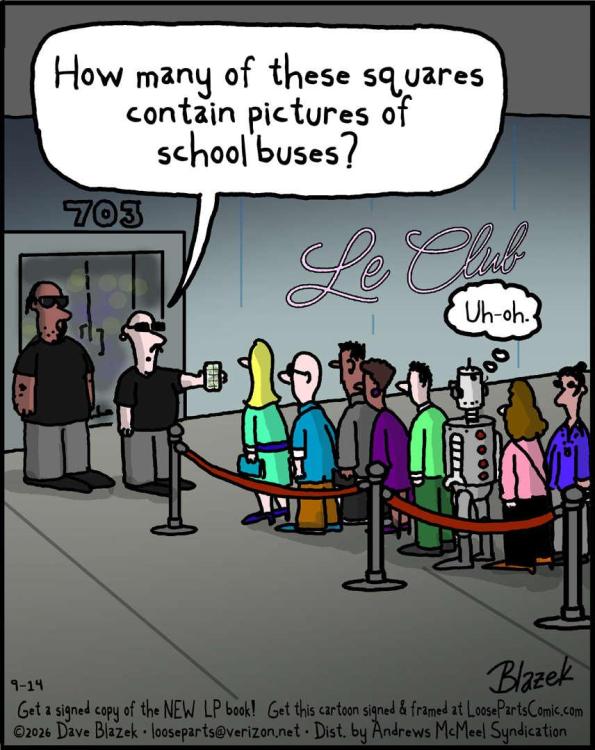
I dunno... put yourself in the robots' shoes. It's got to be stressful for them too.
-
Church's Policy on Surrogacy - Looking for Input
manol replied to smac97's topic in General Discussions
Agreed. If all things “give us [valuable] experience, and work together for our good”, then we're never being screwed over. Imo this is an idea for which there are many, many witnesses, some within the canon of the LDS Church, but most from outside the LDS Church. Ime near-death experiencers offer depths of insight in this area which are not articulated in our few applicable verses of scripture. Hence my posting of links to relevant YouTube videos, in case it's a topic of interest to anyone. Agreed. When permitted to do so, the intellect is very adept at coming up with self-serving justifications for unloving attitudes and behaviors. Imo this is a mistake; imo the intellect should be the servant of the soul, and not the master. Instead of letting the ego and/or intellect steer the bus, what if we choose to show up as love incarnate to the best of our ability in the moment, regardless of how we showed up in the preceding moment? -
Church's Policy on Surrogacy - Looking for Input
manol replied to smac97's topic in General Discussions
I've read most of those. My understanding is that the at-the-time-revolutionary LDS concept of a pre-existence wherein choices were made, possibly including "plans", predates Raymond Moody's book by maybe 145 years or so. On the other hand my recollection is that the musical "My Turn On Earth" rather clearly depicts people making plans in the pre-existence, and it came out a two years after Raymond Moody's book. Were such ideas present in LDS culture before then? I don't know. But I don't think pre-birth planning was mentioned in Moody's book. AI doesn't think so either. I also asked AI when the first near-death experience accounts describing the making of pre-birth plans were published and it said 1992, but I do not trust AI to have made a thorough search. So if the one is informing the other it is not clear to me who started it, but I think the idea showed up in LDS culture first. What do you think? I did imply independence, and have no idea how I could ever present evidence of such. It would be like trying to prove a negative: Theoretically possible but not practical. So I now formally withdraw the implication of independence and will edit my post accordingly. <- EDIT: The time window for editing the post I was referring to has passed, so I hope this retraction is sufficient. Imo the bigger question is, are we being screwed over, or not? It is quite possible that our confirmation biases will present us with evidence supporting whichever belief we already have. -
Church's Policy on Surrogacy - Looking for Input
manol replied to smac97's topic in General Discussions
Apologies for being dense... are you saying that NDE accounts likely influenced/instigated LDS folklore, and/or vice-versa, or something else? Well my brain state seems to be one of density... it sounds to me like you're saying, in effect, that extraordinary claims (such as NDEs and/or LDS folklore on pre-birth planning) require extraordinary proof... am I misunderstanding you? -
Church's Policy on Surrogacy - Looking for Input
manol replied to smac97's topic in General Discussions
This is a topic on which quite a few near-death experiencers have weighed in. Their reports are pretty consistent. I come away with the impression that we are not victims; rather, we ourselves are intense experiencers of mortality and the unique opportunities for growth it offers us. I also come away with the impression that we simply do not have enough information to reliably sit in judgment. Here are two compilation videos wherein NDEers (and a few others) talk about planning our lives. While not everything on the videos aligns with current LDS thought, imo there are too many parallels with LDS doctrine and/or folklore for it to be mere coincidence. Each video is cued up to a clip that stood out to me, but imo all of the clips offer valuable insights. I think we are now living in one of the most amazing times in all of human history, having literally at our fingertips hundreds of first-hand accounts from otherwise ordinary people who have been on the other side and returned to report for the benefit of the rest of us: -
Prayers for you Pyreaux. I think you can still talk to him.
-
I think you are being inspired. And it sounds to me like at-the-time seemingly disconnected threads in your life are now weaving together. I think there's a story out there that wants to be told by YOU.
-
Great reply @quietcanon, and I appreciate your taking my questions seriously. You have addressed all of my concerns. Very best to you.
-
I've been out of the loop for a while so your posts are the first time I've heard of anything like this. Imo it's prudent, and of course unfortunate that present circumstances make it prudent. Thirty-something years ago a man began calling our ward repeatedly threatening to show up and kill Mormons. Nobody else took his threats seriously, which was probably logical because nothing like what he was threatening had ever happened. I appointed myself "unofficial greeter", hanging around outside before and after meetings, and keeping an eye on what was happening outside and/or at the entrances as best I could during meetings both on Sundays and during the week. I was in the bishopric so my presence wasn't abnormal, and people just thought I was this cheerful little guy who liked to greet everyone. Nobody ever knew I was carrying, illegally because there was no other option in that jurisdiction at that time. Glad to hear there is now an actual plan in place, at least in some locations, and that actual trained personnel are involved.
-
A couple of weeks ago, just to mess with the AI's brain (it's not a sin to deliberately be a jerk to an AI, is it?), I started selecting ONLY wrong answers. I did this for well over a dozen different sets of images. Then... seemingly out of nowhere... it evidently concluded I was human and let me in! My guess is the AI figured out that only a human could be so intentionally obtuse as to consistently get ZERO correct. The AI being able to deduce that I was a human from my deliberate disobedience to its instructions is a bit unnerving. I feel like it out-smarted me. Not that that bar is set very high, but still...
-
Thank you for replying. I can see the utility of the hierarchy you advocate as a tool for resolving apparent contradictions within the canon, and/or between the canon and subsequent teachings and commentary, at least among parties agreeing to its basic assumptions. For instance, it would be interesting to open-mindedly examine plural marriage through the lense of the hierarchy you advocate, rather than starting out with “the answer” having already been determined in one's mind. Must admit that would be challenging for me! It sounds like you might have in mind limiting the scope of application for the heirarchy you propose to a particular type of discussion, in which case the following reservations don't apply: My first thought when reading your post was, what you're describing is all about the intellect. The hierarchy you advocate decrees how to go about making a reasonable intellectual categorization of scriptures and other teachings. It looks to me like this completely leaves out personal responsibility for connecting with God and receiving guidance. It's like a formula whose infallibility and exclusivity is assumed, such that progression within this paradigm becomes a matter of logical application of the formula. Does God the Holy Spirit have a primary role, or a secondary role, or any role, within this paradigm? Second, it seems to me the hierarchy you advocate decrees that God must communicate according to its criteria in order to be taken seriously. 2 Nephi 29:11 (arguably Class 1?) envisions God speaking through multiple channels in multiple locations: “I command all men, both in the east and in the west, and in the north, and in the south, and in the islands of the sea, that they shall write the words which I speak unto them”. It looks to me like the hierarchy you advocate would not even notice, much less attribute any credibility to, communication from God which does not come exclusively through the channel it approves of. So right now God could be revealing “many great and important things pertaining to the kingdom of God” through one or more intermediaries other than Dallin H. Oaks and such would never be taken seriously. Third, applying the thinking the hierarchy advocates to the hierarchy itself, does it have more Class 1 scriptural support than any other competing paradigm? I understand that the hierarchy makes logical sense if we make a few foundational assumptions about the infallibility and exclusivity of what has made its way into the canon, but from within the canon itself, what are the scriptures that support it? And, applying the hierarchy's formula, are those scriptures more persuasive than scriptures which support any other paradigm? Is the priority the pursuit of truth, or the pursuit of correctly understanding the canon, or are the two assumed to be one and the same? As I said, the above reservations might not apply. To give some context to where I'm coming from: My personal belief is that we have the calling and the privilege of being the same manner of men and women as Christ. I think this would be “being filled with the pure love of Christ”. And I think being filled with the pure love of Christ is not primarily an intellectual pursuit; rather, it is something felt, something experienced, something embodied, something we are to deliberately return to again and again and again whenever we notice we've slipped into any lesser state of consciousness. (<- And for the record, that's all something I aspire to, rather than something I claim to do.)
-
@quietcanon, do you believe that "God does now reveal many great and important things pertaining to the kingdom of God"? If so, how might we recognize them? And, how would they fit into your "canon first" theological hierarchy?
-
@BlipBlap seems to have forgotten that the Latter-day Saints have a scripture specifically instructing them not to attack other religions. D&C 18:20: "Contend against no church, save it be the church of the devil."
-
I think God desires our closeness, in our hearts if not in physical proximity, and I think it's wonderful that Catholicism has a way for its members to experience the Presence of God in both ways. My understanding is that the Divine is present where two or more are gathered in his name (no mention of a requirement that they agree about everything), and perhaps that gathering "place" can even be an internet forum.
-
General Conference talk on the understanding of the Godhead
manol replied to GoCeltics's topic in General Discussions
Yeah, I can't see gloating being a thing that anyone does in Heaven. And it's not that I'm thinking those looking forward to gloating are going to be disappointed and therefore I'll get to secretly gloat about that! I just don't think we will be seeing through lenses that show us something to be gloated over. Imo we don't even have to wait until we die to see through a lense that shows us love instead of judgment, and kinship instead of separation. -
Beautiful message in those lyrics indeed, THANK YOU Navidad! Below is a link to a blog post by a near-death experiencer writing about love. He does not come from a religious background, but he ends up in a similar place to where Frederick Faber takes us in that inspired hymn. Here's a quick quote, as a preview: "Love everyone where they are. Not where you wish they would be." Love (jonathanashford.com)
-
I agree with you. I think Christ is more interested in how we perceive and treat one another than in whose religion is the best. The accounts of near-death experiences have found their way into my personal "open canon", and the following is from notes taken while listening to one of them: On the other side there are no lines of separation. On the other side we are all family. I aspire to see that way down here, and @Tony uk I think you set a wonderful example. Thank you.
-
I'm not committed to any particular doctrine of how creation happened, or is happening (maybe it's not over yet?), but as a thought exercise: Suppose God exists in a realm where thoughts are, or can be, energy. From there, it's not a huge leap to envision a sufficiently advanced "celestial technology" (for lack of a better term) converting this energy into matter; in fact, down here in the physical we even have an equation describing how much physical-world energy it takes to create matter: E/C^2 = M Now down here in the physical world we have conservation of matter and energy, such that the total sum of the two remains constant in the physical universe, but maybe that is not the case for the non-physical universe. For instance suppose you become filled with the pure love of Christ. Is there now less of the pure love of Christ somewhere else in the universe(s)? I don't think so; I think you have actually increased the net amount of the pure love of Christ in the universe(s). I'm not saying the above two paragraphs are descriptive of how creation happened; what I'm really saying is, I think it's a good idea to keep an open mind. If one's paradigm is correct, it will survive open-minded encounters with other paradigms. And if one's paradigm is incorrect, it will be corrected by open-minded encounters with other paradigms (assuming one of those is more correct). Imo this is a topic where there is vastly more we don't know than what little we do "know".
-
What are we here to do? We are here to become the same manner of men and women as Christ, which means we are here to develop and embody and radiate the pure love of Christ. The pure love of Christ is a state of being that fills a person and if unimpeded it shows up in everything they do. Now it doesn't require much growth to love someone if they agree with us about everything that matters to us. But we came here to grow. Therefore... People we disagree with, and especially people we disagree with strongly about things that matter to us, are giving us a wonderful gift: They are giving us the opportunity to develop spiritual muscles that would otherwise go unused. They are giving us the opportunity to love where love does not come easy. They are giving us an opportunity to develop the pure love of Christ. This goes for those who stay in the Church as they look at those who leave, and it goes for those who leave the Church as they look back at the Church and those who stay. We are each on the same journey towards becoming the same manner of man or woman as Christ whether that is presently our focus or not, whether we are even aware of it or not, whether we are learning the easy way or the hard way, regardless of how many mistakes we make, and regardless of how different all outward appearances may be. In my opinion.