All Activity
- Today
-

A psychosocial analysis of polygamy & monogamy
webbles replied to AnchoredinChrist's topic in General Discussions
Oh, it absolutely was a forced marriage solution. She didn't really make the choice, it was done by her parents. But it isn't polygamy related. Parent arranged marriages where the child (either daughter or son) didn't agree was definitely a thing in those days. I'd love to see these other stories. Do you know where I can find them? I don't think the website does a good job with arguing those three points. I actually agree with the first point and I think the website isn't really strong in their argument. The way it is written, it is all over the place and doesn't really use the data it has. It references some data that is not very strong or incorrect. So, even though I agree with it, I wouldn't use that website as a source to learn. I disagree about the other 2 points. Now this could be because I do believe that God actually did command polygamy (and yes, I've prayed about it and studied it extensively). So I don't find the website's arguments very convincing. - Yesterday
-

SCOTUS Decision: Ban on "Talk" Conversion Therapy is Unconstitutional
Calm replied to smac97's topic in General Discussions
It is the same issue imo as whether one believes the inner voice is the Light of Christ or the ‘natural man’ when it comes to beliefs that contradict church teachings, scriptures, etc. How can you tell? -

SCOTUS Decision: Ban on "Talk" Conversion Therapy is Unconstitutional
smac97 replied to smac97's topic in General Discussions
They are stable and widely shared. I hope you will clarify what you are saying here. As I see it, the categories ("man" and "woman") were stable and widely shared for a very long time. What has changed is that a concerted effort has been made, in a relatively short period, to redefine “woman” from an adult human female to a person of either sex who subjectively "identifies" as one. That redefinition and lack of stability, and differing, rather than "shared," understanding are precisely why we are having this conversation. When the meaning of the category itself becomes contested, the informal social-contract approach loses the common ground it needs to function. People can no longer rely on a shared understanding of who belongs in the category; they are instead asked to accept a subjective claim that may contradict physical reality. The stability you assert is what existed before the redefinition project began. The current dispute is evidence that the prior consensus has been disrupted, not proof that it remains intact. I think what we are seeing is not "confusion," but rather disagreement. Nobody is "confused" about whether Lia Thomas is biologically male. The issue is whether he should compete against women because he "identifies" as a woman. That's disagreement. Saw this on Facebook, both apparently of the above person at different points in her life: "{F}or purposes of selecting which restroom to use," I think the person on the left would use the woman's bathroom. The dispute, then, is about whether this woman, having taken cosmetic, medical and sartorial measures to deliberately appear and "identify" as the person on the right (the numerically same person as the one on the left), actually is a man because of those measures and identity. Aydian Dowling, who identifies as "trans man," is biologically female. She has taken steps to present as male—masculinized appearance, mastectomy, facial hair, etc.—and identifies as a man. You seem to think that because she has adopted sociological indicia of being a male, a man, she therefore actually became a man. I think your position requires A) denial of reality and B) radically redefining basic words (e.g., "a woman is anyone who identifies as a woman"). My position requires neither. Some assert that her subjective self-identification makes her a man for purposes of sex-separated spaces. Others maintain that sex remains the relevant criterion. Those are competing definitions, not a failure to understand the same definition. In my view, the prior, widely shared understanding was that “woman” refers to an adult human female. The current dispute exists because that definition has been contested and, in some settings, replaced by one based on self-identification or appearance. Calling the resulting conflict “confusion” obscures what is actually happening, namely, a substantive disagreement over which definition should govern. I do not think a man can become a woman by "identifying" as one, or by any other means, nor can a woman become a man by "identifying" as one, even if she goes so far as to undergo an elective mastectomy and other medical procedures, and otherwise wear cloths and adopt affectations intended to help her approximate the outward appearance of a man. Those statements are true as far as they go, but they do not answer the question of whether sex is a rational basis for separation. Yes, genetic differences create competitive advantages within sexes. Yes, public restrooms and locker rooms can involve discomfort. Yes, prisons and shelters can be unsafe. The existence of residual unfairness or discomfort does not mean that removing a major, predictable source of it is irrelevant. Sex-based categories in sports exist because the average male performance advantage is large, well-documented, and not erased by self-identification. Sex-separated bathrooms, locker rooms, shelters, and prison units exist because of persistent differences in strength, patterns of sexual offense, and the reasonable expectation of privacy from the opposite sex. These are not arbitrary preferences. They are responses to material realities that affect safety, fairness, and dignity at scale. Pointing out that perfect safety or perfect fairness is unattainable does not justify eliminating one of the primary mechanisms used to approximate them. The fact that some problems remain after sex separation is not evidence that sex separation accomplishes nothing. Two separate issues are being combined here. The first is what government records should say. Recording biological sex on a driver’s license is a matter of accurate identification. It does not, by itself, dictate every social interaction or every facility rule. Many jurisdictions have long recorded sex without micromanaging every bathroom decision in daily life. The second is the policy for sex-separated spaces. A consistent sex-based rule means that males (however they identify or present) do not use women’s facilities, and females (however they identify or present) do not use men’s facilities. I acknowledge that rule will sometimes produce awkward situations for people whose appearance does not match their sex. That is a real cost. But then, the alternative rule (access according to self-identification) also produces costs: loss of privacy, safety concerns, and competitive unfairness for the group the spaces were created to protect. The question is not whether any rule is cost-free. Rather, I think the we should examine which set of costs is more coherent with the purpose of the spaces. Sex-based separation exists because of average physical differences and patterns of risk that track sex, not appearance or identity. Maintaining that basis may well be uncomfortable for a small number of people whose present themselves in ways which diverge from their sex. But then, setting aside that distinction may be uncomfortable for others. Replacing it with self-identification shifts the burden onto the much larger group for whom the spaces were designed, and removes any stable limiting principle. And it also obliterates the purpose for which sex-specific spaces have existed. I do not claim the sex-based approach creates zero friction. I propose it is still better aligned with the reasons the categories exist than a policy that treats sex as irrelevant once an identity claim is made. Thanks, -Smac -
 This is exactly the point I made in the post that blipblap replied to. I’ve yet to see the “limiting principle” as to why God allows all manner of horrors on earth but draws the line at spirit / physical body gender / sex alignment.
 -
 I totally agree. Mormons believe spirits have a gender that existed before the physical body. They believe this spirit-gender is a very important attribute of who they are on the inside. And they believe you can learn important truths by listening to the spirit. This means that to a Mormon, "I feel like on the inside I'm really a woman" is an intelligible claim about a real thing, and that the mechanism used to come to this belief is a reliable truth-finding mechanism. Wouldn't that mean Mormons should be especially receptive to the idea that when somebody says they feel like a woman on the inside, they really are?
 -
I don't disagree with you on this point, but I'm quite happy to let leagues figure such things out how they see best. Depending upon the sport, league, and individual, there are situations when the particular individual is pretty average. Should leages be legally required to exclude trans athletes, even if they aren't breaking the curve? I don't know, but if you aren't a stakeholder, it really isn't something to worry about. When I was about 10 I was on a flag football team, and one of the better players on the team was a girl. In terms of size and athleticism, she was above-average compared to the boys in the league, and overall she fit right in. The coaches in that league let her play with the boys, and I think that is the right decision. I certainly don't want the U.S. Congress making laws about whether she should be allowed to play in our league. They aren't stakeholders in it.
-
.thumb.png.a8fec09ea72f7f63225be68234db1073.png)
A psychosocial analysis of polygamy & monogamy
AnchoredinChrist replied to AnchoredinChrist's topic in General Discussions
I don't understand why a girl being married off to get her out of the house would be less of a case of forced marriage than if her parents had no such ulterior motives. Even if you are wanting to argue that the marriage wasn't necessarily immediately consummated, it is still a forced marriage situation. If she tried to run away on the way back instead of the way there, then that detail should be changed on the website, though it would lead me to question whether the girls had been informed of what their trip to Salt Lake City was for. There are other stories of women not having full & informed consent before a sealing ordinance was performed. But regardless of whether Augusta was Brigham's first or second plural wife, or what the name of the man Augusta wanted to remarry was, or which of Jules Remy's accounts are most accurate, the stated assertion of Monogamy as Divine Design is to show that: polygamy is not a good practice for women, families, or for societies there is not sufficient doctrinal or theological foundation that God commanded, inspired, or guided early Mormons in their polygamy practice there is not sufficient doctrinal or theological foundation that polygamy would ever be commanded by God for any 'higher unknown reason that we just don't understand." I agree that making details as perfectly articulated as possible is good in order to lend greater credibility to an argument, but I think the writer of the website does a good job of arguing the above points. I consider historical details (which are often extremely complicated and difficult to shorten into easily readable text) to be of lesser importance (not of no importance, but lesser) than the understanding that polygamy was wrong, not of God, and never will be of God. The last section of both websites reads, "Also seek confirmation of the truth from the Lord in prayer, as "by the voice of the Spirit ye may know the truth of all things," and as Joseph Smith read, "If any of you lack wisdom, let him ask of God, that giveth to all men liberally and upbraideth not, and it shall be given him." I would think that to focus on the minor points and neglect going to the Lord in prayer to ask if He never commanded polygamy, never would command it, and that it is harmful to us, would be rather missing the point. I hope that along with all of the examination of particulars, those who read the websites would foremost ask God himself if the premise of them is correct. -
I’m sorry, but you’ll need to read back to understand the context that you’re replying to.
-
They are stable and widely shared. To the extent they are not, who is causing the confusion? For example, you are the person who insists for purposes of selecting which restroom to use that Aydian Dowling (pictured below) is a woman. Sporting events can be unfair for many reasons, including others having genetic advantages. In public restrooms sometimes you see, hear, and smell things that make you feel uncomfortable or even unsafe. If you change at the gym, you are going to see things in the locker room that will make you feel uncomfortable. You might be seen naked by people you wouldn't choose to be seen naked by. If you are incarcerated in prison, you aren't necessarily going to be safe. If you go to a shelter, there might be people there who don't make you feel safe, either. Those are all real issues. But only on exceedingly rare occasions is the person guilty of causing the harm or discomfort transgender. You don't seem interested in talking about fixing these problems in the 99.999% of the time transgender people aren't to blame, and only care about these problems in the 0.001% of the time when transgender people can be blamed. That's weird. What is also weird is your proposed solution: requiring people like Aydian Dowling (photograph above) to have an "F" on their drivers license and legally requiring them to use the women's restroom and the women's locker room. Can you see how your favored solution to this could cause some of the problems you claim you are trying to avoid? What is your basis for thinking that the laws you support are doing more good than harm?
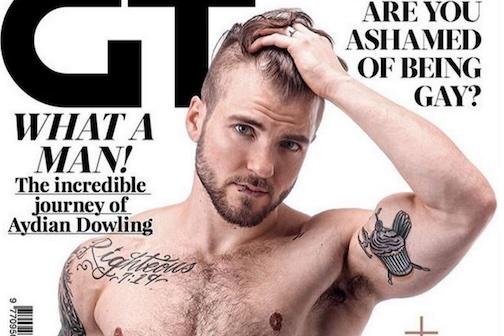
-
 That's a good question. Something I occasionally see when people ask how they should act is people asking, "What do you want the result to be?" I think that is important to ask here.
 -
I agree that all churches have their historical issues and mistakes. That's one main reason I haven't left the LDS church for another. It would just be trading in one set of doctrinal and historical issues for another. As a lifelong LDS, LDSism is my native "language" of religion. At some point, if there isn't going to be a church that is inerrant, what is church for? Why participate in a church at all? I recall a conversation in this forum where someone asked the value of participating in the church if it isn't uniquely church, and I responded asking if it is necessary for the church to be uniquely true to have value? Is it enough for a church to simply be good? To be found useful for a place to commune with God and other believers? As I contemplate my future relationship with the church, I find that a main question I encountere is the one I've mentioned -- the question of belonging and fellowship. As long as I feel something a little more than tolerated, I figure I can stay.
-
SCOTUS Decision: Ban on "Talk" Conversion Therapy is Unconstitutional
smac97 replied to smac97's topic in General Discussions
It seems like this distinction is a central tenet of the concept of "trans"ness. "'Sex' is what's between your legs, 'gender' is what's between your ears" and all that? I would like to better understand this. I'm not sure "distinct entity" is apt. See, e.g., here: This sounds accurate, except it might be more accurate in this context to speak of the "spirit body" and "physical body." Yes. Not sure what "matching the spiritual" means, but I surmise you are headed toward "a woman's spirit may be placed in a man's body." Hard to give a definitive answer to this. Well, that becomes a matter of faith, and thus takes the discussion outside the ambit of public policy discussions about "what is a woman." Thanks, -Smac -
SCOTUS Decision: Ban on "Talk" Conversion Therapy is Unconstitutional
Calm replied to smac97's topic in General Discussions
This is a good rule, imo. Unfortunately laws can backfire when it comes to protection and equal rights and access, so they need to be cautious with them. One of the prime examples are less female coaches now than before the law tried to ensure female sports in schools got equal financial support. Once the coaches for female sports got paid decently, men moved in to compete for the jobs and cultural bias that men are better at sports and the fact that male coaches tend to have stronger resumes because of the greater attention male sports got and gets ensured men were more likely to get the coaching jobs even for female sports. So more female athletes, but fewer of them can turn their passion into a career of coaching. https://appliedsportpsych.org/blog/2022/08/the-50th-anniversary-of-title-ix-comes-with-a-catch-fewer-women-coaches/ -
SCOTUS Decision: Ban on "Talk" Conversion Therapy is Unconstitutional
smac97 replied to smac97's topic in General Discussions
Thank you for sharing your thoughts. When you say “it depends” and that inclusion is acceptable so long as it “doesn’t defeat the purpose of having the category,” who decides whether the purpose has been defeated, and by what measure? In a women’s prison, is the purpose defeated only after a certain number of male-bodied people are housed there, or after a single assault, or after female inmates report that they no longer feel safe, or after they express a desire for privacy from biological males? In elite women’s sports, are there any other legitimate "purposes" in addition to competitive advantages (of biological males)? Safety? Privacy? In a domestic-violence shelter, is the purpose defeated when women stop using the shelter, or only when a formal incident is documented? What is the purpose of a women’s bathroom or locker room? Is it solely about toilets and sinks, or does it also include privacy, dignity, and the expectation of not undressing or performing intimate functions in the presence of biological males? Under the “doesn’t defeat the purpose” test, how would we know when that purpose has been defeated? Does it require a documented incident of voyeurism, assault, or exposure? Or is the loss of perceived safety and privacy by female users enough? Should the women who feel uncomfortable, or unsafe, or who want privacy from biological males, be required to provide evidence of harm before the boundary can be enforced? If so, what form of evidence is sufficient? Once access to a facility is opened on the basis of self-identification, how is the line drawn for the next person who identifies as a woman? Is there a limiting point, or does each case simply get evaluated after the fact for whether harm occurred? If the test is whether inclusion defeats the purpose, that seems to require us to wait for measurable harm before drawing a boundary. Is that the rule you are proposing—that sex-based categories must remain open until harm is first demonstrated? Also, once the purpose is judged to have been defeated in a particular case, what happens? Does the male-bodied person who was included get removed, or does the category itself get redefined going forward? I’m asking because “it depends” and “as long as it doesn’t defeat the purpose” sound flexible, but they appear to shift the burden onto the very people the category was created to protect - women - because it seems to require that they prove harm after the fact rather than allowing the category to rest on the ordinary, predictable differences that justified sex-based rules in the first place. How do you see that working without effectively eroding the category? Very interesting stuff. Thank you for weighing in. Thanks, -Smac -
It isn't that "We claim truth, prophets, revelation, etc.", it's that we bluntly and openly claim it. Every denomination within Christianity claims truth bluntly and openly. However, they also claim prophets and revelation, but that requires a little working out to get to because they simultaneously deny those two things. You can look to the popes and ecumenical councils of the Catholic church and see that, while they don't claim the titles of "prophet, seer, and revelator", they behave in much the same way. They determine what is dogma, which is definitionally a core truth that has been divinely revealed. That is revelation in all but name. Protestant churches get slightly trickier as they do not have a magisterial clergy, at least according to them. However, the inherent problems in the concept of sola scriptura shows otherwise. If the Bible is complete, inerrant, infallible, self-interpreting, and the ultimate authority, why are there different interpretations at all? Some would try to claim that some interpretations are of the devil, but all that does is lead to the question being asked again. Why are pastors in Protestant churches even necessary if the Bible is supposed to be the ultimate, infallible authority? How is any individual Protestant supposed to determine what is true? The reality is that at least some of their pastors use this as cover for making their own interpretations authoritatively, as they feel they were "called by God" to be a pastor in the first place. What is a person who is called by God to authoritatively receive, interpret, and convey the will of God to the people? A prophet.
-
Me too!
-
The caricature: Mormons wishing to "get their own planet"?
InCognitus replied to theplains's topic in General Discussions
Doesn't matter. What matters is how your interpretation goes totally contrary to the context of the verse. -
I'm looking forward to watching this one myself. Yes it is set in England, with a very good cast. I have always found Hugh Jackman to be a very good actor, and person. Emma Thompson came through into acting, with a number of other actors, male and female in the early 80's. All various degrees of success.
-

SCOTUS Decision: Ban on "Talk" Conversion Therapy is Unconstitutional
Amulek replied to smac97's topic in General Discussions
When it comes to determining who is a "woman" for purposes of women's only spaces and set asides (e.g., women's sport, women's health, women's education, and women's prisons), the answer for me, at least, is "it depends." If inclusion doesn't defeat the purpose of having the category in the first place, then I don't see the harm in allowing for it. In places like competitive sport, however, I believe excluding male-bodied athletes from female events is the (obvious) right answer. In elite sport, there's just too much of a competitive advantage to having access to male-levels of testosterone during development. That's born out by science, and it's not at all controversial. It's why the IOC recently updated their guidelines for trans athletes in women's sports to be determined by the presence of the SRY gene, as it is "fixed throughout life and represents highly accurate evidence the athlete experiences male sex development" (link). I believe the NCAA has taken a different path to approach the issue, but they seem to be targeting the same kind of result. -
Can you use it in an example as I am going ‘huh?’
-
I enjoyed it. Would have loved to see more Emma Thompson as she was fun to watch. I got nit picky (because that’s what I do for fun) with some of the world-building around the sheep, but it’s not like it’s going to be turned into a series of films with multiple storylines, etc.
-
Hey BlipBlap. Always fun to see new posters around. I wasn't presuming that gender was "meant" to be separate from biological sex. It's my understanding that under Latter-day Saint theology, the spirit is a distinct entity from the physical body. That among many other characteristics the spirit has a gender (you'll have to tell me if it makes sense for you to define a spirit's "biological" sex). The spirit predates the physical body. Sometimes the physical body has defects because we live in a fallen world. Many of these defects prevent the physical body from matching the spiritual. For example, some genetic defects result in significant neurological impairment, blindness, and many other ailments. Why does your god allow his children's physical bodies not to align with their spirit body in these cases? How does he always ensure that spirit gender and biological sex are always in alignment? And why does he always make sure that lines up when he allows so many other horrors in the world?
-
From the DesNews article: I am not sure what sort of nomenclature need be deployed here. I'm not sure what you are asking here. In this chapter Abinadi is quoted as speaking of "the wicked." There is no racial or skin color component to verse 3 (moreover, Abinadi was speaking to a Nephite king). Or it may reflect the possibility that not everyone who encountered this error was pained by it. You would first need to demonstrate that any "waiting" was involved. I think the disavowal is what we have. Reasonable minds can disagree about collective guilt, the utility of public "apologies," and the like. I think the Church, and more particularly its leaders, has gone through long an arduous processes intended to differentiate doctrine from conjecture and personal opinion, as such differentiations were not always made. I made these comments in 2016: And in 2022: I think this has some application to the teaching of our doctrine as well. Perhaps you could clarify what you mean by "led its members astray." I think there was a lot more to it than that. See, e.g., these comments of mine from 2018 (regarding the Priesthood Ban) : Prince also provides this fascinating account (p. 104): This uncharacteristic outburst in the presence of an astonished church architect highlights the contrast between two strands in McKay's thought that are, by today's standard, inseparably joined: civil rights for blacks and priesthood ordination for black men. The blurring, combined with McKay's own reticence, means that this difference has not been understood until now. By Prince's accounting, Pres. McKay wanted to rescind the ban, but was told by the Lord to "not bring the subject up with the Lord again; that the time will come, but it will not be my time, and to leave the subject alone." You seem to be suggesting that the Civil Rights Movement was a major precipitating cause of the 1978 revelation, and you cite Prince as your source. But Prince's citations about McKay's efforts to rescind the ban have it starting around 1954 (if not earlier), when the Civil Rights Movement was in its infancy. Meanwhile, the revelation came in 1978, fourteen years after the Civil Rights Movement was at its apex (1964). And more to the point, Prince characterizes Pres. McKay as having "built the foundation upon which the revelation to Spencer W. Kimball rests," and this foundation was built by repeatedly seeking revelatory guidance. Prince seems to have very little to say about Pres. McKay (the president of the Church during the entirety of the Civil Rights Era) being influenced by the "pretty big spectacle" of "activism for blacks receiving the priesthood." Furthermore, Edward Kimball traces efforts to address the ban back to 1948 (pp. 18-19). Thoughts? Noted. I will reword that claim when the LDS Church removes the error, which leads people astray. Why was it found in manuals and books prior to 2020? Because the LDS Church continued to teach what previous LDS Presidents and apostles taught as "truth". If you can show me where Joseph Fielding Smith and others taught it as opinion, speculation, or theory, then let me know with specific words of his or theirs to that effect. See above. I am happy to listen to what you have to say on this point. It appears that you are inferring notions of prophetic/apostolic infallibility, and that any demonstrated flaw or error in their actions and words amounts to "lead{ing} the Church astray." For this conversation to be effective, I think you will need to define and explain, rather than presuppose, these things. I would say that one error does not make an entire manual fallible. Okay. What does make "an entire manual fallible"? What manuals do you believe to be "entire{ly} ... fallible"? Okay. I guess this goes back to the presuppositions about leading the Church astray. I'd like to better understand your perspective on that. What do you think defines a "false teacher"? Do you differentiate between a "false teacher" and a person who harbors some errors in their understanding of doctrine? If so, how? I appreciate your input. Thanks, -Smac
-
The caricature: Mormons wishing to "get their own planet"?
theplains replied to theplains's topic in General Discussions
I don't believe men and women can be formed into Gods but I understand this is an LDS doctrine. "Ye are my witnesses, saith the Lord, and my servant whom I have chosen: that ye may know and believe me, and understand that I am he: before me there was no God formed, neither shall there be after me" (Isaiah 43:10). "Thus saith the Lord the King of Israel, and his redeemer the Lord of hosts; I am the first, and I am the last; and beside me there is no God" (Isaiah 44:6). "Fear ye not, neither be afraid: have not I told thee from that time, and have declared it? ye are even my witnesses. Is there a God beside me? yea, there is no God; I know not any" (Isaiah 44:8). "I am the Lord, and there is none else, there is no God beside me: I girded thee, though thou hast not known me" (Isaiah 45:5). "For thus saith the Lord that created the heavens; God himself that formed the earth and made it; he hath established it, he created it not in vain, he formed it to be inhabited: I am the Lord; and there is none else" (Isaiah 45:18). "Tell ye, and bring them near; yea, let them take counsel together: who hath declared this from ancient time? who hath told it from that time? have not I the Lord? and there is no God else beside me; a just God and a Saviour; there is none beside me. Look unto me, and be ye saved, all the ends of the earth: for I am God, and there is none else" (Isaiah 45:21-22). "Remember the former things of old: for I am God, and there is none else; I am God, and there is none like me" (Isaiah 46:9). -
The caricature: Mormons wishing to "get their own planet"?
theplains replied to theplains's topic in General Discussions
What is the context of "before" or "after" for the LDS Jesus who became the first spirit child of heavenly parents and then became a God, whom the Book of Mormon now refers to as the Eternal God?