Calm
-
Posts
93,275 -
Joined
Everything posted by Calm
-

Mormons not Christian (according to new military list)
Calm replied to Nofear's topic in General Discussions
I see it more like a family relationship with Christ as the family patriarch overseeing the vast numbers. Some family members may put in a lot of effort to keep that tie strong and ever present in their thoughts and hearts with constant reaching out to communicate not only to the family head but to as many others in the family as possible. For others, it amounts to recognizing they carry the patriarch’s surname with the sense of kinship that comes with it (or should). I have a relative whose personality changed in their teens and they became at times very aggressive in behaviour. Even put significant distance between themselves and the rest of us and stopped communicating for a time. But when they were in trouble, they reached out in despair and were answered with love and those who were needed traveled to their side and did what needed to be done and much more. Most of the time this relative did and does very well with limited to no interaction with the rest of us. Since it all started there has been more of that distance than the good or bad times. They are still part of my extended family even when intentionally trying to hurt other members of the family, even when they aren’t speaking to the rest of us. There are other extended family members who maintain good, but limited relationships because their lives are busy and full of good things, but not the same good things other members are involved in. We make connections at pretty much weddings and funerals. There are other relatives who live down the street from us, a sister I talk to daily, a brother who lives across the world but took on the family role of ‘father’ when my dad died until Mom passed as well though he was the youngest because he was best suited. Another set gets together every birthday of their deceased parents to celebrate their lives and the family as well as having a massive family reunion every Christmas and summer. Iow, so many different relationships not just with the family leader, but with each other exist in a family. Christ has called us his children. To me, that makes Christianity essentially a family, a very large and very dysfunctional family, but one nonetheless. While some language is harsh (sheep and goats, wheat and tares), the parables of the prodigal son, the lost sheep, and lost coin stand out to me as lessons as why I should not be tempted to exclude others from a relationship with Christ, no matter how bad, as long as they see themselves in some way as connected to him enough to want the name of Christian for whatever reason. I try to assume sincerity, but I will still accept another as Christian even if I believe they chose to be for power or wealth; if they did so, they will need to repent or they will suffer in the end, but I don’t read minds, so not my calling to say who these will be. It is not my mission to determine if anyone is lying about that desire to be known by Christ’s name. Not saying I can’t judge that they aren’t the best behaved of the family and I admit at times with some Christians I might prefer to cut family ties. But I don’t have that right, Christ does. PS: I am not saying you are wrong and need to change your definition of Christian. I think your definition is a beautiful one and I will try and remember it when I speak to you because I believe that is respectful. But that doesn’t mean I will change my own definition of Christian to yours. I don’t see respect or love requiring me to adopt your language or you to adopt mine, only to try and understand each other and adapt to increase understanding, such as through discussing the differences in usage of terms….just as I might discuss with a German their language and they mine, having especially fun times with words that look or sound the same but have very different meanings. My 5 year old daughter loved calling her brother “brat” when we lived in Moscow. She thought it the funniest thing. -
Mormons not Christian (according to new military list)
Calm replied to Nofear's topic in General Discussions
For which I am very grateful. I want to be in a faith that is open to not only learning additional knowledge, but correcting itself where there are errors with continuing revelation, which may come direct from God through the Spirit or pass through multiple hands of those doing the work of God, in and out of the Restored Church, imo. I would be even more grateful if we talked about the changes and either labeled them as errors, incomplete, or unknown as to what God wanted them to do back in their day since we can’t tell when they were inspired and when they were not in many cases (God may send us a sense of peace over comments that trouble us, but if he does, that may mean he’s taking care of it, it’s not our burden, not that what prophets said and taught was always true), but I also understand that for many respect isn’t taking the other as they are and celebrating the good and acknowledging they erred in other ways and proactively contribute to the healing, but just focusing on celebrating the good, sometimes even without a nod to the errors assuming that will be enough for healing as if our spirits heal like a cut on our skin, we just need to keep it clean when the wound might be much deeper and therefore require intensive effort to remove the damage and support the healing. Our doctrine teaches there will be errors and that they will be made known, for now I am satisfied with that, but I look forward to more assertive efforts to heal the wounds from past errors. I do believe making our history much more accessible to all and allowing scholars to lead the effort there is a massive step forward for acknowledgment. Thanks for listing the examples. I find the “so-called” pretty much equivalent to labeling someone not a Christian. One or three of the others are close enough as well for me, some I don’t see as excluding, but saying they are bad examples. Still it’s understandable that many would interpret them as implying others were not only bad examples, but not Christian. -
Mormons not Christian (according to new military list)
Calm replied to Nofear's topic in General Discussions
Did we ever call even those we saw as corrupt nonChristian? Serious questions. I have seen stuff that essentially labeled some as bad or apostate Christians, but I see that as still labeling them as Christians. Did we ever label those who had false doctrine as nonChristian? I am not defending or diminishing the insult because much was insulting, imo. I want to be accurate. -
Mormons not Christian (according to new military list)
Calm replied to Nofear's topic in General Discussions
Sure, but they aren’t necessary to be considered a Christian. That’s a much lower bar in the LDS world. -
I don’t remember it since the update. But then I didn’t get it that much anyway for some reason. And just the check to see if human. No pictures…maybe once, can’t remember which site that happened on.
-
Trademark infringement case against Open Stories Foundation
Calm replied to Calm's topic in General Discussions
What does this mean “dead”? https://tmsearch.uspto.gov/search/search-results/78161091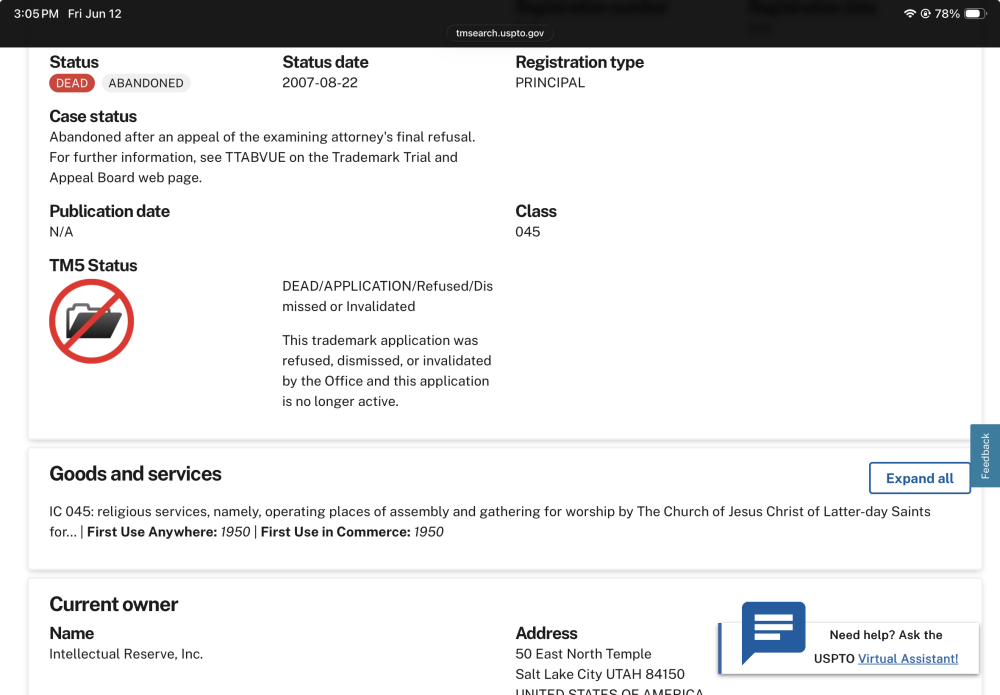
-
While I know this happened with many, it didn’t happen with my family or extended as far as I have heard (looking on us as proto apostates).. We have all been active (held leadership and teaching callings, a brother has been a bishop, others in the bishopric or stake), but spoke in Church in support of more scientific and scholarly positions back when evolution was considered a dirty word by many members with no blowback except argument as far as I know. My dad got called as seminary and gospel doctrine teacher. We never made waves, we just made it clear we were in disagreement with some of what was pushed by the McConkie style culture. I also knew back in the 70s and 80s professors and practitioners of science who were called as bishops, branch presidents, and to the high council. My professor who was very openly an evolutionary psychologist got called as a stake president. Not saying there was no pushback against such (we heard stories from Ken Hamblin who taught geology and lived across the street from my parents after they retired of some of the hassles he had to go through, but his standing in the Church was never at risk I believe). There were also plenty of stories we laughed about of conservative responses when I was a student (first in physics and then psych when my dad convinced me that finding a job in physics would be difficult and I knew my personality wasn’t assertive to promote myself as the best candidate). But maybe you mean some members treated those of a different POV that way, not an official or global response. I would also not be surprised if there were disapproving comments when members assumed they were among those who would not take offense where they would never be critical to the person and wouldn’t question their faith, just appropriateness. I remember a conversation in my in-laws’ home where one of my sister-in-laws expressed her dissatisfaction with seeing jean skirts and flip flops at church. She did not attack the person except to convey she thought it was disrespectful. Unknown to her I had worn both, flip flops were because of an injured foot, but I wore a jean skirt at least once a month to church. I did not speak up at that time because she was in mourning and I assumed some of it came from the stress as I never heard her criticize in that way at any other time. Her family were typically very, very welcoming of anyone. A very loving family over all. But if those thoughts occur with her, chances are they are popping up with others who are less normally respectful. I assume similar conversations happen over scholarly and political topics, though I have never heard one set of my in-laws, who are highly conservative, speak in any disapproval in terms of spirituality or church standing of more progressive members even when they condemn the politics as dangerous or stupid…which I appreciate greatly. And thinking about it, I am certain if their minds went there, to question whether progressives were apostate prone or standing in church, I would hear it as they were not shy about criticizing church critics. And I do not share my politics publicly except in very limited conditions as too often the reaction is more than the enjoyment of the discussion is worth. I pretty much end up disagreeing as much as I agree with most as I have a varied approach when it comes to politics. Just bringing up the last example of my in-laws to demonstrate even those highly invested in politics in the Church (and they were the most I personally know, worked for a PAC for a time, very politically active) may question someone’s sanity without thinking apostasy is on the horizon. I hope that makes sense, edited it and edited it so many times and it still looks confusing and all over the place to me. That kind of day.
-
The Seed of Abraham - the people of God whom He foreknew
Calm replied to telnetd's topic in General Discussions
I appreciate hearing about such things, so like when there is discussion here even if I don’t tend to do research in this area myself (too many other more intense interests). -
Trademark infringement case against Open Stories Foundation
Calm replied to Calm's topic in General Discussions
California boy, I assume with your work you know how to search the trademark database. It would be interesting to me to see who has trademarked any use of “Mormon” by itself or as part of a word. I sent Chat to that for exmormon and it reported there was no trademark registration for that as well as no record the Church required a license from them and no discussion of them getting a cease and desist letter, which is unlikely if they did get one surely. If it’s not a big deal, maybe you could take a look? I am not in the mood to read instructions from Chat today or do much searching, but I will probably be able to do it tomorrow if your or no one else is interested. -
Trademark infringement case against Open Stories Foundation
Calm replied to Calm's topic in General Discussions
I assume this site like FAIR and websites owned by FAIR members had to get a license from the Church to use the name as reported by said members. The Church would allow the use of “Mormon” by Dehlin if he made it clear it was focused on former LDS by using Post or Ex Mormon or some such thing. This is what Reel did for his website as reported by the Trib iirc. (It’s linked to above.) I am curious if the Church pushes for licensing from those who make it clear they are former members in their usage, such as exmormon dot org. -
I have no clue if that will work, but something similar worked for us when both the Canadian and US governments were screwing around with our residency. We worked on it off and on for ten years, they lost the paperwork again and told us we had to start from scratch. The university got my husband hooked up with our Minister of Parliment and 6 months later we were official with us doing nothing, but signing some papers and driving down to the border to walk around the flag (do not ask me why, it seemed like nonsense to me, why couldn’t we go to embassy territory in Calgary or just use our US birth records or latest visa records showing where we entered the country? Originally they wanted us to go to Texas…no one told us the same thing, which was one of the main reasons it took so long.)
-
Mormons not Christian (according to new military list)
Calm replied to Nofear's topic in General Discussions
Got smart…In the church link above, there is a link to the chaplain guide book which has this picture (I was hoping it actually said something, but nothing came up):
-
Mormons not Christian (according to new military list)
Calm replied to Nofear's topic in General Discussions
Not the cross. (Added: oops, I was wrong, lol; I thought it would be the same as the headstone, I guess.) Moroni with a horn like on the temple I thought. Will look it up. Here is LDS chaplain guide page if interested: https://www.churchofjesuschrist.org/callings/military-and-chaplain/chaplains?lang=eng Battle of the AIs, to speed up research I asked chat but their link didn’t refer to the emblem, which it claimed was Moroni. Goggle AI (because it came up without asking) says it’s the Latin cross which makes more sense given the listed concern. Its link was reddit (semirandom people). There are a number of posters in this reddit thread saying it’s been a cross to identify them as Christian and capable of leading nondenominational Christian meetings (one at least said Protestant meetings). https://www.reddit.com/r/exmormon/comments/1ji2b8p/mormon_chaplains/ Google is working hard to avoid giving me an authoritative source apparently and Chat is just making stuff up. Too unfocused to do the work myself, sorry. -
Mormons not Christian (according to new military list)
Calm replied to Nofear's topic in General Discussions
Interesting, because my reaction is you are just being accurate in what you know. Your experience is what they claim, not actual thoughts you hear. Why would they claim something different than what they actually believe? Why would they lie? -
I completely agree with you, but also think there needs to be included compassion and patience and respect in understanding*** because our particular community creates a sense of belonging and stability in part through promoting faith in our leaders knowing truth. We value highly committed Position 2s, sometimes it seems more than position 9s (also I think people tend to be a mix of positions and it can be confusing if they are much more vocal when dealing with one position rather than all of them that they hold so they appear to be Position 2 overall, but are not). I personally believe that promise of truth from prophets needs to be applied in a very limited, though extremely important fashion, thus a true need for a personal witness, seeking personal revelation and above all a personal relationship with God. However, there have been notable leaders who have limited the necessity of personal witness and revelation to confirmation of what has been taught by prophets or at least who can be easily interpreted to mean that (meaning in part they focus so much on confirmation of the truth it can sound like they believe prophets will never err, especially since they don’t give much instruction for if that happens in significant ways, even if at times they admit error, such as what was said in 1978 about forgetting anything contrary to the new revelation). Same with the idea of a personal relationship with God, which got very confusing for awhile. In many ways, we are requiring our own to rise above our culture—which has been in part created by various teachings of very prominent leaders—in order to maintain a spiritual connection with our community. I personally think that is a good thing in the long run. Just believe there should be public recognition we haven’t made it very easy for each other (speaking generally as my mother and father made it very easy for me to see my faith as potentially having errors, but inherently structured to be open to change; the way my brain works also helps a great deal…even if it causes massive issues in the nonreligious sides of my life, lol). *** not saying you lack it, just that’s it’s not always included in these types of conversations as if this type of moving past old ways of thinking is natural and just happen without much nudging
-
“than has survived”, I think you mean (it may be confusing to those not familiar with the history, otherwise it’s a minor typo)
-
Which is what it should be, imo. If not daily life, then at crucial times when needed most. I don’t fault anyone who has not experienced this as not everyone is capable. The muted experience or complete lack of it may occur for a variety of reasons not a result of their own behaviour (genetics, environment they grew up in, medications required for physical well being and others) from what I have seen, learned, and personally experienced plus there is so much noise and external pressures (not talking just religious ones, but general behavior) these days, one’s internal experience may not be clear (many people have acted so long in ways they believed they should behave and were pushed to behave that once they recognize this persona is not who they really are, they have great difficulty figuring who they really are or what they want). I see this being discussed in communities of neurodiversity the most (probably because I visit them a lot these days), but every community, including and especially family, has expectations of its members and roles they are expected to play and narratives they tell that gets internalized and can end up being louder than the inner voice in some, maybe many ways.
-
Mormons not Christian (according to new military list)
Calm replied to Nofear's topic in General Discussions
My experience is our shared heritage is rarely discussed and it’s more the accusations that we are the ones who have gone into apostasy that we focus on. We generally don’t appreciate that, to say the least. Our emotional, cultural response is often very human, imo (the official one is pretty dry, either ignored and treated no differently than other faiths or in some cases their doctrine and relationship with their former offshoot faith needs to be examined before baptism is allowed). I think many of us feel we have more in common with creedal and other forms of Christianity than those who see themselves as the heirs of Joseph Smith rather than us, who stake the same claim of authority and authenticity as we do. -
Mormons not Christian (according to new military list)
Calm replied to Nofear's topic in General Discussions
When religion gets used as a slogan to mobilize forces no matter what the causes are, it’s going to feel like religious persecution, imo. -
Mormons not Christian (according to new military list)
Calm replied to Nofear's topic in General Discussions
I see that as the fundamental issue myself since I learned of the Catholic understanding of valid baptism. There is more possible wiggle room with most of the other issues imo due in part to the variation of belief among LDS that Rory refers to. Plus this is just so huge, it doesn’t matter if we get other stuff right in Catholic eyes, it seems to me. -
Mormons not Christian (according to new military list)
Calm replied to Nofear's topic in General Discussions
We hope all will come together in unity, but being too familiar with certain mortal tendencies to force unity based not on God’s desires, but our own, religious pluralism protected by law is beneficial to everyone. A monarchy will be wonderful when Christ is King, but put a human in his place and things can go very wrong. Religious pluralism would be along the same lines as what Churchill said about democracy, imo. Though I will be open and say I love variety of religious thought. There is plenty of variation in LDS beliefs if one digs a bit, but there is great beauty imo in the many expressions of understanding about the divine. A very big part of me would miss that if we didn’t have it (I don’t anticipate missing it after resurrection because the ability to share ourselves and the universe will be so much, much, much more powerful and therefore endless variety of expressions of the beauty in the Divine will be present to revel in all with a fullness of truth in every way unlike the partial expressions we have now). -
Mormons not Christian (according to new military list)
Calm replied to Nofear's topic in General Discussions
We don’t teach from our pulpit or lesson manuals about other faiths for the most part, usually only where we agree (leaders and lessons might quote a nonLDS for insight or support), so my experience is there isn’t either an official or unofficial way to refer to them beyond using their names or speaking generally of any offshoots as apostate groups. I would prefer “offshoot” if I was sharing their beliefs and history. Might use “apostate” just out of habit from my youth, but hopefully I would limit that to if I was focusing on their opposition to the mainstream Latter-day Saint faith headquartered in Salt Lake. I would love to know how they would prefer us to refer to them when arguing where we are right and they went wrong. -
Mormons not Christian (according to new military list)
Calm replied to Nofear's topic in General Discussions
Is this a problem? I use “claim” a lot, not because I think someone is misrepresenting anything, but because claim means to assert something is factual, truth, etc. Also, “they claim” is a good way imo to say I am reporting what others say. Maybe the connotation of intentional inaccuracy is strong for you because of how it might be used in lawyering? My perspective is more from science and writing… https://rmit.pressbooks.pub/researchwritingmodules/chapter/what-is-a-claim/ Tone is what will convey skepticism. Is there any reason to read that article as the author being skeptical? If he is a former member, he probably knows what we actually believe among ourselves, not just what we publicly claim. Is he challenging our claims at all? -
Mormons not Christian (according to new military list)
Calm replied to Nofear's topic in General Discussions
Just because you (speaking personally and generally) may have some wrong doctrines and practices hardly means your faiths are all wrong and therefore valueless. There is no doctrine in the LDS faith that says there is no error in our own doctrines. We need continuing revelation for more than just filling in the gaps of our knowledge. There are weaknesses that can be strengthened and errors that can be corrected in our faith by the teachings of others. Speaking of gaps, while there may be members and possibly even leaders who believe those of the LDS faith have nothing to learn from other faiths, I certainly do not. I know many Saints who study other religions, not to learn where they went wrong, but to receive truth and wisdom. My mother was one of them, reading extensively in some of my earliest memories, looking for insights that gave greater meaning and better direction to her life. Of course, she was also studying LDS history and doctrine at the same time, but my memories mostly have her sharing nonLDS sources that enlightened her understanding of Christ’s work and the gifts that God had given her as well as what she was meant to do with them. Her shelves had many more nonLDS books on them than LDS. -
Mormons not Christian (according to new military list)
Calm replied to Nofear's topic in General Discussions
Thank you, Smac. You itemized most of my concerns here about why I think it’s inappropriate.