


InCognitus
-
Posts
3,054 -
Joined
-
Last visited
Everything posted by InCognitus
-
Ephraim, the birthright, and the gathering
InCognitus replied to theplains's topic in General Discussions
Are you accessing this page on your phone or computer? It lags a bit for me (on my computer), but it doesn't crash. Also, your post and this post will help, because once there are 25 posts on page 6 it will push it to page 7! -
Ephraim, the birthright, and the gathering
InCognitus replied to theplains's topic in General Discussions
Yes! Skylla was able to recover it, fortunately. In a couple of weeks I'm going to respond to theplain's latest post (in the other thread) in this thread to keep things in context (I'll be out of town for a while). -
That is always a danger, but you were contrasting what Joseph Smith was saying with what President Nelson was saying. The context of Joseph Smith's remarks was about disrespecting the process of repentance (with no intent to improve), whereas President Nelson's remarks were in the context of his talk on The Power of Spiritual Momentum, saying that "Repenting is the key to progress. Pure faith keeps us moving forward on the covenant path", and "Walking the covenant path, coupled with daily repentance, fuels positive spiritual momentum". President Nelson was talking about daily repentance as a process to move past ones sins (with "spiritual momentum"), whereas Joseph Smith's remarks were directed at treating repentance casually with no intent at improvement.
-
* Cambridge Dictionary: "trifle with someone/something: to treat someone or something carelessly or without respect: trifle with someone's affections He trifled with her affections (= feelings). As you know, Caroline O'Neill is not a woman to be trifled with. It seems to me that Joseph Smith (in context) is referring to an attitude of disrespect toward the process of repentance, wherein a person has a casual mindset toward the sin and continues in it with the idea that he or she can simply repent of it every day after they are done enjoying the sin for that day.
-
Continued - Ephraim, birthright, and the gathering
InCognitus replied to theplains's topic in General Discussions
The original thread has been recovered. I'll be responding to your post in the original thread, since you seem to be repeating yourself again and some of your current responses haven't really engaged the things I posted about our beliefs, and the context of those prior posts is important. I'll be out of state and away from home off and on for the next two and a half weeks, so it may be a while. -
It's back now! Thank you so much for recovering that thread! There are a lot of posts there that I need to reference. Thank you!
-
Isn't Jennifer Nelson President Nelson's granddaughter? I'm not sure why she's obsessing about Delta Airlines. (I really shouldn't joke about such things, next thing I know it will be bouncing around the internet).
-
I had hoped there would be a way to delete the users and the posts created by those users along with them, which might also delete all the created threads. But apparently that's not the case. I can see how easy it would be to accidently delete a thread given all the activity.
-
Thank you! I realize this must be a huge headache with everything else that's going on.
-
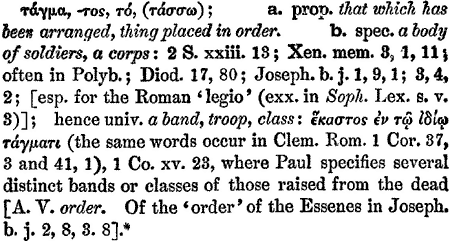
There were several resurrections (a raising of the dead) before Christ's crucifixion and his eventual resurrection. But apart from Christ, I don't believe they were raised to immortality. So in that sense, I would consider the first resurrection as being a future event (1 Thessalonians 4:15-17). “Raising of the dead” is not the same as resurrection as you well know. And you didn’t consider what I posted about Matthew 27:52-53 in my post on 06/02. Matthew 27:50–53 records the following: “Jesus, when he had cried again with a loud voice, yielded up the ghost. And, behold, the veil of the temple was rent in twain from the top to the bottom; and the earth did quake, and the rocks rent; And the graves were opened; and many bodies of the saints which slept arose, And came out of the graves after his resurrection, and went into the holy city, and appeared unto many.” And this was in fulfillment of Isaiah 26:19: “Thy dead men shall live, together with my dead body shall they arise. Awake and sing, ye that dwell in dust: for thy dew is as the dew of herbs, and the earth shall cast out the dead.” Those saints which slept and arose were resurrected after Christ’s resurrection and they were raised to immortality as a witness to the power of Christ’s resurrection. Where does the resurrection of those saints fit into your resurrection timetable? 5 people being resurrected means five individual resurrections. They are not in the order of Christ's resurrection millennia ago (being the firstfruit). The faithful dead would come forth in their order; which would precede the order of the faithful living at the Second Coming. I am not sure if they all happen at the same time or whether milliseconds, seconds, minutes, or hours separate each individual resurrection for all the millions mentioned in 1 Thessalonians 4. Another way to look at "order" is degrees of rewards, levels of blessedness, or orders of magnitude (like earthquakes are measured) instead of a priority of order. As was shown from Matthew 27:50–53 (that you did not address) and Isaiah 26:19, there is more to the “every man in his own order” statement than what you seem to recognize. The Greek word translated as “order” in the King James version of 1 Corinthians 26:34 is tágmati, and it means “rank”, or “class”. Thayer’s Lexicon defines the word this way: Note that it says “1 Co. XV. 23, where Paul specifies several distinct bands or classes of those raised from the dead”. So what you say above is incorrect. Maybe due to the wording, Doctrine and Covenants 88:96-97 gives the impression of a different order. According to the Bible, the dead in Christ are raised first, and then the living in Christ who are alive at the Second Coming are raised up next. It’s not just the Doctrine and Covenants that gives the impression of the “order”, as noted above, “Paul specifies several distinct bands or classes of those raised from the dead”. Regarding my comment "That's because not all the wicked living at the Second Coming of Christ are killed off". I should have clarified. I meant all the wicked that war against Christ at the Second Coming (the event specifically described in Revelation 19:19). But you are correct. All the wicked do eventually get destroyed somehow and sometime after the Second Coming. But it is at the time of his second coming that the wicked are destroyed from the earth, not sometime after. 2 Thessalonians 1:7–9: “And to you who are troubled rest with us, when the Lord Jesus shall be revealed from heaven with his mighty angels, In flaming fire taking vengeance on them that know not God, and that obey not the gospel of our Lord Jesus Christ: Who shall be punished with everlasting destruction from the presence of the Lord, and from the glory of his power”. Let me briefly compare the disobedient whom God swept away in the flood with another group. I don't see a significant difference between those Israelites who were disobedient and perished in the wilderness exodus out of Egypt versus those corrupt Israelites who were also destroyed after entering the promised land. A teenage child who doesn’t come home by his or her designated curfew is “disobedient”. A person who joins a gang and makes a pact to murder and steal is “violent” and “corrupt”. And you don’t see the degree of difference? This has been answered several times in this thread already. Go reread the thread, and specifically the end of my post on 05/20/2025. The severity of their sins resulted in the same outcome: they perished. We all perish, for all have sinned and all will die. But we are all judged individually according to our deeds (Romans 2:5-11, 2 Corinthians 5:9-10, Galatians 6:7-9). That’s exactly why those who are only “disobedient” are treated differently than the violent and corrupt individuals when the gospel is preached to those who have died. “For for this cause was the gospel preached also to them that are dead, that they might be judged according to men in the flesh, but live according to God in the spirit.” (1 Peter 4:6) So according to your own reasoning above, the people who lived at the time of Noah would have varying degrees of sinfulness, and the judgement against their false teachers would be greater than those who were led astray by them. The truth is, those who know the Lord’s will and do not do according to his will receive a greater punishment than those who do not know the Lord’s will. (Luke 12:47-48).
-
And, be sure to tell them that Mormon Dialogue and Discussion sent you (you'll get extra sympathy points for doing that).
-
Thank you for the advice. As for the size of the last post, I was shocked when I realized how many pages it occupied.
-
It is the "Ephraim, the birthright, and the gathering" thread that I don't see (this should link to it but it's missing). My last post in that thread was on May 26 and it exceeded 51 pages in a Word doc (so maybe the system couldn't handle that?). lol ETA: Does anyone know how to contact a moderator? I realize they have their hands full at the moment, but I want to see if that thread can be recovered.
-
I also hope they can recover some threads that appear to be completely missing now (or at least one that I know of).
-
Scripture does not indicate that some in the first resurrection do not rule as kings and priests. When exactly is the “first resurrection” and who is included in the first resurrection according to scripture? Are those who were resurrected at the time of Christ included in the “first resurrection”, or was that THE “first resurrection” and the one at Christ’s second coming is really the second resurrection? And why does the apostle Paul teach that there are possibly as many resurrections as there are men, since it is (as he puts it), “every man in his own order”? 1 Corinthians 15:21–24: “For since by man came death, by man came also the resurrection of the dead. For as in Adam all die, even so in Christ shall all be made alive. But every man in his own order: Christ the firstfruits; afterward they that are Christ’s at his coming. Then cometh the end, when he shall have delivered up the kingdom to God, even the Father; when he shall have put down all rule and all authority and power.” That’s exactly like how it is described for the celestial and terrestrial individuals in Doctrine and Covenants 88:96-99: “96 And the saints that are upon the earth, who are alive, shall be quickened and be caught up to meet him. 97 And they who have slept in their graves shall come forth, for their graves shall be opened; and they also shall be caught up to meet him in the midst of the pillar of heaven— 98 They are Christ’s, the first fruits, they who shall descend with him first, and they who are on the earth and in their graves, who are first caught up to meet him; and all this by the voice of the sounding of the trump of the angel of God. 99 And after this another angel shall sound, which is the second trump; and then cometh the redemption of those who are Christ’s at his coming; who have received their part in that prison which is prepared for them, that they might receive the gospel, and be judged according to men in the flesh.” (Doctrine and Covenants 88:96–99) That's because not all the wicked living at the Second Coming of Christ are killed off. All the “wicked” are not killed off? Really? My Bible says differently: Isaiah 13:9: “Behold, the day of the Lord cometh, cruel both with wrath and fierce anger, to lay the land desolate: and he shall destroy the sinners thereof out of it.” Malachi 3:2 “But who may abide the day of his coming? and who shall stand when he appeareth? for he is like a refiner's fire, and like fullers' soap”. Malachi 4:1 “For, behold, the day cometh, that shall burn as an oven; and all the proud, yea, and all that do wickedly, shall be stubble: and the day that cometh shall burn them up, saith the LORD of hosts, that it shall leave them neither root nor branch.” Peter is not referring to good people of Noah's time who died prior to the flood arriving. We also don't find any good people being killed off when the door to the Ark is closed and the waters being to rise. "Sometime were disobedient" does not mean "sometimes they were obedient, sometimes they were not". "Sometime" is qualifying the time frame when God waited and was longsuffering toward the wicked, giving more mercy and time in order to repent. Why are you focusing on the word “sometime”? I didn’t. And why are you saying they were “good people”? I didn’t. I smell a straw man here. My point was that Peter said they were “disobedient”, which is not the same as the violence and corruption described among “all flesh” in Genesis 6 which is the reason that God caused the flood. I never said anything about "good people who heard Noah's message, believed and died". You did. I said they were "disobedient". And, “all have sinned”, even Noah and the other seven. They were disobedient at some point in their lives. But do you really think disobedience when compared to corruption and violence has nothing to do with the severity of their sins? Apparently, you agree that Noah could not have possibly been able to preach his message to every man, woman, and child upon the earth. So, what about those who died without the law? What about those men, women, and children who were blinded by the craftiness of the corrupt and violent leaders? Do you think that has any bearing on the severity of their sinfulness? Do you view God’s judgments as binary only (you either made it or you didn’t), or do you see that sins have varying degree of severity for which there are greater or lesser punishments?
-
Hints at, yes. But it is still really puzzling. Thanks for posting the link.
-
The article says: "The designation bars the private American university and the German nonprofit from operating in Russia. Under Russian law, individuals found to be affiliated with 'undesirable' organizations face up to four years in prison, while organization leaders risk up to six years." I wonder if this is just another way to prevent the Latter-day Saint "volunteer" status in Russia (since Russia banned proselyting in the country in 2016), and someone who is a BYU alumni could now be construed as having an "affiliation" with the "undesirable" organization, in order to find a way to deter the "volunteers".
-
If I understand you correctly, and with the quotes from Gospel Principles, then Heavenly Mother and Father attained their fullness of joy when they became Gods in their exaltation. The Gospel Principles manual doesn’t say anything about when God received a fulness of joy, it only says God had a fulness of joy, and wanted us to have a fulness of joy too. But this has nothing to do with this topic. The book of Revelation is describing the extremes, much like Jesus talking about the sheep and the goats, those on the right hand or the left hand. It’s a way of describing the full extent of God’s doings. The reality is that the “first resurrection” is a continuous process that began with Christ's resurrection and continues up to the beginning of the Millennium. After the resurrection of Jesus, the gospel of Matthew describes the graves being opened, and “many bodies of the saints which slept arose, and came out of the graves after his resurrection, and went into the holy city, and appeared unto many” (Matthew 27:52-53). Those saints had a part in the first resurrection, among the “first fruits”. And as I said in my prior post, those of the celestial kingdom that are resurrected in the morning of the first resurrection are also called the “first fruits” (Doctrine and Covenants 88:96-98) and are those who are the priests reigning with Christ for a thousand years. Those of the latter part of the first resurrection are referred to as “those who are Christ’s at his coming; who have received their part in that prison which is prepared for them, that they might receive the gospel, and be judged according to men in the flesh.” (Doctrine and Covenants 88:99). They wouldn’t be included among the “priests” (they are not referred to as "first fruits"), but they do participate in the millennial reign of Christ on the earth. The Bible makes it clear that not everyone that continues into the millennium will be completely righteous, and it even describes sinners who are there: Isaiah 65:19–25: 19 And I will rejoice in Jerusalem, and joy in my people: and the voice of weeping shall be no more heard in her, nor the voice of crying. 20 There shall be no more thence an infant of days, nor an old man that hath not filled his days: for the child shall die an hundred years old; but the sinner being an hundred years old shall be accursed. 21 And they shall build houses, and inhabit them; and they shall plant vineyards, and eat the fruit of them. 22 They shall not build, and another inhabit; they shall not plant, and another eat: for as the days of a tree are the days of my people, and mine elect shall long enjoy the work of their hands. 23 They shall not labour in vain, nor bring forth for trouble; for they are the seed of the blessed of the Lord, and their offspring with them. 24 And it shall come to pass, that before they call, I will answer; and while they are yet speaking, I will hear. 25 The wolf and the lamb shall feed together, and the lion shall eat straw like the bullock: and dust shall be the serpent’s meat. They shall not hurt nor destroy in all my holy mountain, saith the Lord. Obviously not everyone in the world could have heard his message and rejected it. That would be impossible. And the Bible says (in Genesis 6) that the earth was corrupt, and all flesh had corrupted his way upon the earth. That would include those evil men who caused and spread the violence and corruption, but there would also be those (men, women, and children) who would have been blinded by the craftiness of those evil men. No, Peter says they “sometime were disobedient when once the longsuffering of God waited in the days of Noah”. Disobedience is putting things very mildly compared to what is described in Genesis 6. Peter also says God was patient with these people that Jesus visited (“the longsuffering of God waited in the days of Noah”), so these were the people living in the period prior to the flood, and not the wicked people that caused God to lose his patience when he brought about the flood. Jesus only visited those that God was patient with during that time.
-
I think he would say, "no", and I certainly would not want to misrepresent his beliefs (so maybe he could answer that).
-
Were those who inherited terrestrial glory previously in paradise or spirit prison? Are you even reading my posts? I don't think you are. See the bolded portion above. I answered that in my prior post, and it should have been quite clear from what I documented. I said, “I believe that those in the terrestrial realm are considered to be in a state referred to as ‘prison’, but this is not the same as lumping them all together with those of the telestial realm.” I see a difference between "might" receive and "will" receive. Do you believe all resurrected beings will receive a fulness of joy or is the fulness of joy found only within the framework of exaltation? I already answered that. The resurrection, in and of itself, is not “causing someone to have a fulness of joy” as you claimed. Resurrection is not equal to exaltation (a fulness of joy). But without the resurrection, a person cannot receive a fulness of joy. But do you believe Doctrine and Covenants 138:12-16 describe what type of people were in paradise after they had died? Did you not read my prior posts? I answered this before several times. This time I'm not reposting it, you'll need to read my posts and find my answer. What quotes which I provided from "Teachings of President of the Church: Joseph Smith" do you find false and deceptive? The quotes aren’t false or deceptive, but you trying to represent a topic heading from the manual as a direct quote from Joseph Smith is false or deceptive. A manual topic heading is not a direct quote from Joseph Smith. You didn’t provide a source in your original post where you quoted from the manual, and you said: “[C]onsider Joseph Smith's teaching that they will suffer immeasurable torment in their mind. ‘The torment of the wicked is to know they have come short of the glory they might have enjoyed’” (etc. etc.), and that was a topic heading, not a quote from Joseph Smith. It was how you present the material, not what it says that is the issue. Had you said (instead), “Consider this quote from the Teachings of the Joseph Smith manual”, it would have been different. So what happens to devout and honorable individuals from other faiths (like Hindus, Buddhists, and Muslims) who knowingly reject Christ either during their mortal life or (according to some beliefs) even after being taught the gospel in the spirit world? Will they remain in spirit prison until the resurrection with others who will instead inherit a telestial glory? You keep trying to get me to pass judgement on Hindus, Buddhists, and Muslims, and I’m not playing that game. Jesus is their judge, not me. Only Jesus knows the hearts and minds and circumstances of each and every individual, and Jesus doesn’t judge someone simply based on a label. Where do you find in scripture that the first resurrection is split into a morning (for those who become gods/priests/kings in the highest division of the celestial kingdom and two other groups for the two lower sections) and an afternoon (for the terrestrials)? Read my last post, I clearly documented from scripture the different resurrections for the celestial, terrestrial, and telestial. You know this, because you are quoting from that portion of my last post, so why are you asking this question? The celestial is on the morning of the first resurrection, and the terrestrial is on the latter part of the first resurrection, both of which are prior to the millennial reign of Christ on the earth. The telestial kingdom is resurrected after the millennial reign of Christ on the earth. I provided the scripture that says that in my last post. Based on Doctrine and Covenants 138:12-15, are the people of 76:73-77 initially in paradise or in spirit prison with the wicked after they died? And when did Jesus visit and preach to them? You’re going to make me say it again, obviously. Doctrine and Covenants 138:12-15 doesn’t say anything about the boundaries of paradise or spirit prison, and in fact all of the inhabitants of the spirit world considered the long absence of their spirits from their bodies as a bondage. And obviously Jesus visited those of the terrestrial realm during the period of time between his death and resurrection, but Jesus didn’t visit those of the telestial realm. Do you believe the flood of Noah was a worldwide flood? Do you believe everyone (man, woman, and child) who lived at the time of Noah heard his warning and rejected his message? I don’t see how that is possible, do you? I asked you this question before and you speculated that Noah may have had over a hundred years to build the ark, but you didn’t really address the question on how it would have been possible for him to contact everyone so that they could have had the opportunity to out right rejected his message.
-
Ephraim, the birthright, and the gathering
InCognitus replied to theplains's topic in General Discussions
I can't do that with actual documented proof but I'm speculating that the parents would pass on these traditions to their children and their children's children so they know they are descended from Abraham, Isaac, and Jacob and that are viewed as God's special people delivered in the Exodus. Some of this is inferred in Exodus 12:24-27; Deuteronomy 4:9-10; 6:6-7; 11:18-19. In your prior post you said you “believe all or most of the descendants of Isaac (the child of promise) know they are Israelites based on their records of family tree and/or traditions passed down from parent to children”. And of course you can’t document that. It’s pure speculation. But given that those tribes were scattered among the Gentiles because of their continued rejection of God’s covenant and their disobedience and departure from the faith (i.e. Jeremiah 5:19, Jeremiah 16:11-13, Jeremiah 29:15-19), why would you think that the things in Exodus 12:24-27, Deuteronomy 4:9-10; 6:6-7; 11:18-19 would even cross their mind? Some of the covenant promises and curses are given to Israel in Deuteronomy 28 and Leviticus 26, and in Deuteronomy it explains what happens to them after they are scattered: “And it shall come to pass, that as the Lord rejoiced over you to do you good, and to multiply you; so the Lord will rejoice over you to destroy you, and to bring you to nought; and ye shall be plucked from off the land whither thou goest to possess it. And the Lord shall scatter thee among all people, from the one end of the earth even unto the other; and there thou shalt serve other gods, which neither thou nor thy fathers have known, even wood and stone.” (Deuteronomy 28:63–64) So why would they be taught by their parents who they are? Why would they keep a tradition of a God they have rejected? In order for Israel to be gathered again they must return to God’s covenant. How are they going to do that if they are not taught the gospel of Jesus Christ, and how will they know who they are unless God reveals it unto them? Jeremiah explains how the gathering is carried out: “Therefore, behold, the days come, saith the Lord, that it shall no more be said, The Lord liveth, that brought up the children of Israel out of the land of Egypt; But, The Lord liveth, that brought up the children of Israel from the land of the north, and from all the lands whither he had driven them: and I will bring them again into their land that I gave unto their fathers. Behold, I will send for many fishers, saith the Lord, and they shall fish them; and after will I send for many hunters, and they shall hunt them from every mountain, and from every hill, and out of the holes of the rocks. For mine eyes are upon all their ways: they are not hid from my face, neither is their iniquity hid from mine eyes.” (Jeremiah 16:14–17) The Lord sends his servants to find them and to seek them out specifically. The closest we can dome to this is an African tribe known as the Lemba people in South Africa and Zimbabwe, and they speak the language Bantu (not Hebrew). Modern DNA studies have revealed that a substantial number of Lemba men carry a Cohen genetic marker (Cohen modal haplotype), although some other studies have disputed those claims. These people do have a Jewish connection and have Jewish customs, but your ideas about how this would play out for all the so called “lost tribes” (Reuben, Simeon, Dan, Naphtali, Gad, Asher, Issachar, Zebulun, Manasseh, and Ephraim) seems rather unrealistic. Do you have any other ideas on how these lost tribes might be recognized on their own without God’s help? I suppose that is why you believe the patriarchal blessing is for. The 1991 Ensign magazine mentions a few things: "The great majority of those who become members of the Church are literal descendants of Abraham through Ephraim" "The set time is come for God to gather Israel, and for His work to commence upon the face of the whole earth, and the Elders who have arisen in this Church and Kingdom are actually of Israel". The Religion 430-431 Student Manual teaches "It is Ephraim, today, who holds the priesthood. It is with Ephraim that the Lord has made covenant and has revealed the fulness of the everlasting gospel. It is Ephraim who is building temples and performing the ordinances in them for both the living and for the dead". Why does this (the building of temples and their ordinances) rely on Ephraim in the LDS Church at the exclusion of the other tribes? You are rebooting the conversation again. We’ve already discussed this quote from the Religion 430-431 Student Manual several times in this thread. See my post on 05/18/2024. Don't forget about Jeremiah 16:14–17 (that I quoted above): “14 Therefore, behold, the days come, saith the Lord, that it shall no more be said, The Lord liveth, that brought up the children of Israel out of the land of Egypt; 15 But, The Lord liveth, that brought up the children of Israel from the land of the north, and from all the lands whither he had driven them: and I will bring them again into their land that I gave unto their fathers. 16 Behold, I will send for many fishers, saith the Lord, and they shall fish them; and after will I send for many hunters, and they shall hunt them from every mountain, and from every hill, and out of the holes of the rocks. 17 For mine eyes are upon all their ways: they are not hid from my face, neither is their iniquity hid from mine eyes.” (Jeremiah 16:14–17) Israel is being sought out specifically, God has his eyes on “them”, and he sends his servants out to find “them”. You forgot about Deuteronomy 33:17 which we also discussed several times in this thread, where Moses blessed Joseph (Ephraim and Manasseh) to “push the people together to the ends of the earth”. See my post on 02/25/2024, and also my post on 07/26/2024 where I also pointed out: “Even in early Christianity, some of the early Christian fathers saw Christ working in Joseph in the last days in the fulfillment of the prophecy in Deuteronomy 33:17 regarding the pushing together of the ‘nations’ (for two such examples, see Tertullian – Against Marcion, Book 3, Chapter 18, and Justin Martyr, Dialogue with Trypho, Chapter 91). “ And Zechariah 10:6-12 shows that the Lord prepares the house of Joseph and Ephriam specifically to do this by sowing them among the nations, and “they shall live with their children, and turn again”. Then the Lord begins the gathering, starting with them. Right. No women, no Gentiles, and no proxy baptisms. No kidding. But the question you asked was: “How is the symbolism of the brazen sea the same in the Old Testament as in LDS temples?” The symbolism is the same. Both are for cleansing and purification, and the twelve oxen with three each facing the four directions (north, south, east, and west) represent the gathering of the twelve tribes of Israel. The same symbolism of the old temple is used in the new, which is now for the baptismal purification on behalf of the dead. One of the key elements that Freemasons are expected to keep private are the rituals and ceremonies involved in initiation and advancement through the different degrees of Freemasonry. “He that hath an ear, let him hear what the Spirit saith unto the churches; To him that overcometh will I give to eat of the hidden manna, and will give him a white stone, and in the stone a new name written, which no man knoweth saving he that receiveth it.” (Revelation 2:17) Right, so let’s connect everything that a person is expected to keep private to the Freemasons. And of course nothing like that ever occurred in early Christianity, right? The anti-Christian philosopher Celsus (writing around AD 170 to 180) wrote the following about the Christians of his day: “The cult of Christ is a secret society whose members huddle together in corners for fear of being brought to trial and punishment. Their persistence is the persistence of a group threatened by a common danger, and danger is a more powerful incentive to fraternal feeling than is any oath. As to their doctrine, it was originally barbarian, and while even barbarians are capable of discovering truth, it happens to be the case that Greeks are best equipped to judge the merit of what passes for truth these days. They also practice their rites in secret in order to avoid the sentence of death that looms over them.” (Celsus On the True Doctrine – A Discourse Against the Christians, translated by R. Joseph Hoffmann, Oxford University Press, 1987, p.53) Minucius Felix (between 200 and 250 AD), one of the earliest Latin apologists for Christianity, wrote a dialogue on Christianity between the pagan Caecilius Natalis and the Christian, Octavius Januarius. He records Caecilius Natalis as saying the following against Christians: “They know one another by secret marks and insignia, and they love one another almost before they know one another. Everywhere also there is mingled among them a certain religion of lust, and they call one another promiscuously brothers and sisters, that even a not unusual debauchery may by the intervention of that sacred name become incestuous: it is thus that their vain and senseless superstition glories in crimes.” (Minucius Felix—Octavius Chapter 9) Lactantius (c. 250 – c. 325), a North African Christian apologist, wrote the following: “This is the doctrine of the holy prophets which we Christians follow; this is our wisdom, which they who worship frail objects, or maintain an empty philosophy, deride as folly and vanity, because we are not accustomed to defend and assert it in public, since God orders us in quietness and silence to hide His secret, and to keep it within our own conscience; and not to strive with obstinate contention against those who are ignorant of the truth, and who rigorously assail God and His religion not for the sake of learning, but of censuring and jeering. For a mystery ought to be most faithfully concealed and covered, especially by us, who bear the name of faith. But they accuse this silence of ours, as though it were the result of an evil conscience; whence also they invent some detestable things respecting those who are holy and blameless, and willingly believe their own inventions.” (Lactantius—Divine Institutes Book 7 Ch. 26, paragraph 3) The early Christians must have gotten their secret marks and secret rites from the Freemasons too, right? (No doubt you think so.) Temple rites are for individuals, each and every one of them. Hippolytus of Rome, one of the most important Christian theologians of the second-third centuries, wrote the following in approximately 215 AD: “We have delivered these things to you only briefly concerning baptism and the oblation because you have already been instructed concerning the resurrection of the flesh and the rest according to what is written. If there is anything else which needs to be told, the bishop shall tell it privately to those who receive baptism. None but the faithful may know, and even them only after receiving baptism. This is the white stone about which John said, ‘A new name is written on it, which no one knows except the one who received the stone.’” (Hippolytus, The Apostolic Tradition, Chapter 21, statements 39-40 – PDF page 11) The quote above was long after the actual temple rites had vanished, but the statement reflects that there was a tradition of these things that was passed down to them. And of course neither the Great Commission nor what the disciples did in the temple prior to its destruction around 70 A.D. had anything to do with the temple rites that were administered among the early Christians, as I have repeatedly said throughout this thread. So what is your point exactly? In case you didn’t know, the early Christians also had secrets rites that aren’t in the Old or New Testament scripture (as noted above). Why would you think they would be stupid enough to publish those secrets in the Old or New Testaments for all to see? (Obviously they must have gotten that from Freemasonry too, of course). Those details were not secret. I didn't understand what point you are trying to make when you ask "But what about at Mount Sinai before Israel broke their covenants". Prior to Israel breaking their covenants at Mount Sinai there were temple rituals being performed, including those leading up to and including the seventy elders of Israel seeing “the God of Israel” as depicted briefly in Exodus 19 and 24, and none of the details are depicted in the Old Testament. There are, however, some key features mentioned such as sacrifice and atonement (Abraham and Isaac) and the offering of sacrifices (Adam, Cain and Abel, Noah, Abraham, Isaac, Jacob, and more), and covenant making. After Israel broke their covenants the law of Moses was given, and Israel was subjected to the lesser law of God, which included limitations on the priesthood (by lineage) and the keeping of detailed rituals that are spelled out in depth in the books of the law (Exodus, Leviticus, Numbers, and Deuteronomy). So prior to Israel breaking their covenants on Mount Sinai, where are the commandments written down on when and how to make offerings explained? Where are the detailed instructions leading up to why Noah built an altar to the Lord and offered burnt offerings on the altar (Genesis 8:20)? Or why did Abram build an alter to the LORD in Genesis 12:7-8? Did these people just spontaneously start making altars and making offerings and sacrifices? Or did they receive some instructions from the LORD on how and when to do those things that we don’t have in the biblical texts? If it was just a man-made practice because it seemed like the right thing to do, then why did God continue some aspect of those prior practices in the law of Moses? Here is one detailed example: “Ancient Temple Imagery in the Sermons of Jacob”, by David E. Bokovoy, in Interpreter: A Journal of Latter-day Saint Faith and Scholarship 46 (2021): 31-46. New Testament Christians did not baptize for the dead in the brazen sea. But you already know its purpose. And, I already said that they didn’t do baptisms for the dead in the Jerusalem temple. But as you already know (since you asked that question), the symbolism is exactly the same. Apparently, you believe the Book of Mormon and Bible are supposed to contain every single detailed instruction from God about the temple and everything we need to know about God and everything that was ever done or taught. But I don’t believe that, because that is not the purpose of either one of those books of scripture. So, who cares if baptism for the dead isn’t mentioned in the Book of Mormon? I don’t. But it is mentioned in the Bible. This was in my response to my statement that Ether's record of the Jaredites doesn't even mention the temple. My response about the Jaredites was in the context of temples such as those erected by Israel later on (such as the temple at Jerusalem). The Jaredite temple worship was different for reasons explained below. Read President Nelson’s comments more carefully, including the footnotes from which he is getting his quote. President Nelson was quoting from the Bible dictionary topic on the “Temple”, where it also says: “In cases of extreme poverty or emergency, these ordinances may sometimes be done on a mountaintop (see D&C 124:37–55). This may be the case with Mount Sinai and the Mount of Transfiguration. The tabernacle erected by Moses was a type of portable temple, since the Israelites were traveling in the wilderness.” Mountain tops are often used as temples in the Old Testament. This is also true for the Jaredites in the Book of Mormon. See for example: Why Did Moroni Use Temple Imagery While Telling the Brother of Jared Story? Where does the Bible say that there were “no temples” from the days of Adam until the one is built in Jerusalem? What was God’s purpose at Mount Sinai? What was the purpose of the tabernacle in the wilderness, if not for a temple? We already know that the Old Testament, prior to God bringing Israel to Mount Sinai, doesn’t give us any indication for why sacrifices and offerings were made (see Genesis 4:4; 8:20; 12:7-8; 13:4,18; 22:9; 26:25; 33:20; 35:7), nor does it tell us why Melchizedek was the “priest of the most high God” and Abraham just spontaneously decided to pay tithes to Melchizedek (Genesis 14:18-20, Hebrews 7:4-10). So why would you expect it to tell you about temples too? Nor are any commandments recorded on how and when to make offerings or animal sacrifices prior to the law of Moses, yet it was done. There is no mention of it. So why was it done? See Genesis 12:7-8; 13:4, 18; 22:9; 26:25; 33:20; 35:7. I guess the Bible forgot to include that important information and left that part out? (See the response above as well). Neither the Bible nor the Book of Mormon was intended to a be a day by day, minute by minute account of the people described in the book, nor is it intended to be a handbook of everything we need to know about God or a handbook of instructions on how to operate his church on earth. Both books were always intended to be supplements to the administration of the church through prophets and apostles that are called by God, and God directed (and directs today) his church through those men by revelation. This is one of the many reasons why I find the arguments that say “The Book of Mormon never mentions [whatever]” to be straw man arguments and lacks understanding of the Latter-day Saint views on the subject. The veil isn’t done away. The blood of Jesus lets us enter with “boldness” into the holiest place in the temple, “through the veil” (Hebrews 10:19-21). That’s not going to happen if there is no “veil”. Furthermore, veils were often present in early Christian places of worship. See for example the photos and descriptions in this article: The Development of Early Christian Sanctuaries, from Temples to Homes to Basilicas. The temple in Revelation 11:1-2 seems to be a future temple in Jerusalem. The Gentiles will thread on the holy city for forty-two months. Ok, so we have a future temple not in heaven here. Obviously temples are still said to continue into the future despite you saying they are only “the temple of the Holy Spirit”, and “That is why New Testament Christians do not build physical temples like Latter-day Saints do.” We have already discussed all this. And, we have already discussed all this, and it is answered in the very next statement from me in my prior post that follows what you quoted above, and it said: “Which are exactly the kinds of places they could have used to set apart a specific area within one or more of those locations and dedicated it for temple related ordinances. The same kind of thing happened in the early days of the restored Church.” Early Christians often met and worshiped in homes during the New Testament times. This practice was common because dedicated church buildings as we know them today didn't exist yet. You are repeating yourself; we have already discussed all this. Those are also exactly the kinds of places they would have picked out a place and dedicated for temple worship, as well. None now (but you already know that, so why ask this as a question?), because temples are available now in various parts of the world, so that isn’t done today. But in the early days of the restoration, baptisms for the dead were performed in rivers and streams prior to the construction of temples, and endowments were administered at first in the upper room of Joseph Smith’s red-brick store building in Nauvoo. Brigham Young also used a mountain top, Ensign Peak, for temple ordinances. And, the upper floor of the Council House, Salt Lake City's first public building, served as the Endowment house between February 1851, and May 1855. And later another structure was dedicated as the Endowment house near temple square prior to the completion of the Salt Lake temple. The early Christian saints would have used similar resources for performing temple ordinances in the absence of a building constructed specifically for that purpose. I understand that view. On the flip side, the veil is torn and the temple is no longer needed. No need for earthly LDS high priests either. See Hebrews chapters 9 and 10. That's why we don't build temples. Right, which is why you say you don’t build temples and ignore the office of priests in the New Testament. But this is totally contrary to the New Testament intent for the temple as we have discussed previously and was shown above. "Him that overcometh will I make a pillar in the temple of my God, and he shall go no more out: and I will write upon him the name of my God, and the name of the city of my God, which is new Jerusalem, which cometh down out of heaven from my God: and I will write upon him my new name" (Revelation 3:12). There is some commentary about that verse which indicates this temple is symbolic of the Body of Christ, the Church. Of course, and this points out a big difference between what you believe and what I believe. I believe that God is the same today as he was in Bible times and that he directs his church today through revelation to men who are called by God, just exactly like he did in Bible times. God has given instructions to his church today to build temples. Consequently, when I read verses like Revelation 3:12 where Jesus teaches that those who overcome will be made a “pillar in the temple of my God”, it fits right in with what God has told us to do today. But for those who believe that God isn’t the same as he was in Bible times and that God’s revelations are confined to the 66 books of the Bible, things are different. When they come across a verse like Revelation 3:12 where it talks about future temples and faithful followers of Jesus being told by Jesus that they will be made “a pillar in the temple of my God”, and those people aren’t building any temples, they need to find a way to reinterpret that verse to not be talking about an actual temple of God, but to make it be “symbolic of the Body of Christ, the Church” instead. What else can they do? Right, but they will be ruling and reigning as co-heirs with Christ as pillars “in the temple of [his] God” during the millennial kingdom, as the verse says. That’s hard to do unless there are actual temples around during the millennial kingdom. Yes, in the New Testament both our individual bodies and the body of the church itself have been compared to a temple for the Holy Spirit. However, that interpretation makes absolutely no sense in the context of the book of Revelation pertaining to Revelation 3:12 and Revelation 21:22 (as I will explain below). Earlier you claimed that Revelation 3:12 was referring to “the temple of the Holy Spirit”. I responded (referring to 1 Corinthians 3:16) that “Our bodies are the temple of the Holy Spirit. How does it make sense for Jesus to say (in Revelation 3:12), him that overcometh will be made a pillar in the temple of their bodies?” And the commentary you quote above seems to be alluding to this same nonsensical interpretation. In addition, the commentary also brings up that the church itself has been compared to a temple, as it is described in Ephesians 2:19-22: “Now therefore ye are no more strangers and foreigners, but fellowcitizens with the saints, and of the household of God; And are built upon the foundation of the apostles and prophets, Jesus Christ himself being the chief corner stone; In whom all the building fitly framed together groweth unto an holy temple in the Lord: In whom ye also are builded together for an habitation of God through the Spirit.” (Ephesians 2:19–22) But these verses also explain that the church is a “temple” only in the same sense that our individual bodies are “temples”, which is “an habitation of God through the [Holy] Spirit”. So this interpretation is really no different than the idea that our bodies are the temple of the Holy Spirit, which doesn’t really work for those who “overcome” and are made pillars in the temple of God the Father. Furthermore, this interpretation makes absolutely no sense in the context of the book of Revelation, given that when describing New Jerusalem in Revelation 21:22, John finds it noteworthy to say, “And I saw no temple therein: for the Lord God Almighty and the Lamb are the temple of it.” Are we to understand that there are no believers (both individually and corporately) in that city? Of course not. Revelation 21:22 also explains why there is no temple in New Jerusalem, because “the Lord God Almighty and the Lamb are the temple of it”. This correlates with Revelation 3:12, where Jesus says the overcomers are made pillars in “the temple of my God”. In other words, the temple described in Revelation 3:12 is not the temple of God through the Holy Spirit (as it the word “temple” is used symbolically in 1 Corinthians 3:16 and Ephesians 2:19-22), but it is the actual temple of God the Father (the God of Jesus Christ). The verse means that those who overcome will be in his actual presence of God the Father in the celestial kingdom of God (the holy place of the temple). The New Jerusalem that comes down from heaven (of Revelation 21:22) is not of the telestial world, which is ministered through the Holy Spirit (D&C 76:86), and it is not of the terrestrial world (as it is during the millennial reign of Christ on earth), who “receive the presence of the Son, but not of the fulness of the Father” (D&C 76:77), but it is the celestial kingdom of God that is present on the celestialized earth. This also explains why temples are needed now (on the telestial earth) and why they will be needed during the millennial reign of Christ (on the terrestrial earth), because temples are dedicated and set apart as a sacred space where the things of the world and unprepared individuals are separated from the presence of God the Father who is through the veil into the holy place. But all the earth will be celestialized at the time of Revelation 21:22, so that is exactly why no temple is needed at that time. I see your point. The phrase "whither I have been to minister" would be clearer if it said "whither I will go to minister". I don’t think you see my point (about what the text says) if you think it would be clearer if he said “whither I will go to minister”. Jesus says here that he has other sheep (that he will visit in the near future) which aren’t of “this land” (the land of the Nephites), neither are they from any of the areas where he had already been to minister during his mortal ministry (as explained in the prior chapter). Jesus continues in the next verse: “For they of whom I speak [the other sheep that aren’t in the Nephite lands or the areas where Jesus taught during his mortal ministry] are they who have not as yet heard my voice; neither have I at any time manifested myself unto them. But I have received a commandment of the Father that I shall go unto them, and that they shall hear my voice, and shall be numbered among my sheep, that there may be one fold and one shepherd; therefore I go to show myself unto them.” (3 Nephi 16:2–3) Scripture is quiet between the time of Malachi and the advent of John the Baptist, so I cannot elaborate further. God didn't forget the scattered tribes. I believe they had still some form of scripture. Some were looking for the Messiah to come. Simeon and Anna the prophetess are specifically mentioned. Scripture is more focused on the remaining tribes that were still living in the land of Israel. Yes, the scriptures that we have currently in our Bible are centered around the events taking place in and around Jerusalem, which is why it doesn’t give us accounts of what happened to the scattered tribes of Israel after their dispersion. But God didn’t forget those scattered tribes and Jesus went to visit them after his resurrection. And scripture being quiet between Malachi and the advent of John the Baptist is totally irrelevant to the question of the records of the scattered tribes of Israel, because the ten northern tribes were long gone by that point in the recorded history. God had not forgotten them. But I have no record of God visiting these other tribes other than what some believe are true events written in the Book of Mormon. I see the "other sheep" as the Gentiles but you see it as other Israelites. Right, I see the “other sheep” as the other Israelites because having it refer to the Gentiles would contradict Jesus when he said, “I am not sent but unto the lost sheep of the house of Israel” (Matthew 15:24). I don’t believe Jesus contradicts himself. I think the timing on when God might have sent prophets to the lost tribes could have at the very least be as you describe above, yes. Those prophets would definitely be preparing the way for when Jesus visited those lost tribes after his resurrection (since Jesus was sent to the lost sheep of the house of Israel). But obviously John the Baptist himself didn’t go out to where the scattered tribes were located in the north countries and all over the world. I see the reference to the meek (all nationalities) inheriting the earth (in general; the children of the promise - Matthew 5:5) and the literal Israelites inheriting a more specific land of inheritance (Genesis 13:14-15; 15:18; 17:8; 24:7; 28:4,13; 35:12; Exodus 13:11; 32:13; 33:1; Leviticus 25:38; 26:42; Numbers 13:2; Joshua 14; Ezekiel 11:17; 20:40,42; 28:25;36:24,28; 47:13-14; 48:7-29 – there are many more). Yes, the Israelites (and all nationalities) will inherit the entire earth, for they are among the meek, the righteous, those who are blessed of the Lord, and those who wait on the Lord (Psalm 379, 11, 21-22, 34). But again, the verses you list for the land promises don’t say anything about whether they are literally the seed of Abraham or not. But given that Israel was scattered among all nations, maybe all the world has literal Israelite blood in them at this point? How would you know? The land inheritance mentioned in the scriptures I provide do not specifically include those who would later become the spiritual seed of Abraham (those who accept Christ as Savior - Romans 9:7-9 and Galatians 4:28-31). Nor do they exclude them. I’m not the one mixing the blessings, scripture says that those who come to Christ become the seed of Abraham and are counted as “the children of the promise” (Romans 9:7-9, Galatians 4:28-31). What is that “promise”? President Anthony W. Ivins, April 1929 General Conference: “We must be careful in the conclusions that we reach. The Book of Mormon teaches the history of three distinct peoples, or two peoples and three different colonies of people, who came from the old world to this continent. It does not tell us that there was no one here before them. It does not tell us that people did not come after. And so if discoveries are made which suggest differences in race origins, it can very easily be accounted for, and reasonably, for we do believe that other people came to this continent”. So you take a more literal interpretation of the book of Revelation (using the word “literally” to mean taking words in their usual or most basic sense without metaphor or allegory), making it out to be a literal beast with literal horns and their armies riding on literal horses, and angels standing on the literal four corners of the earth, and there are literal harlots, literal dragons, a literal lamb, literal seven heads, literal serpents, etc. etc. Right. A literal beast with seven heads and ten horns will be a lot easier to pick out in a crowd, so I understand why a literal view might be appealing to some. But that’s just not how apocalyptic literature symbolism works (see the Got Questions website article, Why is apocalyptic literature so strange?). Do you also believe there are only “seven churches” that ever existed or will exist, as discussed in the beginning of the book? Or do you accept the possibility that even the numbers can be symbolic along with the other prophetic keys to understanding these things? You are doing it again. You aren’t engaging in anything I said, and your comment above proves you didn’t even read what I wrote last time, or you wouldn’t be inferring that I believe those specific verses are past events. This is part of what I said last time: “As for 2 Thessalonians chapter 2, the ‘man of sin’ is Satan and those he influences. Satan is THE antichrist and those he influences are antichrists, and it is through those under Satan’s influence that his works of darkness are made manifest. And, according to the apostle Paul, Satan’s power was at work from Paul’s day (as he says in 2 Thessalonians 2:7, ‘the mystery of iniquity doth already work’) and his work will continue until Jesus returns and exposes him. So, Satan works through a myriad of persons from Paul’s day all the way until the second coming of Jesus, where Paul says the coming of Jesus “is after the working of Satan with all power and signs and lying wonders” (verse 9). This is one huge reason that this so called ‘antichrist’ cannot be one single human being. Humans don’t live that long.” So according to Paul, the events described in 2 Thessalonians chapter 2 begin to take shape starting in Paul’s day (“the mystery of iniquity doth already work”, verse 7) and will continue to unfold up until the time when Jesus returns and the wicked works of Satan (that are being done through the evil men he influences) will be destroyed with the brightness of his coming. The only parts of 2 Thessalonians chapter 2 that I said have already been fulfilled are the great apostasy and the man of sin being made manifest through Titus (verses 3-4) when he looted and destroyed the Jerusalem temple in 70 AD, when he “opposeth and exalteth himself above all that is called God, or that is worshipped; so that he as God sitteth in the temple of God, shewing himself that he is God” (2 Thessalonians 2:4). He looted and destroyed the temple at Jerusalem and was “deified” for his conquest by the Romans, as I documented in my prior post. And Satan continued to work through a myriad of persons after that time and continuing all the way up to the present day when he continues to do the same, and the workings of Satan will all be put to an end at the second coming of Jesus. I have no interest in speculating with you about the meaning of those chapters in Revelation. It is irrelevant to our topic except related to your claim to identify the timing of the apostasy mentioned in 2 Thessalonians 2:3, which you still haven’t explained. I see there being an unholy trinity of Satan (the Devil), the beast, and the false prophet. The beast and the false prophet are men. They are both cast alive into the lake of fire at the Second Coming (Revelation 19:20). Satan is bound for a thousand years in the pit after this event (Revelation 20:1-3). Maybe the Latter-day Saints view the Devil, the beast, and the false prophet in Revelation 19 and 20 as encompassing the statue in Daniel's vision – depicting only kingdoms in opposition to God instead of specific individuals. You still didn’t answer the question, and the question is at the very heart of the reason that your view makes absolutely no sense in conjunction with 2 Thessalonians 2:7. This was the question: “So if you believe 2 Thes 2 is referring to the beast mentioned in Revelation 19:19-20, then how is it that this beast began his work at the time of Paul (i.e. ‘For the mystery of iniquity doth already work’)? Is the beast a man, or something else that can live from the time of Paul until the coming of Christ?” Do you agree that Paul was saying that the man of sin (and his lawlessness) was already at work in 2 Thessalonians verse 7? If so, what is that referring to? And given that it was starting in Paul’s time how could there be any connection to Revelation 13 and 19? There was some apostasy in the church as Paul mentioned. Some apostasy is also mentioned in one of the seven churches in the Book of Revelation. But I don't believe the church was destroyed like the 1997 Gospel Principles teaches. First of all, my comment was about when the Roman emperors Theodosius I, Gratian, and Valentinian II had published the Edict of Thessalonica (on November 27, 380 AD), which ordered that all their subjects should profess the faith of the bishops of Rome and Alexandria, and they punished anyone that rejected the Nicene creed, the same creed that had the word homoousious inserted into it by another Roman emperor (Constantine). And you call this “some” apostasy? Does that church at that time have any resemblance to the organization of the church that Jesus established? Seriously? Second, “some” apostasy is not what Paul was talking about. “Some” apostasy FROM the church is not the same as apostasy OF the church itself. It would be really really silly for Paul to try to tell his troubled readers that the second coming of Jesus would not happen “soon” because there must come “some” apostasy first, if the kind of apostasy he had in mind was exactly like the kind of apostasy that was already happening all around them. How would that help them to think that the second coming would not happen soon? They would think Paul was crazy. The apostasy that Paul had in mind was on a much larger scale, the kind that changes the church itself (like what I documented above). It came about from individuals changing the leadership structure (the elimination of the apostles and the replacement of the bishops) and then the replaced leaders would teach according to their own thinking rather than getting revelation from God. Paul prophesied that the changes to the bishops would take place “after his departing” (Acts 20:28-31), and the historical writings of the Christians after that time confirmed that those bishop replacements were taking place (such as that noted in Clement of Rome’s letter to the church at Corinth). As for the 1997 Gospel Principles manual (which you are very fond of bringing up), you already know (because you’ve been told many times) that that portion of the manual is talking about the changing of the organization of Christ’s church in exactly the same way Paul described it. In the section, the “Apostasy from the True Church”, it says: “Throughout history, evil people have tried to destroy the work of God. This happened while the Apostles were still alive and supervising the young, growing Church. Some members taught ideas from their old pagan or Jewish beliefs instead of the simple truths taught by Jesus. In addition, there was persecution from outside the Church. Church members were tortured and killed for their beliefs. One by one, the Apostles were killed. Because of the persecution, surviving Apostles could not meet to choose and ordain men to replace those who were dead. Eventually, local priesthood leaders were the only ones who had authority to direct the scattered branches of the Church. The perfect organization of the Church no longer existed, and confusion resulted. More and more error crept into Church doctrine, and soon the destruction of the Church was complete. The period of time when the true Church no longer existed on earth is called the Great Apostasy.” (Gospel Principles, 1997, page 105) Now, are you going to tell me that the exact same organization that Jesus established of apostles and prophets actually did continue to exist, and therefore the “destruction of the Church” was not complete? Do you really think the church that was directed by the Roman emperors in the Edict of Thessalonica in 380 AD is the exact same church that Jesus established? (Honest question). Furthermore (thanks to you bringing it up), we’ve already established that Daniel’s interpretation of Nebuchadnezzar’s dream in Daniel 2 says that the only kingdom that shall “never be destroyed: and… not be left to other people” is the one that is cut out of the mountain without hands during the time of the kingdoms of the feet and toes of iron and clay (in the latter days). And Jesus said, of the kingdom of God that was established on the earth in his day, that it would be “taken from you, and given to a nation bringing forth the fruits thereof" (Matthew 21:43), indicating that it would be “left to another people” and therefore subject to the idea that it was “destroyed”. So your disagreements with these things don’t make sense Biblically or historically. Biblical sources and early Christian sources establish that the apostasy happened just the way Paul described it. Ephesians 5:25-27 says that Christ loves the church and gave himself for it, so that he might sanctify and cleanse it. He redeems his church from the error of their way. That’s the purpose of repentance. That doesn’t mean those people wouldn’t fall away and that they wouldn’t change the church into their own organization. The Lord has always considered his people to be his “bride”. But he also refers to them as backsliding, playing “the harlot”, and they are forsaken by the Lord at times (temporarily). See for example Isaiah 54:4-8, Jeremiah 3:14, 31:32, and Ezekiel 16:8-22. Israel has gone in and out of apostasy several times. The fact that the Lord’s people are his “bride” does not mean that they will never go into apostasy or be “forsaken” by the Lord for a time. Yes. The following was the CFR for me saying Joseph Smith taught the ten toes are the government of the United States. https://www.josephsmithpapers.org/paper-summary/history-1838-1856-volume-b-1-1-september-1834-2-november-1838/92#full-transcript Except it wasn’t Joseph Smith teaching that the ten toes are the government of the United States (it was Robert Matthews). Yes, what Matthews taught about the ten toes was incorrect. A seminary manual teaches the ten toes are a group of European nations. And that’s pretty much what I had in mind when I said in my post on 03/03/2025: “the kingdoms of the feet and toes mixed of iron and clay (the modern kingdoms and states of the world that came about after the fall of Rome, having remnants of Roman influence [represented by the iron] among them).” The European nations make sense as the feet and toes, since they are the successors of the Roman empire (and that’s what the dream that Daniel interpreted was about, successors to the regional powers). But these nations also should include the middle eastern countries as well. Exactly right, the stone doesn’t strike the image until the Second Coming of Jesus. But you miss a very important point, which is the timing of when the stone is cut out of the mountain without hands (which was in 1830) and rolls forth in preparation for the Second Coming of Jesus: Daniel 2:44: “And in the days of these kings [which kings? The kingdoms of the feet and toes] shall the God of heaven set up a kingdom, which shall never be destroyed: and the kingdom shall not be left to other people, but it shall [after it rolls forth] break in pieces and consume all these kingdoms, and it shall stand for ever.” The timing of the events are as follows: The kingdoms of the feet and toes [of iron and clay] are established after the Roman Empire [the iron legs] had fallen. The stone (the kingdom of God) is cut out of the mountain without hands [it is done by God, not by the will of man]. The stone rolls forth, preparing the way for it to become a “great mountain” [a metaphor for the temple of God]. Jesus returns at his Second Coming, and "The kingdoms of this world are become the kingdoms of our Lord, and of his Christ; and he shall reign for ever and ever." (Revelation 11:15) The stone which becomes a great mountain [the kingdom of God] fills the whole earth. Daniel 2:33-34: “His legs of iron, his feet part of iron and part of clay. Thou sawest till that a stone was cut out without hands [it was cut out of the mountain without hands at the time of the feet and toes] which smote the image upon his feet that were of iron and clay [after the stone was cut out of the mountain without hands], and brake them to pieces.” Doctrine and Covenants 65:2, 5-6: “The keys of the kingdom of God are committed unto man on the earth, and from thence shall the gospel roll forth unto the ends of the earth, as the stone which is cut out of the mountain without hands shall roll forth, until it has filled the whole earth…. Call upon the Lord, that his kingdom may go forth upon the earth, that the inhabitants thereof may receive it, and be prepared for the days to come, in the which the Son of Man shall come down in heaven, clothed in the brightness of his glory, to meet the kingdom of God which is set up on the earth. Wherefore, may the kingdom of God go forth, that the kingdom of heaven may come”. The stone is rolling forth. And when Jesus returns, he will take over the kingdom. You’re thinking too literally again (using the word “literally” to mean taking words in their usual or most basic sense without metaphor or allegory). There was never one single leader behind any of the kingdoms you listed (Babylon, Mede-Persian Monarchy, Greco-Macedonian Empire, or Rome), so why would you automatically assume there is literally one single leader over the literal ten kings of the ten literal toes? (Those toes don’t smell right.) Furthermore, Daniel’s prophecy doesn’t even emphasize the number of toes. In fact, he always says the feet are included (as in Daniel 2:41, 42) and sometimes mentions only the feet (see Daniel 2:33, 34). The book of Daniel talks about the "kingdom of men" (Dan 4:32, 25, 32, Dan 5:21), as if it were one kingdom, even though it is made up of many nations or kingdoms. And the last "kingdom" is represented by two feet and 10 toes, indicating that many nations are included. A few questions come to mind. "And the great dragon was cast out, that old serpent, called the Devil, and Satan, which deceiveth the whole world: he was cast out into the earth, and his angels were cast out with him" (Revelation 12:9). "And when the dragon saw that he was cast unto the earth, he persecuted the woman which brought forth the man child" (Revelation 12:13. "And to the woman were given two wings of a great eagle, that she might fly into the wilderness, into her place, where she is nourished for a time, and times, and half a time, from the face of the serpent" (Revelation 12:14). "And the serpent cast out of his mouth water as a flood after the woman, that he might cause her to be carried away of the flood" (Revelation 12:15). When was the dragon cast unto the earth? What is the time gap between verses 9,13 and verses 14-15? Who is the man child that the woman [the church according to Joseph Smith] brought forth? How was the church nourished and by whom for a long period of time that you say? "And the earth helped the woman, and the earth opened her mouth, and swallowed up the flood which the dragon cast out of his mouth. And the dragon was wroth with the woman, and went to make war with the remnant of her seed, which keep the commandments of God, and have the testimony of Jesus Christ" (Revelation 12:16-17). Where is the dragon warring with the remnant? In the wilderness period or outside? When did the dragon start warring with this remnant? We’ve already discussed all these things, and you are asking the same questions you asked before and pretending like you’ve never read my answers. And you never engaged my prior responses. See my post on 07/16/2023, and then my post on 08/03/2023 where you ask the same questions you are asking above, and then again my post on 09/12/2023 where I reposted the same response again (because you asked the same questions over again), where I said: Jesus said he saw Satan cast down to the earth before John ever wrote Revelation (likely in the beginning - see Luke 10:18). From John's perspective, Satan began persecuting "the woman" immediately after Jesus was born, but Satan has been making war with God's people since the beginning. Revelation chapter 12 depicts the woman going into the wilderness multiple times with Satan (the dragon or serpent) going after her to persecute her multiple times. Verse 4 says that the dragon stood before the woman which was about to be delivered to devour her child as soon as it was born, and verse 6 says the woman fled into the wilderness to a place prepared for her. Then verses 7 through 10 talks about the war in heaven and Satan being cast out down to earth (that's the flashback), and how Satan is "the accuser of our brethren", and verse 11 explains that those saints overcame him by the blood of the Lamb. Verse 12 pronounces woes to the inhabitants of the earth, because the devil was cast down to earth. And verse 13 depicts the dragon persecuting the woman after she brought forth the man child, and this goes with verse 4 which says that the dragon was there before she was to be delivered. And verse 14 depicts the woman going into the wilderness again (a repeat of what it says in verse 4). And verses 15-17 depict the persecution of the saints of God by the dragon, with the dragon making "war with the remnant of her seed". There is a "remnant" left, but they become martyrs as John said earlier in Revelation. So it's not a chronological depiction of events in this chapter, since it repeats events to provide information about why the saints of God were persecuted and put to death after the time of John. They were hopeful that Christ could return in their days so they were told to be ready. "We" does not necessarily have to include only those living in Paul's day. The same message is for us today. We can preach the same that Paul was preaching even if we who are live today don't live to see the return of Christ. The "we" means those who are living at the time of the Second Coming. If you apply the same logic to the Great Commission, then it was only given to the Apostles for their time. Of course, you can reinterpret those verses to be referring to us today (just like people do for the Great Commission), but that is reconstructing the statement to mean anyone who happens to be alive and remains to the coming of the Lord (which is a true statement even though that’s not the way Paul said it). But Paul said “WE which are alive and remain unto the coming of the Lord” in the present tense. He clearly understood the second coming to be an event that he and his readers would live to see. Paul seems to have recognized the problem he created between the writing of his first and second letter to the Thessalonians, which is why he had to explain, in his second letter, why the second coming would not happen soon because of the apostasy. I suspect he first learned (in between writing the two letters) that there would be an apostasy that must take place, because he was correcting the panic in the first two verses of chapter two of his second epistle: "Now we beseech you, brethren, by the coming of our Lord Jesus Christ, and by our gathering together unto him, That ye be not soon shaken in mind, or be troubled, neither by spirit, nor by word, nor by letter as from us (i.e. Paul himself) as that the day of Christ is at hand." (2 Thessalonians 2:1–2) The realization of the impending apostasy of the church and the man of sin being manifest at the destruction of the Jerusalem temple in 70 AD (which began the work of the lawless one that would continue from that time up until the second coming of Jesus Christ) changed Paul’s thinking. Yes. Leaven was already making itself into the church. It was present in Paul's time and continued to our present age. It will continue until Christ returns. Suggesting that Paul was merely talking about individuals going into apostasy in 2 Thessalonians 2 rather than the church itself falling into apostasy doesn’t work for the reasons explained earlier and below. I’ll repost part of what I posted to you on 03/20/2025 from a different message thread: There was individual apostasy and schisms from the church starting from the beginning. There were those who would "walk no more" with Jesus (John 6:66), the early schisms of those of "Apollos" or "Cephas" (etc., 1 Cor 1:11-13), those after Hymenaeus (1 Tim 1:20, 2 Tim 2:17), those after Alexander (1 Tim 1:20), those after Phygellus and Hermogenes (2 Tim 1:15), those after Philetus (2 Tim 2:17), those after Diotrephes (3 John 1:9), and then the Nicolaitans (Rev 2:6, Rev 2:15). Consequently, when Paul wrote to the saints at Thessalonica and told them to “be not soon shaken in mind, or be troubled… that the day of Christ is at hand” because there must come an apostasy first, it would do little to calm his troubled readers if he was only talking about the same kind of apostasy that they already saw all around them. He obviously had a general apostasy in mind of a lasting duration, or it would make no sense for him to point out that the impending apostasy was one of the main reasons that the second coming of Christ would not come “soon”. Paul taught that the general apostasy was already beginning (2 Thessalonians 2:7). It was also around this same time period when Paul told the bishops at Ephesus that “after [his] departing” grievous wolves would enter into the church “not sparing the flock”, and the bishops themselves would become corrupt and draw away disciples after them (Acts 20:28-31). Paul knew the apostasy was coming and that it would be a general apostasy that involved the replacement of the leadership of the church itself. In Paul's epistle to the Galatians, he was quite surprised to learn that the saints at Galatia were "so soon removed from him that called you into the grace of Christ unto another gospel", and that they were perverting the gospel of Christ (Gal 1:6-9). If Paul had not been there to correct them, how would they know if they were in apostasy, or not? Would they have considered themselves to be the real Christians? Or how else could they possibly know? Without Paul’s intervention, the people in the church at Galatia would likely go on believing they were orthodox if it wasn't for Paul's attempt at correcting them (and of course some of them might even try to say Paul was in the wrong). There must be a measuring stick to determine what is orthodoxy and what is heresy. In New Testament Christianity, it was the apostles that made those calls by revelation from Jesus Christ. It wasn't based on which group had the most power or by popular opinion or which group could interpret scripture better than another group. There was no sense of a "do it yourself" church in those days. It was Christ's church, and he was the head of it, and he directed it through revelation to his divinely appointed leaders. And without the divinely appointed prophets and apostles, the church would be left to be “children, tossed to and fro, and carried about with every wind of doctrine, by the sleight of men, and cunning craftiness, whereby they lie in wait to deceive” (Ephesians 4:14). So in the context of 2 Thessalonians 2, how exactly would it make sense for Paul to ease the "shaken in mind" or those "troubled" that the "day of Christ is at hand", if he was merely referring to individual apostasy that was already happening all around them? He had to have something much bigger or different in mind, would he not? You keep saying that, but you have never shown where the verses in Revelation 13 or 19 indicate anything about the great apostasy that Paul was talking about in 2 Thessalonians 2:3. Furthermore, Paul said that the mystery of iniquity was already at work in his day. You misunderstand “total apostasy” if you think that the church going into the wilderness would disqualify that. The priesthood keys were withdrawn and the apostolic leadership and direction in Christ’s church as an institution ceased to exist. The church of Jesus Christ was withdrawn from among men. This doesn’t mean that there was a total loss of all truth or that nobody was ever led by the Holy Spirit during the apostasy (Joseph Smith and the Book of Mormon teach otherwise). But Christ’s church as he organized it ceased to exist among men. The indication that those of the church of Philadelphia remained faithful does not preclude the church from going into apostasy. You are missing the entire point and aren’t seeing the big picture. Jesus remained faithful, but he was put to death. The apostles remained faithful, but they were put to death. And Clement of Rome remained faithful, and he wrote and complained about the bishops, who were appointed by the apostles, being replaced by men taking over their office at the church of Corinth. He wrote that the faithful bishops who had died were “blessed” because “they have no fear lest any one deprive them of the place now appointed them”. And he continued, “But we see that you have removed some men of excellent behaviour from the ministry, which they fulfilled blamelessly and with honour”. And according to some, Clement was imprisoned by Roman Emperor Trajan, and was executed by being tied to an anchor and thrown into the sea. And to the church of Smyrna, John had only good things to say about them too, but they were being persecuted. John wrote to them, “Fear none of those things which thou shalt suffer: behold, the devil shall cast some of you into prison, that ye may be tried; and ye shall have tribulation ten days: be thou faithful unto death, and I will give thee a crown of life.” (Revelation 2:10) So, their options were either faithful martyrdom or unfaithful apostasy. That’s why the book of Revelation has so much to say about the martyrdom of the saints of God (Revelation 2:10, 2:13, 6:9, 12:11). The context for Isaiah 47:8 and Zephaniah 2:15 are different from Isaiah 44:6. "For thou [Babylon] hast trusted in thy wickedness: thou hast said, None seeth me. Thy wisdom and thy knowledge, it hath perverted thee; and thou hast said in thine heart, I am, and none else beside me" (Isaiah 47:10). ... That "I am, and none else beside me" is not saying that there is no other city besides Nineveh or Babylon. It's a metaphorical way of Nineveh and Babylonia considering themselves great cities, greater than all others. No, the meaning of “none else” and “beside me” for Isaiah 44:6 or Isaiah 47:10 are not at all different than Isaiah 47:8 or Zephaniah 2:15. All of those statements are rhetorical constructs to emphasize the greatness of the subject matter in the context (either Ninevah, Babylon, or the LORD God of Israel). You either need to believe Ninevah or Babylon to be the only city in existence (for ever and ever) to apply the statement equally, or you need to see it for what it is, a rhetorical devise for expressing how great is the God of Israel, the “God of gods”. I point this out to show that you are cherry-picking verses and misusing the biblical language and are taking the verses out of context. Anciently they understood that other gods existed (God is the “God of gods”) and had no problem applying the rhetorical language used in Isaiah 44:6, 47:8 and 10, and Zephaniah 2:15 to show the greatness of the God of Israel (or to show the extreme pride of Babylon or Ninevah). It’s part of the language of the Bible and should not be taken out of context try to read back into the verse a modern idea that didn’t exist in ancient times (i.e. modern monotheistic ideas). If you really want to understand me, just read what I said to you about this many many times before, such as in my post on 09/16/2019 and my post to you on 09/21/2019. Read the verse in context (not out of context). Your reading of the verse takes it out of context and makes it say something totally illogical given the fact that God is an eternal being. You don’t engage in anything I say, you just repeat yourself over and over and over. Also read my post on 09/26/2020 (where I also chided you for not reading the posts I made to you a year earlier in 2019, and my post on 12/22/2022, where I also referenced this thread from June 21, 2011, and my post on 09/19/2023, where I posted Michael Heiser’s discussion about the denial statements of Isaiah 43:10 (and others), and my post on 09/20/2024 where I discussed the “before me” and “after me” statements in the verse, and my post earlier in this thread on 09/22/2024 where I gave an extensive breakdown of Isaiah 43:10 explaining its meaning in the context of the chapter, and my post to you on 10/20/2024 where I again explain how you are completely misinterpreting the verse in its context, and there are others. Please READ my responses and ENGAGE them if you want to discuss any of this further. Homoousious has been interpreted in various ways like the terms "firstborn" and "salvation". Homoousioius has been interpreted in various ways (although it is most often understood by mainstream Christians as “one in being” as I pointed out previously). But why do we need to interpret it at all? It’s not a biblical word. It wasn’t taught by Jesus or the apostles. It isn’t even a concept that is found anywhere in the Bible. It’s just a word that was added into a creed by the Roman emperor Constantine, a creed that the government enforced as a requirement to be a “Christian” (which you say was the same church as Christ’s church that did not fall into apostasy). That word changed the meaning of how the Father and Son are “one” and is at the very heart of the modern Christian doctrine of the Trinity. We don’t need to come up with new and unbiblical explanations for how the Father and Son are “one”. The best explanation is the one that comes from the perfectly clear and more coherent explanation that Jesus himself gave as to how the Father and Son are “one God” right within the biblical texts: Jesus prayed for his disciples to be “one” with him and his Father in exactly the same way Jesus is “one” with his Father (John 17:11, 20-23). He prayed for his disciples, “that they may be one, as we are”, and “that they all may be one; as though, Father, art in me, and I in thee, that they also be one in us…. And the glory which thou gavest me I have given them; that they may be one, even as we are one: I in them, and thou in me, that they may be made perfect in one”. With this clear biblical explanation there is absolutely no reason to make up a new definition of how the Father and Son are “one”. Just believe they are one in the biblical way. But why has the concept tied up in this word become a requirement of the Chistian faith, to believe in a “homoousioius” Father, Son, and Holy Spirit? Why should a word that was added by a Roman emperor and later enforced as doctrine in the church by the Roman government be the core concept for our definition of God? And since you believe Christ’s church never went into apostasy, you surely believe this as well, right? And why do you suppose that the majority of Christians prior to the invention of the doctrine of creation out of nothing and prior to the first council of Nicaea (when Constantine added the word “homoousious” to the creed) believed and widely taught that God is the God over other gods, and that men become gods? What he said seems to align with what the seminary manual mentions, but that doesn't necessarily mean what Origen taught is true, nor does it imply that all Christians accepted it. Yes, it is remarkable how much LDS doctrine aligns with the earliest Christian doctrines before the Greek philosophers and Roman Emperors started meddling with those doctrines. But other mainstream Christians did accept such doctrines as true. For example, Clement of Alexandria (c. 155 - c. 220 AD): “CHAP. II.--THE SON THE RULER AND SAVIOUR OF ALL. To know God is, then, the first step of faith; then, through confidence in the teaching of the Saviour, to consider the doing of wrong in any way as not suitable to the knowledge of God. So the best thing on earth is the most pious man; and the best thing in heaven, the nearer in place and purer, is an angel, the partaker of the eternal and blessed life. But the nature of the Son, which is nearest to Him who is alone the Almighty One, is the most perfect, and most holy, and most potent, and most princely, and most kingly, and most beneficent. This is the highest excellence, which orders all things in accordance with the Father’s will, and holds the helm of the universe in the best way, with unwearied and tireless power, working all things in which it operates, keeping in view its hidden designs. For from His own point of view the Son of God is never displaced; not being divided, not severed, not passing from place to place; being always everywhere, and being contained nowhere; complete mind, the complete paternal light; all eyes, seeing all things, hearing all things, knowing all things, by His power scrutinizing the powers. To Him is placed in subjection all the host of angels and gods; He, the paternal Word, exhibiting the holy administration for Him who put [all] in subjection to Him.” (Clement of Alexandria, The Stromata, Book VII, Chapter 2) I'm just trying to figure out if you believe Heavenly Father and Heavenly Mother of our Earth were made priests/priestesses and kings/queens by the God above them and if Heavenly Father is above all beings who were formed into Gods long before he became God. You really don’t seem to be trying to figure out what I believe (or what LDS believe), because you have been ignoring what I say and just repeat how you want to portray what we believe. How many times have I corrected you and you just ignore it? Be honest. The answers to what you are “trying to figure out” should be obvious from what I quoted previously in what you are responding to from my last post. How can there be a God who made God the Father a priest if he is the “one Eternal God of all other gods”? How can God the Father be made a king and a priest to another God if we become “kings and priests to God, the same as all Gods have done before” us? I’ll say more about this below. I don't see any scripture which specifically shows Jesus and the Apostles using the words "man can become Gods" but I'm aware the LDS Church teaches that those led by the Spirit / the sons of God / the joint-heirs with Christ (of Romans 8:14-17) are exalted beings. Actually, Paul, in Romans 8:14-17 was teaching that the joint-heirs with Christ become exalted beings (i.e. “heirs of God, and joint-heirs with Christ; if so be that we suffer with him, that we may be also glorified together.” (Romans 8:17)). But your demand that a reference be found saying the exact words, “man can become Gods” (like the early Christians clearly taught it as based on the teachings of the apostles) is like someone demanding you to show the word “Trinity” in the Bible to prove the idea of the Godhead. The concepts teaching that men become gods are clearly found in the biblical texts (and after all, God is a “God of gods”). Here is one example (of many possible examples) of the widely taught early Christian doctrine that men become gods: “Then become pure in heart, and near to the Lord, there awaits them restoration to everlasting contemplation; and they are called by the appellation of gods, being destined to sit on thrones with the other gods that have been first put in their places by the Saviour.” (Clement of Alexandria, Stromata, Book 7, Chapter 10, paragraph 4). Sounds familiar, doesn’t it. This is funny, really. The question I asked was, “Why do you think the earliest Christians taught that men become gods but later they did not?” In response, you gave me a list of well-known early Christian heretics as if this somehow disproves the orthodoxy of the mainstream Christians that actually taught that men become gods. What would you say to someone who pointed to this list of individuals in the Bible who followed after Apollos or Cephas (1 Corinthians 1:11-12), or Hymenaeus (1 Tim 1:20, 2 Tim 2:17), Alexander (1 Tim 1:20), Phygellus and Hermogenes (2 Tim 1:15), Philetus (2 Tim 2:17), Diotrephes (3 John 1:9), or the Nicolaitans (Rev 2:6, Rev 2:15), as a reason that we shouldn’t take the teachings of the apostles in the New Testament as true doctrine? Get real. That’s exactly the same logic you are applying to the early Christian Fathers here. Here is a list of some of the early Christian Fathers that taught that men become “gods” or are deified (they are “exalted”), and taught that other “gods” exist in reality: Clement of Rome (35 AD – 99 AD) – “Saint” (Clement is mentioned in the Bible in Philippians 4:3). Justin Martyr (150 AD) - “Saint” Irenaeus of Lyons (c. 175 - c. 195) - “Saint” Theophilus of Antioch (died approximately 180 AD) Clement of Alexandria (c. 155 - c. 220 AD) - “Saint” Hippolytus of Rome (c. 170–235 AD) - “Saint” Origen (185-254 AD) - Highly regarded as one of the most influential Christian theologians Cyprian (A.D. 200-258) - “Saint” Athanasius of Alexandria (A.D. 296–373) - “Saint” Gregory of Nyssa (c. 335-395) - “Saint” Augustine of Hippo (354-430 AD) - “Saint" Why would you think that providing a list of known heretical teachers in early Christianity would discredit the orthodoxy of these mainstream Christian writers? Where is the logic in that? These Christian Fathers were not heretics (look up each one on this list of revered CHURCH FATHERS), and they were teaching mainstream Christian doctrines in their day. None of them were considered heretics in their own lifetime. And what they taught about men becoming gods was always based in scripture (the sources prove this to be true). And since the early Christian teaching that men become gods was widely taught across a wide area and a wide range of early Christian Fathers, there is no question that this was a fundamental doctrine of early Christianity that came down to them from the apostles. So again I ask (with clarification), why do you think these earliest MAINSTREAM Christians taught that men become gods and other gods exist in reality, but later Christians did not? I can give you several reasons for the changes, and it has to do with doctrines that were invented later on (like the invention of the doctrine of God creating all things out of nothing – creation ex-nihilo, and the invention of the idea that the Father and Son are homoousious, one being, and the much much later doctrine of modern monotheism). I beg to differ. I am not doing this on purpose. Regarding your list of attributes of God the Father: 1. He is an eternal being (he has always existed) 2. He has all power 3. He has all glory 4. He is all knowing 5. He is perfect 6. He rules over all other beings But none of us have all power, all glory, are all knowing, are perfect, nor do we rule over all other beings. Regarding #1, LDS theology identifies you and me as eternal beings. We have always existed. But we are not eternally Gods. A God will exist only when a being becomes a God. As you well know the Bible never says that God has been God eternally. We’ve already been through that. Second, when a man goes to medical school and becomes a doctor, we don’t say a “doctor” begins to exist. The “doctor” title is a title that someone earns, and it does not mean he suddenly becomes a separate entity. He’s the same entity but has the title of “doctor”. Similarly, a God does not come into existence when a person is exalted and has the title of “god” or “God”. They are the same entity that they always were, but with added authority, power, and dominion. You are repeating yourself. We’ve already settled this. Never does the Bible say God has eternally existed as God. And in your example, the fact that Jack has existed eternally and then becomes a plumber, it can rightly be said he is now an eternal plumber (because he is). Your logic is flawed. Remember our discussion about “eternal life”? When Christians say they have “eternal life” and start telling people that they have “eternal life” then we really shouldn’t believe them, because their life hasn’t existed eternally and they gained “eternal life” at some point. Is that how it works? That’s the exact same flawed logic you are trying to use here. It all comes down to this: “The first principles of man are self-existent with God. God himself, finding he was in the midst of spirits and glory, because he was more intelligent, saw proper to institute laws whereby the rest could have a privilege to advance like himself. The relationship we have with God places us in a situation to advance in knowledge. He has power to institute laws to instruct the weaker intelligences, that they may be exalted with himself, so that they might have one glory upon another, and all that knowledge, power, glory, and intelligence, which is requisite in order to save them in the world of spirits.” (Teachings of the Prophet Joseph Smith, p. 354) In other words, all our worship and all our devotion is to the one God who is above all other gods. Heavenly Father [the God of all worlds, which are without number] is the one Eternal God of all other gods (Doctrine and Covenants 121:32), and when we learn how to be Gods ourselves (through God’s plan as provided in the scripture), we become “kings and priests to God, the same as all Gods have done before” us. We are always subject to the one God and Father who is above all others. And He isn’t made a king and a priest unto anyone else, since he is the one God who is “above all” (Ephesians 4:6). Please engage what I’m saying and you’ll see how what you are saying doesn’t make any sense. You start with a false premise, leading you to false conclusions. Remember, it was Jesus who caused other men to worship those saints that Jesus exalted. This is a Bible teaching. I’ll say more about this comment below. This proves you are doing this on purpose. You tried to claim that I said the same thing (as the bolded portion above) last time, but I corrected you. And now you are trying to put words in my mouth yet again, even after being corrected. Last time you said, “I think you said several times that Heavenly Father becoming God is only in the sense that he became our Parent.” Remember, it was actually you (posting as marineland on 11/21/2022) that said, “According to what I understand from LDS teachings, Heavenly Father becomes ‘our God’ when ‘we’ are born as spirit children to him and his heavenly wife (or wives).” You said that, not me. Don’t put words in my mouth. God has always been the “most high” God. He has always been the God of all other gods. He has always been the most intelligent of all spirits. But he became our God when he proposed his plan for us to become like him, and we accepted his plan. We made a covenant with him. Or maybe I see it in the context of the revelations and everything else that Joseph Smith taught as important, and don’t interpret it the same as you are trying to do. Read my responses and engage them, and perhaps you’ll begin to see why I am emphasizing the context. I will discuss this quote in detail below. It sounds like you believe Jesus is not a creator because he created no creatures. If all beings are eternal, then God the Father doesn't create any beings either. On the contrary, speaking of Jesus, “The worlds were made by him; men were made by him, all things were made by him, and through him, and of him” (Doctrine and Covenants 93:10). I believe Jesus created all the creatures (he created all things “that were made”), he just didn’t create our spirits (which were not made). Remember how the Bible teaches of the creation of man? Genesis 2:7 “And the LORD God formed man of the dust of the ground [body], and breathed into his nostrils the breath [spirit] of life; and man became a living soul.” God formed man’s body from the dust of the earth, but the spirit of man came from the presence of God. You say above that John 1:3 is teaching that “all beings are created through Christ”. Do you believe John 1:3 is teaching that Jesus created God the Father? If you believe that Jesus created God the Father then what you say above is consistent. But if you don’t believe that Jesus created God the Father, then what you say above doesn’t follow. In what you say above you even include the stipulation that “there are no beings created without Christ being their creator”. Our physical bodies were created, but our spirits were not created (our spirits came from God, as I showed above). John 1:3 is quite clear: “All things were made by him; and without him was not any thing made that was made.” This verse explicitly excludes things (or beings) that were not “made” (like God the Father and our spirits which came from the presence of God). Remember, we are the same kind of being as God (we are his génos or offspring), as the apostle Paul taught in Acts 17:28-29. Here are a few examples where wings for some creatures are depicted as the means of their flying. Revelation 14:6 – "And I saw another angel fly in the midst of heaven, having the everlasting gospel to preach unto them that dwell on the earth, and to every nation, and kindred, and tongue, and people". Isaiah 6:2 reveals a winged creature, a seraphim (not an angel), flying. "Above it stood the seraphims: each one had six wings; with twain he covered his face, and with twain he covered his feet, and with twain he did fly". Daniel 9:21 reveals the angel Gabriel flying. "Yea, whiles I was speaking in prayer, even the man Gabriel, whom I had seen in the vision at the beginning, being caused to fly swiftly, touched me about the time of the evening oblation". So, do angels (defined as a type of creature) have wings? Yes. “Angels” are never “defined as a type of creature” by the Bible as you state above, nor does it ever say they have “wings”. And you just contradicted yourself. You said seraphim are not angels, yet they are the only creature you listed above that scripture says have wings (contrary to your opening statement, “Here are a few examples where wings for some creatures are depicted as the means of their flying”). And for scripture to describe individuals “flying” does not necessitate that they have wings by any means. Both Daniel chapter 9 and Revelation 14 are part of a larger apocalyptic literary genre that characterizes the book of Daniel and Revelation. The genre determines how we interpret those passages. As the Got Question website says in the article, How should the different genres of the Bible impact how we interpret the Bible?: “Prophecy and Apocalyptic Literature: The Prophetic writings are the Old Testament books of Isaiah through Malachi, and the New Testament book of Revelation. Apocalyptic literature is a specific form of prophecy, largely involving symbols and imagery and predicting disaster and destruction. We find this type of language in Daniel (the beasts of chapter 7), Ezekiel (the scroll of chapter 3), Zechariah (the golden lampstand of chapter 4), and Revelation (the four horsemen of chapter 6). The Prophetic and Apocalyptic books are the ones most often subjected to faulty eisegesis and personal interpretation based on emotion or preconceived bias. However, Amos 3:7 tells us, ‘Surely the Sovereign LORD does nothing without revealing his plan to his servants the prophets.’ Therefore, we know that the truth has been told, and it can be known via careful exegesis, a familiarity with the rest of the Bible, and prayerful consideration. Some things will not be made clear to us except in the fullness of time, so it is best not to assume to know everything when it comes to prophetic literature.” I will add one comment regarding the explanation above. The article says “the truth has been told” to the prophets already, with the assumption that everything we need to know about interpreting these books of prophecy and apocalyptic literature is already contained in the Bible (which of course the Bible does not even make that claim about itself, so that’s an unbiblical assumption already). But the overall point is that you can’t simply take the books literally as you seem to want to do. So, the book of Daniel and Revelation saying that an angel “flies” depicts that they have power to move and act, it is not intended to be taken literally (like seeing a literal beast with literal ten horns). Other passages of scripture describe things that “fly” that don’t actually have wings, such as Isaiah’s “fiery flying serpent” (Isaiah 14:29, 30:6). Jesus ascended into heaven, and he didn’t have wings. It’s just not necessary for a person (an angel, a messenger of God) who has the power of God (or is taken up by the power of God) to need literal wings in order to “fly”. Yes, an “angel” is a job description. It isn’t just “like messenger” an angel is a messenger. That’s what the word means in both Hebrew (mal’akh) and Greek (ángelos). And certainly, lots of things could be used as messengers. Men have used pigeons and dogs as messengers for centuries, for example. But “using that reasoning” (which is the accurate reasoning for the word angels/messengers) totally undercuts your entire argument regarding the supposed reality of a “nature of angels”. You are just proving my point, which is that there is no such thing as a “nature of angels”. (Do angels have the nature of dogs or pigeons too?) In your post on 11/25/2024 you said, “I believe God is of a different nature than those whom he created. So God has a different nature from his angels. Humans also have a different nature than angels. Humans are also of a different nature from plants and animals.” You also said in your post on 02/14/2025, “If the offspring of God are the same kind of being as God is (a god), how is it that those who remain single (the same offspring of God) are now considered angels, and not gods? Does this mean they transition from having the same nature as God to adopting the nature of angels?” Those statements demonstrate your complete misunderstanding of how the Bible (and LDS thought) uses the word “angels”. There is simply no such thing as a “nature of angels” that is unique from whoever (or whatever) is fulfilling that role or job description. And now you are trying to put creatures that have wings (cherubim and seraphim) into the “angels” box just so you can support the modern Christian idea that angels have wings. That’s just silly. Seraphim are described by Isaiah as having six wings, whereas later Christian art depicts angels as having only two wings. So which is it? But the real problem is that the Bible always depicts angels of God as having the appearance as an average human being, so much so that some individuals who had angels appear to them in the Bible didn’t even realize they were conversing with angels of God until later on. And never does the Bible refer to cherubim and seraphim as “angels”, and even if it did it would still not change the fact that there is no such thing as a “nature of angels”. An “angel” is just a job description, so even Jesus who is a divine being can be called a messenger (angel) of God the Father. “For there is one God, and one mediator between God and men, the man Christ Jesus” (1 Timothy 2:5) No, not as defined in the Bible. Those winged creatures are never called “angels” in scripture. And neither are those who are given the job description or role of “angels” are ever described as having wings as you well know. I don't believe Paul was inferring a literal and physical (i.e. spiritual) birth with the assistance of a heavenly mother. Supposedly all spirit is matter, but more fine and pure than material matter (D&C 131:7-8). In Paul’s teaching to the men of Athens, his use of the Greek word génos designated that we are the same kind of being as God. It means we are literally the same kind of being. And remember, you were the one who told me how his Greek audience would understand his use of the Greek word génos as “‘offspring’ in the sexual case of literal reproduction for the Greek gods; like that which occurs between male and female.” So why would Paul use that word if he knew that’s how his Greek audience would understand the word if Paul didn’t intend that meaning? Was he trying to trick them into joining Christianity? Remember, you were the one who told me about how the pagans would understand the Greek word génos when Paul was speaking to them. In your post on January 2, you said: “The pagans understood ‘offspring’ in the sexual case of literal reproduction for the Greek gods; like that which occurs between male and female.” So why don’t you tell me what they believed about a heavenly mother since you were the one who said they would understand it that way? An heir is an exalted being in that theology you stated above. That was my point. "For if ye live after the flesh, ye shall die: but if ye through the Spirit do mortify the deeds of the body, ye shall live. For as many as are led by the Spirit of God, they are the sons of God. For ye have not received the spirit of bondage again to fear; but ye have received the Spirit of adoption, whereby we cry, Abba, Father. The Spirit itself beareth witness with our spirit, that we are the children of God: And if children, then heirs; heirs of God, and joint-heirs with Christ; if so be that we suffer with him, that we may be also glorified together. These are the qualities of the heirs: • They are led by the Spirit of God. • They receive the spirit of adoption • They are the children of God. • They are heirs of God and joint-heirs with Christ. Only the children of God (through faith) are the heirs. Those in the two lower divisions of the celestial kingdom, the terrestrial kingdom, and the telestial kingdom are not heirs (they do not receive the spirit of adoption). So if that was really your point, that only those who are legally adopted as the children of God become heirs of God and joint-heirs with Jesus Christ to be “glorified together” with him, then we are in complete agreement. Did you post Romans 8:14-17 just to prove Latter-day Saint doctrine? Or what was your reason for bringing it up? This is exactly what our scriptures teach (3 Nephi 9:17, Moroni 7:26, 48, Doctrine and Covenants 11:30, 34:3, 35:2, 45:8, Moses 7:1). But you are mistaken if you believe that only those who are heirs of God are the only ones who are actually his children in a literal way (see below). This is simply not true. A king can have lots of children, but there are rules that must be met by a child of a king to be an heir to his throne and to inherit his kingdom. Consequently, there may be many children of the king, but only those who meet the conditions set forth by the king may be considered children of inheritance in the legal sense for his kingdom. So, a child of a king is not necessarily an heir of the king. The same goes for children of God. All mankind are the children of God in a literal sense, since they are the same kind of being as God (his “offspring”), and God the Father is the “Father of spirits” (all spirits). But because of sin only those who receive Jesus Christ and covenant with him can become the “sons of God” in the legal adopted sense of receiving the inheritance. There are rules attached to the inheritance clause as you pointed out in those verses from Romans 8:14-17. So, a child of God is not necessarily an heir of God. That’s not just LDS theology, it’s exactly what Paul was teaching in Romans 8:14-17 so it should be part of all Christian theology too. As I was saying above, there are rules attached to receiving the inheritance. This is why Jesus taught us that we need to “Love your enemies, bless them that curse you, do good to them that hate you, and pray for them which despitefully use you, and persecute you; That ye may be the children of your Father which is in heaven” (Matthew 5:44–45). We are all God’s children in a literal sense, but we must behave like him so that we “may be” his children in the legal sense of inheritance. This is basic LDS doctrine. For example: New Testament 2019: Come, Follow Me – For Individuals and Families, p. 28: “JOHN 1:12 What does it mean to ‘become the sons of God’? Though we are all spirit sons and daughters of God, when we sin we become estranged or separated from Him. Jesus Christ offers us a way back. Through His atoning sacrifice and our obedience to gospel covenants, He “[gives us] power to become the sons [and daughters] of God” once again. We are born again and become reconciled to our Father, worthy of His eternal inheritance and heirs of all that He has (see Romans 8:14-18; Jacob 4:11).” So why were you trying to point out what Latter-day Saints already believe? I still don’t get your point. We have different opinions of what it means to "inherit all things". What do you mean? You don’t believe heirs of God “inherit all things” (Revelation 21:7) and they don’t sit with God in his throne (Revelation 3:21), or receive power over all the nations (Revelation 2:26-27)? Again, you totally misconstrue the meaning of Revelation 21:7. When Jesus says, “I will be his God, and he shall be my son” it is covenantal language, very much like Jeremiah 31:31-33: “Behold, the days come, saith the Lord, that I will make a new covenant with the house of Israel, and with the house of Judah: Not according to the covenant that I made with their fathers in the day that I took them by the hand to bring them out of the land of Egypt; which my covenant they brake, although I was an husband unto them, saith the Lord: But this shall be the covenant that I will make with the house of Israel; After those days, saith the Lord, I will put my law in their inward parts, and write it in their hearts; and will be their God, and they shall be my people.” (Jeremiah 31:31–33) Does that mean that God is not the God over those who don’t covenant with God? Or does that mean that those who do not covenant with God are not the offspring (génos) of God? Of course not. The point these verses are making is that when we make and keep covenants with God, we will be “his people” or “his sons” in the sense that we make God our mentor and we follow him and behave like him, and he will be our God in the sense that we worship and give glory to him, which may not be the same for those who don’t covenant with God. Do you believe God the Father has a Father like Joseph Smith taught? See below. Let's go down your path again. So you believe the female members of the church of Philadelphia and other churches will be worshipped? If no, show me where Jesus is only speaking about the men being worshipped? Where are the members of the synagogue of Satan when they are worshipping at the feet of those Philadelphians and others who you believe will be formed into Gods? You say, “Let’s go down your path again”, yet you totally ignored everything I said except for hyper focusing on my use of the word “men”. I used “men” in that context as a synonym for mankind, humans. I’ll rephrase what I said: All of the promises that Jesus makes to the “seven churches” (the entire church) include the future promises to those who “overcome”, which includes humans (who overcome) sitting with God in his throne in the same way Jesus sits on the throne with his God and Father. And the “seven churches” are representative of the entire church of Jesus Christ, with the church of Philadelphia being an example of situations that exist across the entire church. See the Got Questions article, What do the seven churches in Revelation stand for? And Jesus causing some humans to worship other humans isn’t limited to the “church of Philadelphia” (which represents many of the people within Christ’s church). For example: Isaiah 49:23: “And kings shall be thy nursing fathers, and their queens thy nursing mothers: they shall bow down to thee with their face toward the earth, and lick up the dust of thy feet; and thou shalt know that I am the LORD: for they shall not be ashamed that wait for me.” Isaiah 60:14: “The sons also of them that afflicted thee shall come bending unto thee; and all they that despised thee shall bow themselves down at the soles of thy feet; and they shall call thee, The city of the LORD, The Zion of the Holy One of Israel.” Finally. I kept hoping you would bring this up, as I wanted to discuss these sources. But again, you butchered up and misconstrued the sources. (Why do you keep doing that?) Where should I begin? The Kent Nielsen 1971 New Era Article First, I’ll address your misuse of the quote from the New Era article to get that out of the way. You quote from a 1971 article written to the youth by a BYU professor of Physics and Astronomy (Kent Nielsen) and attributed everything Nielsen speculated about in one of his paragraphs to Brigham Young based on a footnote provided right in the middle of the paragraph. The reference is to Journal of Discourses, Volume 14, p. 71. The only thing Brigham Young said in that discourse that pertains to what Kent Nielsen wrote in his article is related to this one sentence from Nielsen (also shown in red in your quote above): “One among these, it is presumed, was a savior for them, and through him they obtained a resurrection and an exaltation on an eternal, celestial world.” It is at the end of the sentence above where the reference to footnote 8 is placed (referring to Brigham Young, in Journal of Discourses, vol. 14, p. 71). Below is the relevant portion of Brigham Young’s discourse where Nielsen gets his “presumption”. Referring to the debt incurred by the consequences of sin, Brigham Young remarks: “He says to his children on this earth, who are in sin and transgression, it is impossible for you to pay this debt; I have prepared a sacrifice; I will send my Only Begotten Son to pay this divine debt. Was it necessary then that Jesus should die? Do we understand why he should sacrifice his life? The idea that the Son of God, who never committed sin, should sacrifice his life, is unquestionably preposterous to the minds of many in the Christian world. But the fact exists that the Father, the Divine Father, whom we serve, the God of the Universe, the God and Father of our Lord Jesus Christ, and the Father of our spirits, provided this sacrifice and sent his Son to die for us; and it is also a great fact that the Son came to do the will of the Father, and that he has paid the debt, in fulfilment of the Scripture which says, ‘He was the Lamb slain from the foundation of the world.’ Is it so on any other earth? On every earth. How many earths are there? I observed this morning that you may take the particles of matter composing this earth, and if they could be enumerated they would only be a beginning to the number of the creations of God; and they are continually coming into existence, and undergoing changes and passing through the same experience that we are passing through. Sin is upon every earth that ever was created, and if it was not so, I would like some philosophers to let us know how people can be exalted to become sons of God, and enjoy a fulness of glory with the Redeemer. Consequently every earth has its redeemer, and every earth has its tempter; and every earth, and the people thereof, (p.72) in their turn and time, receive all that we receive, and pass through all the ordeals that we are passing through.” ( Journal of Discourses, Volume 14, p. 71) The bolded portion above in the quote from Brigham Young is the only part of his address that is referenced in Nielson’s article (pertaining to the presumption that “every earth has its redeemer”). And you’ll notice that there is nothing in the quote from Brigham Young (above) that is remotely like anything you are attributing to Brigham Young. Maybe there is some other reference to Brigham Young saying those things? But here you only have Kent Nielson’s interpretation and speculation on the items in his article. The Sermon in the Grove Second, earlier in your post you quoted a brief segment from a sermon that Joseph Smith gave in Nauvoo in a grove east of the temple, on June 16, 1844, a sermon that is commonly referred to as the “Sermon in the Grove”. The Kent Nielsen article also quotes a small portion of that sermon as well. There are some potential issues with the accuracy of the notes taken during that sermon as I will explain below. That sermon was not dictated to a scribe by Joseph Smith and checked for accuracy, as was the procedure for each of the revelations in the Doctrine and Covenants. So the accuracy of what was said in that sermon depends entirely on the notes taken by people listening to the sermon, and the number of people taking notes (so the accuracy of the notes can be compared). With the “King Follet Sermon”, given by Joseph Smith at the general conference of the church on April 7, 1844, several people were taking notes. For that sermon, the Joseph Smith Papers site explains, “It seems that Joseph Smith intended this to be a significant discourse. Several of his listeners recorded accounts of the address contemporaneously, including three scribes from the President’s Office, making it the best recorded of his discourses. The reporters included Willard Richards, Wilford Woodruff, Thomas Bullock, and William Clayton. Because none of these individuals recorded the address stenographically, none of the accounts provides a complete record of what Smith said on that occasion. On 15 August 1844, the church newspaper Times and Seasons offered the first published account of the discourse, a version amalgamating Bullock’s and Clayton’s independent reports. Other amalgamated versions were produced later, including the now well-known version prepared in the 1850s for the “Manuscript History of the Church” by Jonathan Grimshaw, a clerk in the Church Historian’s Office.” Note that even though the King Follet Sermon is said to have been “the best recorded of [Joseph Smith’s] discourses” because of the number of people taking notes, there is still a caution against assuming that the text is complete, since “none of these individuals recorded the address stenographically”, and therefore “none of the accounts provides a complete record of what Smith said on that occasion”. Unlike the King Follet Sermon, our published text of the Sermon in the Grove relies primarily on the account of only one person, Thomas Bullock. And to top things off, the sermon was given during bad weather (it was raining and the sermon had to be cut short due to the rain). There were two other people who took some notes (William McIntire and George Laub), but each of their notes barely fill a single small paragraph of information, and they both mention things said in the sermon that are not found at all in Thomas Bullock’s account (such as William McIntire’s reference to Joseph Smith quoting Psalm 82, and George Laub including a complete quote from Romans 8:16-17). This evidence alone shows the limitations of how these sermons were recorded, and it lets us know that the Thomas Bullock account doesn’t give us the complete context. Furthermore, there are other clear indications that Thomas Bullock did not record everything accurately. During the sermon, Joseph Smith quoted from a portion of the book of Abraham (Abraham 3:19), but there were some key principles that are taught in Abraham 3:19 that the Thomas Bullock notes get wrong (he makes it say the opposite of what the verse says). Joseph Smith knew the book of Abraham text well, so I think it’s highly unlikely that Joseph Smith said it wrong. It is far more likely that Thomas Bullock heard it incorrectly and/or recorded it wrong. (I’ll say more on this later). We need to keep these things in mind when we are trying to interpret Joseph Smith’s teachings. We should always give the personally dictated revelations the top level of authority and accuracy, since they contain revelations from God as given to his prophet and dictated carefully to scribes and reviewed afterward for accuracy. And when reviewing other historical records, we need to carefully consider how the information was recorded and whether it comes to us first-hand (such as in a handwritten letter in the handwriting of the author), second hand or hearsay. And we need to also consider the challenges in how the information is recorded, such as if it was done by someone taking notes in a public meeting (using a pen dipped in ink that needed to be re-dipped to continue the flow of ink), and how many different sources we have of the sermon that we can compare. These are all reasonable considerations. Furthermore, there is a distinct difference between what God gives to us through his prophet in a revelation and what his prophet may say in communication with others in casual conversation or even in a public speaking situation. For example, sometimes Joseph Smith spoke of things in his sermons that he clearly affirmed he received by revelation, and in other situations Joseph Smith used his own human reasoning to work out how he interpreted some of the things that he had learned (and the Thomas Bullock notes indicate that Joseph Smith “reasoned” on the things included in the sermon at least three different times). And finally, we always need to consider the context of what is said in a revelation or in a particular sermon. If we cherry-pick quotes from the scriptures or from a sermon and try to interpret them out of context, we may very well go wrong in our interpretation. Now let me explain how I view what Joseph Smith said in the King Follet Discourse along with our incomplete source for the Sermon in the Grove, but most importantly how these things fit with the revelations recorded in the Doctrine and Covenants, Book of Mormon, and Pearl of Great Price. You already know part of my reasoning, because you have been working really hard to ignore it and to avoid engaging it. The Head God of All Other Gods The scriptures clearly teach that God is “the Eternal God of all other gods” (Doctrine and Covenants 121:32). Abraham 3:19 also teaches this: “And the Lord said unto me: These two facts do exist, that there are two spirits, one being more intelligent than the other; there shall be another more intelligent than they; I am the Lord thy God, I am more intelligent than they all.” God the Father has created “worlds without number” and is the God over all those worlds, and he is not merely “the Heavenly Father of our Earth” (as you like to mischaracterize it): “[W]orlds without number have I created; and I also created them for mine own purpose; and by the Son I created them, which is mine Only Begotten.” (Moses 1:33) And in both the King Follet Sermon and the Sermon in the Grove, the primary focus for Joseph Smith was that Heavenly Father is the “head God” of all other gods. In both sermons he taught this principle using Genesis 1:1. This is what he said in the King Follet Sermon: “I shall comment on the very first Hebrew word in the Bible; I will make a comment on the very first sentence of the history of the creation in the Bible—Berosheit. I want to analyze the word. Baith—in, by through, and everything else. Rosh—the head. Sheit—grammatical termination. When the inspired man wrote it, he did not put the baith there. An old Jew without any authority added the word; he thought it too bad to begin to talk about the head! It read first, ‘The head one of the Gods brought forth the Gods.’ That is the true meaning of the words. Baurau signifies to bring forth. If you do not believe it, you do not believe the learned man of God. Learned men can teach you no more than what I have told you. Thus the head God brought forth the Gods in the grand council.” Joseph Smith emphasized that God is the “head God” at least eight times in the King Follet Sermon, calling him “the head, the Father of the Gods”. In the Sermon in the Grove, Joseph Smith made the same point as follows: “Berosheit baurau Eloheim ait aushamayeen vehau auraits, rendered by King James' translators, ‘In the beginning God created the heaven and the earth.’ I want to analyze the word Berosheit. Rosh, the head; Sheit, a grammatical termination; the Baith was not originally put there when the inspired man wrote it, but it has been since added by an old Jew. Baurau signifies to bring forth; Eloheim is from the word Eloi, God, in the singular number; and by adding the word heim, it renders it Gods. It read first, ‘In the beginning the head of the Gods brought forth the Gods,’ or, as other have translated it, ‘The head of the Gods called the Gods together.’” Joseph Smith emphasized that God is the “head God” at least seven times in the Sermon in the Grove. This same idea (of the head God above all other Gods) is also expressed in this statement from the King Follet Discourse: “Here, then, is eternal life—to know the only wise and true God; and you have got to learn how to be Gods yourselves, and to be kings and priests to God, the same as all Gods have done before you”. God the Father was a Divine Being Before He Became Man In both the King Follet Sermon and in the Sermon in the Grove, Joseph Smith explained that during the earthly experience of Jesus, Jesus did the very same thing as what his Father did with respect to one important event: laying down his life and taking it up again. Joseph Smith used John 5:19 as the basis for that teaching. King Follet Sermon: “What did Jesus say?... The Scriptures inform us that Jesus said, As the Father hath power in Himself, even so hath the Son power—to do what? Why, what the Father did. The answer is obvious—in a manner to lay down His body and take it up again. Jesus, what are you going to do? To lay down my life as my Father did, and take it up again.” He also taught in the same sermon that God the Father “was once a man like us; yea, that God himself, the Father of us all, dwelt on an earth, the same as Jesus Christ himself did”. Sermon in the Grove (from the Thomas Bullock notes), “I want you all to pay part[icu]lar attent[io]n. J. sd. as the Far. wrought precisely in the same way as his Far. had done bef[ore]— as the Far. had done bef— he laid down his life & took it up same as his Far. had done bef— he did as he was sent to lay down his life & take it up again— & was then committed unto him the keys &c I know it is good reasoning”. Only a divine being could lay down their life and take it up again in the same way that Jesus did it (and humankind can do that only through the resurrection power of God). Furthermore, if God the Father once “dwelt on an earth, the same as Jesus Christ himself did”, then God the Father was divine before he dwelt on that earth, because Jesus Christ was fully divine before he became man. Problems with the Thomas Bullock Notes During the Sermon in the Grove, Thomas Bullock recorded Joseph Smith saying the following: “I want to reason— I learned it by translating the papyrus now in my house—I learned a test. concerning Abraham & he reasoned concerng. the God of Heaven— in order to do that s[ai]d. he— suppose we have two facts that supposes that anor. fact may exist two men on the earth— one wiser that the other— wod. shew that anor. who is wiser than the wisest may exist— intelligences exist one above anor. that there is no end to it” The problem with this record is that it directly contradicts the source that Joseph Smith is said to be referencing. Bullock records that the “two facts” are that there may always be one that is wiser than the wisest (which is logically impossible, or otherwise the wisest is not really the wisest). And he also says that there is no end to intelligences existing one above another. But Abraham 3:18–22 says the following: 18 … if there be two spirits, and one shall be more intelligent than the other, yet these two spirits, notwithstanding one is more intelligent than the other, have no beginning; they existed before, they shall have no end, they shall exist after, for they are gnolaum, or eternal. 19 And the Lord said unto me: These two facts do exist, that there are two spirits, one being more intelligent than the other; there shall be another more intelligent than they; I am the Lord thy God, I am more intelligent than they all. …. 21 I dwell in the midst of them all; I now, therefore, have come down unto thee to declare unto thee the works which my hands have made, wherein my wisdom excelleth them all, for I rule in the heavens above, and in the earth beneath, in all wisdom and prudence, over all the intelligences thine eyes have seen from the beginning; I came down in the beginning in the midst of all the intelligences thou hast seen. So, the “two facts” stated in the book of Abraham are that there is one who is the wisest and the most intelligent than all others, and that being is the Lord God. And it is the eternal existence of intelligences that have “no end”, because they have no beginning and no end, not that there is no end to them existing one above another as the Bullock notes indicate. Also, above you quoted from this part of the Sermon in the Grove as follows: You linked to the “History, 1838–1856, volume F-1 [1 May 1844–8 August 1844]” source for this, but you will notice that that prepared for publication version of the Sermon in the Grove was “created 9 Apr.–7 June 1856 and 20 Aug. 1856–6 Nov. 1856”, and is in the “handwriting of Leo Hawkins and Jonathan Grimshaw” as an extrapolation from the Thomas Bullock notes. In relation to the quote above, you asked me this question: “Do you believe God the Father has a Father like Joseph Smith taught?” Your question hinges on one important phrase, “like Joseph Smith taught”. What exactly did Joseph Smith teach that day? Did Thomas Bullock record all his words correctly? Did Thomas Bullock leave out some important context that could change how we interpret what Joseph Smith said? Or given the context of that sermon that Bullock did include, how should we interpret what he wrote down? First of all, I would caution against drawing any hard-set doctrinal conclusions from this sermon at all, considering the incomplete and inaccurate source of the sermon. But laying that aside, I believe it is clear that Joseph Smith was teaching that God the Father is the “Most High” God, the head God of all other gods (because he also taught the same thing in the King Follet Sermon), and it is also clear that he taught that God the Father was a fully divine being at the time when he was once a man “the same as Jesus Christ himself did”, and these ideas are not only found within the recorded text of the Sermon in the Grove, but in all of the other teachings of Joseph Smith. Consequently, we should try to understand what Joseph Smith intended to say about God the Father having a Father (if that’s what he really said) within that clear framework of teaching. And you keep wanting to leave that part out. I realize that some Latter-day Saints interpret the published version of that sermon as teaching that there really is no such thing as a Most High God, which is contrary to Joseph Smith’s teachings. The article written by BYU Physics professor Kent Nielsen, that you quoted above, follows that line of thinking where he says, “Long before our God began his creations, he dwelt on a mortal world like ours, one of the creations that his Father had created for him and his brethren… Then they gained the power and godhood of their Father and were made heirs of all that he had, continuing his works and creating worlds of their own for their own posterity—the same as their Father had done before, and his Father, and his Father, and on and on” (the statement that you mistakenly attributed to Brigham Young). But that interpretation contradicts Joseph Smith’s teaching that God the Father is the head God of all other Gods and does not allow for the fact that God the Father was a divine being prior to dwelling on an earth, and thus he would have created his own world, “the same as Jesus Christ himself did”. Furthermore, I see from Thomas Bullock’s notes of that sermon that the discussion of God the Father having a father was in the context of God the Father’s mortal experience on an earth. His notes show that the statements about God the Father having a “father” are immediately followed by “I want you to pay particular attention to what I am saying. Jesus said that the Father wrought precisely in the same way as His Father had done before Him”. In other words, Bullock’s notes indicate that God the Father’s “father” would have been either his earthly father when he was born into mortality, or that God the Father (as the head of all other Gods) would have appointed some other God to produce him in the same way that Jesus came into mortality. But Bullock also seems to have repeated himself in part of those notes, so it’s hard to tell if Joseph Smith was restating something for emphasis, or if Bullock recorded it incorrectly, or if he did get it correct we need further information and context to draw any conclusions with certainty. Since Kent Nielsen’s interpretation clearly contradicts the revelations and Joseph Smith’s teaching that God the Father is the head God of all other Gods, I can’t follow that line of reasoning. And the Church does not have an official interpretation of the things recorded in the Thomas Bullock notes of the Sermon in the Grove. Now let me address the “climb up a ladder” statement. Joseph Smith taught that even though God the Father is the head God and “more intelligent than they all”, he still “worked out his kingdom with fear and trembling”. He established his kingdom and provided a way that others may progress the same way that he did. God knows all things that are logically possible for him to know, but there are some things that can only be learned through experience. Pain and suffering are examples of things that can only be known through experiential learning. You can’t explain what severe pain is to someone else who has never experienced severe pain, they need to experience it to fully know what it is. The Bible is clear that Jesus had to go through the experience of mortality for this very purpose. The scriptures tell us that Jesus, “grew, and waxed strong in spirit, filled with wisdom: and the grace of God was upon him (Luke 2:40), and he “increased in wisdom and stature, and in favour with God and man” (Luke 2:52). And, “Though he were a Son, yet learned he obedience by the things which he suffered; And being made perfect, he became the author of eternal salvation unto all them that obey him” (Hebrews 5:8-9). And Hebrews 2:17–18 tells us (of Jesus), “Wherefore in all things it behoved him to be made like unto his brethren, that he might be a merciful and faithful high priest in things pertaining to God, to make reconciliation for the sins of the people. For in that he himself hath suffered being tempted, he is able to succour them that are tempted.” Jesus lived a sinless life, and since Jesus did what he saw his Father do we know that God the Father also lived a sinless life. A person doesn’t need to experience sin to know what sin is. But a person can’t really know what pain or suffering is without experiencing it to some degree or another. It is only in this way that the 1997 Gospel Principles manual says that “This is the way our Heavenly Father became God”. In quoting Joseph Smith, the manual says, “He was once a man like us;… God himself, the Father of us all, dwelt on an earth, the same as Jesus Christ himself did”. So, God the Father became the God he is by going through what he asks us to do. The manual continues, “Our Heavenly Father knows our trials, our weaknesses, and our sins. He has compassion and mercy on us. He wants us to succeed even as he did.” (Gospel Principles, 1997, p. 305). Our Heavenly Father knows these things because he had similar experiences to us, just like our Savior Jesus Christ went through mortality to “learn… obedience by the things which he suffered”. They are only asking us to go through the same process they went through so that we can learn all that they know through our mortal experience. Who gave spirit birth to God the Father before he would progress to have enough power to create any worlds? Nobody. Joseph Smith never taught anything about spirit birth (that was reasoned out later on, nor has that ever been defined), and God the Father had been creating many worlds prior to when he once dwelt upon an earth, assuming that what Jesus did was mirroring what God the Father had done before (remember Moses 1:33, “worlds without number have I created... and by the Son I created them, which is mine Only Begotten”). And Joseph Smith taught that God the Father is the Most High God, the head God of all other Gods. Brigham Young taught a man (currently God the Father) and his other brothers and sisters were not Gods before they became men and women on the worlds they grew up on. They would later progress into becoming Gods. I referenced the 1971 New Era article earlier. Nope, those were Kent Nielsen’s words, not Brigham Young’s. You keep ignoring what I'm posting and keep trying to divert to something else. Are you reading my responses this time? Will you actually engage them? If not, then there's no point to any of this. That’s like saying the Christian God was not God from all eternity because Jesus once was a man who dwelt on an earth. Joseph Smith was teaching that God the Father is the Most High God for all eternity, but in addition he was once a man on an earth (same as Jesus Christ was) and that he became our God in the sense that he presented a plan to us (eternal spirits) and we accepted his plan to follow him so that we could progress to be like he is. Right. And the Father of God the Father instituted laws whereby his children (Heavenly Father and Mother of our Earth and all their brothers and sisters from their worlds) could advance to Godhood. That’s impossible, since God the Father is the “head God” and the “God of all other gods”, as Joseph Smith and the revelations teach us. Brigham Young taught that the God of God the Father made him and Heavenly Mother a priest and king along with some of the other brothers and sisters of Heavenly Father and Mother. I referenced this earlier in the 1971 New Era. Nope, those were Kent Nielsen’s words, not Brigham Young’s. Now will you engage what Joseph Smith actually taught? All the Gods “before us” (compared to our place and time right now) became “kings and priests to God”, the one God who is above all others and is the God of all other gods. The way I see it is that the LDS Heavenly Father of our Earth was not a God before he became a spirit child of his heavenly parents. He became subject to his Father (i.e. Jesus' Grandfather). Sorry to keep repeating myself several times but I don't know if you believe Heavenly Father of our Earth has a Mother and Father God himself or not. “LDS Heavenly Father of our Earth” - Completely wrong, see Moses 1:33. “was not a God before he became a spirit child of his heavenly parents” – Joseph Smith never taught any such thing “He became subject to his Father (i.e. Jesus' Grandfather).” – Was Jesus subject to his earthly father, Joseph, when he was a child? How about his grandfather? “Heavenly Father of our Earth” – Completely wrong, see the first bullet point. I know, you are trying very hard to change the meaning to try to make it seem like it is contradicting the Isaiah verse that you take out of context, trying to make it sound like Isaiah is saying that God is illogical since he says there is a “before” and “after” a time that God existed, whereas the actual context of the verse explains what God means by “before” and “after” perfectly. Yes. I figured as much (it’s the Bible, after all). But based on those references I quoted above (1 Thessalonians 1:5-6 and 1 Corinthians 2:4-5), does that mean you also see a difference between the way the apostles taught in the New Testament, where the truth of what they taught was manifest to those who were hearing or reading their words by the power of revelation and the Holy Ghost (the power of God), as compared to the way it is done in many of the Christian sects of modern times that argue back and forth against other denominations over the meaning of their own pet interpretations of scripture, wherein they claim that their interpretation is the correct one? He emphasizes that true understanding comes not through the wisdom of the world but through the Spirit of God. Specifically, in verse 10, Paul explains that God reveals these profound truths to us through His Spirit, which "searcheth all things." Verse 12 further clarifies that we have received the Spirit of God so that we might know the things freely given to us by Him. Good, you agree. So continuing revelation is not only biblical, continuing revelation is essential to Christ’s true church. Do you agree? So what about God revealing to us “the deep things of God”, as Paul taught? As far as I can tell you don’t seem to believe in continuing revelation about God himself and prefer to accept post biblical teachings about God that have come down through tradition. Why is that? If you believe everything that we need to know about God is contained in the Bible and that the canon of scripture is closed, are you not “denying the power thereof”, as Paul warned against in his epistle to Timothy? Is that what you believe? This scripture speaks about people who may seem pious or religious on the outside but are missing the true, transformative power of godliness in their lives. It highlights a disconnect between outward appearances and genuine inward conviction or action. The phrase "form of godliness" might refer to things like participating in religious rituals, attending church, or using religious language—but without personal conversion, sincere faith, real love, or the spiritual strength that comes from actually living the gospel and relying on the Spirit. The "power thereof" points to the transformative power of God and the Holy Spirit—the kind that truly changes hearts and lives—and that's an essential part of true discipleship. Paul's words encourage us to take a personal look at our own discipleship. It's a call to make sure our faith is alive and active, and that we're really letting God's power work in us. That means being sincere and authentic in how we live our beliefs, and allowing the gospel of Jesus Christ to shape our thoughts and actions every day. It's a powerful reminder to seek the Spirit and embrace the full power of Christ's Atonement in our lives. It’s also a powerful reminder that Christ’s church is built upon “the power” of God that comes through revelation about “the deep things of God”, even “hidden wisdom”, is it not? And if the churches of today believe in a closed canon of scripture and deny continuing revelation, aren’t they fulfilling what Paul warned us to “turn away” from in 2 Timothy 3:5, because they have “a form of godliness, but [are] denying the power thereof”? Wouldn’t that be true apostasy from Christ’s church? What does your church believe about continuing revelation? -
I just logged on to edit my post to add one thing, and your comment above adds to what I was going to say. There are other advantages to having large families, such as the siblings watching after each other. I'm horrified to hear that, and I hope my comment didn't add to that pain. I didn't mean it that way.
-
You make your point well. And the implications of your statement above would be humorous if it wasn't so horrifying. Sure, if you have thirteen children, it's not as big a deal if one happens to get killed in an accident. You still would have twelve children left. (Now you can argue with your siblings about which one of them would be the least missed, that would be a fun conversation at a family dinner).
-
The article says: Also, you can't take a photo of a temple recommend with your phone and try to use that as a mobile recommend.
-
That I point out the fact that Doctrine and Covenants 138 does not define the boundaries of “paradise” and “spirit prison” is no reason to assume that I don’t believe the church teachings on the spirit world. And earlier I pointed out that even the righteous individuals in the spirit world considered their state as a prison, to be in bondage (as in 138:50). So it doesn’t mean that all the people who inherit the telestial kingdom are in prison and those of the celestial kingdom are in paradise. And I believe that those in the terrestrial realm are considered to be in a state referred to as “prison”, but this is not the same as lumping them all together with those of the telestial realm. You keep trying to dish this out with a false dichotomy. It’s not an either/or situation with the judgement. I also provided church sources outside of sections 93 and 138 but maybe you don't believe those teachings are true. You provided sources that have an entirely different context. The context of section 138 is that those individuals were in a state where they could not progress and receive a fulness of joy since their spirits were separated from their bodies. The resurrection of Jesus changed that, and thus created the opportunity for them to progress that they ”might receive a fulness of joy”, it is stated as a future potential: “Their sleeping dust was to be restored unto its perfect frame, bone to his bone, and the sinews and the flesh upon them, the spirit and the body to be united never again to be divided, that they might receive a fulness of joy” (section 138:17). The resurrection, in and of itself, is not “causing someone to have a fulness of joy” as you claimed. Those initially identified as being in paradise (D&C 138:12-15) do not reflect the attributes of the people identified in Doctrine and Covenants 76:74-75 and 138:20-22. Maybe you believe those in spirit prison can travel to paradise. We’ve already been through this. You are setting up a false dichotomy. Section 138 focuses on extremes (the righteous and the wicked). Not mentioning those in the intermediate state does not automatically lump them in with one or the other. Doctrine and Covenants 138:12-16. You are going in a circle, so I’ll just repeat myself too: There’s no indication in the text of Doctrine and Covenants 138:12-16 of what is paradise and what is not, nor does it define what is “prison” nor does it exclude Jesus from teaching the people in the terrestrial realm. So this doesn’t answer the question. Where does section 138 put limits on what is “paradise”? Where does section 138 exclude Jesus from teaching those in the terrestrial realm? (It doesn’t). From my understanding, only resurrected beings who attain to the highest division of the Celestial Kingdom will have a fulness of joy. One of the several church teachings I provided previously was Gospel Principles – "We can be exalted as God is and receive a fulness of joy". I already addressed this above. The resurrection, in and of itself, is not “causing someone to have a fulness of joy” as you claimed. Resurrection is not equal to exaltation (a fulness of joy). But without the resurrection, a person cannot receive a fulness of joy. Based on the footnotes provided in Teachings of Joseph Smith, I thought I had it right. But if Joseph Smith is not the source, is the real source teaching the truth or deceiving people? Here's how it appears on page 224: The torment of the wicked is to know they have come short of the glory they might have enjoyed. Exactly, the part you bolded above is a topic heading in the manual, it’s not a quote from Joseph Smith as you made it appear in your prior post. You didn’t say you were quoting from the Teachings of the Presidents of the Church: Joseph Smith manual last time, you attributed the entire quote to Joseph Smith, including the manual’s topic heading. It’s the same thing you did with the Gospel Principles manual where you (or Vincent Poldrugovac in the book you were copying and pasting from) made the manual commentary appear to be a quote from what Joseph Smith said. Yes, that part applies only to the people in the telestial realm. I also noticed that you couldn't find anywhere that it says those who inherit in the terrestrial kingdom have "knowingly rejected the Atonement of Christ in mortality". "Blessed and holy is he that hath part in the first resurrection: on such the second death hath no power, but they shall be priests of God and of Christ, and shall reign with him a thousand years" (Revelation 20:6). Yes. That is what we call the morning of the first resurrection. Those in the terrestrial realm are resurrected in the latter part of the first resurrection. Those who come forth in the morning of the first resurrection "are Christ's, the first fruits," and they will have celestial bodies and go to a celestial kingdom. Then, "those who are Christ's at his coming" will come forth in the first resurrection with terrestrial bodies and go to a terrestrial kingdom. And after the millennial reign of Christ on the earth those that come forth in the beginning of the second resurrection will have telestial bodies and go to a telestial kingdom, and then finally the sons of perdition will be resurrected. Doctrine and Covenants 88:96–102 explains that both the celestial and terrestrial individuals are resurrected as part of the first resurrection prior to the millennial reign of Christ. Celestial, verses 96-98: “And the saints that are upon the earth, who are alive, shall be quickened and be caught up to meet him. And they who have slept in their graves shall come forth, for their graves shall be opened; and they also shall be caught up to meet him in the midst of the pillar of heaven— They are Christ’s, the first fruits, they who shall descend with him first, and they who are on the earth and in their graves, who are first caught up to meet him; and all this by the voice of the sounding of the trump of the angel of God.” Terrestrial, verse 99: “And after this another angel shall sound, which is the second trump; and then cometh the redemption of those who are Christ’s at his coming; who have received their part in that prison which is prepared for them, that they might receive the gospel, and be judged according to men in the flesh.” Telestial, which comes after the millennial reign of Christ on the earth (which describes those in Doctrine and Covenants 138:20-22), verses 100-101: “And again, another trump shall sound, which is the third trump; and then come the spirits of men who are to be judged, and are found under condemnation; And these are the rest of the dead; and they live not again until the thousand years are ended, neither again, until the end of the earth.” Finally, the Sons of Perdition, verse 102: “And another trump shall sound, which is the fourth trump, saying: There are found among those who are to remain until that great and last day, even the end, who shall remain filthy still.” Notice that verse 99 describes those who come forth in the second part of the first resurrection as “those who are Christ’s at his coming; who have received their part in that prison which is prepared for them, that they might receive the gospel, and be judged according to men in the flesh”. This correlates exactly with Doctrine and Covenants 76:73-77: “And also they who are the spirits of men kept in prison, whom the Son visited, and preached the gospel unto them, that they might be judged according to men in the flesh; Who received not the testimony of Jesus in the flesh, but afterwards received it. These are they who are honorable men of the earth, who were blinded by the craftiness of men. These are they who receive of his glory, but not of his fulness. These are they who receive of the presence of the Son, but not of the fulness of the Father.” And that’s exactly how Jesus visited those in the terrestrial realm, and those people are not excluded from Jesus teaching them in any of the verses in section 138 (section 76 says "they receive the presence of the Son"), and this is also why Peter taught that Jesus went to preach the gospel to "the spirits in prison". All these revelations go together.