


InCognitus
-
Posts
3,215 -
Joined
-
Last visited
Everything posted by InCognitus
-
Thank you. By the way, I have no desire to do it, I was just curious about how someone could train to do it the way it is done in the opening post video. I understand why it would be exciting to do. That way makes a lot more sense than what they did in the opening post video.
-
I have a question. How do you go about learning to do that? It seems like a situation where the mother bird pushes her chicks out of the nest and wishes the best for them as they fall to the ground Is there a way to train for the falling with wings part of the dive without killing yourself?
-
Isaiah’s "Denial" Verses, Incomparability and the Divine Council
InCognitus replied to Pyreaux's topic in General Discussions
It is when God the Father (the God of gods) appoints you to rule and reign with him, correlating with what it says in Revelation 3:21 and others. -
A couple of weeks ago I saw this video posted by Dan McClellan: In the video Dan Beecher and Rainn Wilson said they would join the LDS church if they could "be in the Tabernacle Choir". This doesn't quite count as being "in" the Tabernacle Choir, but yesterday KSL news had the following article headline: 'My dream has come true': Rainn Wilson sings with the Tabernacle Choir Rainn Wilson is working on a documentary exploring what God means in the modern world and is meeting with people from different faiths as part of the project. He joined the choir and orchestra for a practice last week and watched their Music and the Spoken Word performance on Sunday. The KSL article mention's Dan McClellan's video and posts a link to it: I presume the video mentioned in the last paragraph of the quote above is this one, posted in July of 2025: There may be a different original source to this video, as this one is framed with a Book of Mormon quote from Enos 1:3. But I thought it was interesting that Dan McClellan got mentioned in a KSL news article as well.
-
I was given the DJI Avata 360 Fly More Combo. It's a lot of fun. I've taken some really fun videos, but I haven't prepared any for uploading to YouTube. I may do that at some point (probably after I retire, which may be in a few months). Awesome videos, by the way!
-
I can understand the thrill of doing something like this, but it's also insane. Especially considering this recent news item in Utah that happened last Sunday morning: BASE jumper dies after wingsuit failure in Cache County I was recently given a drone as a gift of appreciation from the company I work for. I had never considered buying a drone myself, but I have really enjoyed it. I definitely prefer taking videos of high places from the safety of my RC controller screen instead of dropping from the sky myself.
-
Isaiah’s "Denial" Verses, Incomparability and the Divine Council
InCognitus replied to Pyreaux's topic in General Discussions
Right on. -
Isaiah’s "Denial" Verses, Incomparability and the Divine Council
InCognitus replied to Pyreaux's topic in General Discussions
I’ve “proven” that several times already. See my post on 08/30/2025 for example where I’ve “proven” that the Greek word génos refers to the “kind” of being. The word génos is the same Greek word from which we get our English word “genes”. Look up the word yourself if you don’t believe me. The Greek word translated as “offspring” in Acts 17:28-29 is génos, which Thayer’s Lexicon defines as follows: The word génos would be understood by Paul and his Greek audience in the same way the word is used in the Septuagint (the Greek translation of the Old Testament), where it is translated from the Hebrew word miyn which means species or kind, in verses like the following (referring to the Septuagint): Gen 1:21 (LXX): “And God made great whales, and every living reptile, which the waters brought forth according to their kinds [génos], and every creature that flies with wings according to its kind [génos], and God saw that they were good.” Gen 1:24 (LXX): “And God said, Let the earth bring forth the living creature [Greek: psychen - soul] according to its kind [génos], quadrupeds and reptiles and wild beasts of the earth according to their kind [génos], and it was so.” Gen 1:25 (LXX): “And God made the wild beasts of the earth according to their kind [génos], and cattle according to their kind [génos], and all the reptiles of the earth according to their kind [génos], and God saw that they were good.” For all references above, see also the interlinear LXX here. Or where the word génos is used in the Septuagint for a family relationship, like in this verse (this reads a little differently in the Hebrew text so I don’t know the Hebrew word it was translated from here): Gen 19:38 (LXX) “And the younger also bore a son, and called his name Amman, saying, The son of my family [génos]. This is the father of the Ammanites to this present day.” And this is how Acts 17:28-29 is translated in the Latin Vulgate, translating the Greek word génos as “genus”, a word that refers to a taxonomical ranking as to the “kind” of being: “28 In ipso enim vivimus, et movemur, et sumus: sicut et quidam vestrorum poëtarum dixerunt: Ipsius enim et genus sumus. 29 Genus ergo cum simus Dei, non debemus æstimare auro, aut argento, aut lapidi, sculpturæ artis, et cogitationis hominis, divinum esse simile.” So when Paul says, “Forasmuch then as we are the offspring [génos] of God, we ought not to think that the Godhead is like unto gold, or silver, or stone, graven by art and man’s device”, he’s referring to the “kind” of being that God is, which is why it makes no sense to think of divinity like unto gold, or silver, or stone, because WE are not like gold, or silver or stone. His argument absolutely does require that. See above. You are completely ignoring the meaning of the Greek word génos in making that claim and not considering how Paul’s audience would have understood the word given the meaning of the word as I explained above. You are making your theology determine what the Bible must say instead of letting the Bible speak for itself. His point is that since we are the same kind of being as God (his génos), we should not think of divinity as gold or silver or stone because WE are not gold or silver or stone. He doesn't say, “Therefore, we are gods” because there is more to being “gods” than simply being the same kind of being as God. He doesn't say, “Therefore, we possess God's divine nature”, because there is more to possessing the divine nature than being the same kind of being as God. The divine nature is something we partake of as we grow to become like our Heavenly Father (like virtue, diligence, knowledge, temperance, patience, and godliness – see 2 Peter 1:3-8). He doesn't say, “Therefore, humans can become gods” in these verses, but it is certainly part of their potential since he says we are the same “kind” of being as God. He DOES say, “Therefore, humans are the same kind of being as God.” That’s what the Greek word génos means! Wrong, you are the one reading your theology into the passage instead of letting the words (as they were used anciently) speak for themselves. Look up the Greek word génos and its Latin translation, genus. There is no way that Paul was saying that God merely created us in those verses, and the fact that we are the same kind of being as God is essential to his argument that it is illogical to worship gods of gold or silver or stone, because WE are not gold or silver or stone (we are his "offspring", his génos).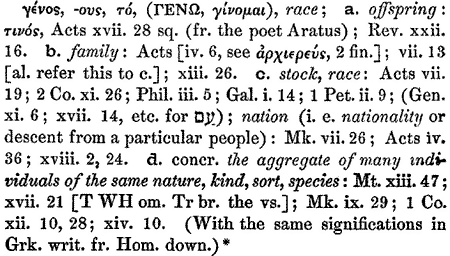
-
Isaiah’s "Denial" Verses, Incomparability and the Divine Council
InCognitus replied to Pyreaux's topic in General Discussions
Do you really think that Paul's audience understood their Greek poets to be saying that all humans are literally Gods when they wrote, "we are his offspring"? Can you show that the Greek philosophers understood themselves to be "Gods"? I think your definition of "God" is hindered by your modern ontological definition. Jesus is the brother to all of us, the Bible says so (Hebrews 2:16-18) As stated above, I think your definition of "God" is hindered by your modern ontological definition. Have you considered the possibility that there are attributes of being called "God" that can be acquired? You said as much in the other folder. Attributes like perfect goodness, wisdom, power, or holiness? Are humans born with those attributes? And obviously it's more than being a human, since it is our spirits that come from God. Our bodies are from the dust of this earth and are created by our earthly parents. As for what Paul was teaching in Acts 17:28-29, how can your interpretation make any sense given what Paul was teaching his audience? Paul's core argument is this: "if humanity is God’s offspring, then the divine cannot be captured in images of gold, silver, or stone" (see Paul and Zeus, A Universalizing Thread in Acts). Paul was teaching them that we are all the same kind of being that God is. You said that Paul just meant we are created beings. How does your interpretation make any sense in that context? -
Isaiah’s "Denial" Verses, Incomparability and the Divine Council
InCognitus replied to Pyreaux's topic in General Discussions
Key word: “sometimes”. I’m familiar with these verses, and they are often used to try to divert attention away from the literal meaning of the word “offspring” (translated from génos) in Acts 17:28-29. But none of those verses have any bearing on the context of Acts 17:28-29. First, none of the examples you gave use the Greek word génos. The Greek word génos refers to the "kind" of being in this context and has a kinship meaning. There is simply no way that the Greek word génos in Acts 17:28-29 can be misconstrued to mean that we are merely created by God. It’s totally foreign to the core meaning of the word. Second, if you reimagine the meaning of the Greek word génos in this context to be non-literal, it invalidates Paul’s entire argument. Paul's core argument is this: "if humanity is God’s offspring, then the divine cannot be captured in images of gold, silver, or stone" (see Paul and Zeus, A Universalizing Thread in Acts). Your changing of the meaning of the word génos to be about God creating humanity out of nothing (which is an impossible definition of the word) totally destroys Paul's entire argument, because if humanity is merely a creation of God and gold, silver, or stone are also creations of God, then there's no difference (so why not assume that god is gold, silver, or stone?) "What Acts 17 reveals is that early Christian thinking could treat non-Jewish, non-Christian sources as real witnesses to God, even while arguing against Greek religious practice. If humanity is truly God’s offspring, as Aratus wrote about Zeus, then representing God through statues and images misses the point of that relationship entirely. The argument only works if the Greek poets were right about something essential, and that is a significant move for understanding how early Christianity saw itself within its intellectual world. What Paul is depicted describing in Athens is not a rejection of Greek thinking about God but a universalizing claim that it was always, without knowing it, about the creator God." ( Paul and Zeus, A Universalizing Thread in Acts) And finally, you haven't considered how Paul's Greek audience would have understood his teaching. Do you think they would have thought Paul was only teaching them that God created us out of nothing? There's no possible way that they would get that message out of what Paul was saying and what he quoted from their poets. And you didn't answer the question. Given what Paul was teaching in those verses do you believe that Paul meant that we are all literal Gods right now? -
General Conference talk on the understanding of the Godhead
InCognitus replied to GoCeltics's topic in General Discussions
That is the point. In John 1:1, God the Father is referred to as “THE God”, while Jesus (the Word) is only referred to as “God” (without the article). Jesus is not “the God” in this context, he is just “God”. Jesus is not God the Father, and God the Father is “THE God” of Jesus Christ. I didn’t say it was. The point of John 1:1 is to show the subordinate relationship of Jesus to his God, God the Father, the “only true God”. John 1:1 it distinguishes “The God” (God the Father) from Jesus (“God”), and it shows that God the Father is “THE God” of Jesus Christ. Look closely at what you just said. You wrote, “John is saying that everything that was created came into existence through the Word. Nothing that was made came into existence independently of him.” Then you say, “That is why I believe Jesus created Satan”. But that is just circular reasoning. You must first presuppose that Satan “was created” or “was made”, and then you use that verse to try to prove what you already presupposed, that Jesus created Satan. But nowhere does scripture say that Satan “was created” or “was made”. The same is true for the spirits of men, because the biblical teaching is that we are all the very “génos” of God, the “kind” of being that God is. That’s not two definite articles. What you are claiming to be “two definite articles” above are the phrases “the Lord” (ὁ κύριός) and “the God” (ὁ θεός), both of which use the one and the same definite article in the Greek for two different name titles for God. A definite article is a word placed before a noun to show that the noun refers to a specific, known person, place, or thing. In English, the only definite article is "the", and Greek has only one definite article (meaning "the"), but it changes its form depending on the noun's gender, number, and grammatical case (see here). Here’s a quote from the early Christian Father Origen (185-254 AD), from his commentary on John 1:1. This is relevant to my point above about John 1:1, and to your claim that Origen didn’t teach that “the Father and the Son are two separate Gods” down below: There is no question at all that Origen considered God the Father and Jesus Christ to be two distinct Gods, as well as affirming the existence of many other Gods. If you're comparing traditional Christianity with LDS theology, these verses raise the question of how Jesus can be called God while simultaneously having God as his God and remaining subject to the Father. Traditional Christianity generally answers this through the distinction between the persons of the Father and Son while maintaining that both share the one divine nature. Right, and it’s the “share the one divine nature” part of your explanation that’s not biblical at all, and why these verses are such a problem to traditional Christianity. The verses are plainly saying that Jesus, who is God, has a God above him, and separating them into separate persons still makes two persons and two Gods. The Bible has no problem saying that God is the God of other gods, or that Jesus (who is God) has a God. There are “gods many, and lords many, but to us there is but one God, the Father, of whom are all things, and we in him; and one Lord Jesus Christ, by whom are all things, and we by him”. Several LDS teachings portray this "God" you refer to above as achieving godhood. Yes, he may have been a God before he became God in relation to us, but he has not always been God. A being who needs to achieve godhood has not always been God. In your July 13 2026 post, you said "I don't think anyone denies that God the Father is an "exalted man". He has "achieved Godhood" and "progressed to Godhood" in that he was once a man who is now exalted. But that's not the same thing as him "becoming God". God the Father received exaltation (his body was exalted)". From what I know of LDS theology, exaltation involves much more than getting an exalted body: • Becoming a heavenly father or mother (D&C 132:19; D&C 131:2–4). • Becoming a God (D&C 76:58–60; D&C 132:20). • Receiving a fulness of glory (D&C 76:56, 70; D&C 93:28). • Receiving a fulness of joy (D&C 138:17; D&C 93:33–35). • Being made equal in power, might, and dominion (D&C 76:95). • Receiving thrones, kingdoms, powers, and dominions (D&C 132:19–20; D&C 121:29). • Having eternal families (D&C 132:19; D&C 131:1–4). • Having a continuation of posterity / "seeds" (D&C 132:19). • Living in God's presence (D&C 76:62; D&C 130:3). This is all biblical theology as well. • Becoming a heavenly father or mother (1 Corinthians 11:11, 1 Peter 3:7). • Becoming a God (2 Corinthians 3:18, 2 Peter 1:4, 1 John 3:2). • Receiving a fulness of glory (John 17:20-23, 2 Corinthians 3:18, Colossians 3:4, 1 Thessalonians 2:12, 2 Thessalonians 2:14, 2 Timothy 2:10, Hebrews 2:10, 1 Peter 5:1-4, 2 Peter 1:3). • Receiving a fulness of joy (Psalms 16:11). • Being made equal in power, might, and dominion (Revelation 3:21). • Receiving thrones, kingdoms, powers, and dominions (Matthew 25:21, 23, Revelation 2:26, Revelation 3:21, Revelation 21:7). • Having eternal families (1 Corinthians 11:11, 1 Peter 3:7). • Having a continuation of posterity / "seeds" (Isaiah 55:3-5). • Living in God's presence (Revelation 21:3). But these things that pertain to us for how we can become like God is now, and they don’t all define what “exaltation” fully means or what it is entailed in becoming “God”. For example, Jesus didn’t have God’s “glory” until God the Father gave it to him in the beginning (John 17:5, 22, 24, 1 Peter 1:21), nor had he received a resurrected body, and Jesus was still considered to be God in the beginning. And God’s “glory” increases eternally, as God continues to create worlds and brings to pass the immortality and eternal life of man. So, there is no end to the glory and dominion that God receives. Given the fact that God the Father has always been the most advanced, most intelligent, supreme being above all others (as Joseph Smith taught), he has always possessed thrones, kingdoms, powers, and dominions. He created worlds before he dwelt on one of them. It is only in his relationship to us that he became our God. Psalm 90:2 says nothing about Christ (that’s another circular reasoning issue you have with that verse), nor does it say God is “eternally God” as you well know (“from age to age” is not the same as “eternally God”). We’ve been over that and you know better. And you also know that from Proverbs 8:22-25, where it is clear that the phrase “from everlasting” does NOT mean “eternally”, which contradicts your belief and misconstruing of scripture. That is a false interpretation of Isaiah 44:6 as the context shows. In LDS theology, no other Gods are formed to be the God of Israel, either before or after God declared himself to be the God of Israel, as Isaiah 44:6 is teaching in its context. John 17:3 says, "And this is life eternal, that they might know thee the only true God, and Jesus Christ, whom thou hast sent". Trying to comprehend that in simple fashion would lead one to conclude that Jesus is not a true God. Or it means that Jesus was saying that God the Father is indeed the only true God and Jesus is the agent and representative, the “image” of the one true God (God the Father). This is the message all throughout the gospel of John. And, as John 17 continues to show, all those who follow Jesus can also become agents of the one true God, his representatives and images of God, becoming “one” with Jesus and his Father in the same way Jesus is one with his Father, and receiving his full glory. You are the one changing what the Bible says. When Paul says, “there is one God” in 1 Corinthians 8:4, he adds “and one Lord Jesus Christ”, showing that Jesus is considered separate and distinct from the one God that Jesus represents. And elsewhere, “For there is one God, and one mediator between God and men, the man Christ Jesus” (1 Timothy 2:5). The Bible explains it perfectly. As Jesus said, God the Father is the “only true God”, but Jesus went on to explain in the same chapter how he and his Father and all the believers can become “one”, or “one God” in representing the one true God who is above all. What really creates the tension is inventing some other non-biblical way that Jesus and his Father are “one God” by combining them into one being. It’s not only non-biblical, it is also nonsensical and contradicts scripture that teaches that God is the “God of gods”. The “homoousious” doctrinal invention creates more problems than it tries to solve. Not really, not when you understand the context, how the “one God” rhetoric works, and how divine images of God work in Old Testament times. And without that understanding you come away with a lot of Bible contradictions, such as all the verses that say God is the God of gods (Deuteronomy 10:17, Joshua 22:22, Psalms 136:2-3), and that God is compared to these other gods in heaven (Psalm 89:5-7, Exodus 15:11, Psalm 97:9, Psalm 135:5). See this post in the topic thread “Many Gods in the Bible”. As for how images of God work in Old Testament times, here’s an example from the Septuagint version of Genesis 31:13: "I am God that appeared to thee in the place of God, where thou anointedst a pillar to me, and vowedst to me there a vow; now then arise and depart out of this land, depart into the land of thy nativity, and I will be with thee." The same God who is the “only true God” as Jesus said in the New Testament, obviously. I read that link. https://www.newadvent.org/fathers/04165.htm It does not portray Origen teaching the Father and the Son are two separate Gods. Actually, it does. See the other quote I posted from Origen, above, and my further comments, below. Don’t you even see what Origen said in the quote you posted above? God the Father and Jesus Christ are “two… persons or substances”. In other words, they are not one substance, which is what the word “homoousious” means that the Roman Emperor Constantine added to the Nicene creed from which modern Christians get this teaching today (it’s not from the Bible). And Origen goes on to describe how Jesus and his Father are “one” in the exact same way Latter-day Saints teach it and the way that Jesus himself defined it in John 17:11 and 20-23. Origin said they are “one in unity of thought, in harmony and in identity of will.” Compare what Origen said above to this statement from the Church Newsroom article, Latter-day Saints 101: What Church Members Believe: “Do Latter-day Saints believe in the Trinity? Latter-day Saints most commonly use the term ‘Godhead’ to refer to the Trinity. The first article of faith for the Latter-day Saints reads, ‘We believe in God, the Eternal Father, and in His Son, Jesus Christ, and in the Holy Ghost.’ Latter-day Saints believe God the Father, Jesus Christ and the Holy Ghost are separate personages, but one in will and purpose — not literally the same being or substance, as conceptions of the Holy Trinity commonly imply.” How clear can it get? Compare the two again: Origen said, “they are two, considered as persons or subsistences, are one in unity of thought, in harmony and in identity of will”. The Church website says they “are separate personages, but one in will and purpose — not literally the same being or substance”. That’s what the earliest Christians taught and believed. -
General Conference talk on the understanding of the Godhead
InCognitus replied to GoCeltics's topic in General Discussions
Joseph Smith taught, "It is the first principle of the Gospel to know for a certainty the character of God. He was once a man like us; God himself, the Father of us all, dwelt on an earth, the same as Jesus Christ himself did". He was not alone on his earth. He apparently lived with a woman, who would later become his wife, and with millions or billions of other people. How did Heavenly Father become a God in relation to "her" and "them"? Was she and the others offspring of Heavenly Father (the God of our Earth), or were they the offspring of some God who came before Him? I already addressed this nonsense speculation of yours last time. I’m not going to entertain your speculative meanderings. It’s pointless to discuss things that have not been revealed. Furthermore, you know there are no answers to those questions, and by asking them over and over it is an indication that you are simply trying to provoke, mock, or ridicule rather than engage in fruitful discussion. So, prepare to be ignored. It seems you are trying to cloud what the term "offspring" means. Perhaps only for what you think “offspring” means, but otherwise, no. See below. Yes, and the “Becoming Like God” Gospel Topic essay says that too, but it also says: “Latter-day Saints see all people as children of God in a full and complete sense; they consider every person divine in origin, nature, and potential. Each has an eternal core and is ‘a beloved spirit son or daughter of heavenly parents.’ Each possesses seeds of divinity and must choose whether to live in harmony or tension with that divinity.” In other words, the fact that we are the same kind of being as God (as Acts 17:28-29 teaches) is our “eternal core” (we have existed eternally), AND (note the word “and”) each of us is “a beloved spirit son or daughter of heavenly parents”. Not defined. And of course, you know that Joseph Smith didn’t teach that “many Father Gods existed before a being becomes the Father of our Earth”. You already know that, because you have never been able to show that he did. Do you want me to issue this as a CFR? You need to show where Joseph Smith taught that or quit posting this nonsense. And don’t post the same quotes that I’ve already discussed and shown that they don’t teach what you are claiming. I agree that Hebrews 12:9 calls God the "Father of spirits," but I don't think that necessarily means that our spirits are literally offspring of God in the sense of being spiritually procreated by him and a his spouse. In the biblical context, "Father" can describe God as our Creator, source, and rightful Father without implying that He physically or biologically fathered our individual spirits. The verse itself doesn't say that God and a heavenly wife produced us as spirit children. I realize you are forced to take this interpretation given that you were taught by your tradition to believe that God created all things, including human spirits, out of nothing (even though the Bible never says any such things and contradicts this teaching in Acts 17:28-29). But “in the biblical context” the meaning of Hebrews 12:9 can be perfectly understood by the surrounding verses and in the light of Acts 17:28-29, which is a clear teaching from the apostle Paul that we are the same kind of being that God is, we are his “offspring”. Look at the context. When Hebrews 12:7-9 talks about the chastening of a father to his sons, it compares the “fathers of our flesh” to the “Father of spirits”. It is talking about literal “fathers of our flesh” on the one hand as compared to the “Father of spirits” on the other hand. This is a direct comparison. But you want to change the latter meaning to be only that God created us and he is only our “Father” in a figurative sense. God also created rocks. Is God also the father of rocks and he chastens them too? Your interpretation breaks the meaning of the comparison and diminishes the impact of what is being taught there. Again, your rationalization above is an attempt to dodge the clear meaning of the word génos in Acts 17:28-29, which teaches that we are the same “kind” of being that God is. That we are the same “kind” of being as God is not something that can be explained away by attempting to divert attention to other meanings of “Father”. Focus on what the word génos means. It’s in the Bible. You can’t make it say what you are trying to make it say. Do you? I don’t. What Paul was doing was teaching his pagan audience about the true God of the Bible, and he used quotes from the Greek poets to help communicate true teachings about the God of the Bible. Even the phrase “For in him we live, and move, and have our being" is a direct quote from Epimenides (Cretica), writing about the Greek god Zeus. (See https://en.wikipedia.org/wiki/Epimenides). Do you think Paul was talking about Zeus? That would mean all non-exalted beings (those who don't become Gods) are not children of the New Covenant. They are not the "sons of God". Whose sons are they? They are of the devil (John 8:44; 1 John 3:10). See my post on 02/09/2022 for a complete explanation of John 8:33-44 and how the different meanings of “child” or “father” are used in those verses and in the Bible. If you read John 8:33-44 carefully, you can see that Jesus recognized and used multiple meanings of the words “children”, “seed”, and “father”. A person can be the literal seed or “offspring” of someone but not be their “child” in a behavioral sense because they don’t follow the example that was set by that individual, like the Jews in those verses that were the literal seed of Abraham but because they didn’t do the works of Abraham they did not have Abraham as their “father”. You are latching on to a single meaning of these words without consideration of the context or allowance for the other meanings and it is wresting of scripture. Joseph Smith said, "Why, what the Father did. The answer is obvious—in a manner, to lay down his body and take it up again. Jesus, what are you going to do? To lay down my life, as my Father did, and take it up again". As said before, Joseph Smith was using the "Jesus did what he saw the Father do" statement in that sermon only with regard to creation (“I do the things I saw my Father do when worlds come rolling into existence”), and that God the Father dwelt on an earth the same as Jesus Christ did and he had the power to lay down his life and take it up again (as you quoted above). There is no other information about God the Father's earthly experience other than that. See my post to you when you were posting as telnetd, here, here, and here. It seems you believe Paul was equating Heavenly Father with Zeus and omitted mention of Heavenly Mother; the goddess Hera. You’ve got that backwards. It seems you believe Paul was equating Heavenly Father with Zeus and Hera. Remember, you are the one who said how his audience would have understood Paul, as you said in your post on 01/02/2025: “The pagans understood ‘offspring’ in the sexual case of literal reproduction for the Greek gods; like that which occurs between male and female.” Is that why you don’t believe Paul’s teachings in those verses? Do you think Paul was talking about Zeus and Hera? I don’t believe that’s what Paul had in mind. Paul was using the language that his audience would understand to teach the true doctrine of the God of the Bible, that we are all the same “kind” of being that God is, and that we are all his “offspring”. Do you think that Paul didn’t realize what he was teaching them? I think Paul knew exactly what he was saying. The question is, why don’t you believe him? I think you need to read this article on the intertextual.bible website: Paul and Zeus - A Universalizing Thread in Acts. I would love to quote the entire article here, but that would be inappropriate. The whole article is worth reading. But I'll quote a couple of paragraphs here. After quoting from Acts 17:26-31, the article says: "Paul’s speech names the borrowing openly, referring to 'your own poets' before quoting the line. The speech describes a God who made the world and everything in it, who does not live in temples and is not served by human hands, and who placed every nation on earth so that people might 'search for God and perhaps grope around for him.' Into this description of the God of Israel, Paul drops a reference from a hymn to Zeus, not to argue against it, nor even to make a sarcastic reference, but to underline his point. The quotation works as evidence that Greek poets had already said something true about the God Paul is talking about, and the speech then draws a practical conclusion from that shared idea: if humanity is God’s offspring, then the divine cannot be captured in images of gold, silver, or stone." "Paul does not argue that Aratus was wrong about Zeus or that the Greek poets were talking about a false god. He takes what was said about Zeus and applies it directly to the God of Israel, suggesting that the Greeks, through their own poetry and philosophy, had already stumbled onto something real about God. The implication is that genuine theological knowledge is not limited to Jewish scripture but can be found in other cultures and their ways of thinking about the divine. The speech accepts that Greek thinkers recognized and described real truths and insists that those truths point towards a universalizing theme, claiming the best of Greek thought while arguing it only makes full sense in the context of what Paul is preaching." The article concludes as follows: "The verse in Acts therefore contains not one but two echoes of Greek poetry about Zeus, both repurposed to describe the God of Israel. Two separate poetic traditions about Zeus are folded into a single verse about the Christian God, and neither is dismissed or corrected, with the text treating both borrowings as honest expressions of a truth the Greek poets had grasped independently. What Acts 17 reveals is that early Christian thinking could treat non-Jewish, non-Christian sources as real witnesses to God, even while arguing against Greek religious practice. If humanity is truly God’s offspring, as Aratus wrote about Zeus, then representing God through statues and images misses the point of that relationship entirely. The argument only works if the Greek poets were right about something essential, and that is a significant move for understanding how early Christianity saw itself within its intellectual world. What Paul is depicted describing in Athens is not a rejection of Greek thinking about God but a universalizing claim that it was always, without knowing it, about the creator God." What the Jehovah’s Witnesses believe is irrelevant and a diversion away from the point of what is evident in Proverbs 8:22-25, which is that the phrase “from everlasting” does NOT mean “eternally”, which contradicts your belief and misconstruing of scripture. In the 1844 discourse, Joseph Smith taught God the Father had a Father. "If Jesus Christ was the Son of God, and John discovered that God the Father of Jesus Christ had a Father, you may suppose that He had a Father also". Joseph Fielding Smith explicitly interpreted Joseph Smith's teaching as meaning that Heavenly Father had a Father, and that this continued backward. In Doctrines of Salvation, 2:47, he wrote "Our Father in heaven, according to the Prophet, had a Father, and since there has been a condition of this kind through all eternity, each Father had a Father, until we come to a stop where we cannot go further, because of our limited capacity to understand" (Doctrines of Salvation). Do you believe these teachings? Joseph Fielding Smith was interpreting Joseph Smith based on a later published interpolation of the notes taken by Thomas Bullock, and Bullock’s notes are incomplete and are contradictory to one of the sources that Joseph Smith referenced. As I explained in my post on 05/26/2025, the original notes of Thomas Bullock indicate some confusion over the quote from Abraham 3:19, and Bullock’s notes contradict the book of Abraham. So, it’s not an entirely accurate source for Joseph Smith’s sermon, and consequently some people may misinterpret what Joseph Smith was teaching by using the published source alone, as was the case for Joseph Fielding Smith. Noted. In that April 1971 New Era article, then one could attribute the following statement to Kent Nielsen: "One among these, it is presumed, was a savior for them, and through him they obtained a resurrection and an exaltation on an eternal, celestial world". Nielsen's statement is a presumption. Yes, and if you had read my post on 05/26/2025 you would have realized that a long time ago, because that’s exactly what I said in that post, and you would have seen that I posted the entire context of Brigham Young remarks relating to the context of that statement. Firstborn does not necessarily mean first born or first created. It depends on the context. Of course. Based on the context of those three biblical verses above plus the one from D&C. That’s funny, because only the D&C verse is about Jesus, the others are not. You hand pick a few verses that have a different meaning of firstborn and apply that meaning to all other applications of the word firstborn, and you claim that “the context of those three biblical verses” (which are not about Jesus) prove that Jesus is really not “firstborn” in any other way? You can’t be serious. What about Matthew 1:25, where it says, “And [Joseph] knew her [Mary] not till she had brought forth her firstborn son: and he called his name JESUS”? Does your picking and choosing of verses apply to that meaning of “firstborn” too? Why not use real biblical verses that apply to Jesus? Like: Hebrews 1:5–6: “For unto which of the angels said he at any time, Thou art my Son, this day have I begotten thee? And again, I will be to him a Father, and he shall be to me a Son? And again, when he bringeth in the firstbegotten into the world, he saith, And let all the angels of God worship him.” The Bible's creation account does not describe God creating mankind as the offspring of a heavenly father and heavenly mother. It describes God Himself as the Creator of both male and female. The Bible’s creation account describes God forming man from the “dust of the earth” and then God placed into the man his spirit (the “breath” of life), and man became a “living soul” (Genesis 2:7). Man’s spirit came from God, for it is the “kind” of being that God is, the very génos of God, as the Bible teaches. And these teachings coincide with what the Bible teaches in Acts 17:28-29 (we are the kind of being that God is) and how God created man in Genesis 2:7, with man’s spirit coming from God. What does Joseph Smith's teaching God the Father (of Earth) having a Father mean to you? In what way is that Father the father of Heavenly Father? Do you EVER read my posts? I’ve explained that many times already, including in my last post right within the context of the quote you clipped from it above. You edited out the answer to this very question. See my post on 09/07/2026, as well as my post on 05/26/2025. Here's part of what I said: Saying that God had a father is not the same as saying that God has a God above him, because he would have had an earthly father when he dwelt on an earth, just like Joseph Smith was teaching. I’ll quote from one portion of my post on 05/26/2025 so you can find it easily if and when you go to read it. Part of what I said is this: “I see from Thomas Bullock’s notes of that sermon that the discussion of God the Father having a father was in the context of God the Father’s mortal experience on an earth. His notes show that the statements about God the Father having a “father” are immediately followed by “I want you to pay particular attention to what I am saying. Jesus said that the Father wrought precisely in the same way as His Father had done before Him”. In other words, Bullock’s notes indicate that God the Father’s “father” would have been either his earthly father when he was born into mortality, or that God the Father (as the head of all other Gods) would have appointed some other God to produce him in the same way that Jesus came into mortality. But Bullock also seems to have repeated himself in part of those notes, so it’s hard to tell if Joseph Smith was restating something for emphasis, or if Bullock recorded it incorrectly, or if he did get it correct we need further information and context to draw any conclusions with certainty.” In other words, Joseph Smith was not teaching that God the Father has a God above or before him, and he was consistent in teaching that God the Father was the “head God”, the most high God. See my post earlier in this thread on 07/26/2026. Already explained. It seems you use the terms "head God" and "most high God" in the context of only Heavenly Father and his spirit children. You’ve tried this “sphere of influence or realm” approach previously (you have several times). I realize that this is your only way out of the corner you are in, but you already know that it doesn’t work because I have responded to your attempt at this many times before. And it’s not just me, it was Joseph Smith that taught this. Joseph Smith was clear in teaching that God the Father is the “the Eternal God of all other gods” (Doctrine and Covenants 121:32). This is what Joseph Smith said in the King Follet Sermon: “I shall comment on the very first Hebrew word in the Bible; I will make a comment on the very first sentence of the history of the creation in the Bible—Berosheit. I want to analyze the word. Baith—in, by through, and everything else. Rosh—the head. Sheit—grammatical termination. When the inspired man wrote it, he did not put the baith there. An old Jew without any authority added the word; he thought it too bad to begin to talk about the head! It read first, ‘The head one of the Gods brought forth the Gods.’ That is the true meaning of the words. Baurau signifies to bring forth. If you do not believe it, you do not believe the learned man of God. Learned men can teach you no more than what I have told you. Thus the head God brought forth the Gods in the grand council.” Joseph Smith emphasized that God is the “head God” at least eight times in the King Follet Sermon, calling him “the head, the Father of the Gods”. He was very consistent in teaching that God the Father is the Most High God. Do you believe Satan is a powerful angelic being? What I believe about Satan is irrelevant to the context and interpretation Colossians 1:15-17 and Titus 3:1. People believe all kinds of things that they read into scripture instead of letting scripture speak for itself (like the idea that Jesus created Satan). If I'm not mistaken, LDS theology puts the cause on Heavenly Father. It was part of his plan – no fall, no progression. No, you are mistaken. In LDS theology Satan is an eternal spirit that has his own agency, and Satan was not created out of nothing as you believe Jesus did in creating Satan. So, the fact that Satan existed already and God used Satan in his plan is not the same as Jesus causing the existence of all evil by creating Satan, as you believe. That sounds a lot like the early Christian notion of a “fortunate fall” (the felix culpa). St. Thomas Aquinas writes: "But there is no reason why human nature should not have been raised to something greater after sin. For God allows evils to happen in order to bring a greater good therefrom; hence it is written (Romans 5:20): “Where sin abounded, grace did more abound.” Hence, too, in the blessing of the Paschal candle, we say: “O happy fault, that merited such and so great a Redeemer!” (Summa Theologica, III, 1, 3, ad 3; see also Catechism, 412.) Does that remind you of anything? God knew Satan would become evil when God created him. Did God make a mistake? I would say no. Obviously, it’s not a mistake if God knew Satan would become evil when God created him, it was an intentional act and it makes God the source of all evil. -
Isaiah’s "Denial" Verses, Incomparability and the Divine Council
InCognitus replied to Pyreaux's topic in General Discussions
I wanted to add one more thing: The apostle Paul taught that we are all literal offspring of God in Acts 17:28-29 (the Greek word translated as offspring in those verses refers to the "kind" of being, in a literal way), and given the context of his remarks that word cannot be misconstrued to mean that we are merely created by God (as that would totally destroy Paul's main point about not worshipping gods of gold or silver or stone, which are also created things). Given what Paul was teaching in those verses are you saying you believe he meant that we are all literal Gods right now? And remember, this is a Bible teaching, so if you are mocking and ridiculing Paul's teaching that we are all the offspring of God then you are just mocking and ridiculing this Bible teaching. -
Isaiah’s "Denial" Verses, Incomparability and the Divine Council
InCognitus replied to Pyreaux's topic in General Discussions
Not according to you (posting as theplains): We currently don't have all those attributes, even though we all are (as the Bible says) the same kind of being as God (Acts 17:28-29). Those are attributes that can be obtained through the cleansing power of the atonement of Jesus Christ and by our willingness to follow and emulate him. -
Isaiah’s "Denial" Verses, Incomparability and the Divine Council
InCognitus replied to Pyreaux's topic in General Discussions
Strawman indeed (same as what Pyreaux said). The other thing that will never make sense under your dichotomy are how the Hebrew superlatives work. The Bible speaks of the Holy of holies, Heaven of heavens, Sabbath of sabbaths, servant of servants, vanity of vanities, song of songs, King of kings, Lord of lords. This Hebrew grammatic construction requires that the two words connected in the expression are in the same category, but one is the "most" or "supreme" over the others. We never suppose that "holies" of the "Holy of holies" are not truly holy, rather the one is the holiest of all others. The same thing with "King of kings". There is one "King" that is supreme, one that rules over all other "kings". The same thing with "Lord of lords". There is one "Lord" that is supreme', the highest Lord over all other "lords". But when we get to the "God of gods" (Deuteronomy 10:17), the modern Christian view can't handle that. So we start hearing excuses and exceptions that these other "gods" must be idols, false gods, corrupt human judges, demons, or some other category of being that totally breaks the Hebrew superlative. It's either that God is the "God of gods", or he is: The False God of false gods The Idol of idols The Corrupt Human Judge of corrupt human judges The Devil of devils The Hebrew superlatives don't work any other way. -
Where was I on the morning of September 11, 2001?
InCognitus replied to Navidad's topic in In The News
It was a Tuesday morning and I was with a co-worker in a car travelling from Phoenix to a client's office in California (near the Arizona / California border). I don't recall if we first heard the news on the car radio or if someone called us on a cell phone, but it was fortunate that we were travelling by car and not by plane that day. It was hard to work with the client that day because everyone was distracted by the news, and it was eerie to see no air traffic in the sky on the drive back home. -
Will do.
-
I know this is an odd topic, but I've re-watched this video several times because the design and mechanics of these wings are so beautifully done, so I had to share it. It's mesmerizing to see them function so effortlessly. And birds make these all the time all on their own! (I think there is intelligent design behind them of course). It makes you appreciate the design of actual bird wings.
-
General Conference talk on the understanding of the Godhead
InCognitus replied to GoCeltics's topic in General Discussions
To be divine is to possess the nature or attributes of God—such as perfect goodness, wisdom, power, or holiness. I don't view humans as being divine in essence, though they may reflect God's image or be close to God. I like that you state the specific attributes of God as perfect goodness, wisdom, power, or holiness. These attributes are obviously separate from his eternal nature, since the Bible teaches that humans are the same kind of being as God in this regard, but humans currently lack these attributes of perfect goodness, wisdom, power, or holiness. Jesus had these attributes along with God the Father in the beginning. And God is drawing his children unto him and asks us to “be holy” as God is holy (1 Peter 1:13-15), and the fruit of the spirit is wisdom and goodness, and the heirs of God are given power. Don't forget the dual nature of Christ. He is both God and man. And as man, God is his father. That does not make Christ a lesser God. Remember, Jesus was even described as separate and subject to God the Father even from before creation, where he was “given” glory by the Father and “appointed” by the Father to carry out the work of creation, which totally removes the excuse that he had a “dual nature” (if there is such a thing). Jesus (the “word”) was called God (theos) alongside “the one true God” in John 1:1-3. In the Greek text of those verses, God the Father is referred to as “the God” (shown in red below), and Jesus is simply said to be “God”: Ἐν ἀρχῇ ἦν ὁ λόγος, καὶ ὁ λόγος ἦν πρὸς τὸν θεόν, καὶ θεὸς ἦν ὁ λόγος. Check out the link above if you don’t believe me. And Jesus continues to be subject to the Father eternally, as 1 Corinthians 15:28 points out. The resurrected Jesus referred to God the Father as “my God” four times in Revelation 3:12. God is already God before he becomes our Father. God was already perfect in goodness, wisdom, power, and holiness and the supreme being before he became our Father, yes. He was God before he became God in relation to us. As for your other comments, I’m not going to entertain your speculative meanderings. It’s pointless to discuss things that have not been revealed. Regarding Hebrews 2:7 and 1:2, it makes it easier to comprehend when you realize that Jesus and the Father are not two Gods. Actually, it makes it much easier to comprehend when you realize that Jesus and the Father are two Gods. God the Father set Jesus “over the work of [his] hands”, and God the Father “appointed” Jesus to be the heir of all things, and it was by Jesus that God the Father “made the worlds”. “But unto the Son he saith, Thy throne, O God, is for ever and ever: a sceptre of righteousness is the sceptre of thy kingdom. Thou hast loved righteousness, and hated iniquity; therefore God, even thy God, hath anointed thee with the oil of gladness above thy fellows.” (Hebrews 1:8–9) Jesus has a God and Jesus was anointed by his God. Clearly this is why Philo, and the early Christian Fathers Origen and Lactantius referred to Jesus as the “second God”, and why Justin Martyr said (of Jesus) “that there is, and that there is said to be, another God and Lord subject to the Maker of all things” (Justin Martyr, Dialog with Trypho, Chapter 56). And as Origen taught: “And although we may call Him [Jesus Christ] a "second" God, let men know that by the term "second God" we mean nothing else than a virtue capable of including all other virtues, and a reason capable of containing all reason whatsoever which exists in all things, which have arisen naturally, directly, and for the general advantage, and which "reason," we say, dwelt in the soul of Jesus, and was united to Him in a degree far above all other souls, seeing He alone was enabled completely to receive the highest share in the absolute reason, and the absolute wisdom, and the absolute righteousness." (Origen Against Celsus, book V chapter XXXIX). Jesus has a God, and Jesus is eternally subject to the only true God, his God and Father. -
General Conference talk on the understanding of the Godhead
InCognitus replied to GoCeltics's topic in General Discussions
I remember. You said, "How he came to be our God was in our relationship to him, and him providing a way for us to advance and become like him. That is the way Joseph Smith taught it in his sermon". In the King Follett Discourse, Joseph Smith does discuss the eternal nature of intelligence/spirits, but he does not explicitly teach that God and a heavenly wife produced spirit children. It does discuss humanity's existence before mortality, but its language is more about intelligence/spirits being eternal than the later familiar LDS formulation of Heavenly Father and Heavenly Mother having spirit children. So in short, it does not discuss how "God came to be God" (a phrase used in the sermon) before becoming "our God" (a phrase not used in the sermon). But it does discuss how God became God in relation to us, which was his entire point. This is only in the sense of a spiritual relationship. Once a person is a literal offspring of God, he or she remains a literal child. In LDS theology, God continues to be the God (the literal parent) or all those spirit children who supposedly rebelled against him in some war in heaven. Those who became his spirit children were those who participated in his plan, and some of them rebelled by siding against his plan after the plan was presented. Exactly how we are his “offspring” is not defined, anywhere, other than the biblical explanation that we are all literally the same kind of being that God is (Acts 17:28-29) and that God is the “Father of spirits” (Hebrews 12:9). In the Protestant and Catholic views, one God is responsible for creating all planets, stars, universes, and everything relating to them. But that’s not the biblical explanation. The Bible says God the Father (who is the “only true God”, according to Jesus) created all things through Jesus Christ (another God and Lord who is subject to the one God and Father of all). The Father alone was responsible for this act of creation, but he did it through his Son who he appointed to be his agent in creation and other things. Also, this doesn’t change the fact that the God of the Bible has an increase in the number of his creations. It is from zero to one (in the Protestant view), and from “without number” to “without number” plus one, in the Latter-day Saint point of view. Offspring in two ways – [1] being created by God, and [2] in a spiritual sense (being adopted into his family), not in the sense of being born literally as spirit children to a heavenly mother. Wrong, offspring in only one way, which is that we are all the génos of God (the same kind of being as God), but we need to “become” his children in a spiritual sense after that. There is simply no way that the Greek word génos in Acts 17:28-29 can be misconstrued to mean that we are merely created by God. It’s totally foreign to the core meaning of the word. I have discussed this with you many times, and to change the word to mean that we are merely God’s creations totally destroys Paul’s main point. If we are merely God’s creations then we are no different than the gold, or silver or stone from which the pagans made their idols, because gold, or silver, or stone are creations of God as well. But given the true meaning of the Greek word génos, do you see how you are pushing back against the text of the Bible? You are simply reasserting your personal beliefs and are refusing to accept what the Bible says on this topic. This is really quite ironic for these reasons: The Bible says, plain and simple, that we are all the same “kind” of being as God, since that’s what the Greek word génos means in Acts 17:28-29. We are the “genus” of God. You say we are not the génos of God, but are merely creations of God, and God created us out of nothing. The takeaway: The Bible says we are the same kind of being as God, but modern Christians say we are creatures that God made out of nothing that are categorically other than him, which contradicts this biblical teaching in Acts 17:28-29. Not only do these verses dispute the modern Christian views about God’s relationship to man, but they also prove that the idea of creation out of nothing for mankind is not biblical, since to be the same “kind” of being as God necessitates that we have an eternal core (our spirits). In the Bible Jesus taught us how he is “one” with his Father. Jesus prayed for his disciples to be “one” with each other and with him and his Father in the same way Jesus is one with his Father in John 17:11, 20-23. And Jesus “gave” to his disciples the same glory that God the Father had given him in the beginning. Modern Christians believe that Jesus and his Father are “homoousious”, a word that was added to the Nicene creed by the Roman Emperor Constantine. This word has come to be understood to mean that Jesus and his Father are “one being”, a concept that is completely absent from the Bible. The takeaway: The Bible defines how Jesus and his Father are “one”, but modern Christians use a non-biblical concept that was conceived centuries after the Bible took place to try to explain how Jesus and his Father are “one”. The bottom line: Modern Christians believe in a different God than what the Bible teaches, and by proclaiming these beliefs they also reject clear Bible teachings (i.e. we are the same kind of being as God). To paraphrase your words, modern Christians are "spectacularly wrong" on these teachings and are drastically divergent from the teachings of the earliest Christian Fathers (there is little resemblance) and have led Christianity astray for over 1,500 years. The irony here is that you come here to this board to try to claim that we are the ones being led astray toward “another god”, when it is clear that the modern Christian view about God and our relationship to him (as described above) has zero biblical support, the doctrines contradict biblical teachings, and they are the ones who follow “another god”. It’s the difference between a false god and the true God of the Bible (again, using your words). So why should we listen to you? One more thing: The fact that we are also adopted as heirs of God and "become" God's children in some other way does not contradict what Paul taught about our nature as same kind of being as God (his "offspring"), so bringing up that fact does nothing to change what Paul taught in Acts 17:28-29. We all come into this world as "offspring" of God, because God the Father is the "Father of spirits" (Hebrews 12:9). But we must be "born again" and adopted as children of the covenant through Jesus Christ. He gives us the "power" to "become the sons of God" (and according to John 5:18, to be a son of God is to be "equal with God"). Supposedly? Not according to Joseph Smith. See my post to you when you were posting as telnetd, here, here, and here. You're making progress. We don't become God's offspring by being birthed by a heavenly mother. But that’s exactly how you said that Paul’s audience would have understood Paul’s teaching in Acts 17:28-29, as you said in your post on 01/02/2025: “The pagans understood ‘offspring’ in the sexual case of literal reproduction for the Greek gods; like that which occurs between male and female.” Do you think that Paul didn’t realize what he was teaching them? I think Paul knew exactly what he was saying. The question is, why don’t you believe him? Really, why don’t you believe him? God being God from age to age = God being God from eternity to eternity = God being God from everlasting to everlasting. But I see your point if you only want to apply "age" to a human's perspective instead of to God's perspective. Do you see what you are doing here? You are trying to reimagine the Hebrew word ʿôlām to fit your modern doctrine instead of trying to understand how the ancient Hebrews understood the term. In Hebrew the word just means a long time, or as the Young’s Literal Translation puts it, “Even from age unto age Thou art God.” (Psalm 90:2). It doesn’t mean what you are trying to make it mean. This is especially evident in Proverbs 8: 23-25, where “wisdom” is personified and said to have been “set up from everlasting [ʿôlām], from the beginning, or ever the earth was”. Obviously, this can’t mean “eternal” as you want to make it to mean, or how else could wisdom be “set up” and “brought forth” if it is eternal? Here are the verses: “The Lord possessed me in the beginning of his way, before his works of old. I was set up from everlasting, from the beginning, or ever the earth was. When there were no depths, I was brought forth; when there were no fountains abounding with water. Before the mountains were settled, before the hills was I brought forth”. (Proverbs 8:22–25) Joseph Smith and other LDS leaders taught there were Gods before (above) the God of Earth. Let me know which of the following 12 teachings are false and leading people astray and/or have another intended meaning: You posted the exact same list of quotes last time. So, if you are going to just repeat yourself without engaging in how I responded to what you said before, then I will just repeat myself. You are just making it easy for me to respond to your posts with cut and paste or by referring to prior posts. In this case, see my last post on this from 08/23/2026. And Joseph Smith never taught that there were “Gods before (above) the God of Earth”, as you claim. See my post on 05/26/2025 for complete details, and other comments below. I’ll add one thing that I didn’t say in my last post: I don’t think you are even reading my responses. I say this because you’ve already been called out on your misrepresentation of the quote from the article by the BYU Physics professor in the April 1971 New Era article by attributing the source to Brigham Young (see my post on 07/12/2026 and 05/26/2025 where I discussed that article extensively). But you continue to post it as if it was a quote from Brigham Young. I don’t think you are that dishonest (at least I hope you’re not), so I’ll assume you simply haven’t read what I said before and are unknowingly misrepresenting the quote. But if you keep posting it as a quote from Brigham Young from the Journal of Discourses, I’m sure there’s a board rule somewhere related to the continued posting of a misrepresentation after having been corrected. I am not aware of better LDS sources today which show that the 12 teachings I provided above are false LDS teachings. If you have these better sources, then let me know. By better sources, I mean we have access to the original notes from the only primary source (Thomas Bullock) who was present during that specific sermon of Joseph Smith, and those original notes can be found on the Joseph Smith Papers website. And we can compare those notes to what was published and see what was interpolated from those notes, and we can see where Thomas Bullock may have gotten some things wrong (like the contradiction to the quote from the Book of Abraham). And you do? This is pretty funny, because the early Christians certainly had a different understanding of what the Bible means when it says Jesus is the firstborn than you do. How do you know your interpretation is the correct one? How do you know the early Christians didn’t get it right? You really don’t know, you can’t know, can you? How can you tell? As is the shotgun approach diversion tactic, where the critic attempts to deflect and divert the topic off into a myriad of other red-herring topics by copying and pasting quotes from early LDS leaders on a variety of subjects. I’m not going to entertain that diversion. And isn’t it ironic that you keep trying to divert people away from what the Biblical characters wrote, away from where Paul taught that we are all the same kind of being as God in Acts 17:28-29? There’s a good reason that I have said that the doctrines and teachings of the Church of Jesus Christ of Latter-day Saints are more in harmony with the Bible than any other religion on the planet. Regarding digging up obscure quotes from past LDS leaders: People say all kinds of things, sometimes officially, but most often unofficially. But who cares? And we must be even more cautious when the information doesn’t come from firsthand sources, or if the notes are recalled from memory decades after the time and place of the original setting. For example, we need to take into consideration the fact that Oliver B. Huntington was an 11 year old boy in 1837 and never wrote down what he said he overhead Joseph Smith saying until he remembered it over 44 years later, and he is the only source for what he said he remembered. Those kinds of details are important when weighing the accuracy of anything. Right, like the biblical teaching that we are all the génos of God can’t really mean that we are the same “kind” of being that God is, so you need to change that to say we are merely created by God. I'll just focus on one. You quibble too much about whether one considers it a doctrine. Let's focus on whether it's true or false. This teaching of Joseph Smith leads no doubt as to what he intended to mean. There is no ambiguity. "If Abraham reasoned thus—If Jesus Christ was the Son of God, and John discovered that God the Father of Jesus Christ had a Father, you may suppose that He had a Father also. Where was there ever a son without a father? And where was there ever a father without first being a son? Whenever did a tree or anything spring into existence without a progenitor? And everything comes in this way. Paul says that which is earthly is in the likeness of that which is heavenly, Hence if Jesus had a Father, can we not believe that He had a Father also? I despise the idea of being scared to death at such a doctrine, for the Bible is full of it" (Teachings of Joseph Smith, 1938). One thing that you continually fail to understand is that when Joseph Smith said that God had a “father”, it is not the same as your claim that there were “Gods before (above) the God of Earth”. Your failure to understand this point is clear from some of the quotes you posted that you tried to claim were saying God has a God above him. And I already provided a full analysis of the quote above and provided commentary in extensive detail in my post on 05/26/2025, which you either ignore or have never read. READ what I posted already before making accusations about my motives and emotions. Saying that God had a father is not the same as saying that God has a God above him, because he would have had an earthly father when he dwelt on an earth, just like Joseph Smith was teaching. I’ll quote from one portion of that post so you can find it easily if and when you go to read it. Part of what I said is this: “I see from Thomas Bullock’s notes of that sermon that the discussion of God the Father having a father was in the context of God the Father’s mortal experience on an earth. His notes show that the statements about God the Father having a “father” are immediately followed by “I want you to pay particular attention to what I am saying. Jesus said that the Father wrought precisely in the same way as His Father had done before Him”. In other words, Bullock’s notes indicate that God the Father’s “father” would have been either his earthly father when he was born into mortality, or that God the Father (as the head of all other Gods) would have appointed some other God to produce him in the same way that Jesus came into mortality. But Bullock also seems to have repeated himself in part of those notes, so it’s hard to tell if Joseph Smith was restating something for emphasis, or if Bullock recorded it incorrectly, or if he did get it correct we need further information and context to draw any conclusions with certainty.” In other words, Joseph Smith was not teaching that God the Father has a God above or before him, and he was consistent in teaching that God the Father was the “head God”, the most high God. Powers can be angelic beings with power. I’m sure you can imagine the “powers” to be anything you want them to be to fit your desired dogma. But what is more important is what the Biblical writer (Paul) said they are in Titus 3:1. He didn’t say anything about angelic beings with power, and he certainly wasn’t referring to Satan (which is what you claimed he was saying). The Bible does not say that Jesus created Satan, period. God foreknew Adam and Eve would sin and bring death into the world. The fall has had severe consequences for mankind and the rest of creation. And the fall was caused by Jesus, according to you, since you believe Jesus created Satan from nothing, and Satan caused the fall. Cause and effect. But you believe Jesus created Satan from nothing. Did Jesus know that Satan would become evil when Jesus created him from nothing? Since Jesus created Satan from nothing, could Jesus have created him to be something other than what he became? Did Jesus make a mistake when he created Satan? It still results in Jesus as the source of all evil when he created Satan from nothing. What a huge mistake. This is why the Bible doesn’t say that Jesus created Satan, because he didn’t. So why believe it? -
The Journal of Book of Mormon Studies, volume 4, no. 1 contains a few articles that I think related to what you are asking about above. The articles that I think relate to your question above are as follows: PDF The Book of Mormon as Literature Sidney B. Sperry PDF Types of Literature in the Book of Mormon: "The American Gospel" Sidney B. Sperry PDF Types of Literature in the Book of Mormon: Epistles, Psalms, Lamentations Sidney B. Sperry PDF Types of Literature in the Book of Mormon: Historical Narrative, Memoir, Prophetic Discourse, Oratory Sidney B. Sperry PDF Types of Literature in the Book of Mormon: Patriarchal Blessings, Symbolic Prophecy, Prophetic Narrative, Prophetic Dialogue Sidney B. Sperry PDF Types Of Literature in the Book of Mormon: Allegories, Prayers, Songs, Genealogies Sidney B. Sperry Does that help? ETA: I've also found the Book of Mormon Online resource to have some useful information. When you look up specific passages there are various commentaries on the Book of Mormon included. But their "Book of Mormon Analysis" section includes information on Chiastic Features, but it also has a "Coming Soon" section on Literary Structures (it's not released yet).
-
I have his volume 3 of that series, but not volume 1, but based on what I know about his other book I would definitely recommend it.
-
Maybe it's similar to someone who is a "reformed alcoholic"?
-
But on the bright side I'm getting really good and identifying cars, busses, motorcycles, crosswalks, and bridges. It has helped me to become a better driver.
-
You can posts links to Wikipedia here. Documentation is encouraged But I'm sure you can see why we are confused, and don't grasp the subtle differences that you are aware of.