


InCognitus
-
Posts
3,054 -
Joined
-
Last visited
Everything posted by InCognitus
-
Ephraim, the birthright, and the gathering
InCognitus replied to theplains's topic in General Discussions
This is part 1 of a response to the post by @theplains on June 20, located here, which was a response to my post dated 05/26/2025. I'm posting my response here to put us back into the original folder. I'm also going to divide my response to make it a little more manageable, so there will be more than one part to this. PART 1 I believe that even non-religious Israelites can know they are descendants of Abraham through Isaac. Accepting God's covenant and being faithful is not necessarily a prerequisite to someone knowing their lineage. I know that my lineage is Italian but I don't know if my Grandfather or Great-Grandfather was an atheist, Roman Catholic, or some other faith. Accepting God’s covenant is not a prerequisite for someone knowing their lineage, but ultimately it is a prerequisite for the gathering of Israel and participating in the final land covenant promises. How do you propose that non-religious Israelites who were scattered among the nations and intermarried in those nations and were integrated into the genetics and cultures of those various nations will know they are descendants of Abraham through Issac? And what about the Ephraimites who were told that they would become a “multitude of Gentiles” (nations)? Get realistic here. Point out where the people of Reuben, Simeon, Dan, Naphtali, Gad, Asher, Issachar, Zebulun, Manasseh, and Ephraim are right now and explain how they would know that they are of that lineage. How would anyone really know without God’s intervention? They may not have a tradition of the God they rejected but I assume a child would know his heritage from his father. For example, I only know I am of Italian blood because my father comes from Italy. This is despite me not knowing what faith, if any, my previous ancestors had. Your comment above demonstrates the entire problem with your assumptions. What exactly is “Italian blood”? The fact that a parent came “from Italy” doesn’t describe the person’s actual genetic ancestry at all, and intermarriage totally messes up your assumptions. According to the biblical account, the ten northern tribes of Israel were scattered in approximately 720 BC, or roughly 2,745 years ago. The rest of the tribes of Israel were scattered in 70 AD, or 1,955 years ago. And according to the Wikipedia article on “Italians”: https://en.wikipedia.org/wiki/Italians “The Italian peninsula was divided into a multitude of tribal or ethnic territory prior to the Roman conquest of Italy in the 3rd century BC. After a series of wars between Greeks and Etruscans, the Latins, with Rome as their capital, gained the ascendancy by 272 BC, and completed the conquest of the Italian peninsula by 218 BC.” So there was ample time and opportunity for various descendants from the tribes of Israel to migrate to the Italian peninsula before or during the 3rd century BC (or even after), and they may have in fact been among the “multitude of tribal or ethnic” groups that occupied that area, or they may have intermarried with those groups prior to or during the Roman occupation or intermarried with the Greeks, Etruscans, Latins, or Roman individuals. Thus, when you say your “father comes from Italy”, what does that mean exactly with respect to genetic ancestry? Do you know without a doubt that none of your ancestors came from any of the various scattered tribes of Israel because for over 2,700 years they kept meticulous genealogical records? Or how do you know, or how would you know any of your genetic ancestry earlier than a few generations? Be realistic. There are two types of gathering: a] spiritually into the body of Christ and b] gathering to their lands of inheritance. We’ve already discussed this many times. Regarding the gathering of Israel, you keep forgetting the process that the Lord details in scripture for the gathering. Isaiah 11:11 says that in the “day” the Lord sets up an “ensign” to the nations, “that the Lord shall set his hand again the second time to recover the remnant of his people”. And in verse 12 it says, “he shall set up an ensign for the nations, and shall assemble the outcasts of Israel, and gather together the dispersed of Judah from the four corners of the earth.” For some reason you seem to think that this means the Lord will take them directly into the lands of their inheritance without some intermediate “gathering”, but neither the context of Isaiah 11:10-16 or the comparison of how the Lord recovered the remnant of his people the first time (when they were brought out of Egypt at the time of Moses) indicate that happening. In the book of Exodus, we find the Lord assembling his people first and bringing them to belief in him and his covenant: Exodus 3:16: “Go, and gather the elders of Israel together, and say unto them, The LORD God of your fathers, the God of Abraham, of Isaac, and of Jacob, appeared unto me, saying, I have surely visited you, and seen that which is done to you in Egypt”. Exodus 4:27-31: “And the LORD said to Aaron, Go into the wilderness to meet Moses. And he went, and met him in the mount of God, and kissed him. And Moses told Aaron all the words of the LORD who had sent him, and all the signs which he had commanded him. And Moses and Aaron went and gathered together all the elders of the children of Israel: And Aaron spake all the words which the LORD had spoken unto Moses, and did the signs in the sight of the people. And the people believed: and when they heard that the LORD had visited the children of Israel, and that he had looked upon their affliction, then they bowed their heads and worshipped.” From that point Moses (the prophet of God) led Israel to Mount Sinai (the LORD’s temple) where the people of Israel made covenants with God (Exodus 19:5-8, 24:3) and were sanctified and prepared to enter into God’s presence (Exodus 19:10-11, 22) and then entered into the presence of God by going up with Moses on the mountain to see the God of Israel (Exodus 24:9-11), and the LORD said “I will dwell among the children of Israel, and will be their God” (Exodus 29:38-45). It was not until several years later that they were led into the lands promised to them in the Abrahamic covenant. So the way that the Lord recovered the remnant of his people the first time is as follows: A. The people of Israel are called out the physical and spiritual bondage of Egypt B. The people of Israel are taught the word of the Lord. C. The people of Israel believe the words of the Lord and are physically assembled and led in their worship of the Lord. D. The people of Israel covenant with God and are sanctified. E. The people of Israel covenant with God on Mount Sinai (the Lord’s temple) F. Israel then goes forward to the lands of their inheritance. The way the Lord is now recovering the remnant of his people the “second time” is the same pattern as the first time, as follows: A. The people of Israel are called out of spiritual bondage (figuratively Egypt). B. The people of Israel are taught the gospel of Jesus Christ. C. The people of Israel believe the words of Christ and are physically assembled in their places of worship. D. The people of Israel covenant with God and are sanctified, and come to know who they are. E. The people of Israel go to the house of the LORD (in one of God’s temples) and make covenants with him. F. Israel then goes forward to the lands of their inheritance. In your version, you seem to go from A to F with no explanation on how they figure out who they are (to begin with) and how they get there in between. Ephraim and Manasseh are the ones who “push the people together to the ends of the earth”. They can’t do that unless they return to God’s covenant first and come to recognize who they are so that they can assist in getting God’s people together again. Jeremiah 16:15 is a reference of them being gathered to their land of inheritance from where they have been scattered to. "But, The Lord liveth, that brought up the children of Israel from the land of the north, and from all the lands whither he had driven them: and I will bring them again into their land that I gave unto their fathers" (15). This has nothing to do by servants specifically identified as being of Ephraim's or Manasseh's lineage. The time frame is also not specified as being after 1830. Remember, you made the claim in your post on 04/21/2025 that “This focus on only literal Israelites through Jacob and/or the other descendants of Abraham through his other wives is not in line with the Great Commission.” But Jeremiah 16:14-17 clearly contradicts that claim. The point of Jeremiah 16:14-17 is that the Lord says he will prepare his servants (referred to as “fishers” and “hunters” in the verses). He will “send for many fishers” and “send for many hunters” so that they can “hunt” and “fish” and he will send them out to specifically find and gather the scattered lost tribes of Israel. And as I have previously stated, the gathering will eventually lead to them being able to return to the lands that were promised to the seed of Abraham (following the same pattern as the “first” gathering). You pointing out that they will also eventually be gathered to their lands is just a distraction to the fact that the Lord searches out these lost tribes specifically through his servants he calls for that purpose. And as Deuteronomy 33:17 says, this is done through the lineage of Joseph where Moses blessed Joseph (Ephraim and Manasseh) to "push the people together to the ends of the earth". So we already know that Ephraim and Manasseh are involved in that process. We’ve already discussed and settled this a long time ago in this thread. See my post on 02/25/2024, and on 07/26/2024. Who are these servants (the “hunters” and “fishers”) that the Lord sends for to “hunt” and “fish” for the tribes of Israel specifically? Protestant Christians? Catholics? Government officials? Who are they? No. But we may find out in the future. I don't believe that an LDS elder can give a patriarchal blessing to one of these people and tell them that they are a literal descendant from either this or that tribe. You don’t believe this because you are opposed to the Lord’s restored church, The Church of Jesus Christ of Latter-day Saints. But do you believe the Lord knows who these people are and one way he could have these people recognize their lineage is to reveal it to them through a blessing like the blessing that father Jacob gave to each of the tribes of Israel? Or are you opposed to any kind of revelation from God at all? How else are these people going to know who they are? Will it be from the meticulous genealogical records that you seem to believe these people have been keeping for the last 2,700 years? Or how? They are sought out to be gathered to the land that God gave to their fathers. This is literal Israel, not spiritual Israel. Yes, they will be gathered to the land that God gave to their fathers. And it is literal Israel that I’m talking about. Where does the Bible say that these servants in Jeremiah 16:14–17 are NOT literally from Ephraim or Manasseh? And who are these servants (the “hunters” and “fishers”) that “hunt” and “fish” for the tribes of Israel specifically? Protestant Christians? Catholics? Government officials? Telemarketing people? Gallup Poll employees? I know who they are, they are the missionaries and members of the Church of Jesus Christ of Latter-day Saints, the ones the Lord has called specifically to gather Israel, and that’s why it is one of the priorities of President Nelson. The priesthood is not one of the blessings that falls on the firstborn son or daughter of each of all the families within all the tribes of Israel. Not now, but it certainly was that way prior to Israel breaking their covenant with God on Mount Sinai. We already discussed and settled this. See my post on 03/16/2024, where I provided ample evidence that the firstborn son was given a right to the priesthood in ancient Bible history prior to Israel breaking the covenant that God made with them on Mount Sinai. Quit trying to reboot the thread without dealing with things that we have already discussed. Commentaries are manmade and can be short sighted, such as the older commentaries you quoted earlier in this discussion topic saying that they (the commentary writers) believed the gathering of Israel would not happen until Christ returns, even though we see it already starting to take place in our day. Without the hindsight we have now, a commentary written in 800 BC might interpret the blessing that Jacob gave to Judah in Genesis 49:8-12 as referring to David and the rule of Judah in Judea at that time. But now we can see that there are prophetic references to Christ in those promises. The same thing applies to Joseph (through Ephraim and Manasseh) in Deuteronomy 33:13-17. A short sighted person might see the pushing the people together to the ends of the earth as referring to the conquests described in the book of Judges alone. But the promised blessings of Jacob and Moses extend far beyond those times. And, as I mentioned previously in my post on 07/26/2024, the early Christians viewed these verses in a way that pertained to the salvation of the people, with Christ working through Joseph in the last days. You disagreed with their interpretations, but nevertheless, it was a view held by the early Christians. Zechariah 10 speaks of the restoration of Judah and Israel (the northern and southern kingdoms). This is again alluded to in Ezekiel 37:15-28. This is clearly identified in verses 21-22. "And say unto them, Thus saith the Lord God; Behold, I will take the children of Israel from among the heathen, whither they be gone, and will gather them on every side, and bring them into their own land: And I will make them one nation in the land upon the mountains of Israel; and one king shall be king to them all: and they shall be no more two nations, neither shall they be divided into two kingdoms any more at all". Zechariah 10 doesn't mention Ephraim being gathered first. You make the mistake by interpreting "them" (verses 8-12) as only "Ephraim" and not any of all the other tribes. Even "Judah" (in verse 3) is not only the tribe of Judah, but rather the southern kingdom. "Mine anger was kindled against the shepherds, and I punished the goats: for the Lord of hosts hath visited his flock the house of Judah, and hath made them as his goodly horse in the battle". The northern kingdom (representative of Ephraim) is never specifically referred to as the flock of God. We see special emphasis on Judah again in Isaiah 5:7 ("For the vineyard of the Lord of hosts is the house of Israel, and the men of Judah his pleasant plant: and he looked for judgment, but behold oppression; for righteousness, but behold a cry"). Again, like earlier in our discussion (and on your web page) you are focusing on the trouble between Judah and Ephraim prior to the Assyrian conquest and the scattering of Israel (the northern ten tribes) at around 721 BC. Isaiah was one of the pre-exilic prophets. You say that “The northern kingdom (representative of Ephraim) is never specifically referred to as the flock of God”, and you quoted Zechariah 10:3 selectively. But you didn’t read on to verses 6-7 which says, “And I will strengthen the house of Judah, and I will save the house of Joseph, and I will bring them again to place them; for I have mercy upon them: and they shall be as though I had not cast them off: for I am the Lord their God, and will hear them. And they of Ephraim shall be like a mighty man, and their heart shall rejoice as through wine: yea, their children shall see it, and be glad; their heart shall rejoice in the Lord.” So Ephraim is indeed included back into the flock of God. And remember, Jesus said he was “not sent but unto the lost sheep of the house of Israel” (Matthew 15:24) and said he would go to his “other sheep” and they would hear his voice, and as a result, “there shall be one fold, and one shepherd” (John 10:16). Ephraim is included in that “one fold and one shepherd”. After the dispersion, the prophets in Judea had no reason to mention Ephraim by name because they were out of the picture. But they did refer to Ephraim in the context of them being “Gentiles”. Remember, Israelites were sown among the Gentiles, and they are called “Gentiles”. In Genesis 48:19, it says (of Jacob blessing Ephraim): "And his father refused and said, I know it, my son, I know it; he [Manasseh] also shall become a people, and he also shall be great; but truly his younger brother [Ephraim] shall be greater than he, and his seed shall become a multitude of Gentiles." So when Isaiah quotes the Lord as saying, “I will lift up mine hand to the Gentiles, and set up my standard to the people: and they shall bring thy sons in their arms, and thy daughters shall be carried upon their shoulders” (see Isaiah 49:18-23), he is including Ephraim in that prophesy as “his seed” became a “multitude of Gentiles”. You failed to consider the symbolism representing the people who were not permitted to enter the brazen sea: all Israelite women, all Israelite men who did not belong to the Aaronic/Levitical Priesthood, and all the Gentiles. I’m not sure how what you say above helps your position at all. What exactly are you trying to say, that the sacrifice and atonement of Jesus Christ did not change anything at all between the old covenant and the new? The symbolism of the brazen sea is exactly the same, both under the old covenant and the new, for purification and cleansing. But the atoning sacrifice of Jesus Christ brought in the new covenant, and it also opened the way for the work on behalf of the dead by Jesus preaching the gospel to the dead and providing a way for their redemption. It also opened the way for all of us to pass through the veil of the temple. If there is any “symbolism” in the prior restrictions under the old covenant compared to the freedom provided in the new, it is that Christ provided the way for all of us (living and dead) to access the holy place of the temple. This secrecy was for protection. Sacred things were not kept secret or withheld from fellow Christians. But this secret keeping, where persecution is not in question, is contrary to what we see in the LDS Church. While some of the secrecy was for their protection, your other statement is simply false as any Bible reader should recognize. For example, 2 Corinthians 12:2-4: “I know a man in Christ who fourteen years ago (whether in the body or out of the body I do not know, God knows) was caught up to the third heaven. And I know that this man (whether in the body or apart from the body I do not know, God knows) was caught up into paradise and heard things too sacred to be put into words, things that a person is not permitted to speak.” (New English Translation) John had a similar experience when he received his Revelation on the isle of Patmos: "And when the seven thunders had uttered their voices, I was about to write: and I heard a voice from heaven saying unto me, Seal up those things which the seven thunders uttered, and write them not." (Revelation 10:4) Clearly there were things to be kept sacred and secret, even from fellow Christians until they were prepared for those things to be revealed. Jesus expressed this principle in his teachings: John 16:12; "I have yet many things to say unto you, but ye cannot bear them now." And the apostles also followed that same principle: 1 Corinthians 3:2, “I have fed you with milk, and not with meat: for hitherto ye were not able to bear it, neither yet now are ye able.” The same concept is expressed in the quote from the early Christian Father, Lactantius, that I included in my last post that you are responding to above. He wrote, "God orders us in quietness and silence to hide His secret, and to keep it within our own conscience". He continues, "For a mystery ought to be most faithfully concealed and covered, especially by us, who bear the name of faith.” Furthermore, I quoted from Hippolytus of Rome in my last post (you didn't comment on that quote), who was writing to fellow Christians about 215 AD, the following: “We have delivered these things to you only briefly concerning baptism and the oblation because you have already been instructed concerning the resurrection of the flesh and the rest according to what is written. If there is anything else which needs to be told, the bishop shall tell it privately to those who receive baptism. None but the faithful may know, and even them only after receiving baptism. This is the white stone about which John said, ‘A new name is written on it, which no one knows except the one who received the stone.’” (Hippolytus, The Apostolic Tradition, Chapter 21, statements 39-40 – PDF page 11) The quote above was long after the actual temple rites had vanished, but the statement reflects that there was a tradition of these things that was passed down to them. The disciples only gathered in the temple for prayer and worship. Temple ordinances were only performed by the Levitical priests. You keep beating this dead horse and keep neglecting the fact that this was only the case under the law of Moses, which was instituted only after the Israelites broke their covenants on Mount Sinai. Prior to that time there was no such thing as Levitical priests, but there was a priesthood and priests (Genesis 14:18, Exodus 19:22-24) and obvious temple ordinances were performed (such as sacrifices and offerings: Genesis 4:4; 8:20; 12:7-8; 13:4,18; 22:9; 26:25; 33:20; 35:7, Exodus 18:10-12, 24:5). Under the new covenant after the time of Christ, the priesthood was “changed”, and Jesus opened the way for all to enter into the holy of holies, returning to the people the same privileges that the Lord was trying to offer Israel prior to them breaking their covenant. Maybe you consider the Old Testament writers stupid for describing all that adorned the temple or what the priests did therein. It was all sacred but it was not a secret. Again, you are neglecting the fact that the details of the temple ordinances recorded in the books of the law were done under the lesser covenant, after Israel broke their covenants on Mount Sinai. But the details of what God revealed about sacrifices and offerings (temple ordinances) prior to the law of Moses are not recorded in scripture. But you are wrong again. Didn’t we already talk about this? See: King Benjamin and the Feast of Tabernacles, by John A. Tvedtnes. See also the Youtube video: Why is the Feast of Tabernacles Significant to Latter-day Saints? (Come, Follow Me: Ezra, Nehemiah) The commandments as we know it do not come into existence until the Law of Moses. Instructions on offerings and sacrifices were not explicitly detailed in written form as they were later in the Law of Moses. Correction, the written commandments in the Bible “as we know it” do not come into existence until the Law of Moses. Prior to the law of Moses they were obviously commanded to make offerings and sacrifices, or else why would they all do it the same way and with the same intent? Do you believe the Lord simply liked the idea and copied what men came up with on their own when he instituted the law of Moses later on? Since the book of Genesis only covers the lives of the “key figures” in those times, it’s no wonder that only those key figures are mentioned making sacrifices and offerings. But you forgot some of them: Genesis 4:4; Cain and Abel Genesis 8:20; Noah Genesis 12:7-8, 13:4, 18; Abram Genesis 22:9; Abraham and the binding of Isaac Genesis 26:25; Abraham and Isaac Genesis 33:20; Jacob Genesis 35:7; Jacob Exodus 18:10-12; Jethro, Aaron, and all the elders of Israel Exodus 24:5-6; Moses and the young men of the children of Israel Given that these key figures made offerings and sacrifices in the same basic way, it is apparent that they were acting under a common commanded from God to do these things, and these same sacrifices and offerings were later confined to the temple by the men who ruled later in the history of Israel. I don’t believe that God would copy this practice and institute it in the law of Moses later on, I believe God is the one who commanded it from the beginning at time of Adam. What are you trying to say here, that Cain’s offering was rejected by God because it was fruit? And Adam and Eve should not have been depicted as offering the firstfruits of their crops? Please demonstrate that God rejected Cain’s offering because it was fruit. Do you not realize that God also commanded firstfruit offerings (Deuteronomy 26:1-2, Exodus 23:19; 34:26; Numbers 18:13)? You should also read the Got Questions article, “Why did God accept Abel’s offering but reject Cain’s offering?” First, notice in the article that they say exactly what I’ve been saying here: “Cain and Abel, the sons of Adam and Eve, ‘in the course of time’ brought offerings to the Lord (Genesis 4:3). Without doubt, they were doing this because God had revealed to them the necessity of a sacrifice. Some wonder how Cain and Abel were supposed to know what to sacrifice. The answer is that God must have instructed them concerning the details of acceptable worship, although those instructions are not included in the Genesis narrative.” Now isn’t that the very thing you have been arguing against here? Further in the article they explain that Cain’s offering was rejected by God because of his motivation. It was his heart that was not right before God, not because it was fruit. A Jewish rabbinical commentary on the statement, “of the fruit of the ground” in Genesis 4:3 indicates that Cain’s fruit offering was “of the worst fruits” (Rashi), while Bereshit Rabbah 22 indicates, “’Cain brought an offering of the fruit of the ground to the Lord’ – from the refuse. This is analogous to a malevolent sharecropper who eats the ripe fruit himself and provides the field owner with the unripe fruit.” Now please explain your criticism of the statue in the Visitor's Center on Temple Square depicting “Adam and Eve offering what appears to be fruit (the offering of Cain)”? What exactly was your reason for trying to associate Adam and Eve’s offering of fruit with the offering of Cain? What was your intention? They are not mentioned in any of the LDS canon of scriptures. Nor are they mentioned in the Bible, and even the Got Questions website acknowledges this fact (as noted above). Yet, those key biblical figures did build altars and make burnt offerings. So obviously the Lord commanded them to do this (as the Got Questions website also acknowledges). Do you think that God just copied what men started doing on their own? Do you believe God saw what they were doing in the beginning and thought, “that’s a good idea, I think I’ll copy that” when he issued those commandments in the law of Moses later on? Abraham built an altar to the Lord as an act of worship and gratitude. No instructions were provided. As I mentioned before, the making of altars or giving offerings was not as widespread as you believe. Abraham was given specific instructions from the Lord on offering up Isaac in Genesis 22. And the Got Questions website totally disagrees with you. I think you are simply trying hard to be contrary to Latter-day Saint teachings on this topic, because why else would God institute the same practice again under the law of Moses later on? As for how widespread those offerings and sacrifices were, do you believe the Bible covers everything that everyone did prior to the law of Moses, or does it only discuss the key figures? And since those key figures built altars and made offerings and sacrifices to God in the same way it was done in the temple after the law of Moses, why would you think that the practice was only limited to those key figures? Remember what the Got Questions website says of the offerings of Cain and Abel? “Without doubt, they were doing this because God had revealed to them the necessity of a sacrifice… God must have instructed them concerning the details of acceptable worship, although those instructions are not included in the Genesis narrative.” Since God had revealed that practice early on (during the life of Adam and Eve), why in the world would you suppose that Adam and Eve would not have passed down those commandments to the rest of their children? Why keep it a secret from the rest of the world as you seem to suppose? It was certainly a commandment known of Abel, Noah, Abraham, Isaac, Jacob, and Jethro, Aaron, and the Israelites prior to the law of Moses. In the Book of Mormon, there is no specific mention of Levite priests making offerings in the temple. Of course not, there were no Levite priests in the Book of Mormon. But there were offerings and sacrifices made by those who held the higher priesthood (Mosiah 2:3). The purpose was to establish a covenant with the Israelites. The one temple in Jerusalem would become the one and only one sanctioned by Him. There was no temple or tabernacle before the days of Moses. From the Jewish Encyclopedia article, “Sacrifice”, starting under the heading, “Biblical Data”: Note what it says above: The practice of offering sacrifices and offerings is “coeval with the race”, meaning that it is as old as the origin of man. The place of sacrifice was “wherever the opportunity was presented”, meaning that this practice, which was later confined to the temple, was practiced anywhere and “No one fixed place seems to have been selected”. Most importantly, the article says, “This freedom to offer sacrifices at any place recurs in the eschatological visions of the Later Prophets… thus confirming the thesis… that the end is always a reproduction of the beginning”. In other words, temple practice (of being done in multiple places throughout the world) will return to how they were in the beginning during the end times. And finally, it was not until “Under Moses” that “this freedom to offer sacrifices anywhere without the ministrations of the appointed sacerdotal agents disappears”. It was only then that it was to be done “before the door of the tabernacle” or “later in Jerusalem at the Temple”. Since there seems to have been temple practices done in many places prior to the law of Moses, your claim that “There was no temple or tabernacle before the days of Moses” is completely unfounded. Sacrifices and offerings were made as an act of worship. They were not commanded by God, as indicated in the Pearl of Great Price, until the Mosaic Law is given. The Got Questions website and Jewish Encyclopedia disagrees with you. You are simply trying to be contrary to Latter-day Saint doctrine without considering all the facts. I viewed it. Roman Catholics (pre-Vatican II), Eastern Orthodox, Eastern Catholics, and some Anglicans/Lutherans traditionally had priests face away from the people during liturgy, symbolically leading the congregation in worship toward God. Some even used large veils, but the laity could not pass through. "Having therefore, brethren, boldness to enter into the holiest by the blood of Jesus, By a new and living way, which he hath consecrated for us, through the veil, that is to say, his flesh; And having an high priest over the house of God". The veil was torn from top to bottom as Jesus entered the Holiest by his blood. He became the way that we enter the Holiest too, without the veil but by the blood of Jesus. The Israelites, who were not permitted to enter the Holiest place, could now enter by faith in Christ. They did not need the Levitical high priest anymore. It is true that we don’t need a Levitical high priest anymore, but Hebrews 10:19-21 demonstrates that your belief that we enter in “without the veil” is totally incorrect. Christ made it possible for all of us to pass “through the veil” (Hebrews 10:19-21) and go into the holy of holies in the temple of God. It can’t be “without the veil” if we go “through the veil”. You keep repeating yourself. You’ve made this claim several times previously without any biblical support. We have already discussed this. I realize the “only high priest” idea is your belief (you can believe whatever you want), and I understand that this is a very popular teaching among many Christian groups today, but there is simply no biblical basis for this belief at all. We discussed this previously in this very thread. See my post on 04/19/2024, where I demonstrated that there is no Old Testament precedent for the idea that Christ “is the one and only High Priest” because there are several Old Testament examples of times when there were multiple high priests. The same goes for the New Testament. Latter-day Saint belief is the most in harmony with the Bible on this topic. See also my post on 07/10/2023 followed by Kevin Christensen’s post on 07/12/2023 on the “high priest” topic. The New Testament never says Christ is the one and only High Priest, it simply says Christ is the great High Priest (Hebrews 4:14). Besides baptisms for the dead, what other temple ordinances do you believe they participated in? Already asked. Already answered. Think of something new to talk about. I see only one temple in Revelation 3:12. I don’t see any restriction on the number of temples in Revelation 3:12. If Christ says it is the “temple of my God”, it can be anywhere or any one of God’s temples. Or why can’t individual groups just quit trusting in their own traditions about the closed canon of scripture and how to interpret it all on their own, and trust in God instead? Where has God ever said his word is limited to those 66 books? Where has God ever said he would leave men to the pleasure of their own interpretations of his word? Where has God ever said he would quit sending apostles and prophets to direct his church? He hasn’t ever said that. He has actually said the opposite, that apostles and prophets would continue “till we all come to a unity of the faith”. So why don’t these individual groups read and use what God has actually said in those 66 books to see that God would continue in what he has done all along, through living apostles and prophets? You’ve tried this nonsense argument before and have been corrected on it, but you seem determined to repeat your errors. First, section 137 and 138 were canonized in the Saturday Afternoon session of the 1976 General Conference (at first considered to be part of the Pearl of Great Price), but not added to the Doctrine and Covenants until 1981, so you are a few years off. Second, your criticism that the Lord’s church hasn’t added anything to its canon of scripture for the last 44 years is not that long when compared to the gaps in time between some of the books of the Old Testament, and especially the gap between Malachi or Nehemiah and the first books of the New Testament. Just because God doesn’t add something new to his canon of scripture for a period of time doesn’t mean that he’s done adding to it. There were likely individuals from other tribes living in Jerusalem and its surrounding areas. This is because after the division of the united monarchy of Israel, some members of the northern tribes may have migrated to the southern kingdom for various reasons, including religious ones, as Jerusalem was the center of worship with the temple. 2 Chronicles 34:21 indicate some of the northern tribes were still in Israel prior to the Babylonian captivity. 1 Chronicles 9:3 indicates some of Ephraim and Manasseh lived in Jerusalem after returning from Babylon. Yes, I pointed some of that out to you before. Those verses substantiate the background of people like Lehi and his family in the Book of Mormon. But obviously this doesn’t have anything to do with the scattered northern tribes and the records of their prophets which was the point I was making. We don't have historical records of these prophets being sent all over the world to the scattered tribes, Jesus coming to them, calling 12 disciples, and then setting up a church among them. We do have one historical record of this, the Book of Mormon. More will be forthcoming in the future. God hasn’t forgotten his people. They will have records from those prophets. That promise is eternal life, the same for all faithful Israelites and Gentiles. But the blessings of the land inheritance is still there for a specific people. Yes, a specific people, the seed of Abraham. END OF PART 1 - TO BE CONTINUED -
First, given your hypothetical example, I think the angel would be rebuked and he would be the one in jeopardy for accidently killing Alma the younger, because I know the Lord knew Alma was deceived and that he could be used for a greater purpose (much like the apostle Paul when he was going around witnessing the killing of faithful Christians before his conversion). Furthermore, I suspect another angel would show up and raise Alma from the dead. (How's that for getting around your hypothetical example? ). I don't believe all hope for complete repentance would be lost, and I think Alma would recognize the error of his ways in the spirit world if that story played out the way you described it. But I can't say how the Lord would judge him or where his place would be in the degrees of glory. I hope they have a hypothetical question and answer seminar in the afterlife so we can ask that question.
-
What you say above is not a “fact”. People who hear the true gospel of Jesus Christ in this life and understand it and knowingly reject it are not given the same opportunities as others in the next life. And as I said before, their being judged according to men in the flesh has to do with their living their mortal life in accordance with the truths that they given and understand while in mortality, even if those truths are few in number. People in that situation “obey all the ordinances” by accepting those ordinances as performed for them vicariously. As it says in Doctrine and Covenants 137:7–10: “Thus came the voice of the Lord unto me, saying: All who have died without a knowledge of this gospel, who would have received it if they had been permitted to tarry, shall be heirs of the celestial kingdom of God; Also all that shall die henceforth without a knowledge of it, who would have received it with all their hearts, shall be heirs of that kingdom; For I, the Lord, will judge all men according to their works, according to the desire of their hearts. And I also beheld that all children who die before they arrive at the years of accountability are saved in the celestial kingdom of heaven.” And just in case anyone had any doubts that you (telenetd), and theplains are not the same person, your repeated preoccupation with this issue should definitely prove it. Read what has already been said on this topic in the other thread.
-
I think we do get a clear indication from scripture that they rose from the dead and did not die again, since it was “after his resurrection” and a demonstration of his power in that regard. You can believe whatever you what, that Jesus raised them up just to died again in the same way as any of the other apostles and prophets have done before. But I believe this was a sign of the resurrection of Jesus and a demonstration of the power that Jesus has to raise them up to immortality and eternal life. Yes. Paul wrote about the celestial and telestial. Joseph Smith invented the telestial glory. Actually, Paul wrote about the celestial, terrestrial and telestial: “There is one glory of the sun, and another glory of the moon, and another glory of the stars: for one star differeth from another star in glory. So also is the resurrection of the dead” (1 Corinthians 15:41–42). The “telestial” was not invented by Joseph Smith. It was given by revelation from God in Doctrine and Covenants section 76. But only Christ is mentioned as the firstfruits of the resurrection (1 Corinthians 15:20). Jesus is the first to be resurrected: Colossians 1:18, he is "the firstborn from the dead", 1 Corinthians 15:20 "the firstfruits of them that slept", Revelation 1:5 "the first begotten of the dead", and Acts 26:23, "That Christ should suffer, and that he should be the first that should rise from the dead". And none of these references say that Jesus is the one and only firstfruits of the resurrection. But others are mentioned as firstfruits of the resurrection in the revelations that God has given in the Doctrine and Covenants. For the saints that were resurrected in Matthew 27:52-53, their bodies weren’t “changed”, their bodies were raised up from the grave as incorruptible immortal bodies to begin with, the same way Jesus was resurrected. The only references to being “changed” in 1 Corinthians 15 have to do with those who are alive when Christ comes, and their bodies will be “changed” from corruptible to incorruptible. Every man will be resurrected “in his own order”, or as Thayer’s Lexicon put it, “Paul specifies several distinct bands or classes of those raised from the dead”. The righteous are resurrected first (starting with Christ) and the wicked are resurrected last after the millennial reign of Christ (Revelation 20:5). And “every man in his own order” according to the several distinct bands or classes tells us that there are successive resurrections in between. No doubt the first of those are considered “firstfruits” of the resurrection along with Christ, who was the very first. What does it mean that the terrestrials would only receive the presence of the Son and the telestials would only receive the presence of the Holy Ghost? It means what it says. For those of the telestial kingdom it says: “These are they who receive not of his fulness in the eternal world, but of the Holy Spirit through the ministration of the terrestrial; And the terrestrial through the ministration of the celestial. And also the telestial receive it of the administering of angels who are appointed to minister for them, or who are appointed to be ministering spirits for them; for they shall be heirs of salvation” (Doctrine and Covenants 76:86-88). And similarly, for those of the terrestrial kingdom: “These are they who receive of his glory, but not of his fulness. These are they who receive of the presence of the Son, but not of the fulness of the Father” (Doctrine and Covenants 76:76-77). The terrestrials, telestials, and those in the two lower divisions of the celestial kingdom did not follow the Spirit of God. They did not inherit all that God had for them. Only the sons (the heirs) did. If sons, then heirs. That's correct. Only those who are covenant sons of God inherit all that God has for them. All others, even though they are children of God in the sense that they are the offspring of God and God is the Father of spirits, are not children of God in the covenant sense of the word for inheritance. But the "many" are not the firstfruits from the dead. But they are firstfruits in that they are Christ's. I elaborated more about this above. Not all the “firstfruits” have been resurrected as of now. But there are indeed other “firstfruits” from the dead, because Doctrine and Covenants section 88 says they are. Various churches have leaders who operate as apostles or prophets without necessary calling themselves Apostle John or Prophet Joe. But I have not seen any exhibit the miraculous signs and wonders which existed in the early church. I think this happens more in parts of the world where the church is struggling with severe persecution. I don't shop around for a church that will teach me what I want to hear. If my church stops preaching the word of God, I leave it and find another which does. I don't believe any person (so-called prophet or apostle) who would teach God was not God from all eternity to eternity but was once a man who became the Heavenly Father of our Earth. Preferring to interpret scripture yourself or presupposing a certain set of traditional interpretations of scripture and imposing those traditional doctrines upon scripture and trying to find ways around verses of scripture that don’t support those traditional views is not following the Spirit of God. And you still didn’t answer my question. For the Christians who do what I just explained above (by not following the Spirit of God in the context of Romans 8:14), what happens to them? By offspring, I don't mean spirits as offspring of Heavenly Parents. I just mean creation by God alone. I know you accept the latter position. I accept the biblical position and biblical usage of the Greek word génos in the context of Acts 17:28-29, where Paul taught that we are all the offspring of God (the very same kind of being as God), where Paul couldn’t have possibly meant “creation by God alone” as you believe. Which understanding makes more sense in the context of Paul’s teachings? “For in him we live, and move, and have our being; as certain also of [many modern Christian commentaries] have said, For we are also [created by God out of nothing]. Forasmuch then as we are [created by God out of nothing], we ought not to think that the Godhead is like unto gold, or silver, or stone, graven by art and man’s device.” (Acts 17:28–29) Or: For in him we live, and move, and have our being; as certain also of your own poets have said, For we are also [the same kind of being as God] his offspring. Forasmuch then as we are the offspring of God [same kind of being as God], we ought not to think that the Godhead is like unto gold, or silver, or stone, graven by art and man’s device.” (Acts 17:28–29) Which one makes more sense, and which one would be the way Paul's Greek speaking audience would understand it? Why can’t you accept the meaning that Paul intended and how his Greek audience would have understood it? Even unbelievers are viewed as children of God in a created, non-procreated sense. Using that logic, even cockroaches, dogs, snails and rocks (gold or silver or stone) could be viewed as children of God in a created, non-procreated sense. Certainly, there is a sense that Jesus Christ is the “father” of creation, but that meaning of the word “father” refers to him being the one who performed it. It is like referring to the founders of a country as the founding “fathers”, or the early Christian “fathers”. But that meaning doesn’t include the idea that we are the “children” of such fathers. There is only one possible way that Paul could have meant it in the context of Acts 17:28-29, as children of God in the sense that we are all the same kind of being as God, his génos or offspring. God is the “Father of spirits”. Why is it so hard to accept what Paul was teaching the Athenians as recorded in the Bible? That is only one other sense of what it means to be children of God, yes. But there are other possibilities as explained in scripture as well as mentioned above and elsewhere. Right, even though the Hebrew words for “image” and “likeness” in Genesis 1:26 refer to form, shape, and appearance or resemblance. We certainly couldn’t have that referring to body parts in modern Christianity, as that would contradict so many traditional views. Violent and corrupt people are disobedient. And disobedient people are violent and corrupt, right? Nope. You are just repeating yourself. I’ve already demonstrated the vast difference between the meaning of corruption and disobedience. See more below. All I can go with is what Genesis 6:5,11-13 says. I go with what Genesis 6:5, 11-13 says and what 1 Peter 3:19-20 says. Didn’t Peter, the apostle of the Lord Jesus Christ, know what Genesis 6:5, and 11-13 says? I’m quite sure he did. So why didn’t Peter say Jesus went and preached to the corrupt and violent ones? There has to be a very good reason that Peter chose to use the far less severe word of “disobedient” in 1 Peter 3:20 to describe the people that Jesus taught, don’t you think? You are just repeating yourself again. We’ve already discussed all of this. Jesus visiting and preaching to those of the terrestrial realm is revealed elsewhere in the Doctrine and Covenants, section 76:73 and alluded to in 88:99. Section 138 just doesn’t get into those details, nor does it preclude that from happening.
-
What They Talk About: Joseph Ran a Scam Business?
InCognitus replied to Pyreaux's topic in General Discussions
Thank you, I wasn't aware of the updated version! -
What They Talk About: Joseph Ran a Scam Business?
InCognitus replied to Pyreaux's topic in General Discussions
It really is a good article, which is why I was surprised that nobody else mentioned it yet. The context of the legal statutes of the day are essential to understanding what was going on and how to interpret the other evidence we have from the situation (such as the bill for services from Justice Neely and the bill from the constable), and how to interpret the supposed accounts of the "trial". Madsen covered all the bases. -
I'm going to quote what I said again to provide the answer to this question: In the bolded portion above I explained that the final judgement is based on how a person responded to the truths made available to them while in the mortal life (in the flesh). In other words it is based on how the person lived their mortal life according to the truths that they "knew" about. Knowledge of the truth is key to judging how a person lives their life in response to those truths. Doctrine and Covenants 138:34 (in context) says basically the same thing. The spirits of the dead were taught the truths that they didn't know about while in the flesh, and they will still be judged based on their deeds while in the flesh according to the truths that they knew about during their mortal life. A person in the spirit world (after death) really can't "keep" or "perform" getting baptized or receiving the Holy Ghost by the laying on of hands (for example), but they can accept those ordinances performed on their behalf (vicarious baptism for the remission of sins and the gift of the Holy Ghost by the laying on of hands). Those who believe the teachings and accept those ordinances will be living according to God in the spirit.
-
Did you even read my prior response? I said (note the bolded part): In Alma 34 it was Amulek speaking (not Alma) and he was teaching the Zoramites who had been given many truths of the gospel already, so it was urgent for them to prepare to meet God, since they will be judged according to what they've been given in this life.
-
I didn't see that anyone posted the follow up story from August 27th that confirms what you say above: Mission president shot in Mexico calls his survival a miracle in message of gratitude I read the above to my wife when I first saw this article, and she replied (jokingly), "That's not a miracle, that happens to nearly every main character of a movie or TV show when they get shot in the abdomen". But this is real life, and when someone is shot in the abdomen the potential for severe injury is high, where the small and large intestines, liver, stomach, kidneys, and major blood vessels, and even spinal chord, are at risk. I consider it a miracle.
-
That was published in FARMS Occasional Papers 3. I have a copy, but you can get it from the internet Wayback Machine. Here's the index: https://web.archive.org/web/20071224104238/http://maxwellinstitute.byu.edu/publications/papersmain.php Click on the "Partakers of the Divine Nature" link to expand it for Occasional Papers 3. And here is Jordan Vaida's introduction: https://web.archive.org/web/20071124152059/http://maxwellinstitute.byu.edu/publications/paperschapter.php?paperid=7&chapid=60 You'll get to the rest of the publication through the other links in that subheading. Since it was published on the internet at that time I am hoping this is not a violation of any copyright. ETA: I'm sure glad I haven't cleaned up some of my really old Internet Explorer browser links, sometimes they come in handy. I fixed the second link just now, I originally posted the original link instead of the Wayback Machine link!
-
The second estate covers the time from mortal birth until the final judgement and resurrection. Mortality is part of the second estate, but not all of it. The final judgement is based on how a person lived and responded to whatever truths had been made available to them while in their mortal life ("judged according to men in the flesh") combined with how they responded to further truths taught to them in the time between death and the final judgment and resurrection ("live according to God in the spirit" - 1 Peter 4:6). That's why it is urgent for those who have been taught the gospel in mortality to repent of their sins and prepare to meet God since they will be "judged according to men in the flesh", and those who have not heard the gospel in this life will be taught it in the time between death and the final judgement and resurrection, so that they may have a chance to "live according to God in the spirit". Actually he does. "And we see that death comes upon mankind, yea, the death which has been spoken of by Amulek, which is the temporal death; nevertheless there was a space granted unto man in which he might repent; therefore this life became a probationary state; a time to prepare to meet God; a time to prepare for that endless state which has been spoken of by us, which is after the resurrection of the dead." (Alma 12:24)
-
What They Talk About: Joseph Ran a Scam Business?
InCognitus replied to Pyreaux's topic in General Discussions
There are Oliver Cowdery's letters published in the Messenger and Advocate, October 1835. In his 8th letter, he includes the following related to this period of time, and for the charges of him being "a disorderly person", Cowdery says that Joseph Smith was "honorably acquitted": Also, I'm surprised that nobody in this thread has mentioned Gordon A. Madsen's 1990 BYU Studies article titled, "Joseph Smith's 1826 Trial: The Legal Setting". Is there something in his article that is outdated or viewed differently now given other documents that he didn't consider? -
A Great Diversity within both Mormons and Evangelicals
InCognitus replied to Navidad's topic in General Discussions
I feel your pain, and I can't possibly comment on what would cause the new bishop to act the way he did. I'm curious as to what "handbook" reason this bishop may have had for ostracizing you the way he did. Did he give one? -
Yes, but isn't that obvious from what I said previously?
-
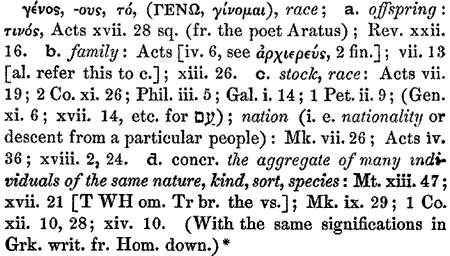
"After his resurrection" does not necessarily mean they were raised immortal like Christ. I discuss this more below. I think “after his resurrection” does mean that they were raised to immortality like Christ, because Matthew is pointing out that the resurrection of Christ brought about the redemption over death permanently, and was demonstrating that fact by what happened to others “after his resurrection”. Romans 6:9 has no bearing on Jairus' daughter and Lazarus. I couldn’t agree more, and this is all the more reason we shouldn’t take the Matthew account of the saints being raised from the dead “after his resurrection” to be the same as Jairus' daughter and Lazarus being raised from the dead. The apostle Paul was writing to people living at Corinth, so of course he was talking about them having a resurrection in the future (they hadn’t died yet). And obviously it’s not talking about those Christ raised from the dead during his mortal ministry, as what would be the point of that? I'm not against it but the scripture gives no specific details for that event regarding the others. Matthew gives us sufficient context to tell us that those saints (which were apparently dead a considerable amount of time) came out of their graves “after his resurrection” and this was in accordance with his resurrection. So, if you are not against this idea, are you opposing it here simply because Latter-day Saints believe others were resurrected already, or what else could the reason be? My comment was about the fact that others are called “first fruits”, not just Christ. And, that the early Christians understood the afterlife to have different “abodes” (according to those who bear fruit) and Paul taught that there are varying degrees of “glory” in the resurrection, even “every man in his own order” for several distinct bands or classes of those who are raised from the dead. What you say above proves what I was saying before, that others are referred to as “first fruits” in scripture (not just Christ), which would then allow for others that may be referred to as “first fruits” of the resurrection. If, as Paul taught, that there are several distinct bands or classes of those who are raised from the dead (i.e. “every man in his own order”), then this obviously allows for others besides Christ who are the “first fruits” of the resurrection. A key point is that the terrestrials do not return into Heavenly Father's presence. Exactly right, as they receive only the presence of the Son. Again, you are taking verses out of context without looking at everything scripture says on the topic. Just because the people in the celestial kingdom “are Christ’s”, it doesn’t mean those in the terrestrial kingdom are not, for scripture says they are. Doctrine and Covenants 88:96-99 says that both the celestial and terrestrial individuals “are Christ’s”, even though those of the terrestrial kingdom “received their part in that prison which was prepared for them, that they might receive the gospel, and be judged according to men in the flesh”. This is correct. Those who do not follow the Spirit of God do not inherit all that God has for them. That’s right, those of the terrestrial kingdom are not among the “first fruits”, but they are those who “are Christ’s” at his coming. Compare Doctrine and Covenants 88 verse 96-98 (those of the celestial kingdom) to verse 99 (those of the terrestrial kingdom). I think you may be confusing the “first fruits” of the celestial kingdom with those of the telestial kingdom (which are not the “first fruits”). There is a clear distinction between them in Doctrine and Covenants 88:96-99. That is your opinion, but as you yourself demonstrated many others are referred to as “firstfruits” (not just Christ). And you quoted 1 Corinthians 15:23 to try to support your belief, but doesn’t it depend on where the translators put the comma or other punctuation in that verse? For example, consider the NIV translation: “But each in turn: Christ, the firstfruits; then, when he comes, those who belong to him.” It says, “each in turn”. Christ is first, then the firstfruits have a turn, and then when he comes, those who belong to him have a turn. “But now is Christ risen from the dead, and become the firstfruits of them that slept” (1 Corinthians 15:20). Jesus was indeed the first among many who are “firstfruits”. Doctrine and Covenants 88:98 is depicting the culmination of the resurrection of the first fruits when Christ returns. As shown above you aren’t looking at all of scripture and are trying to define those that “are Christ’s” using a single verse, when clearly the definition is much broader than that. What you are doing above is like quoting Genesis 14:13, where it says “Abram the Hebrew” and try to use that to imply that Abram is the one and only Hebrew. According to Romans 8:14-17, those led by the Spirit of God are adopted as sons. If, sons, then heirs. Those not led by the Spirit of God are not adopted as sons, If not heirs, then not sons. It's a contradiction to say you accept Christ but want to follow Him only the way you want, not how He wants. But isn’t that what many Christians do today? They don’t want apostles or prophets. They don’t want to be led by the spirit of God, they want to follow their traditions and shop around to find the church that teaches what they want to hear, according to how they want to interpret scripture. Or what’s the difference? What happens to them? Yes. Children of God in a generic sense, of being created by God – not that uncreated, eternal intelligences were somehow transferred/begotten into a family with a Heavenly Father and at least one Heavenly Mother. See below. You totally misconstrue Paul’s teachings in Acts 17:28-29. I added some commentary about Acts 17:29-29 in a June 2025 post entitled "Continued - Ephraim, birthright, and the gathering". Yes, you posted that commentary from the Christianity.com website: What Does it Mean to Be the Offspring of God? But why would you think that commentary addresses this question given that we have already discussed why the line of reasoning put forth in that commentary is totally illogical and contradicts Paul’s argument? (See specifically my post on 12/14/2024, but many other similar references could be provided). And why would you think that referring to that commentary to try to dismiss the real meaning of Acts 17-29-29 is a valid response to the biblical teachings I posted above? I was hoping to post this in my other response to you, but I’ll provide some of the problems with that commentary here. First off, the article makes no effort to define the Greek word génos, wherein Paul teaches we are the “offspring [génos] of God”. I posted this previously, but this is important to the context of this discussion: The Greek word translated as “offspring” in Acts 17:28-29 is génos, which Thayer’s Lexicon defines as follows: The word génos would be understood by Paul and his Greek audience in the same way the word is used in the Septuagint (the Greek translation of the Old Testament), where it is translated from the Hebrew word miyn which means species or kind, in verses like the following (referring to the Septuagint): Gen 1:21 (LXX): “And God made great whales, and every living reptile, which the waters brought forth according to their kinds [génos], and every creature that flies with wings according to its kind [génos], and God saw that they were good.” Gen 1:24 (LXX): “And God said, Let the earth bring forth the living creature [Greek: psychen - soul] according to its kind [génos], quadrupeds and reptiles and wild beasts of the earth according to their kind [génos], and it was so.” Gen 1:25 (LXX): “And God made the wild beasts of the earth according to their kind [génos], and cattle according to their kind [génos], and all the reptiles of the earth according to their kind [génos], and God saw that they were good.” For all references above, see also the interlinear LXX here. Or where the word génos is used in the Septuagint for a family relationship, like in this verse (this reads a little differently in the Hebrew text so I don’t know the Hebrew word it was translated from here): Gen 19:38 (LXX) “And the younger also bore a son, and called his name Amman, saying, The son of my family [génos]. This is the father of the Ammanites to this present day.” As you can see, there’s a family relationship or species/kind-of-being understanding built into the meaning of this word génos that goes far beyond the idea of creation alone (and that is also why our modern word “genes” is based on this Greek word). And when Paul says we are the “kind” of being that God is, this can’t be referring to the genetics of our physical bodies, because our bodies are the offspring of our mortal parents. Instead, this is referring to the relationship of our eternal spirits to God our Father, for our spirits came from God who is the “Father of spirits” (Heb 12:9). And in the beginning, God created Adam’s body from the dust of the earth (the elements) and God put into him the “breath” (or spirit – same Hebrew word) of life, and he “became a living soul”. His body came from the dust, but his spirit came from God (this is the same for all of us, not just Adam). It is in this way that we are created in the image and likeness of God, for we not only have God’s form in likeness, but we have the image of his spirit as intelligent beings. With this definition of the word made clear, there is absolutely no way the Greek word génos can be construed as creation in the sense that God created us all out of nothing. The family relationship or kind of being designation is inherent in the meaning of the word. Now back to the Christianity.com article. The article makes the following points that I will discuss below: “The Stoic philosophers believed that human beings are God's offspring; however, despite believing that humanity was God's offspring, the Stoics did not believe in the God of the Bible.” “After Paul makes reference to Aratus' quote, he connects it with the true God of the Bible. Paul says, "Therefore since we are God's offspring, we should not think that the divine being is like gold or silver or stone — an image made by human design and skill" (Acts 17:29).” “Stone idols cannot speak, move, or express creativity as mankind can. If human beings are the offspring of a stone idol "God," then would not human beings be stone as well? Since human beings are not stone creatures, then it would attest to God being a living, true God as stated in the Bible.” “Paul was telling the philosophers that mankind is indeed the offspring of God because we are created by Him; however, mankind was not created by a mute idol in the center of Athens.” “Just as Paul tells the Epicureans and Stoics, "we are God's offspring" by quoting Cilician Stoic philosopher Aratus, we are told in the Bible, we are God's children (Romans 8:14).” “At the moment of salvation, we become God's children… We are God's offspring because we are made in His Image (Genesis 1:27).” In point #1, the article recognizes how the Athenians would understand Paul’s quote from the Greek poet Aratus, affirming the truth that “human beings are God’s offspring”. The Athenians would have understood it in a way similar to what you said in your post on January 2, that “The pagans understood ‘offspring’ in the sexual case of literal reproduction for the Greek gods; like that which occurs between male and female.” In point #2, the article also affirms that Paul connects the fact that we are the “offspring of God” with the true God of the Bible. We are all the “offspring” of the true God of the Bible. In point #3, the article begins to recognize Paul’s real argument, that it is illogical to believe that God is “like gold or silver or stone — an image made by human design and skill" since we are his offspring, and human beings aren’t like gold or silver or stone. In point #4, the article goes off the rails and begins a line of reasoning that completely contradicts Paul’s logic and the strength of his argument, and brings in outside beliefs and teachings that Paul does not include in his sermon to the Athenians. The article infers that Paul really didn’t mean that we are the “offspring of God” (his génos, the same kind of being as he is), but instead we are just “created by him”. As I said in my post on 12/14/2024, “If Paul was only saying that we are merely God’s creations, then Paul’s audience could easily reason that a god of any kind (gold, silver, or stone) could ‘create’ anything it desires, and Paul’s point would be meaningless. But the strength of Paul’s argument is in the fact that we have a relationship to God as his offspring, we are the same kind of being as God, and thus to conceive of a god of any other kind is unreasonable.” In other words, if in Acts 17:28-29 Paul was merely saying that we are God’s creations, then can’t we also understand that God also created gold or silver or stone? If we are really not the same kind of being that God is (his génos), then how do we know what kind of being God is, and why couldn’t we make an idol of gold or silver or stone to worship? God created gold and silver and stone too. In point #5, the article jumps to a completely different context of what it means to be adopted as God’s children through a covenantal relationship with Jesus Christ and being born again by the Spirit. And in point #6, the article suggests that we become God’s children only at “the moment of salvation”. This is true in the sense that those who believe in Christ and follow the Spirit will be adopted as children of God in his covenant of inheritance as joint-heirs with Christ, but this teaching is totally foreign to the context of Acts 17:28-29, since this idea infers that only saved Christians are children of God. In Acts 17:28-29 Paul is preaching a sermon to a broad audience of unbelievers, the Athenians. In his sermon Paul doesn’t say “only Christians are the offspring of God”. Rather, he says, we [him and his audience] are the offspring of God. Therefore, he can’t possibly be referring to becoming God’s children in the adopted sense of the word, because Paul includes his audience in the teaching that “we are his offspring”. This reasoning (that only Christians are the offspring of God) further confuses Paul’s greater point. Think this through carefully: The unbelieving people worshipped idols of gold and silver and stone. Paul teaches them (supposedly, according to the Christianity.com article) that God created everyone but only Christians are the offspring of God because he adopts only them. And how exactly is this supposed to help the unbelieving Athenians understand why they shouldn’t worship gods of gold and silver and stone, given that God also created gold and silver and stone? It all becomes a mass of confusion. The Christianity.com commentary also portrays Paul as pulling off a classic bait and switch scam. He lures in his Greek audience by quoting their poets and affirming that “we are the offspring [génos] of God”, the very same kind of being as God, but he didn’t really mean génos, he really meant that we are created by him. How would Paul explain his lying to the new converts that joined the church right after he preached that sermon (see 17:34)? So, the Christianity.com article’s reasoning collapses upon itself. The writers of the article are so determined to reassure Christians that the modern popular belief that God is “wholly other” is true that it avoids and bends and twists its way around the real meaning of the Greek word génos. ETA: I also want to point out (again) that the title of the Christianity.com article is, "What Does it Mean to Be the Offspring of God?", but glaringly absent from the article is any attempt at providing a meaning for the Greek word translated as "offspring" (génos ), which one would think would be one of the first things the writers should address given the title of the article. It's not as if the writers shy away from defining Greek words (they make it clear that the "Greek word Paul uses for 'God' [in the verse] comes from theios, 'which means just a general deity that Paul has identified as the worl's creator'", for example). It seems to me that the authors intentionally omitted defining that Greek word because they were aware of its implications. Which way do you think was Paul’s intended meaning when he used the phrase “we are the offspring of God” (using a Greek word that means we are the same kind of being as God) when teaching a pagan Greek audience about our true relationship to God? How did Paul want his pagan Greek audience to understand it? And how does the idea of being adopted as sons and daughters of God through faith fit with the choice of words that Paul used in that passage, given the meaning of the word génos as it was understood by the Greek speaking people in Paul’s day, and according to how the word génos was used throughout the Septuagint (the Greek Old Testament)? I go with using the plain meaning of the text rather than trying to find some way to get around the plain meaning like the Christianity.com article was doing. Now let’s get back to the real point. Like the Christianity.com article, you used Romans 8:14-17 as a prooftext out of context to try to imply that no other humans are the children of God in some other sense. And what does the Bible really say on this topic? Paul taught the nonbelieving Athenians that all men are the same kind of being as God, his “offspring” (Acts 17:28-29). Thus, all men are the children of God in this sense. The book of Hebrews teaches us that God is the “Father of spirits” (Hebrews 12:9). That is, he is the Father of all spirits, not just some spirits. Jesus taught us that we must follow God the Father by loving our enemies and doing good to them that hate us, so “That ye may be the children of your Father which is in heaven” (Matthew 4:45). Note that Jesus did not say that we should do this so that we may be the “children of God”, but that we “may be the children of your Father”. In other words, God is our Father already in some sense (as in in Acts 17:28-29, Hebrews 12:9), but we must behave like him so that we can become his children in another sense. So, the Bible does say some “children” are heirs (the children of the covenant), and others are not. You just need to believe Jesus and the rest of the Bible too, not just a few verses out of context. If sons, then heirs. If you are not a covenant son, then you are not an heir. That is the meaning of Romans 8:14-17. An heir is an exalted being in LDS theology as I mentioned before. Ah, there’s the key word, “a covenant son”. Being a “covenant” son is different than being an “offspring of God”, and all mankind are the offspring [génos] of God, the same kind of being as God. "Children of God" in the sense of being created by God, but not in a spiritual sense of being adopted as sons through faith. Or the more biblically correct, “children of God” in the sense that we are all the very offspring [génos] of God, the same kind of being as God, as Paul taught the unbelievers in scripture (and not that we are merely his creations). The disobedient people would be in the same camp as the corrupt and violent; they are the unsaved in the days of Noah as in 1 Peter 3:18-19. Right, but the difference is that Peter said that Christ only visited the disobedient that were killed in the flood, not the corrupt and violent. And I already explained the difference between “disobedience” and “corrupt”. So they, including Satan, were acting in the will of God by performing all the required steps for progression to begin? Adam and Eve were doing exactly what God expected them to do under those circumstances, which allowed God to fulfill his plan to provide an environment where humankind could use their agency to choose good over evil and have a way to be redeemed through the atonement of God’s Son, Jesus Christ, when they make bad choices and desire to repent. And obviously God knew what Satan would do as well. Why didn’t God just banish Satan to fire and brimstone from the beginning? Why was he cast down to earth? Romans 5:12 says, "Wherefore, as by one man sin entered into the world, and death by sin; and so death passed upon all men, for that all have sinned". What sin of Adam? Moses 6:54 says, "Hence came the saying abroad among the people, that the Son of God hath atoned for original guilt, wherein the sins of the parents cannot be answered upon the heads of the children, for they are whole from the foundation of the world. What is the context of "the sins of the parents"? In the March 2008 Ensign, article titled "The Atonement of Jesus Christ", Elder Jeffrey Holland said, "Some gifts coming from the Atonement are universal, infinite, and unconditional. These include His ransom for Adam's original transgression so that no member of the human family is held responsible for that sin". What sin? I thought I made this clear already. It was the result of Adam partaking of the fruit. It seems you believe some on the earth in the days of Noah were not corrupt and violent but were honorable and were considered as the unsaved who perished. It seems you also believe that some on the earth in the days of Noah were not corrupt and violent, since you also acknowledged that Noah could not have possibly preached to every single man, woman, and child on the earth prior to the flood. Or do you really believe every man, woman, and child that perished in the flood was “corrupt and violent”?
-
A Great Diversity within both Mormons and Evangelicals
InCognitus replied to Navidad's topic in General Discussions
I wish I had more time for the board these days. This summer I have had to go on several out of state trips, my work activity has skyrocketed, and my weekends have been filled with finishing up work projects, baptisms of relatives, and moving my son's family from two different houses on four different weekends to a new house! (I'm past ready to be done with the moving stuff.) Normally summer is the slower time of year for my line of work, but not this year. It's crazy. But I wanted to take a moment to comment on what you've said here. I think I've shared with you a little bit of my background before. I've been a member of the Church of Jesus Christ of Latter-day Saints all my life, but I have always been highly interested in other religious beliefs, especially with regard to understanding the Bible. I know I have shared with you before how I attended a weekly non-denominational Bible study between 2007 and 2020 with some people I met at the office of one of my clients, and have become close friends with one of those people who is an Anabaptist. (The only reason we stopped meeting was because of COVID and then two years later I moved). In addition to those weekly Bible studies, I have also had many lunch visits with my Anabaptist friend and members of the Eastern Orthodox church, and people of evangelical faiths, and I still communicate with my Anabaptist friend occasionally. In the early 90's I also took some classes from the Bureau of Jewish Education in Phoenix, and have had interesting discussions with some Jewish friends. I also have participated on religion related message boards and BBS feeds (those used to exist) since 1988, and in religion chat rooms. In doing that, I have conversed with people from all over the world about their Christian faith and have strived to learn their beliefs by having them explain why they believe some of the things they believe. I have also been thrown into several strange situations by non-LDS Christians trying to evangelize my "Mormon" family. Around 2004, a neighbor found out we are Latter-day Saints and came to our door to put down my faith. She was a member of the "Concerned Christians" group in Mesa, Arizona, and invited me to attend their meetings, which I did on at least two occasions. That was fun And in late 2009, a good non-LDS friend from work who respects me and knows I'm LDS, invited me to their church's "small group" discussion on "Mormonism" which I attended. But what started out as a "small group" turned into a small auditorium event presentation by Jeff Durbin, a person I had had several conversations with previously at the Mesa Arizona Temple Easter Pageant. That was also fun That experience led me to have several lunch meetings and conversations my friend's church pastor and other members of their church. That was also fun . Those are only two of many other examples that could be given. I say all the above to provide my experience with learning about other faiths so as to acknowledge and affirm what you say above about the diversity that exists among Evangelical communities from all over the world. From my chat room experiences I have talked with Evangelical Christians from Great Britain and New Zealand, and found that their beliefs differ in significant ways from many of those in the United States. And there is certainly not unity of belief among the Evangelical communities within the United States, there is a lot of diversity. The bottom line is that it is wrong to put a religious label on a person and put them in a box and portray their beliefs according to popular stereotypes and cultural slants. In all of my experiences described above I have tried very hard to listen carefully to the beliefs that other people have and let them speak for themselves. It is not my place to presume what they believe, or I risk mischaracterizing their beliefs in the same way so many people have done with the Latter-day Saint beliefs. Another thing I have learned is to not be offended about what other people believe. If someone else wants to believe they are in the only true church and mine is not true, what is that to me? That doesn't change my beliefs. But I do feel it is important to correct incorrect perceptions that others have about the church I attend and my own beliefs. If only we could all strive to try to understand one another. -
What They Talk About: Joseph Ran a Scam Business?
InCognitus replied to Pyreaux's topic in General Discussions
If the church has "changed its official tone", it would have needed to be from before Joseph Smith wrote his 1838 history: "In the year 1823 my father’s family met with a great affliction by the death of my eldest brother, Alvin. In the month of October, 1825, I hired with an old gentleman by the name of Josiah Stoal, who lived in Chenango county, State of New York. He had heard something of a silver mine having been opened by the Spaniards in Harmony, Susquehanna county, State of Pennsylvania; and had, previous to my hiring to him, been digging, in order, if possible, to discover the mine. After I went to live with him, he took me, with the rest of his hands, to dig for the silver mine, at which I continued to work for nearly a month, without success in our undertaking, and finally I prevailed with the old gentleman to cease digging after it. Hence arose the very prevalent story of my having been a money-digger." (Joseph Smith—History 1:56) -
As it says, "they who keep their second estate shall have glory added upon their heads for ever and ever". It is fulfilling, through the grace of Christ, the next step to progress to become like God is.
-
What They Talk About: Historical Skepticism of Mormonism
InCognitus replied to Pyreaux's topic in General Discussions
Glad to see you back. -
To "keep" an estate refers to using our agency to follow God's plan to progress to become like he is. In our "first estate" that plan included accepting Jesus Christ as our Savior. But Satan rebelled against that plan and rejected it, so he "kept not his first estate". (But I think you already know that).
-
I hate the idea of just throwing out a scripture in answer to a question like this, but I think Hebrews chapter 12 provides insight into this question in a very beautiful way. This is Hebrews 12:1-11 using the New KJV translation (since it irons out some of the archaic language and flows a little better): Therefore we also, since we are surrounded by so great a cloud of witnesses, let us lay aside every weight, and the sin which so easily ensnares [us], and let us run with endurance the race that is set before us, looking unto Jesus, the author and finisher of [our] faith, who for the joy that was set before Him endured the cross, despising the shame, and has sat down at the right hand of the throne of God. For consider Him who endured such hostility from sinners against Himself, lest you become weary and discouraged in your souls. You have not yet resisted to bloodshed, striving against sin. And you have forgotten the exhortation which speaks to you as to sons: "My son, do not despise the chastening of the LORD, Nor be discouraged when you are rebuked by Him; For whom the LORD loves He chastens, And scourges every son whom He receives." (Proverbs 3:11-12) If you endure chastening, God deals with you as with sons; for what son is there whom a father does not chasten? But if you are without chastening, of which all have become partakers, then you are illegitimate and not sons. Furthermore, we have had human fathers who corrected [us], and we paid [them] respect. Shall we not much more readily be in subjection to the Father of spirits and live? For they indeed for a few days chastened [us] as seemed [best] to them, but He for [our] profit, that [we] may be partakers of His holiness. Now no chastening seems to be joyful for the present, but painful; nevertheless, afterward it yields the peaceable fruit of righteousness to those who have been trained by it. I see these verses conveying the love of our heavenly Father and his desire to make something more of us in our walk of life, and he sent his Son to provide the atonement and to help us through the hard times. And, verse 11 sums it all up.
-
What is the Difference Between a Blessing and a Prayer
InCognitus replied to bluebell's topic in General Discussions
Not at all. Why would you think it's semantics? If the person giving the blessing is using the words given him by the spirit and pronounces it with the authority of the spirit, it is God's blessing upon the person instead of a wishful pleading on behalf of the person. -
What is the Difference Between a Blessing and a Prayer
InCognitus replied to bluebell's topic in General Discussions
It's the difference between using an inspired blessing by the authority of the priesthood with statements such as, "I bless you that you shall...." compared to something like fatherly admonitions and praying that they will follow the commandments or that sort of thing. The first expresses confidence in the Spirit and an authoritative statement, while the latter is more unsure and lacks such pronouncements of authority. -
John 1:1 and the Joseph Smith Translation
InCognitus replied to GoCeltics's topic in General Discussions
If that was Joseph Smith's intent, he certainly didn't do a good job of obscuring the idea that Jesus is God all through the other revelations. The Title Page of the Book of Mormon states that one of the purposes of the Book of Mormon is "to the convincing of the Jew and Gentile that JESUS is the CHRIST, the ETERNAL GOD, manifesting himself unto all nations" 2 Nephi 26:12; "And as I spake concerning the convincing of the Jews, that Jesus is the very Christ, it must needs be that the Gentiles be convinced also that Jesus is the Christ, the Eternal God;" Mosiah 5:15: "Therefore, I would that ye should be steadfast and immovable, always abounding in good works, that Christ, the Lord God Omnipotent, may seal you his, that you may be brought to heaven, that ye may have everlasting salvation and eternal life, through the wisdom, and power, and justice, and mercy of him who created all things, in heaven and in earth, who is God above all. Amen." Mosiah 7:27: "And because he said unto them that Christ was the God, the Father of all things, and said that he should take upon him the image of man, and it should be the image after which man was created in the beginning; or in other words, he said that man was created after the image of God, and that God should come down among the children of men, and take upon him flesh and blood, and go forth upon the face of the earth--" Mosiah 27:31: "Yea, every knee shall bow, and every tongue confess before him. Yea, even at the last day, when all men shall stand to be judged of him, then shall they confess that he is God; then shall they confess, who live without God in the world, that the judgment of an everlasting punishment is just upon them; and they shall quake, and tremble, and shrink beneath the glance of his all-searching eye." 3 Nephi 11:14: "Arise and come forth unto me, that ye may thrust your hands into my side, and also that ye may feel the prints of the nails in my hands and in my feet, that ye may know that I am the God of Israel, and the God of the whole earth, and have been slain for the sins of the world." D&C 18:33: "And I, Jesus Christ, your Lord and your God, have spoken it." D&C 35:1-2: "Listen to the voice of the Lord your God...I am Jesus Christ, the Son of God, who was crucified for the sins of the world...", D&C 38:1-3: "Thus saith the Lord your God, even Jesus Christ, the Great I AM, Alpha and Omega, the beginning and the end..." And there are many other references, such as 1 Nephi 19:7-10, 2 Nephi 10:3-4, and 3 Nephi 11:14. -
Scripture, especially ancient Hebrew prose narratives like the book of Abraham, often repeats important points for emphasis and as part of the literary structure of the text. (There is a chiasmus in Abraham 3:22-23, for example). Consequently, you can't always assume that the text is intended to be chronological without looking at the complete context. And you are taking verse 26 totally out of context. You stopped mid-sentence in verse 26 without looking at everything that comes before it and after it. Here is Abraham 3:22–28 showing the context that informs us of the meaning of the "first estate" and "second estate": 22 Now the Lord had shown unto me, Abraham, the intelligences that were organized before the world was; and among all these there were many of the noble and great ones; 23 And God saw these souls that they were good, and he stood in the midst of them, and he said: These I will make my rulers; for he stood among those that were spirits, and he saw that they were good; and he said unto me: Abraham, thou art one of them; thou wast chosen before thou wast born. 24 And there stood one among them that was like unto God, and he said unto those who were with him: We will go down, for there is space there, and we will take of these materials, and we will make an earth whereon these may dwell; 25 And we will prove them herewith, to see if they will do all things whatsoever the Lord their God shall command them; 26 And they who keep their first estate shall be added upon; and they who keep not their first estate shall not have glory in the same kingdom with those who keep their first estate; and they who keep their second estate shall have glory added upon their heads for ever and ever. 27 And the Lord said: Whom shall I send? And one answered like unto the Son of Man: Here am I, send me. And another answered and said: Here am I, send me. And the Lord said: I will send the first. 28 And the second was angry, and kept not his first estate; and, at that day, many followed after him. All of the bolded red text above refers to the "intelligences that were organized before the world was". The bolded blue refers to the place that is being created where those who were with God 'before the world was" would be sent to "prove them" to "see if they will do all things whatsoever the Lord their God shall command them". Finally, in verse 28 we see one of those intelligences who was "before the world was" who "kept not his first estate", making it clear that the "first estate" refers to the realm before the earth was created, while the second estate refers to the life those same individuals live while on the earth that was created for them.