-
Posts
2,705 -
Joined
-
Last visited
Everything posted by halconero
-
Pres. Oaks: "...a Heavenly Mother or Mothers"
halconero replied to ZealouslyStriving's topic in General Discussions
I don't typically delve into prospective (or in this case, cyclical) speculation, but I lean towards a hypothesis for eternal progression nested within Multiverse theory. Specifically, Max Tegmark's Level IV: Ultimate Ensemble hypothesis. Intelligences are fundamental informational/mathematical structures with no end nor beginning. However, these structures do not have the ability, on their own, to observe their eternal existence. They must observe reality to comprehend their own existence and the existence of others, i.e., experience mortality. Within this ensembles of possibilities, one must not only exist at the meta-level as a theoretical bundle of information, but exist within a reality to begin to comprehend oneself. Thankfully, loving, caring beings exist at the meta-level who not only have the ability to know themselves and know others, but desire the same for others. They heat or reheat a reality, or eternity, (see the Greene or Steinhard-Turok models of creation), giving form to intelligences. Put another way, they become their parents, giving them the ability to observe their existence. Yes, the above sounds like crazy talk, but it's simply my attempt at a fun thought experiment that seeks to reconcile seemingly contradictory truth's like the eternal nature of God with a God who experiences mortality, along with Joseph Smith's ideas around a plurality of eternities (this idea began to emerge towards the end of his life and never got fleshed out), or the course of the Lord being one eternal round. Anyway: -

Pres. Oaks: "...a Heavenly Mother or Mothers"
halconero replied to ZealouslyStriving's topic in General Discussions
Tangential, but a part of Church history I think gets misconstrued is Brigham Young's relative tolerance for exegesis on the scriptures or the uncanonized sayings/writings of Joseph Smith. I could use the term "doctrinal speculation," but I think that understates the amount of time, reasoning, and even scientific experimentation that President Young and his colleagues put into discovering and asserting what they believed to be true principles. Take one look at Elder Pratt's small, but significant contributions to math (he's cited on several wikipedia pages), and you can draw a reasonable line to how he approached theology. Gary James Bergera makes a decent case that the conflict between Orson Pratt and Brigham Young was (a) not as bitter or spiteful as some portray it as, and (b) had much more to do with President Young's position of dynamic revelation (living revelation supersedes past revelation) versus Elder Pratt's adherence to the written canon and past revelation. We've tended towards institutional consistency among the public views of the First Presidency and the Quorum of the Twelve, which I sustain and support for a variety of reasons, but it still makes me smile to see moments like this where members of the First Presidency and Twelve open the doors to revelatory or textual exegesis just a wee bit.- 95 replies
-
10
-
Church of Jesus Christ sees record growth in global membership
halconero replied to InCognitus's topic in In The News
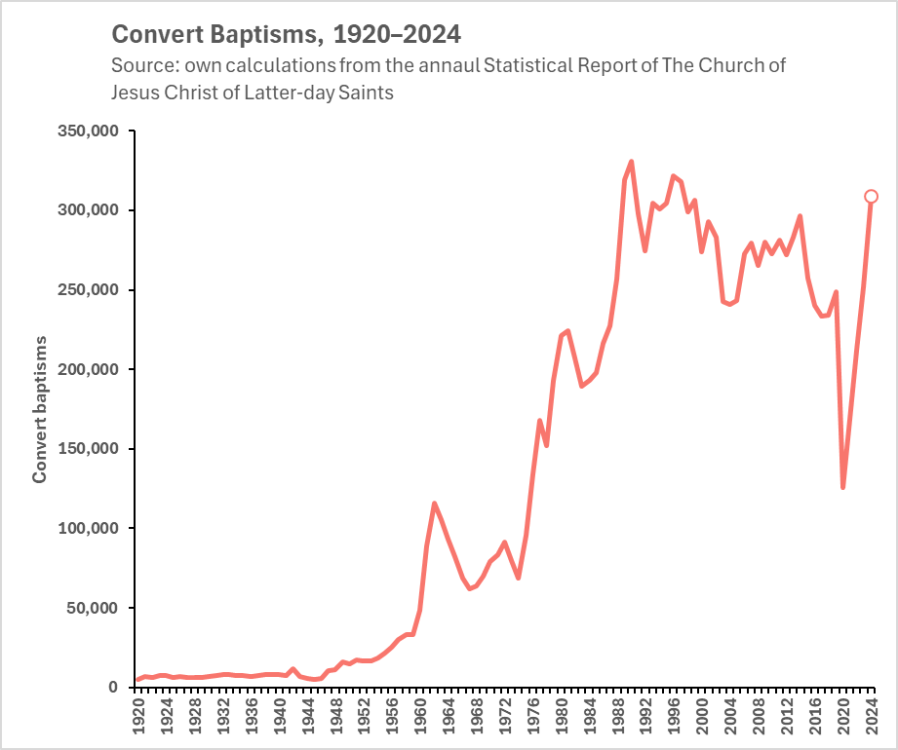
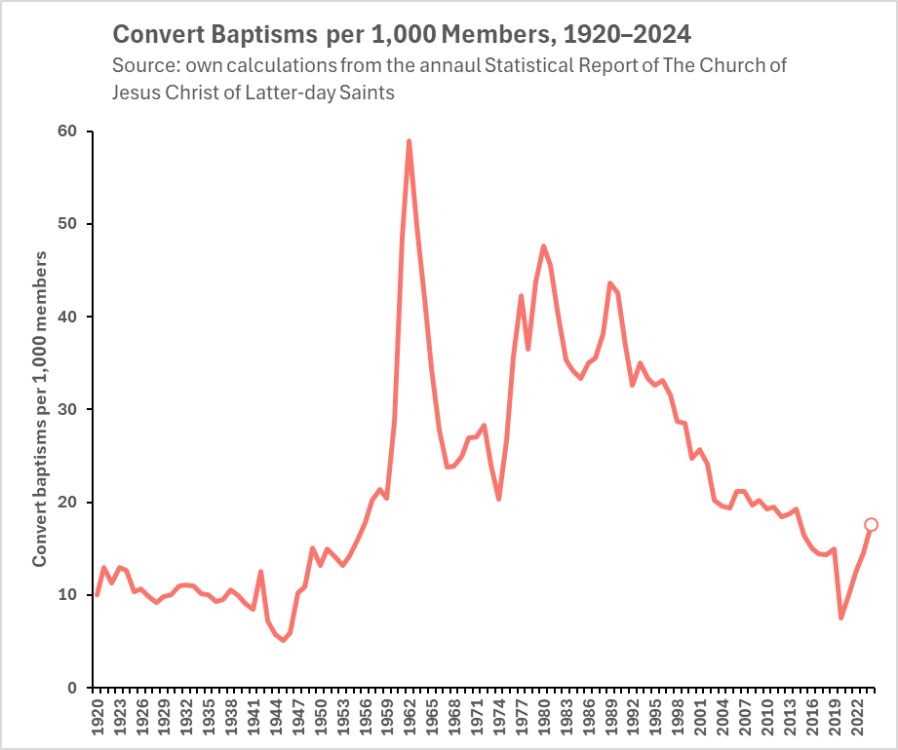
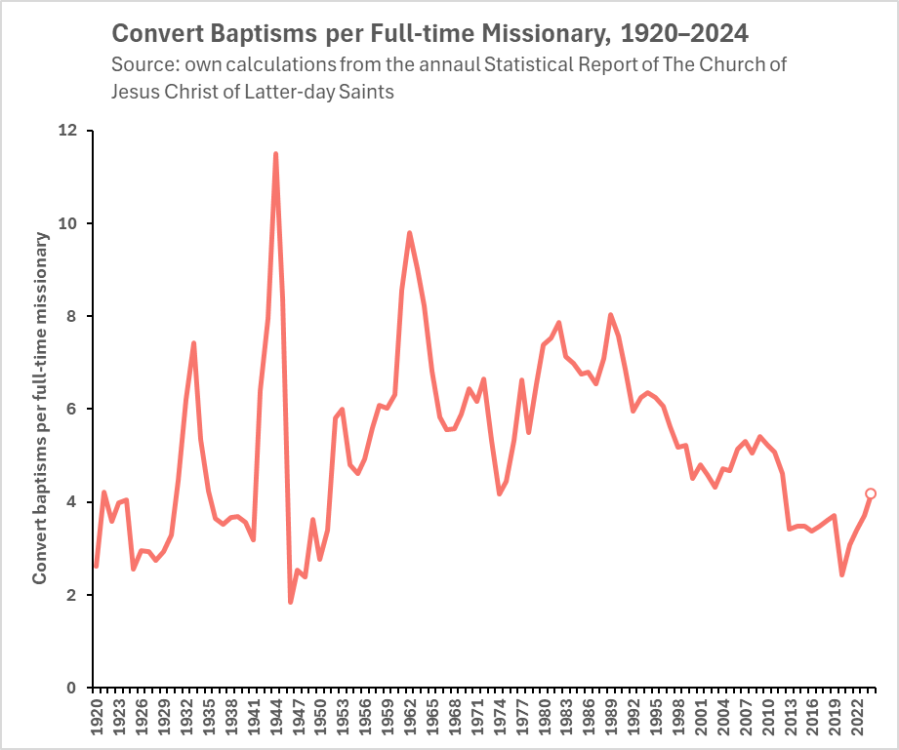
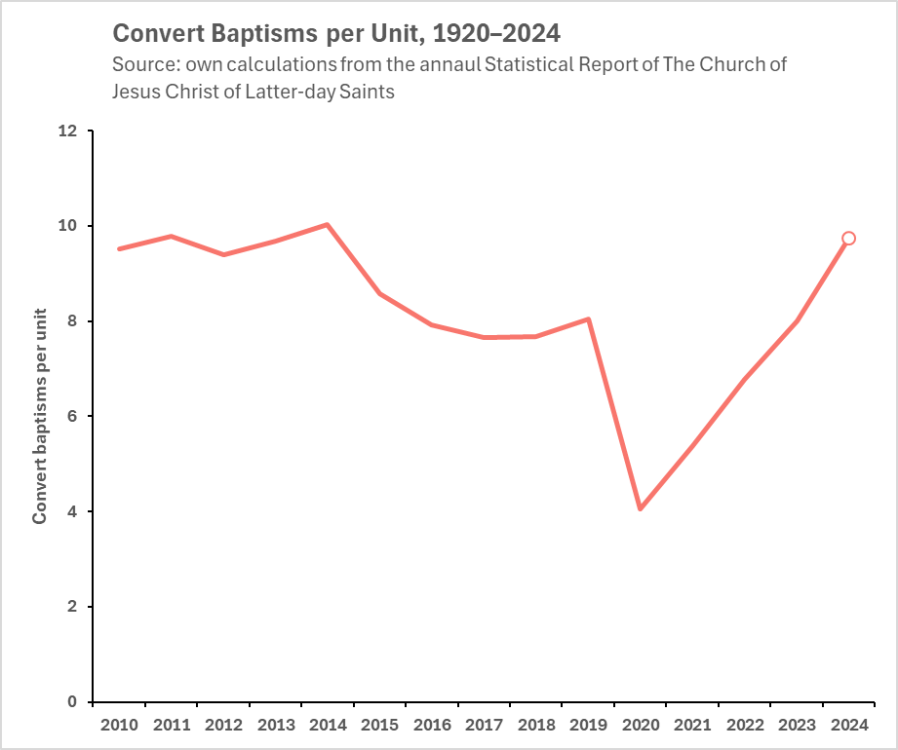
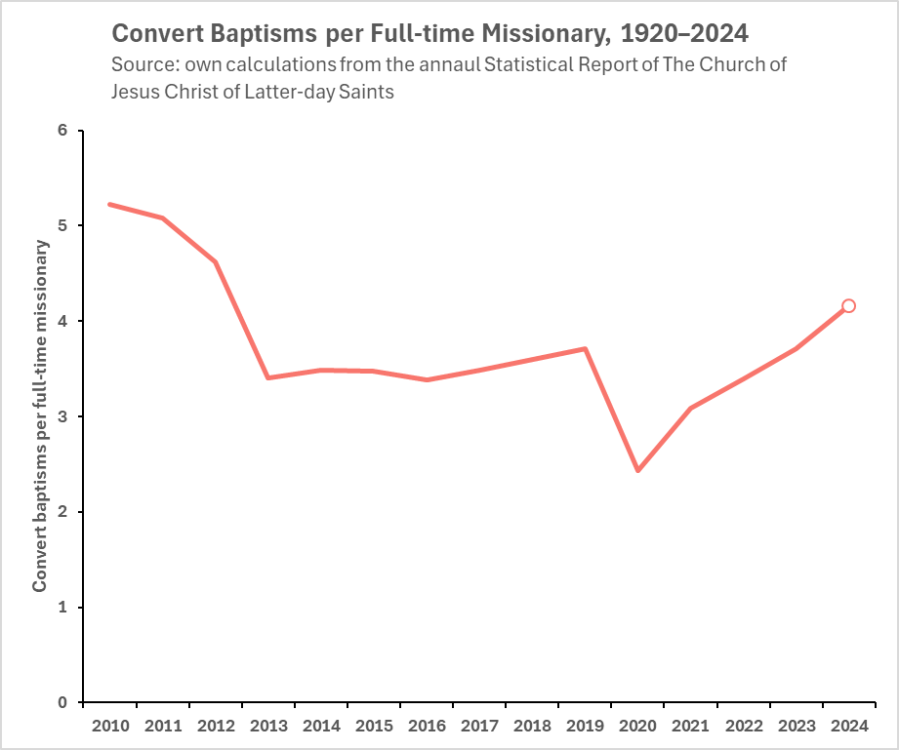
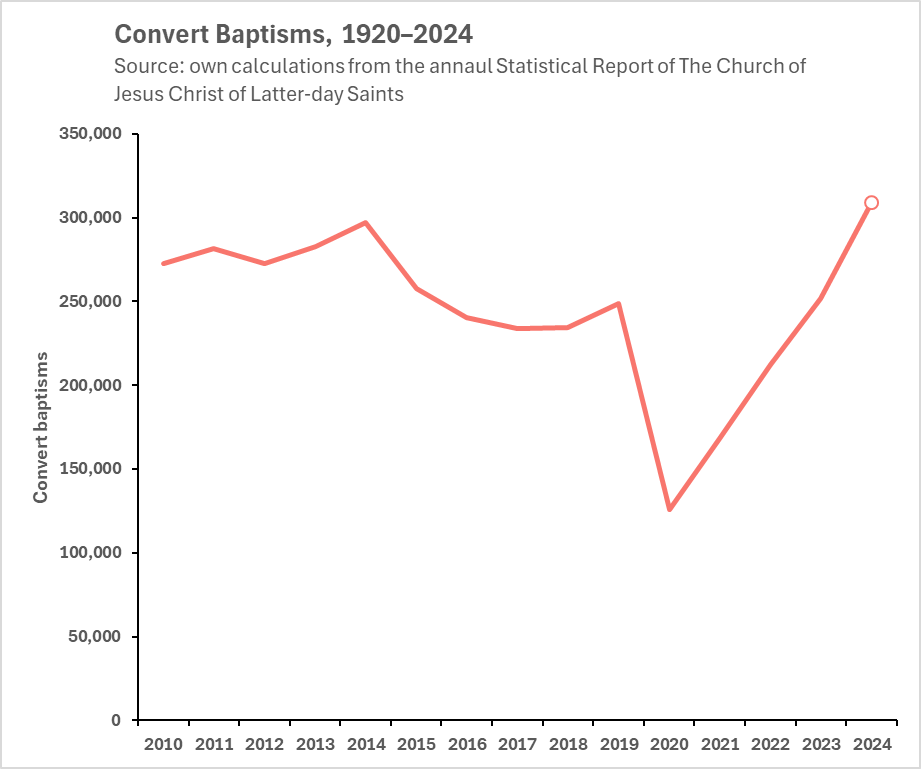
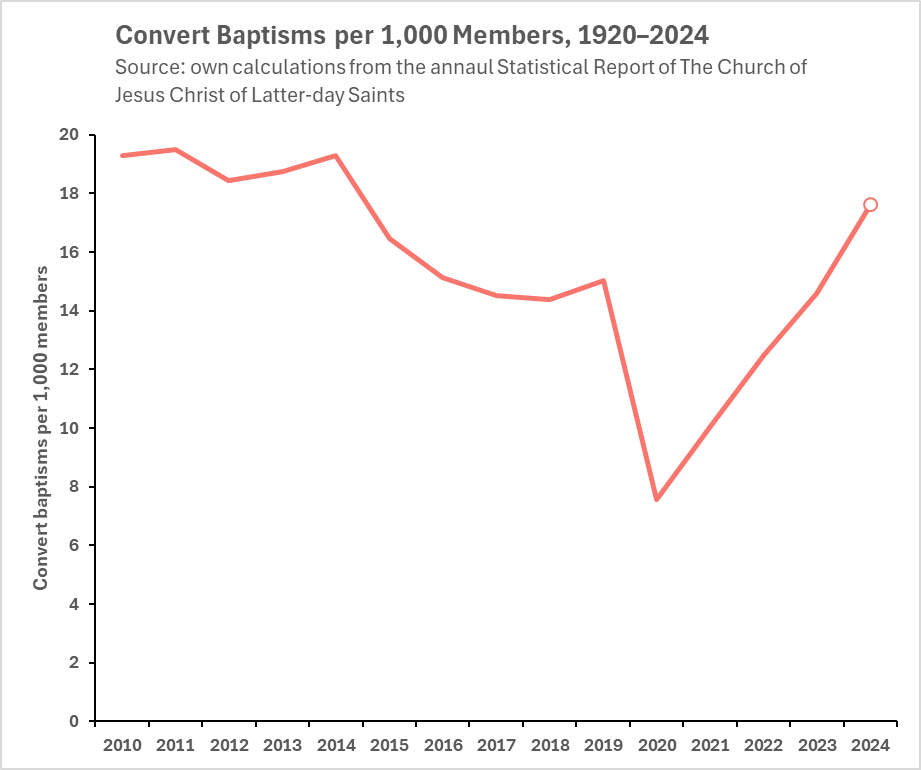
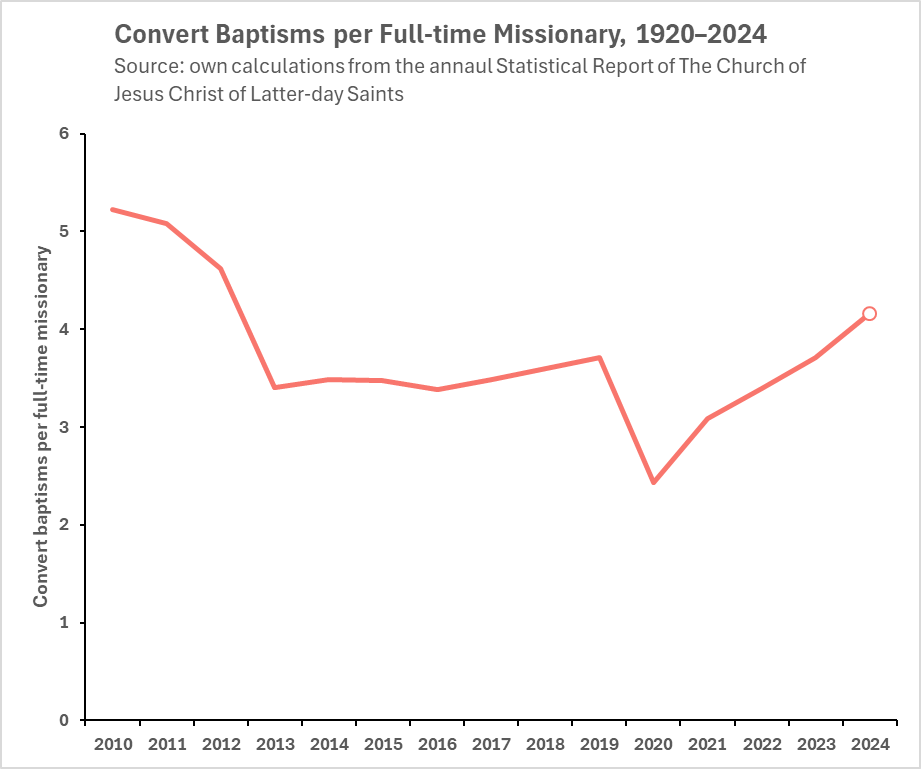
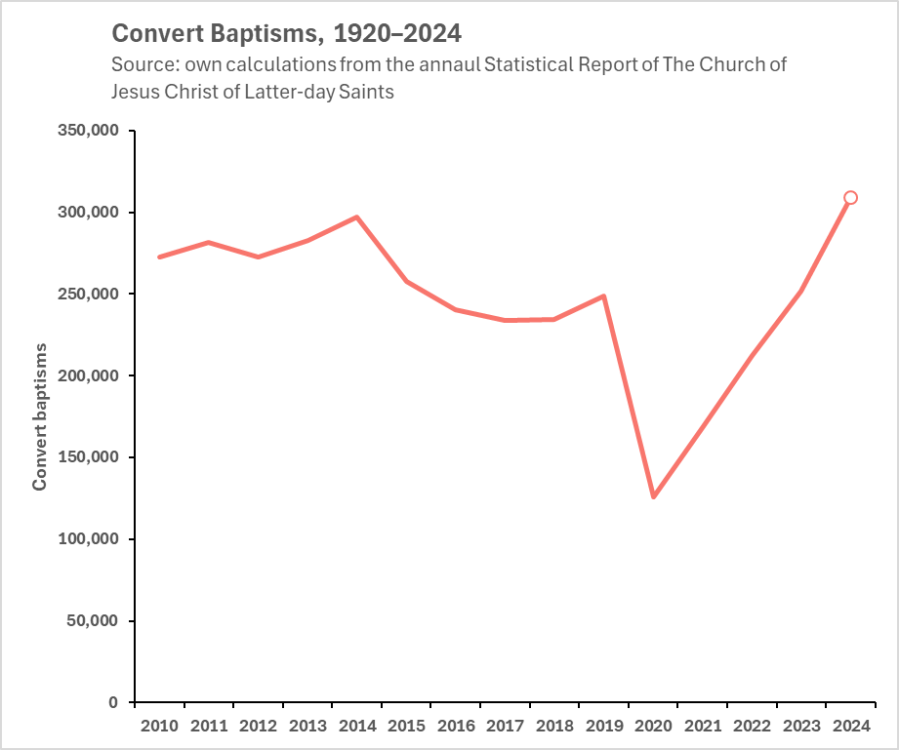
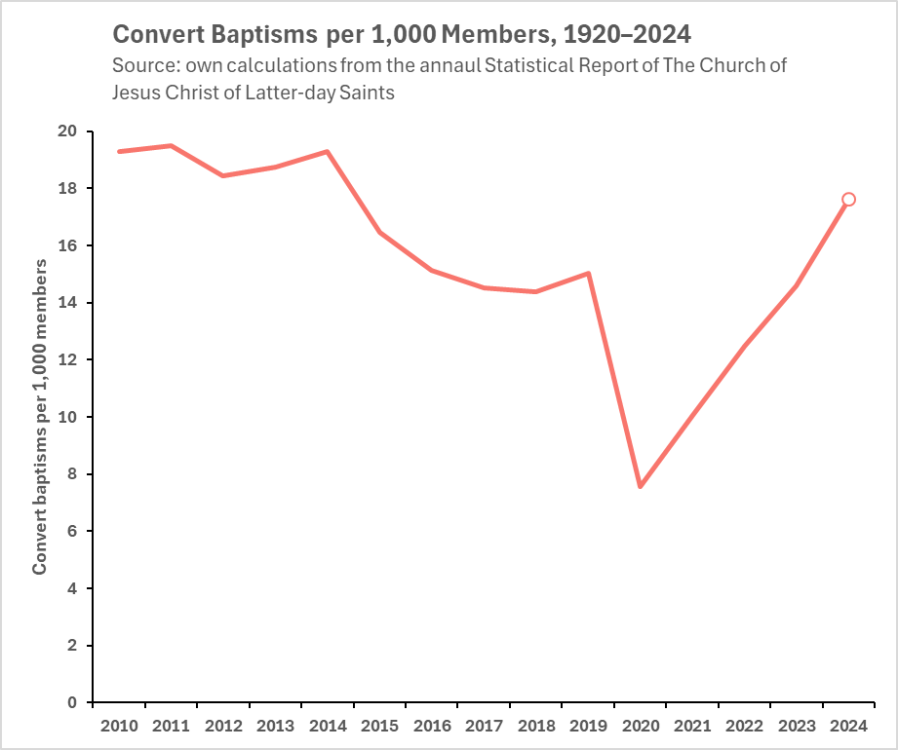
Note, the above graph for total converts in absolute numbers (i.e., not the rate) doesn't conflict with the Deseret News article. The figures use calendar year data, while the data cited by Elder Cook uses midyear data. This isn't obfuscation on either part: using midyear estimates (typically July 1 to June 30) is very common among national and international statistics agencies: the United States, UK, Canada, Australia, New Zealand, Sweden, EU, and UN all use the midyear point as the their annual population count. For various reasons the midyear estimate yields better denominators for annual population changes than a start- or end-year snapshot, dampens seasonal swings in population, and tends to align well with close of the accounting period, which matters given the interplay between demographic and fiscal policy. There's also some institutional inertia: we use midyear estimates because that's what we've done forever and we need to use some sort of international standard, so whatever has been around the longest wins. -
Church of Jesus Christ sees record growth in global membership
halconero replied to InCognitus's topic in In The News
-
Church of Jesus Christ sees record growth in global membership
halconero replied to InCognitus's topic in In The News
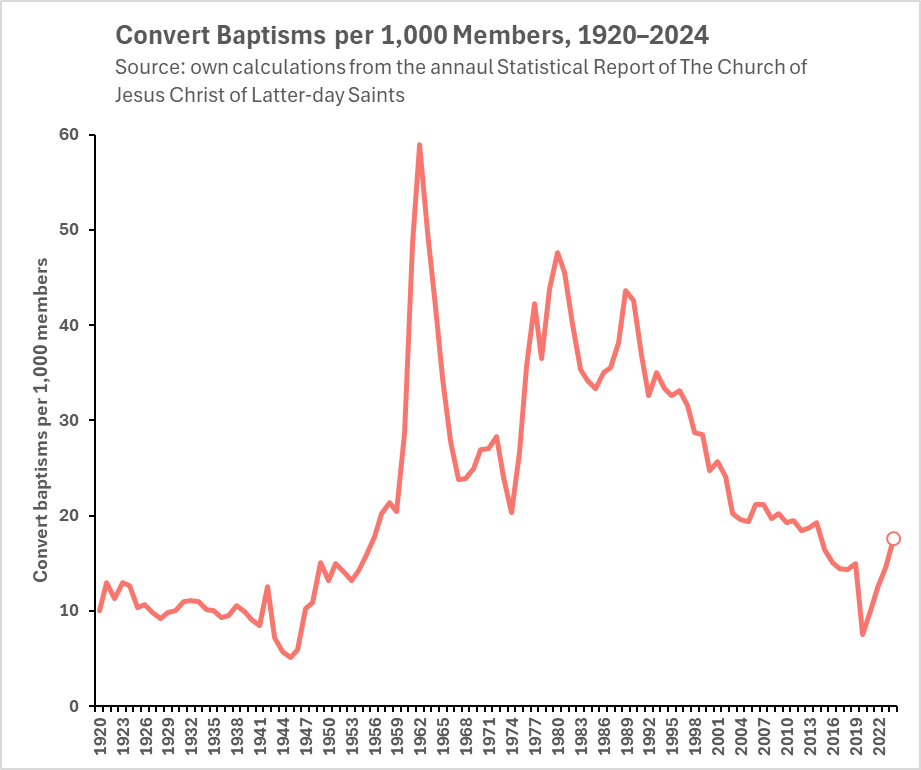
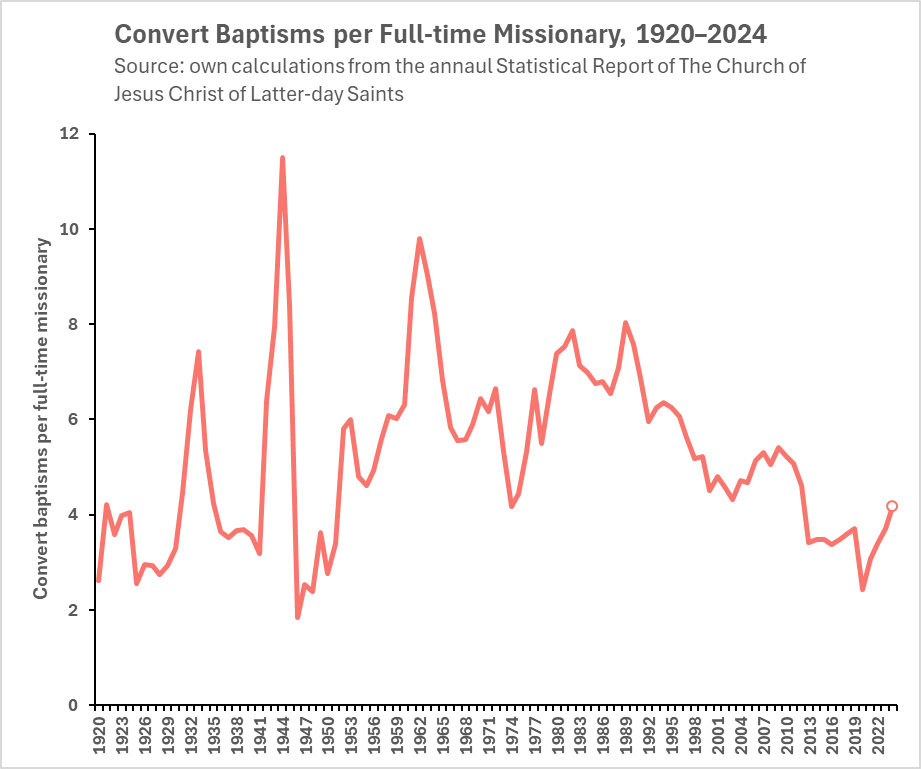
Baptisms by calendar year, in both absolute terms and several per capita metrics. I'm happy to extend out the time period, but changes in growth over the past 15 years are of particular interest to me. -
China Raids Christian 'House' Churches in Beijing
halconero replied to Pyreaux's topic in In The News
The situation for Chinese members living in the PRC is tough. I happen to know far more about this than I should due to my parents living in China for several years. Taiwanese members can choose to attend expat branches or national ones, with the caveat that once they choose, they can't switch. My parents happened to know a couple in their local expat branch that had other family members attending the national branch, and were able to periodically get vague details and news there. Without elaborating too much, I think people would be surprised at the size and organization of the Church in China. I'm not talking about major numbers, but it is surprisingly more "typical" than you might expect when it comes to opportunities for Chinese members to engage in the Gospel with regards to patriarchal blessings, meetings, going abroad to serve missions, etc. That is while staying within the confines of Chinese law. What is different is the extent to which members are under surveillance. My parents told me of one particular incident where Chinese members were planning an activity via WeChat and were subsequently told in no uncertain terms that the branch would be banned if they followed through. The activity itself was rather banal, but there was one obvious tension point (which I won't elaborate on) that likely flagged it.- 1 reply
-
4
-
This came up in Elders Quorum a month or so ago. One brother pointed out that "daily transgression and daily repentance" function as a noun phrase: a group of words that functions grammatically as a single noun or subject. Put another way, daily transgression and daily repentance are joined together as a single idea. This is an oversimplification, and risks turning our relationship to God into an accounting exercise, but for illustrative purposes let's say that transgression puts us in a spiritual deficit of -1. Repentance nets out this deficit with a +1 and returns us to a sum status of 0. If we do this day after day, we persist in a state of spiritual stagnation. Not only that, but Joseph Smith states that we're actually displeasing God through such a pattern of living, suggesting that we're actually worsening our position in relation to Him. Now, let's compare that with President Nelson's remarks in which he used the phrase "daily repentance." Emphasis mine: Also: I bolded the above because, in both cases where "daily repentance" is mentioned, they proceed the subject of getting on, walking, or staying on the "covenant path." President Nelson discusses this concept in greater detail throughout his talk, and outlines a pattern of spiritual momentum focused on learning of and becoming as the Saviour. Put it all together, I don't think Presidents Nelson and Smith are discussing the same patterns of behaviour. The latter focuses on a spiritual stagnation leading to degradation; someone treating a spiritual turn towards God as a trifling nod in His direction. By contrast, President Nelson outlines a pattern of deeper and greater spiritual holiness, recognizing that we periodically falter, but always seeking to move forward and work with the Saviour to fulfill our full potential as sons and daughters of both Him and our Heavenly Father.
-
Catholic Confession and LDS Repentance Process
halconero replied to Devobah's topic in General Discussions
I've discussed this elsewhere, but part of this stems, in my opinion, from our lack of a universal theory of atonement. I'm not suggesting we lack doctrines of the atonement, but we don't always organize them in relation to each other and ourselves in an X → Y → Z fashion. Put more simply, what problem(s) is the atonement trying to solve? When did it solve them? What fundamentally changed about ourselves individually and the world around us the day Christ condescended (our Catholic and Orthodox friends might prefer the term "incarnated"), on that Friday afternoon he was crucified, or that Easter Sunday when he rose? My understanding is that Catholic theology on the atonement is primarily grounded in a framework that first developed under Anselm of Canterbury and Bernard of Clairvaux, and later Doctors of the Church like Thomas Aquinas, and is commonly referred to as Satisfaction Theory. My external understanding (looking outside-in) is that sin dishonours are relationship to God. God himself in Christ, suffers for us and more-than restores this honour to God. It is not so much that Christ was punished in our stead, but that Christ acted with perfect obedience and honour towards the Father, including in his suffering. Given Anselm and Bernard's medieval worldview, my own personal comparison is that of King Arthur, Sir Lancelot, and Sir Galahad. Where Lancelot dishonoured his relationship to Arthur, Sir Galahad acted above and beyond with perfect love and duty. His obedience was such that it not only restored a proper relation to God, but provided an abundant surplus that transform us from not only being innocent, but saintly, should we yoke ourselves with Christ.* Considering this, I personally think it lends itself quite well to the practice of confession. The priest, as proxy, affirms the forgiveness of sin, or the restoration of honour between God and the penitent, because we are able to conceive of how Christ's perfect love and obedience completes the quest necessary to restore this relationship. That isn't a criticism on my part, or an accusation of oversimplification. I likewise don't think a satisfaction model of the atonement is incongruous with other conceptualizations. It's just a subjective observation on my part. By contrast, I think there is a sort of subconscious question on the part of Latter-day Saints with regards to what we want or hope the atonement is doing for us. Is it releasing us from the long-term consequences of sin? Are we being healed from the consequences of our own actions or that of others? What exactly is sin doing to us and what does forgiveness look like? I actually don't think there is anything prohibiting bishops—morally or procedurally—from affirming that someone is forgiven, but there may be some hesitancy in doing so in order to not elevate ourselves to the level of God or assume a particular individual outcome for an individual given the varying nature of sin. The ironic part, if my idea is true, is that we routinely act vicariously for God in applying the atonement to others, both living and dead, through the administration of ordinances. I remember watching a training video when I was a worker in the temple that described ordinances as "portals of grace," and couldn't help but reflect on my own gratefulness for being able to serve as the conduit to others seeking to access this grace. It's not that I was a gatekeeper, but rather, playing the role of opening doors to people who were seeking to enter anyways. In that sense, there are times where it may be entirely appropriate for a bishop working with someone to affirm their engagement with Christ, explain how they've worked with various mechanisms of grace in their lives, and confirm, given their journey, that they are indeed forgiven. *Please feel welcome to correct me, @3DOP and @MiserereNobis. I'm limited but adverse to understanding Catholic teaching on the atonement as I understand it, so the last thing I want to do is mischaracterize teachings on this matter. -
What's interesting to me is how those scattered for sin are not always the ones who are themselves sinning. I think it's reasonable to infer from the writings of Jeremiah and Ezekiel both that those taken into the first captivity (which occurred prior to the destruction of the first temple) were actually among the more righteous in the Kingdom of Judah. We can likewise see this in Lehi and his family, who were themselves scattered away from the covenant people and land to another one.
-
Mote meet beam. Ironically, I don't think they're entirely wrong; they just don't generalize their threat evaluations. My sincere belief is that the philosophies of men, particularly political and social philosophies, are currently the largest threats to Church members. The -isms all provide answers to ontological questions of the soul like why things exist, what existence means, and relationships between individuals, groups, and sociopolitical entities that may be compatible with Gospel principles. At the same time, each of them provide answers that incongruous with Gospel doctrines and principles. I worry that people are increasingly willing to prioritize these incongruous teachings over Gospel principles, particularly in regards to their actions towards others.

-
Daniel McClellan's New Book Is A Best Seller
halconero replied to Peppermint Patty's topic in General Discussions
I wouldn’t be surprised if the menu is different in the States, but the A&W full breakfast is excellent as far as fast food breakfasts go. -
Daniel McClellan's New Book Is A Best Seller
halconero replied to Peppermint Patty's topic in General Discussions
Congratulations, @Dan McClellan! I know that he isn’t here frequently (if at all, anymore), but I appreciate his scholarship. I disagree with some of his takes, but they’re the sort of disagreements that are fun to have and engage with secular scholars and theologians in this particular field. -
Pew Research on Religious Nationalism Worldwide
halconero replied to Calm's topic in General Discussions
I would suggest not, for a couple reasons: 1) The "American promised land": There is nothing in scripture that indicates these verses refer to the United States exclusively. We have plenty of references that suggest the United States was established to allow for the Restoration, but nothing which indicates that the promises in the Book of Mormon refer exclusively to it. By contrast, there are plenty of implicit indications within the Book of Mormon that indicate its promises and warnings extend to the Americas generally. Likewise, there are plenty of statements by Joseph Smith and other early Restoration leaders indicating that Zion as a geopolitical concept encompassed the Americas as a whole. The idea of encouraging continental adherence to Gospel principles would imply a Christian Internationalism versus a country-specific adherence to them. The people of Canada, Peru, or Belize are just as blessed (or condemned) for their (non-)adherence to the promises made on this land as United States citizens are. 2) "Believe in and serve": The verses cited below suggest that service, not belief, is required to receive the blessings of this land. I'm open to the possibility that service includes believing in Jesus Christ, but there are other locations in scripture that suggest service more narrowly encompasses charitable living and justice towards others. We likewise have statements from early Church leaders suggesting that non-members (including non-Christians) will have part in Zion's political project leading up to the Second Coming and during the Millennium. By definition, religious nationalism grounds provides a particular religion or denomination political privileges, whereas the religious political project proposed by Joseph Smith extended religious privilege and protection to all. 3) It may or may not provide a justification, but running counter to that are rather frequent and rather recent admonitions against nationalism generally. Consider: RUSSELL M. NELSON M. RUSSELL BALLARD Remember, nationalism by definition requires the legal favour of certain institutions over others, or what is likewise called positive discrimination (something that SCOTUS recently struck down with regards to Affirmative Action). Laws or policy that would favour one creed over another, whether it be religious restrictions on immigration, employment, or education, are, by transitive value, offensive to God. Do we want to promote principles and ideals grounded in Christianity that do not abused or prejudice against others, Christians and non-Christians? I'm all for it, but then, that's not Christian nationalism. So do we care more about the label and the identity, or the outcome? I think that's fine. It's just not Christian nationalism then. Might I suggest that I often hear conservative and progressive members talking past each other? We all have our favourite sins we like to rail against, and our favourite righteous causes to uphold. Frequently, I see more members focused on wanting to be preachers on the wall without having cleansed the inner vessel first. I routinely here General Authorities calling for inwards repentance and sanctification, and then see members assume they're talking about their conservative (or progressive) neighbour before asking "Lord, is it I?" With regards these verses, I do think it's disturbing to see more progressive leaning members discard certain teachings in favour of certain social causes or issues. I don't like to see them mock more conservative leaning members. However, I likewise see conservative members throw aside Christian principles of service, compassion, charity, love, and our common citizenship in the Kingdom of God in favour of an earthly citizenship that must needs be done away with upon Christ's return. -
White Smoke! And Traditional Catholics Are Worried.
halconero replied to ZealouslyStriving's topic in In The News
My prayers and well-wishes to our Catholic friends here on the board and elsewhere. May Heavenly Father bless His Holiness in his ministry to his flock specifically and to humanity generally. -
Pew Research on Religious Nationalism Worldwide
halconero replied to Calm's topic in General Discussions
A bit of context, but despite my recent forays into atonement theory, but day job is still working in academia with a focus on public policy. Topically, I focus on immigration policy, but increasingly on the broader subject of data collection methods, validity, and reliability. Those things have less to do with data integrity (which deals with transparency, security, fraud, and maintaining data) and more to do with whether the data collection methods we use accurately capture the information we want them to in a consistent way. Without getting overly political, we can all think of recent issues in polling and whether it accurately represents what we want it to represent. In that regard, I actually found myself weirdly frustrated with this survey from a methodological standpoint. The Vatican City question actually typifies it: 1) The survey indexes religious nationalism in way that assumes textual primacy (explicitly) and textual literalism (implicitly). That's very Sola Scriptura of them, and downplays the extent to which different religions value tradition, magisterium, use of ritual space, or symbolism at an equal or greater level than textualism. We probably under-count the number of Japanese religious people for this reason, despite the fact that plenty (if not most) still visit public shrines semi-regularly and keep a private shrine at home. If textualism is the hallmark of religious nationalism, we likely risk making some small county in the Deep South more religiously nationalist than the Vatican, where the latter values plenty of things apart from text alone. 2) I'm not they clearly articulate what they mean by the "nation," "nationalism," or "nationalist." They construct an index, sure, but how do they arrive at those specific questions defining whether someone is a nationalist or not? Plenty of countries link ethnic identity with concept of nationhood (e.g., Québec is legally dined as a "nation" within the Canadian confederation, and retains its own "National Assembly" at the provincial level). The Vatican is quite literally a theocracy, but it's a multi-ethnic one by nature, without a clear concept of national self, but certainly an ecclesial one. In fact, I'm pretty sure the Vatican had major beefs with European conceptualizations of the nation or nationalism for the very reason that it undermined the church's universal claims. Put all together, the term "Catholic" (it's very literally meaning) might actually do a lot of work to undermine attempts to classify it by religious nationalism. I respect the effort, especially the global one, but it's a poor study in my opinion. Theories of religious nationalism typically include dimensions of whether the state should constitutionally favour a particular religion, not just whether the head of state should belong to it. They typically focus on granting policy privileges to a particular religion, and excluding others, and the inclusion of latent symbols in public spaces. As a result, you might get wonky results like this when coding results: 1) Respondent 1: Wants Christianity to be the state religion of the United States. Wants state-funded faith schools. Wants to start the morning off with everyone reciting the Lord's prayer. Accepts congressional sovereignty over the legislative process versus the Bible. Coded non-religious nationalist by Pew. 2) Respondent 2: Supports Sharia as supreme law based on a literal interpretation of the Quran. Thinks minorities should be able to self-govern based on their own laws. Indifferent to special budgets or privileges for mosques or clerical seats in parliament. Coded religious nationalist by Pew. 3) Respondent: Backs Hindutva cultural supremacy, including Hindi signage and cow-protection laws. Refutes the two-nation philosophy in favour of a Hindu dominated, unitary state including Pakistan and Bangladesh under India. Doesn't read nor care for Hindu texts. Coded as non-religious nationalist by Pew. In reality, I'd likely code all three of these as religious nationalists, but the survey methodology and its approach to constructing its index is so specific and limited that it's likely under-counting a good number of people. -
Pew Research on Religious Nationalism Worldwide
halconero replied to Calm's topic in General Discussions
They specifically address Nigeria (and South Korea) in polling about two different historically predominant religions. -
Those are probably the better words. I agree. My one exception is viewing atonement through the ransom lens, where it operates as more of a hostage swap versus a business transaction. The powers of death and sin have taken us captive (or we have given ourselves over to them), and Christ offers himself in our place. The sacrifice of Aslan is probably the best fictional depiction of this. By law, the witch owns and has the right to slay any traitors. Edmund becomes fully reformed after a conversation with Aslan, but the witch still owns his life. Aslan offers himself in the place of Edmund, effectively ransoming him from the witch. The reason Anselm developed satisfaction theory is because the idea that God (or us) owed Satan anything felt off to him. However, Gustaf Aulén suggested a sort of divine irony or guile in the act of self-sacrifice and ransoming souls from sin and death, by essentially agreeing that God did *not* owe anything to Satan or two death—that's the whole point. Christ offers himself in the hostage swap as a sort of divine, undercover rescue mission, getting himself captured as the only prisoner who could not be justly held. As a result, Christ breaks the bands of death and sin, overcoming both. The ransom, then, is less of a payment and more of a ploy (which is also depicted well by C.S. Lewis' Aslan): "If the witch knew the true meaning of sacrifice, she might have interpreted the deep magic differently: that when a willing victim who has committed to treachery (sin) is killed in a traitor's stead the stone table will crack, and even death itself would turn backwards." Somewhat humorously, the early Church fathers extended this to mean that Christ, in part, overcame death and sin through the despoiling or harrowing of hell, going down into the depths, trashing the place, and releasing the imprisoned spirits there. We don't go that far, but I would suggest that at least some of our prophets have taught the above, at least in part. Starting at the finish, and working backwards, we have D&C 138, wherein President Joseph F. Smith shares his vision of the assembly of the righteous at the time of Jesus' death: There is even an element of trickery, whereby not only the Fall but the Atonement are a gambit to simultaneously introduce humanity into mortality and to rescue them from the inevitable bondage which we incur upon ourselves. Moses 4:6 and 2 Nephi 2:24 both suggest that Lucifer was tricked by God in instigating the Fall of Man. One possibility is that Satan believed that bringing about the death of humanity would deliver them into his power forever: However, as Jacob outlines, God had a plan: I think one of the benefits of this approach to the atonement is that it is that (at least to me) it is simultaneously funny and exhilarating all at once. Repentance is agreeing to the swap for a price we could never pony up. Whatever guilt we might feel for this fiscal deficiency should be swept away in the realization that it was a necessary part of the plan so that he could permanently triumph over the very things holding us down. At the risk of too much levity, he becomes our substitute in the same way that Ethan Hunt might, ripping a mask off that previously looked like our visage, revealing that he's spent the past three days infiltrating the prison IT systems, and then blowing off all the doors while he exfiltrates to some cool music written by Lalo Schifrin. Meanwhile, by participating in his image, his life, and his nature, we ourselves were let go from the prison by the same guards who felt there was no just means to hold us there, just three days earlier. I like the catalyst imagery. It's not intimate, but neither is the Harrowing of Hell, and both are acceptable means of portraying what Christ does for us. As was said earlier, the exact means are less important (at least at this stage our existence) compared to the story itself and what it tell us. If we're going to have a story for how we're saved, it's best to have an explanation for how we got into trouble and how the hero comes to save us, whether it be through intimate means of co-participation, or something else.
-
I’m not even sure if deficit is the right term for it, to be honest. I think it’s useful insofar as we want to use terms grounded finance (debt, payment, satisfaction) or penalties. Insofar as we use it, there are likely components of both. One is in an inherited debt of mortality. We don’t believe in inherited depravity, but we do believe an inherited expiry date, wherein all of must die. The other part is a deficit in likeness to God in terms of perfect righteousness. Repentance is less about Christ paying that deficit for us, as inviting us to become inheritors of a large inheritance. The story of of the prodigal son is probably the best analogy, where a son gives up and sells their inheritance, and is later invited back into the household and family of God. Again, all of those are imperfect, and not what I would necessarily use. Studying the ancient Israelite role of sacrifice, restitution, and payment all seem to play a different role in at-one-ment with God than I think penal substitution suggests. Payment especially seems more related to restoration than it does satisfaction or punishment for sin, the latter of which seems to be related to exile into the wilderness and recovery therefrom.
-
Will come back to this, but if I were to summarize this, it would be something like this: - The idea that someone thing must be substituted for, something must be punished, and something must be paid are all foundationally correct. Since issues of legal justice and debt repayment are all around us, we naturally teach these concepts in ways that are familiar to us. - We have likewise inherited a fairly recent understanding of the atonement, with its origin in early modern legal training, which itself is grounded in Roman law (not Hebrew concepts of justice or mercy). We have ditched parts of these ideas, specifically those which limit the efficacy of the atonement to a limited few. We have retained, however, the consequential parts that are inflicted on the unelect, and implicitly worry that we're among them, without questioning whether this needs a re-frame too. - We thus develop a concept of standing liability that can re-attach itself to us if we do not repent. The first step is realizing that Christ doesn't pay the debt if we repent. Christ already paid the debt, the fine, the punishment. The debt is already balanced, the judge is satisfied. Christ is a substitute for us in the sense that we became a forerunner and co-participant with us in our lowest depths and greatest alienation from God. His invitation is that we become co-participants with Him his greatest heights and closest proximity with God. So what is repentance then? It is not repaying something. Rather, it is consenting to be healed. More than that, it's consent to be trained, aided, and supported in becoming as the master healer is. The Evangelicals are right when they say there's nothing we can do to earn forgiveness. They are wrong when they say we don't have a say in the matter. Consenting to God's work in us and invitation to work with him isn't earning our way to salvation, because earning anything was never the point. Nor is justice about satisfying a God who demands something to exercise His wrath on. The just state of communion with God is one of likeness and glory with Him. What justice demands, then, is we become like Him. If we don't want that, we become subject to the alternative demand, which is that we become *not* like Him in glory, happiness, and joy; not because of some legal case, but because we don't want that nature, life, or habitation. By experiencing the results of eternal alienation and triumphing over them, he has the power to withhold its effects. Nevertheless, we we choose not to participate is life, death, and rising with him, we don't make us, and will apply the consequences we ask him to apply. Everyone will rise to the level they embrace that shared life with Christ. Put all together, the victory is won, the debt is paid, the forerunner has conquered sin, trashed hell, and overcome death. He's not asking you to feel guilty over what He did, its only function is to recognize that which holds us back from our yearning desire to be with Him. Whether or not you participate in that doesn't negate those facts, so stop feeling like you can earn it. It was never up to you, your exaltation is not a start-up combining your limited funds with an angel investor — it's a trillion dollar enterprise and God just revealed that you've been adopted into the family as an inheritor. Your repentance is a signature that you want to become part of it, and begin your first day of on the job training with the greatest mentor that eternity has ever produced, who will be with you every step of the way. Exaltation is free, agency is preserved. Repentance, ordinances, and covenant keeping are essential modes of participation, not a co-pay.
-
Getting back to this, but it's worth, I think, differentiating between penal substitution, wherein Christ experienced a punishment in our stead, versus substitution meaning someone doing something in our stead generally, as proxy, forerunner, etc. Western Christianity has been dominated some sort of "satisfaction" model for the past 900 years or so, ever since Anselm (and then Aquinas) developed satisfaction theory, and when John Calvin developed this further the basis for Penal Substitution theory. Aquinas softened Anselm's model for getting a bit to legal about the atonement, but at its core, we still have a God who is not glorified by our sin. Jesus obedient life and death brings a surplus of glory to God, which more than restores humanity, and helps transform humanity from sinners to saints. This is related to but distinct from penal substitution, wherein God must uphold the order of heaven and vent his wrath on sin, which Jesus does for only a limited number of the elect, no one else. What both of these share in common is that Christ is resolving some sort of **legal** or **hierarchical**/**institutional** infraction on our behalf. The former is more-or-less the theory held by the Latin Church in Catholicism (not necessarily the Eastern Catholics), the latter by most Protestants (with some exceptions). I think this context is important for a couple reasons: a) Most Church members come from or descend from a religious or cultural context where these theories pervade. b) God doesn't insist on us adopting a new or different theory, at least right away, and leaves it up to us to figure things out both individually, collectively, and situationally, according to our pastoral needs, the needs of the Church, and readiness for doctrine. With that said, I don't think the idea of substitution generally is wrong, per se. Where I think we get into trouble sometimes is thinking of this in the legalistic or feudalistic terms which we've dragged with us from the Medieval era and the Reformation into our own thought patterns. Substitution exists in scripture, but not in the way a feudal archbishop or 16th century Genevan lawyer thought of it. Part of the issue is that we bring these ideas with us in a rather incomplete manner. We keep, for example, a penal mindset around Christ paying an eternal fine for us, but have ditched a **necessary** part of Calvinist thinking, which suggests that a natural and necessary assumption related to this is **predestination**. If Christ pays, and we cannot, then nothing we do has any effect anyways. If, then, there's nothing we can do to save ourselves, and God must choose us, it therefore means that Christ's atonement is **limited** and **effective**, meaning that Christ saves who ever he suffered for. If he didn't save someone, why would he bother suffering for them? Why would he suffer ineffectively if they aren't going to heaven? The idea of a limited, effective, and predestined selection is *not* inconsequential to the mindset around penal substitution. So why does this matter? Because we've mostly ditched or re-framed the "limited", "effective", and "predestined" parts of this idea. We believe that whatever Christ did, whether we focus on the living, suffering, dying, or being resurrected *for us* parts, it was universal, partially hypothetical (for the partakers, not in terms of what Christ did; it's also 'partial' because the resurrection is unconditional), and involves our agency. We haven't, in my experience, reframed or ditched our understanding of what the penal part means. So there's a punishment that needs to be paid, Jesus pays for it, but we have our agency. We know there are "demands of justice" and that we must "suffer even as [Christ]" if we are under sin, which perhaps lead us to a sort of mentality that suggests "Christ paid my part if I pay my part." There is some heavier penalty Christ paid, which we can take advantage of if we repent sufficiently. This would be fine if we had a systemitized way of penance and guilt, wherein we could check all the boxes and confirm for ourselves that we're forgiven, but as far as we know, that's doctrinally false too. My sense is that this leaves a lot of members, including myself at times, in a quasi-limbo, where we're never quite sure if we've done enough to merit Christ's grace. The sense wherein debt is only cancelled after the payment plan is met can leave many of us feeling as though we're in arrears, and risk turning repentance into a means of earning forgiveness. Penalties remain on the books until after we finish repenting. I believe, however, that a re-interpretation of past scriptures and the revelation of new ones actually allows us to re-frame concepts of justice, penalties, punishments, and payments too in a way that is not only healthier for members, but more in-line with what Christ accomplished through their condescension, suffering, and triumph over sin and death. When substitution is understood in relational terms more than (specifically modern) legal terms, it helps us understand what exactly is being asked of us when we're commanded to repent. Specifically, it is God asking us to partake and participate in the divine nature of His Son, whose payment for us was not a fine towards God, but addressing a deficit which we have incurred against ourselves, and not only returning it to balance, but giving us a surplus of goodness and joy. Edit: The courtroom analogy is funny to me, because the more I think about it, the more I realize that there's simply no way for us to lose the court case if we just shut up and let the Advocate work something out the Judge, both of whom desperately want to let us off. Instead, we sometimes think of repentance as doing something or saying something that gets the Advocate on our side, so He can then save us. Except, to the Advocate, we end up looking like one of those sovereign citizen types trying to come up with our own interpretation of the law, justice, and personhood, while the Judge is practically begging us to let our lawyer take the lead.
-
I think the idea that Alma's main concern was the impact of Corianton's choices on the ministry is the one supported by the text. Consider the following from Alma 39: 1) ALMA'S PREFACE It's possible that the brother Alma was referring to here was Helaman, but in context—letters of instructions to his sons—the letter to Shiblon immediately precedes Alma's letter to Corianton. We also see Alma evaluate Shiblon's ministry in the following words: He notes Shiblon's patience in his trials for the sake of the word, admonishes him to trust God, and after sharing a bit of his conversion, tells him to be wary of pride and to "not boast in your own wisdom, nor of your much strength." Let's return to Corianton in the next chapter: Okay, so he praises Shiblon's "faithfulness and diligence" in reference to his ministry among the Zoramites, a phrase he repeats with Corianton. He warns Shiblon about certain pitfalls, specifically in regards to wisdom and strength, and then points out how Corianton fell into those specific pitfalls. Finally, we see contrasting pictures of sticking to a ministry versus forsaking it. With all that, it's pretty reasonable to conclude that Shiblon was the brother Alma was referring to in his preface to Corianton, and given the language, his main concern was the personal character, action, and its relationship to missionary work. 2) ISABEL IN CONTEXT Notice the structure: (A) You left the ministry (B) You went after Isabel (B) Many have gone after Isabel (A) You should have stayed in the ministry I've grouped these by related ideas. We have no clue whether Corianton broke the law of chastity with Isabel or not. I actually don't think he did (I'll come back to that). Either way, Alma's main concern seems to be what it meant for Corianton's ministry. Besides the above verses, I think the strongest proof comes next: 3) A SIN NEXT TO MURDER Growing up, I heard people suggest that, given Corianton's pursuit of Isabel, the obvious conclusion was that Alma's main concern was possible fornication with her, thus leading us to conclude that fornication is a sin that's almost comparable to the shedding of blood. Except, Alma doesn't suggest it's just one thing he takes issue you with in regards to Corianton's actions, it's "these things." If we had to rely on this chapter alone, we could conclude that breaking the law of chastity was among "these things," but thankfully, we have other writings of Alma, including one where he outlines a sin that he does consider being akin to murder, namely Alma 36: Alma, in sharing the story of his repentance with Helaman, details the harrowing of his soul, which he attributes to his "murder" of many of God's children. He then clarifies this by saying his murder was a spiritual one, leading others away unto destruction. To Alma, leading others astray is a sin, even a great inquity, akin to murder, the gravity of which seems comparable to his use of the word "abominations" in his advice to Corianton. This take seems confirmed in Alma 39, when he describes the fallout of Corianton pursuing Isabel and a subsequent revelation that Alma received from God: The flight of Corianton causes a "great iniquity" among the Zoramites, such that they refuse to believe Alma. The Holy Ghost then counsels Alma to command his children to good, lest they lead others "to destruction," a term which, as we've previously outlined, Alma equates with the murder of God's children. 4) CORIANTON AND ISABEL I mentioned this before, but I don't think Corianton had sex with Isabel. It's possible, but Alma uses a different term than the one I'd choose if Corianton had actually broken the law of chastity when calling on him to repent: If Alma had said "go no more after Isabel" or even more strongly, "go no more unto Isabel" or some other phrasing, I think there would be a stronger case or stronger possibility that Corianton had actually committed fornication or adultery. Instead, Alma counsels his son to no longer go after the "lusts of his eyes," a phrase that is used elsewhere in scripture: 1 John 2:13-16 is actually part of a poetic structure in 1 John 2 that is written to both newest and the eldest members of the Church being addressed by the writer of 1 John. Conceptually, the writer differentiates between lusts of the flesh and lusts of the eyes in such a way that biblical scholars think he is referencing an older story—the Fall. See Genesis 3: The term "good," as in "good for food," is used throughout the Hebrew Bible to mean "pleasing" (2 Kings 2:19; Esther 8:5) or even "beautiful" (Exodus 2:2). The connotation is something that is physically pleasing or good (in Eve's case, to satisfy hunger). There are no normative associations with the term, and it is used to describe both good and bad acts borne out of the regular human need to eat or otherwise satisfy our physical nature. The construction of the Hebrew word here for "pleasant" does take a more normative meaning in the other places it is used, where it suggests an intense, specific, and almost insatiable want. It's something that occurs prior to Eve consuming the fruit. If this association applies to Alma 39, the implication is that Corianton desired Isabel, but it does not go so far as to suggest he actually consummated that desire with her. Prior to this, Alma suggested that his son, like other men, had given his heart to Isabel. The Hebrew Bible tends to use more explicit language when talking about it actual fornication or adultery, using terms like “lie with,” “commit adultery/fornication,” “go in unto.” There isn’t much euphemism, at least in the way we’re used to. By contrast, when talking about sinful, sexual desire, the scriptures tend to use terms like “lust after,” “look on a woman to lust,” “covet,” or “tempted by.” Alma uses the language of the latter rather than the former. This notion is supported by Alma's further admonition that Corianton cross himself in "these things," an appeal which echoes Jesus' teachings in the Sermon on the Mount/Plain, whose verses against sexual immorality focus on eliminating mental and emotional lusts. 5) THE ROLE OF A FATHER I had a pretty tender realization the other day, that behind every successful angel there's a loving parent. Around twelve years ago, the Church put out a three-part series by Elder Bednar called "Patterns of Light." In Part II, Elder Bednar asks why God would send an angel to remind us to say our morning prayers when the Holy Ghost can bring back to us the remembrance of our "angel mother" reminding us to pray—the effect is the same—"everything that invites and entices us to good and to be good comes from God." I would suggest that Alma feels the same, based on his own experience with the angel. Notice below his initial response to the angel’s words: I have come to believe that repentance is not the guilt we feel for sin. It may play some necessary role in producing a desire to change, but it is not sufficient. Rather, repentance is the yearning we feel to be close to God and a willingness to take upon ourselves whatever name, behaviour, or mindset we need to do so. More specifically, it is a desire to receive whatever gift of help that God is willing to give us so that we can be close to him. In that sense, Alma 36:8–16 are a prelude to repentance, during which time Alma resisted the idea of coming near to God. The angel, then, was sufficient to confront Alma with the consequences of his sins, but he was not sufficient to produce a changed heart. The real credit goes to Alma's father: As I said, behind every successful angel there’s a loving mom or dad. I believe Alma had the example of his own father in-mind when he was writing to Corianton, specifically his father’s prophecies of the coming of Christ and the effect they had on his own repentance: It's easy to read Alma 39 as a strong diatribe against a wayward son. I think, however, it is closer to a deeply concerned letter by a father who saw a son going down a path he once followed, and relying on the example his own father—Corianton's grandfather—in prophesying of Christ. The Lord sends angels, including angel parents, into the world as partners in the instruction and redemption of His children and theirs.