All Activity
- Past hour
-

Trademark infringement case against Open Stories Foundation
Calm replied to Calm's topic in General Discussions
There is a particular blue tone range as well I call Mormon blue. This website uses it. So does FAIR. I know FAIR got a license to use the stuff similar to the official site, both verbal and visual. I know several other LDS members’ sites that had to as well. I assume this board did as well, but can’t remember if Nemesis reported this or not. - Today
-

Trademark infringement case against Open Stories Foundation
bluebell replied to Calm's topic in General Discussions
I think you are right. Agreeing with everything the church does is different than consecrating our efforts to the kingdom of God. -

Trademark infringement case against Open Stories Foundation
webbles replied to Calm's topic in General Discussions
I doubt the temple covenants would be brought up. But I would think Dehlin would prefer to have believing members on the jury. I think he would have a harder time convincing non affiliated people that he wasn't causing confusion. Also, if a voter did do what you say, it would just trigger a redo. And I really don't see why the temple covenants would be invoked. Because the worst that could happen to the church is that Mormon Stories continues as it is and the church pays lawyer fees. There's no protection needed for the church. Dehlin, on the other hand, could loose a lot. He needs more protection. -
Trademark infringement case against Open Stories Foundation
Notatbm replied to Calm's topic in General Discussions
If this whole mess goes to trial, is there a chance Dehlin will be able to get rid of jurors who profess to be active temple recommend holding members? Reason I ask is because part of the endowment specifically has a person covenanting to consecrate everything to the kingdom of God...to include their very lives. Certainly voting in favor of the church in this case would be protecting the kingdom of god whether the plaintiffs prove their case or not. I know I have family members who would vote like that and also brag about voting that way. Lying for the lord comes to mind. Jury selection certainly can be an interesting show if it happens. I bet that temple script gets trotted out in selection. -
Trademark infringement case against Open Stories Foundation
webbles replied to Calm's topic in General Discussions
I don't agree that the church would sue her if she had gotten a trademark. I don't really see why the church would sue her. Since the church filed an opposition to the USPTO, it is already trying to block the trademark. If the USPTO still granted that trademark, it gives her a really strong argument against the church. Any lawsuit they file afterwards is starting on weak footing. Anything that was already brought up at the USPTO would probably not be allowed in the lawsuit (https://en.wikipedia.org/wiki/B%26B_Hardware%2C_Inc._v._Hargis_Industries%2C_Inc. was a Supreme Court ruling that says issues argued in front of the USPTO are precluded from district court cases). -
Trademark infringement case against Open Stories Foundation
Notatbm replied to Calm's topic in General Discussions
"You could argue that the church has dropped some of those marks, like "Mormon Tabernacle Choir", "Mormon Channel", "Mormon.org", but that is not as simple as pointing to the style guide or the rename." All three of these (bolded) are still trademarked by intellectual reserve. I dont blame them for MOTAB i mean that is a for-profit venture. The rest...meh So you didnt find any existing LDS trademark that resembles the "bad Mormon" one? So you agree they would have sued her if she didnt withdraw her application? Sounds like they were "going after" her. -

Church's Policy on Surrogacy - Looking for Input
smac97 replied to smac97's topic in General Discussions
I like it a lot as well. John Derbyshire, paraphrasing what Robert Conquest famously observed, said that "Everyone is conservative about what he knows best." Dern tootin'. @california boy is, I think, demonstrative of this. He now wants to "conserve" same-sex marriage. He wanted the definition of marriage "progress" and be re-defined as to gender, but I think he does not want it to thereafter "progress" to a re-definition as to number. Perhaps we could also say: "Everyone is liberal about a good he has seen withheld." For me, I tend to balance the two by looking at Chesterton's Fence, the rule that you do not pull down a barrier until you know why it was put up. The original image is a road with a fence across it. The reformer says it is pointless and should go. Chesterton’s reply is that you are not entitled to remove it until you can say what it was for. If you do not know, you do not yet know whether you are clearing an obstruction or opening a ditch. Once you do know — cattle, a boundary, a flood channel — you may still take it down. The point is not “never change.” It is “do not change in ignorance.” The fence therefore forbids two cheap moves. The "progressive" cheap move: “I do not see the use of this, therefore it is oppression.” Not seeing the use is your ignorance, not the fence’s verdict. The "conservative" cheap move: “It is old, therefore it must stay.” Age is a clue that someone had a reason. It is not a proof that the reason still holds. Used honestly, the test is sequential. First state the purpose of the existing rule (conservative work). Then ask whether that purpose is still real, whether the rule still serves it, and whether a different rule would serve the same purpose with less exclusion (liberal work). If you skip the first step, you get vandalism dressed as compassion. If you refuse the second, you get ancestor-worship dressed as wisdom. Everyone is conservative about what he knows best — he can explain the fence. Everyone is liberal about a good he has seen withheld — he can say who is standing on the other side of it. Chesterton’s rule is the requirement that both speeches happen before anyone brings a saw. I do find the sentiment in the video you like difficult to reconcile with the well that folks like you and SU so frequently go to, namely, "The only plausible explanation for you disagreeing with me is that you are a bigot." You seem to genuinely lack the capacity to allow reasonable minds to reach conclusions which diverge from your conclusions. Two problems with that. First. “Everything that interacts with observable reality is within the purview of science” is true only if you mean: if it leaves a trace in the world, that trace can be looked at. It is false if you mean: the only legitimate explanation of a trace is a current physical law, applied as if the universe were a closed box with no author. A signed document interacts with reality. So does a marriage, a crime, a resurrection claim, a translation of a text. History, law, and testimony are how we handle particular events. Physics is how we handle repeatable regularities. Those are not the same toolkit. “Science owns every interaction” is a territorial claim, not a finding. It is also self-undermining: the decision that only that toolkit counts is not itself a laboratory result. If a prophet claims God spoke, you can ask whether the claim is coherent, whether witnesses held, whether the fruits match the tree, whether rival explanations are better. That is inquiry. It is not the same as saying “unless this shows up as a new force in the Standard Model, it did not happen.” Second. Pinker and Carroll are not talking about revelation. They are talking about a soul or an ESP faculty conceived as an extra physical widget — a field, a particle, a brain that steers photons without a mechanism. Given that picture, yes: everyday physics is complete enough that you should not expect undergraduates to peek behind the curtain. Bem’s porn-curtain study is a bad analogy for Isaiah or Moroni because nobody in those texts is proposing a fifth force in the lab. Revelation, as I am using it, is not “the laws of physics failed in the undergraduate basement.” It is: the God who instituted those laws can address a person, or act in a particular history, without the universe becoming a different kind of machine. That is a claim about an agent who is not an item in the inventory. You can reject the agent. You cannot treat “we have mapped the low-energy effective theory” as a demonstration that no such agent exists. That conclusion was loaded into the prior. “The rules of physics rule out revelation” only works if revelation means a physical leak. I did not mean a physical leak. I meant that some questions — whether we are accountable, whether this record is from God, whether this commandment is His — are not settled by extending the same method that measures a charge-to-mass ratio. Science answers how the furnace burns. It does not tell you whether the owner of the house has spoken. If your view is that nothing can speak except what the current equations already contain, say that. That is metaphysical naturalism. It is not “science.” It is a philosophy that uses science as its branding. I think "Analytics the ardent anti-Mormon" has given us a menu of ways "Analytics the scentifically-minded 'squarely on the side of empirical realiity'" buy must find defective. Compartmentalization. Shelf. Ignorance of esoteric QFT. Cognitive dissonance. Apathy. Cultural religion with the supernatural filed off. Those things exist. They are not a proof that they are what is happening every time a chemist who goes to church walks into a lab. The fact I pointed to is narrower than you treated it. I did not say “LDS physicists exist, therefore Moroni is a theorem.” I said they do not have to check their faith at the door in order to do the work. That is an existence claim about compatibility of practices. You answered with a compatibility claim about metaphysics: if the current laws are true, revelation is false, so the scientist who believes both is fooling himself. That only follows if “the laws” already include “the universe is a closed system with no speaker.” That clause is not in the Lagrangian. “What the laws of physics are” and “what those laws imply” are two sentences. The first is: at everyday energies we have an extraordinarily good effective theory; extra forces and extra soul-particles are not sitting in the gap. The second is: therefore God cannot address a person or act in history. The jump is where the philosophy is doing the work. Carroll is entitled to that philosophy. He is not entitled to call it a measurement. If the only permitted stance is “QFT plus naturalism,” then yes, every believing scientist is compartmentalizing. That is not a finding about them. It is your definition of sanity. A man who thinks the Creator of the regularities can also speak is not required to forget how a semiconductor works. He is required not to treat the semiconductor as a sacrament. Those are different mistakes. You can still argue that particular LDS historical claims fail on historical grounds. Do that. “There are Saints in the hard sciences” was never offered as a substitute for that argument. It was offered against the idea that walking into a lab is an implicit oath of metaphysical naturalism. It isn’t. The oath is yours. No. Science and religion are in tension when religion makes truth-claims about observable reality that contradict science. “That formulation still treats the current naturalistic reading of the data as identical with ‘science.’ Science, as a method, is observation, measurement, and the search for regularities. It is silent, or at least underdetermined, on unique historical events, first causes, and whether agency can ever be a cause. Tension appears only after you add the extra rule that the only respectable explanations are those that stay inside Sagan–Carroll naturalism. That rule is a philosophical premise, not a finding of physics or biology. If a religious claim is about a repeatable, presently observable regularity and it is simply false, then yes, that particular claim is in trouble. Most of the live disputes are not of that kind; they are disputes about what counts as an explanation in the first place.” "Science" can't establish whether Caesar was stabbed to death on the floor of the Roman Senate. You are on record as accepting that event as historically accurate even though it is bereft of derived-from-the-scientific-method empirical verification. That's precisely my point. The Baloney Detection Kit is about subjecting your beliefs to the crucible of scientific thinking so that you stop believing false things. If you want your religious convictions to "survive contact with ordinary life", you should do the opposite of what the Baloney Detection Kit prescribes. The Kit is a good tool for one job: reducing error about repeatable, publicly observable regularities while treating personal, historical, and agent-involving claims as last-resort explanations. That is a legitimate project. It is not the only project. Wanting a conviction to survive contact with ordinary life is not ‘do the opposite of the Kit.’ It is closer to what every research program and every serious moral commitment actually does: protect a core while letting the periphery be revised by experience. Naturalists do this with the uniformity of nature, other minds, and the reliability of induction. They do not put those on the same footing as ‘this particular UFO report.’ The Kit does not start from equipoise. It already decides that first-person spiritual experience, testimony, and unique historical claims are the kind of thing that must be explained away rather than allowed to count as data. That decision is the premise we were discussing, not a result the Kit discovered. If the only goal is ‘never believe a false religious claim,’ the Kit is well-designed. If the goal is also ‘do not systematically ignore a class of evidence that millions of people take themselves to have,’ then applying the Kit without remainder is not neutrality. It is a prior restriction on what is allowed to count.” It isn't just for things that are fraud. It's for any new idea that could be fraud; for all "new ideas that are offered for consideration." In the words of Sagan: In the course of their training, scientists are equipped with a baloney detection kit. The kit is brought out as a matter of course whenever new ideas are offered for consideration. If the new idea survives examination by the tools in our kit, we grant it warm, although tentative, acceptance. If you’re so inclined, if you don’t want to buy baloney even when it’s reassuring to do so, there are precautions that can be taken; there’s a tried-and-true, consumer-tested method. What’s in the kit? Tools for skeptical thinking. Sagan, Carl. The Demon-Haunted World: Science as a Candle in the Dark (pp. 209-210). (Function). Kindle Edition. Sagan says the kit comes out whenever new ideas are offered for consideration. In context those ideas are empirical claims about the world that are being put forward as the kind of thing science should accept or reject: a new particle, a cancer cure, a UFO propulsion system, an ESP result. The tools (independent replication, quantification, rival hypotheses, falsifiability) are built for that class of claim. That is not the same as saying every conviction a person lives by must enter the same protocol from a standing start. ‘God exists,’ ‘Christ rose,’ or ‘this book is what it claims’ are not being offered to a journal as a new physical mechanism. They are already-live options for people who treat testimony, history, and first-person confirmation as admissible. Using the kit on sloppy history or fraud is exactly right. Treating the kit as the sole gatekeeper for whether those options may remain live is an extra rule about which kinds of evidence count. Sagan is explicit that he wants that rule. That is the premise, not a finding the kit produced after a neutral inspection of every possible idea. Tell me you haven't read The Big Picture without telling me you haven't read The Big Picture. I am working from the pages you quoted and I have seen elsewhere, not from a pretense of having read the whole book. Those pages say the particle content relevant to everyday matter is settled, and that a soul that made a difference the way extra particles would have made a difference should have been seen. That is a strong experimental claim. I am not disputing it. What I am disputing is the next step: treating that inventory as a complete list of everything that can exist or act, and then assigning an infinitesimal prior to revelation or a soul. That prior is not a measurement. It is the probability you get once you have already decided that the only admissible causes are items in the Core Theory, coupling the way those items couple. That decision is physicalism. It may be correct. It is not something a detector returned as 10−3010^{-30}10−30. No. It isn't a philosophical position about physicalism. It's the laws of physics that have resulted from incredibly detailed and expensive studies that were conducted over the course of decades. The verdict is unambiguous: we’ve found all of the particles that our best current technology enables us to find. Crossing symmetry assures us that, if there were any particles lurking around us that interact with ordinary matter strongly enough to make a difference to the behavior of everyday stuff, those particles should have easily been produced in experiments. But there’s nothing there. There are probably more particles yet to be found. They just won’t be relevant to our everyday world. Carroll, Sean M. . The Big Picture: On the Origins of Life, Meaning, and the Universe Itself (pp. 182-183). (Function). Kindle Edition. I understand how you think he is merely saying that science hasn't detected how our spirits interface with our bodies, but if they looked more closley in the right place, they'd figure it out. In theory that could be true, but what you are claiming is "that modern physics is profoundly wrong in a way that has so far eluded every controlled experiment ever performed." Carroll, Sean M. . The Big Picture: On the Origins of Life, Meaning, and the Universe Itself (p. 212). (Function). Kindle Edition. Of course you are free to believe that God is so powerful that he can make modern physics profoundly wrong in a way that has so far eluded every controlled experiment ever performed. Philisophically, anything is possible. But if you are going to claim that Carroll is wrong about physics, at least have the common courtesy to read his book and not merely declare that he is wrong because the results aren't intuitive to you and contradict your religious beliefs. I have not read the book. I am answering the passages you quoted. Those passages are about the particle content of the effective theory that governs everyday matter. Crossing symmetry and the absence of extra light, strongly coupled degrees of freedom are real results. I am not saying the LHC missed a particle, and I am not saying the Standard Model is ‘profoundly wrong’ about the interactions it has measured. Carroll’s further claim is that a soul (or any influence that made a systematic difference to bodies) would have to be that kind of extra particle, and therefore either it does not exist or physics is profoundly wrong. That ‘would have to be’ is the philosophical step. It assumes that the only things that can act on ordinary matter are items already in the inventory, coupling the way those items couple. That is physicalism: the physical facts, so described, are the complete facts. A theist can accept the experimental record and reject that completeness rule. God or a soul need not be another field that should have appeared in collider debris. It can fail to be a fifth force, act rarely, or be the kind of cause the Lagrangian was never meant to list. Those options may be false. They are not the same claim as ‘modern physics got the particles wrong.’ So I am not declaring Carroll wrong about physics because the conclusion conflicts with my religion. I am saying the physics he cites does not by itself force the infinitesimal prior. The prior comes after you have already decided that the inventory is the whole story. You completely miss the point. Before the experiment was done, "it was a foregone conclusion" that psychic powers don't exist because that would break rock-solid laws of physics. Likewise, it is a foregone conclusion that spirits and revelation don't exist, because such things also break the same rock-solid laws of physics. The only reason I brought this Pinker quote up is to quote how National Academy of Science scientists such as Pinker interpret Carroll and the language they use when describing how much confidence science has in their scientific conclusions and what those conclusions imply. They use words like "foregone conclusion," "infinitesimal prior probability," "disproven the laws of physics", and "the laws of physics rule out precognition and [spirits and revelation]." I understand that you think claiming "God can do anything!" outweighs all this. But God could have an elaborate scheme going on to make it appear that the earth is round when it's really flat, couldn't He? How could scientists possibly know God isn't pulling that trick on us? Pinker’s language is the point I was already naming. ‘Foregone conclusion,’ ‘infinitesimal prior,’ ‘the laws rule it out’ — that is how you talk once you have read the Core Theory as a complete inventory of causes. I am not missing that. I am saying that reading is the extra step. Bem-style precognition is a proposed regular, lab-detectable channel from future public events into present guesses. If that channel existed as a natural capacity of undergraduates, it would conflict with the causal structure we actually use in physics. Failed replications are evidence against that hypothesis. ‘God can disclose something to a mind’ is not the same hypothesis with different branding. It does not predict a stable, quantifiable psi effect in a psychology lab. It does not require a new particle that couples like the electron. Treating them as one claim is what I called equivocation. The flat-earth trick does not follow. ‘God could in principle deceive us about anything’ is true in the thin philosophical sense that global skepticism is hard to disprove. It is not a reason to treat every particular religious claim as equivalent to last-Thursdayism or a fake-round earth. We still distinguish ordinary regularities we have mapped from unique or agent-involving claims we have not. Particle physics tightly constrains extra forces in the everyday domain. It does not, by itself, convert ‘no extra psi particle’ into ‘therefore no Creator can speak.’ That conversion is the physicalist prior, which is why the conclusion is called a foregone conclusion before the relevant kind of evidence is even admitted. Thanks, -Smac -
It’s understandable how the phrase “generation upon generation could cause some confusion here, but reading verse 24 in the context of the following 20 informative verses (up to verse 43) it become perfectly clear that the previously mentioned righteous souls who were taken up to the heavenly Zion were contemporaries of Enoch who were lifted up so as to avoid the destruction of the great flood that would soon follow the ministry of Enoch, the same ministry that was passed on to Noah after Enoch and his people of the city of Zion were taken up to heaven. 24 And there came generation upon generation; and Enoch was high and lifted up, even in the bosom of the Father, and of the Son of Man; and behold, the power of Satan was upon all the face of the earth. 25 And he saw angels descending out of heaven; and he heard a loud voice saying: Wo, wo be unto the inhabitants of the earth. 26 And he beheld Satan; and he had a great chain in his hand, and it veiled the whole face of the earth with darkness; and he looked up and laughed, and his angels rejoiced. 27 And Enoch beheld angels descending out of heaven, bearing testimony of the Father and Son; and the Holy Ghost fell on many, and they were caught up by the powers of heaven into Zion. 28 And it came to pass that the God of heaven looked upon the residue of the people, and he wept; and Enoch bore record of it, saying: How is it that the heavens weep, and shed forth their tears as the rain upon the mountains? 29 And Enoch said unto the Lord: How is it that thou canst weep, seeing thou art holy, and from all eternity to all eternity? 30 And were it possible that man could number the particles of the earth, yea, millions of earths like this, it would not be a beginning to the number of thy creations; and thy curtains are stretched out still; and yet thou art there, and thy bosom is there; and also thou art just; thou art merciful and kind forever; 31 And thou hast taken Zion to thine own bosom, from all thy creations, from all eternity to all eternity; and naught but peace, justice, and truth is the habitation of thy throne; and mercy shall go before thy face and have no end; how is it thou canst weep? 32 The Lord said unto Enoch: Behold these thy brethren; they are the workmanship of mine own hands, and I gave unto them their knowledge, in the day I created them; and in the Garden of Eden, gave I unto man his agency; 33 And unto thy brethren have I said, and also given commandment, that they should love one another, and that they should choose me, their Father; but behold, they are without affection, and they hate their own blood; 34 And the fire of mine indignation is kindled against them; and in my hot displeasure will I send in the floods upon them, for my fierce anger is kindled against them. 35 Behold, I am God; Man of Holiness is my name; Man of Counsel is my name; and Endless and Eternal is my name, also. 36 Wherefore, I can stretch forth mine hands and hold all the creations which I have made; and mine eye can pierce them also, and among all the workmanship of mine hands there has not been so great wickedness as among thy brethren. 37 But behold, their sins shall be upon the heads of their fathers; Satan shall be their father, and misery shall be their doom; and the whole heavens shall weep over them, even all the workmanship of mine hands; wherefore should not the heavens weep, seeing these shall suffer? 38 But behold, these which thine eyes are upon shall perish in the floods; and behold, I will shut them up; a prison have I prepared for them. 39 And that which I have chosen hath pled before my face. Wherefore, he suffereth for their sins; inasmuch as they will repent in the day that my Chosen shall return unto me, and until that day they shall be in torment; 40 Wherefore, for this shall the heavens weep, yea, and all the workmanship of mine hands. 41 And it came to pass that the Lord spake unto Enoch, and told Enoch all the doings of the children of men; wherefore Enoch knew, and looked upon their wickedness, and their misery, and wept and stretched forth his arms, and his heart swelled wide as eternity; and his bowels yearned; and all eternity shook. 42 And Enoch also saw Noah, and his family; that the posterity of all the sons of Noah should be saved with a temporal salvation; 43 Wherefore Enoch saw that Noah built an ark; and that the Lord smiled upon it, and held it in his own hand; but upon the residue of the wicked the floods came and swallowed them up. (Moses 7)
-
Trademark infringement case against Open Stories Foundation
webbles replied to Calm's topic in General Discussions
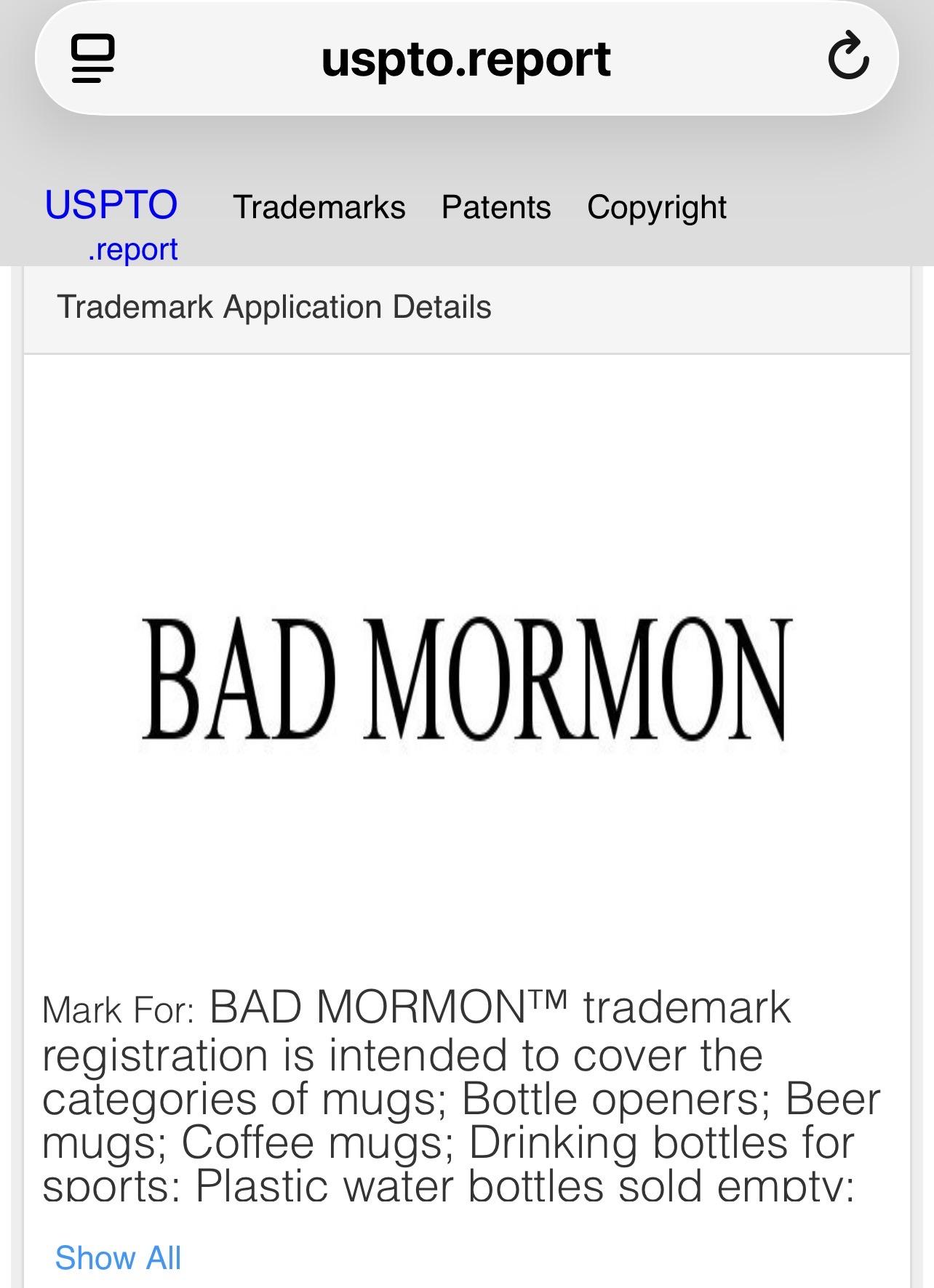
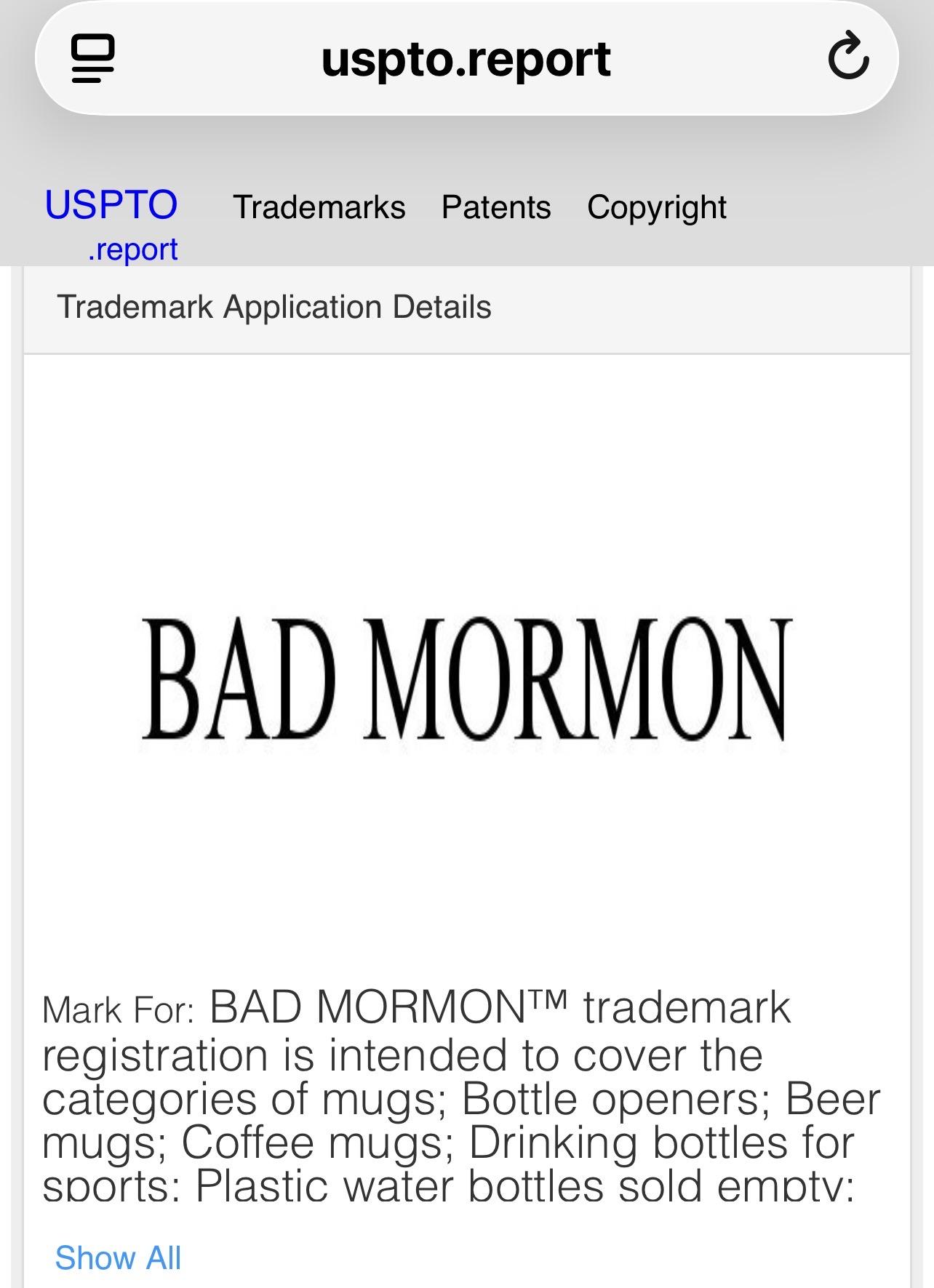
https://ttabvue.uspto.gov/ttabvue/v?pno=91281170&pty=OPP&eno=1 is their filing of opposition. You can read it all there. And Heather Gay could have continued on with the application. It was a voluntary removal. If she had gotten the trademark, she would have been able to use Bad Mormon in all of those things. And the church's only recourse would be to file a lawsuit to break the trademark (similar to what Open Stories is doing in their counter claim). And that would have been really hard to win since she already gained the trademark with their opposition previously filed. Specifically, the trademarks that the church mentioned in their opposition are: "Mormon Messages", "Mormon Channel", "Mormon.org", "Mormon", "Book of Mormon", and "Mormon Tabernacle Choir". The church did the same thing for "Real Mormon" and "Mormon Royalty" and others. You could argue that the church has dropped some of those marks, like "Mormon Tabernacle Choir", "Mormon Channel", "Mormon.org", but that is not as simple as pointing to the style guide or the rename. You have to show that they haven't used the mark anywhere for several years. I've been following an attempt to break Oracle's trademark of the word "Javascript". They hardly use it and have not published or sold anything in the last decade or so that deals with Javascript. Yet, they keep filing renewals and they keep getting those renewals. There have been several attempts to convince the USPTO that Oracle has abandoned the term but because it is used on 1 or 2 pages on all of the Oracle related sites, they keep winning. -
Church's Policy on Surrogacy - Looking for Input
smac97 replied to smac97's topic in General Discussions
I have. I don't think you have addressed it. I think it's about addressing or not addressing a falsehood. A lie. If a 90-pound girl asked her friends and neighbors to acknowledge that she's a big ol' fatty, should they go along with it? Is not going along with "being a jerk?" Or is it me not wanting to perpetuate a falsehood and delusion? If I had Rachel Dolezal as a neighbor, and if she were to ask me to voice my support for her as a "woman of color" running for public office, should I go along with it? If I say no, is that "being a jerk?" Or is it me not wanting to perpetuate a falsehood and delusion? If I had a "trans" co-worker, someone I had to interact with every day, I would probably concede the fight and go along with the falsehood. Both because it would be exhausting to have the co-worker complaint every time someone uses a grammatically correct pronoun and because HR might get involved. Gotta love compelled speech. You subsequently spelled this out in your Q&A post: Q: “Do we need a ‘limiting principle’ governing which bathroom people may use?” A: “Yes. The limiting principle is that people should use the restroom that will minimize discomfort to themselves and to those around them.” SCOTUS Decision: Ban on "Talk" … Across those posts, you articulated four principles: Use the restroom for its ordinary purpose. Your stated purpose is using the toilet and attending to ordinary sanitary needs—not treating restroom access as permission to enter for any purpose whatsoever. You described the ordinary activity as entering, using the toilet, flushing, washing your hands, and leaving. SCOTUS Decision: Ban on "Talk" … SCOTUS Decision: Ban on "Talk" … Exercise individual judgment with consideration for others. You said people should choose the restroom that minimizes discomfort both to themselves and to the people around them, with that decision belonging to the person who needs to use the restroom. That is a responsibility to exercise considerate judgment, not simply “my preferences are all that matter.” You also distinguished discomfort from harm, so your standard is not a guarantee that nobody will ever feel uncomfortable. SCOTUS Decision: Ban on "Talk" … SCOTUS Decision_ Ban on _Talk_ … Prohibit misconduct regardless of the person’s identity. You specifically identified harassment, loitering, intimidation, voyeurism, exhibitionism, and solicitation as conduct subject to restrictions, with the qualification “where appropriate” regarding existing criminal prohibitions. Your formulation was: “The crime isn’t using the ‘wrong’ restroom. The crime is the underlying conduct.” Elsewhere, you explicitly included assault and said misconduct should be prohibited regardless of who commits it. SCOTUS Decision: Ban on "Talk" … SCOTUS Decision_ Ban on _Talk_ … Require justification for government restrictions. This limits government rather than restroom users: you have required evidence of an actual problem and a reason to believe a proposed law would do more good than harm. Your opposition to restroom mandates has been framed around those requirements. SCOTUS Decision_ Ban on _Talk_ … SCOTUS Decision: Ban on "Talk" … Your AI platform is doing well at telling you what you want to hear, but not at identifying limiting principles. "Use the restroom for its ordinary purpose" is not a limiting principle as to who can enter. It is a red herring. Nobody has suggested that restrooms should not be used for their ordinary purpose. "Exercise individual judgment with consideration for others" is not a limiting principle as to who can enter. It's "anyone who wants to can go in." "Prohibit misconduct regardless of the person’s identity" is not a limiting principle as to who can enter. Misconduct (physical/sexual assault, voyeurism, etc.) is already prohibited, and it happens after the person has already entered the bathroom. "Require justification for government restrictions" is not a limiting principle as to who can enter. It's not even trying to be. It's an argument against limiting principles. Not really. And in any event, I was not asking about limiting principles for "appropriate use and behavior." I have been asking about limiting principles as to who can enter into sex-segregated spaces. The closest you have come to that is the "Each person uses the bathroom they are comfortable with" (not the exact wording, but you've said this multiple times). That is not a limiting principle because nobody is limited. Sex-segregated spaces will no longer be segregated by sex, and will be eradicated de jure and/or de facto. You have acknowledged this previously. That's right. You have not. You have not articulate any mechanism to differentiate who may and who may not go into sex-segregated bathrooms. For example, respect without surgery does not logically entail opposition to every eligibility criterion. Supporting healthcare access does not entail rejecting clinical assessment. Calling a particular argument misleading does not entail rejecting evidence. Encouraging public support does not entail requiring agreement with every organizational position. Those implications have to be established—not supplied by the wording of the proposition. The sources document an advocacy program involving identity recognition, nondiscrimination, healthcare access, inclusive facilities, and respectful treatment. They do not establish the entire package of claims about rejecting biology, caution, questions, evidence, and all limiting distinctions. Nor does someone’s support for one of those policies establish agreement with the other nineteen propositions. The appropriate unit of analysis is the specific advocate or organization, its actual statement, and the policy context—not a twenty-point set of beliefs attributed to someone because they support transgender rights. The Walter Martin analogy is backwards. Martin compiled a hostile creed and asked members to sign it. I am asking you claims you accept, or reject, as being generally present in and endorsed by the trans movement. That is the opposite procedure. If the list overreaches or is inaccurate, name the overreach or inaccuracy. “Members of this alleged group should first bless the list” is a way not to answer. I have already said, more than once, that not every transgender person holds every point. The unit I have been talking about is institutional advocacy: HRC, A4TE, Stonewall, WPATH-as-cited-in-advocacy, school and sports policies. ChatGPT is right that a documented policy plus an inference is not the same thing as a twenty-point catechism. Fine. Then we drop the package and do it the way the analysis itself recommends: one advocate, one statement, one policy setting. On the twenty points, I will meet the critique halfway. I will not ask you to ratify a creed. I will ask you to mark five institutional claims that the sources actually support, because ChatGPT already granted them: Gender identity is treated as real and sufficient for recognition without surgery, hormones, or a diagnosis (A4TE, HRC). Institutional advocates mean “trans women are women” as a classification rule, not as a metaphor (David / HRC Senate answers). Restroom and facility access is to follow identity, not the sex marker or surgical status (A4TE). Some major advocacy groups oppose excluding males from women’s sport (Stonewall 2025). Allyship is expected to be active, not merely non-hostile (A4TE). If you agree those five are fair descriptions of those organizations, we can argue the merits. If you think even those five are caricatures, quote the document that retracts or rejects them. You can decline the twenty-point format. I was not presenting it as a "creed," but as a list of commonly-stated declarations/tenets coming from advocates for the "trans community." If they are misrepresentative or inaccurate, please identify which ones and why. I am willing to listen to what you have to say. If you want a different starting list, feel free to formulate what you see as reflecting the basic tenets of trans ideology and advocacy. I'm all ears. Thanks, -Smac -
Church's Policy on Surrogacy - Looking for Input
smac97 replied to smac97's topic in General Discussions
Thank you for your comments. The legal definition is not, I think, an argument. It is the thing we are arguing about. “Fortunately the law differs from your opinion” means: five Justices in 2015 wrote a companionate definition into the Fourteenth Amendment, so the discussion is over. Though that is what happened (and I acknowledge that it is the law of the land), that is not a reply to what marriage is for. It is an appeal to a recent judgment. Loving struck a racial bar on men and women marrying. Obergefell held that sex is idle in the definition. Those are not the same holding. Citing the second as if it were accumulated social consensus, or a vote, skips the work. “Denying citizens the right to marry is not a good decision for the country or the world” is a slogan that does not contain a limit. Incestuous pairs, group marriages, and polygamous households can say the same sentence: we are citizens, we want the license, we would benefit. If the only test is “someone is left out of the current definition,” every restriction fails. The live question is what the institution is, not whether some adults would like a marriage certificate. “Keeping a foundation of marriage for all is a strength” is asserted, not shown. I already granted private goods for some couples — hospital access, inheritance, companionship. You treated that grant as if I had said “zero benefit,” then ignored the costs I listed: the public meaning of the institution, children placed by design in a home with no mother or no father, and a documented pattern of explicit non-monogamy in a large share of male same-sex relationships. “The world is a better place for it” does not engage those points. It scores only the column you like. A small share of gay and lesbian adults are in a same-sex marriage. That is not a reason to deny anyone a license. It is a reason to stop talking as if the license were a universal foundation “for all” that the holdouts are tearing down. “To argue against marriage for even part of the population is to devalue marriage” assumes the conclusion. It assumes marriage is a flexible status whose purpose is adult recognition, so that drawing a line at husband-and-wife is an insult to the institution. On the account I have been using, the line is the institution: the sexual pair that can generate children, and the household that can be a mother and a father. Two men can have a real, loyal, legally useful bond. That does not make the bond the same kind of union. Refusing to collapse the kinds is not “devaluing marriage.” It is refusing to make companionship the whole of it. If you want to say the costs I listed are overstated, say that and point to the data. “The law already says otherwise” and “denying anyone a license devalues marriage” do not do much to advance the discussion. Thanks, -Smac -
Trademark infringement case against Open Stories Foundation
Notatbm replied to Calm's topic in General Discussions
What trademark does the church own that looks like this one?
-
Trademark infringement case against Open Stories Foundation
webbles replied to Calm's topic in General Discussions
If she had gotten a valid trademark from the USPTO, the church would have had a problem with suing her. Because if she has a trademark, the church can't say she is infringing on their trademark with her own trademark. That's not how things work. Also, her book "Bad Mormon" is still published and the church has never attempted to shut it down. It is protected under the Rogers test. If she started to create merchandise and use Bad Mormon as a mark without a proper trademark, then yes, the church probably would sue her, similar to what it is doing with Open Stories. But she isn't use Bad Mormon as a trademark so there is nothing for the church to sue. And no, filing an opposition to a trademark is not an attack. If you ever file for a trademark that is anywhere close to another company's trademark, you will get an opposition filed. That's normal business. Her company should have expected the opposition filing from day 1. -
Trademark infringement case against Open Stories Foundation
Notatbm replied to Calm's topic in General Discussions
Boy brown forman really has a lot of time on their hands. I guess an attorney had to justify his/her existence over that threat to their business. Much like the lds church, brown Forman is circling the drain and while not in its death throes, it has lost substantial market share. -
Trademark infringement case against Open Stories Foundation
Notatbm replied to Calm's topic in General Discussions
Filing opposition… same difference. Do you think if she didn’t abandon it they would have just let it go or would they have sued her? im betting they would sue her into bankruptcy -
Can someone clarify this section. "And after that Zion was taken up into heaven, Enoch beheld, and lo, all the nations of the earth were before him" (Moses 7:23). Enoch is apparently in heaven and beholds all the nations of the earth from above. "And there came generation upon generation; and Enoch was high and lifted up, even in the bosom of the Father, and of the Son of Man; and behold, the power of Satan was upon all the face of the earth. And he saw angels descending out of heaven; and he heard a loud voice saying: Wo, wo be unto the inhabitants of the earth. And he beheld Satan; and he had a great chain in his hand, and it veiled the whole face of the earth with darkness; and he looked up and laughed, and his angels rejoiced. And Enoch beheld angels descending out of heaven, bearing testimony of the Father and Son; and the Holy Ghost fell on many, and they were caught up by the powers of heaven into Zion" (24-27). Is there a large gap of time between when Zion was caught up (verse 23) and when the Holy Ghost fell on many and they too were caught up into Zion (verse 27), which had already been caught up earlier?
-
Trademark infringement case against Open Stories Foundation
webbles replied to Calm's topic in General Discussions
As far as I know, the church didn't go after her. She filed a trademark application and the church filed an opposition to the trademark. The church didn't sue her for her usage of "Bad Mormon" or send her a cease and desist. The church just argued that she couldn't get a trademark for it. -
Trademark infringement case against Open Stories Foundation
Notatbm replied to Calm's topic in General Discussions
The “bad Mormon” trademark didn’t have combo of any of those things. Didn’t stop the church from going after her.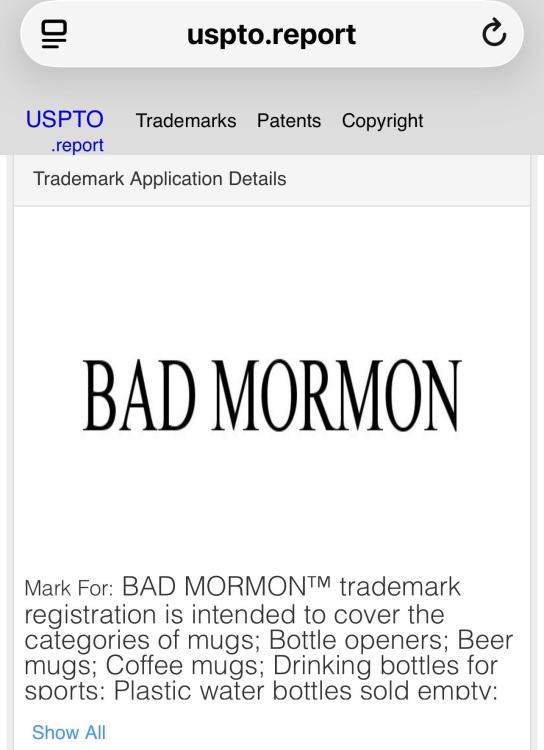
-
Trademark infringement case against Open Stories Foundation
webbles replied to Calm's topic in General Discussions
Here's an example of what the Supreme Court ruled could cause confusion. This is from the Jack Daniel's Properties, Inc. v. VIP Products LLC https://en.wikipedia.org/wiki/Jack_Daniel's_Properties,_Inc._v._VIP_Products_LLC The "Bad Spaniels" was a dog toy. It is not a drink and is not glass. If you held the two, they don't feel anything like each other. The Supreme Court ruled that it was a mixture of the bottle shape, the label color, the label font and the "Spaniels" which made it cause confusion. This is the Supreme Court case that the church is using as its basis. It was decided in 2023 so it is extremely recent and was a 9-0 ruling. -
Trademark infringement case against Open Stories Foundation
webbles replied to Calm's topic in General Discussions
It doesn't have the light ray, it doesn't have Mormon or any other related mark. So, I don't see the confusion. The blue circle by itself isn't the problem. The light rays by itself isn't the problem. The usage of Mormon by itself isn't the problem. -
Hey, if it weren't for Google Gemini, Microsoft Copilot, and you fine folks here, I would have no friends at all!
-
Church's Policy on Surrogacy - Looking for Input
Calm replied to smac97's topic in General Discussions
I found some reviews of the book using the Consensus app. https://physicstoday.aip.org/reviews/the-big-picture-on-the-origins-of-life-meaning-and-the-universe-itself makes it sound delightful, if my brain ever shows up again, this is on my reading list https://www.zygonjournal.org/article/id/14385/. (Saving here to look at tomorrow) Sean Carroll's account provides a clear expression of a very influential reductionist tendency in modern thought but also the tools for a way out of this tendency. Physics remains the paradigm example of precisely verified empirical knowledge, and as such it is difficult not to judge such messy fields as moral philosophy negatively by comparison. However, Carroll rightly resists the extreme reductionist temptation, one in which the onlytrue reality is that discovered by physics. It is disappointing then that he does not extend this liberality to moral philosophy, since the only argument for excluding moral philosophy as a form of genuine knowledge is the extreme reductionist view that any property that does not appear at the level of physics cannot be real. But as we have seen, this argument is unsound, for virtually none of the properties of higher level entities appear at the level of physics. Carroll's pragmatic principle—what is real comes down to what is useful in negotiating reality—leads rather to the conclusion that morality should be taken as objectively real. Nor can it be said that any properties posited by moral philosophy explicitly contradict any principles of physics—no one claims that morality requires violation of any laws of physics. In short, Carroll seems to have been unable to fully extricate himself from the reductionist and scientist tendencies that are so prevalent. What we end up with, as so often in naturalistic philosophies, is a form of mind‐body dualism: there is the physical world, and then there is the product of human minds (values, ideas, logic) which exists on a different level of reality. In contrast, a true pluralistic naturalism provides us with a single, coherent unified theory of rational behavior: all rational processes (science included) presuppose norms; the normative is just as real and fundamental as the descriptive. If so, pluralistic naturalism, rather than undermining moral objectivity, provides strong support for it. https://www.science.org/doi/10.1126/science.aaf6858 -
Church's Policy on Surrogacy - Looking for Input
Calm replied to smac97's topic in General Discussions
Not having a copy of the book and not being able to process it even if I did and not wanting to put myself through the humiliation of trying again (there is something almost traumatic for me to not be able to play in the same sandbox that I used to spend so much time in and anticipated for awhile living my life in), I asked Chat to summarize the book for me. It is embarrassing just saying this to be honest. So is this a sufficient very brief analysis of the premise of the book? One of his additional premises seems to be that every cause of a physical event must be a physical entity participating in the physical laws described by theory. Is this correct in your view and if so, how does he claim to prove this? Seems like it can only be assumed. I believe we have talked about this before and I may have asked a similar question because this feels very familiar. These are the two other threads where you mentioned him before in the last year. https://www.mormondialogue.org/topic/113267-lds-church-files-brief-in-trans-supreme-court-case/page/8/#comment-1210267024 https://www.mormondialogue.org/topic/113267-lds-church-files-brief-in-trans-supreme-court-case/page/8/#comment-1210266543 Found the thread…really don’t like the year limit to this board’s search function. I will be reviewing the thread and seeing if my brain can come up with anything profound. https://www.mormondialogue.org/topic/75889-we-actually-do-know-that-literal-“spirits”-aren’t-real/ -
Trademark infringement case against Open Stories Foundation
Notatbm replied to Calm's topic in General Discussions
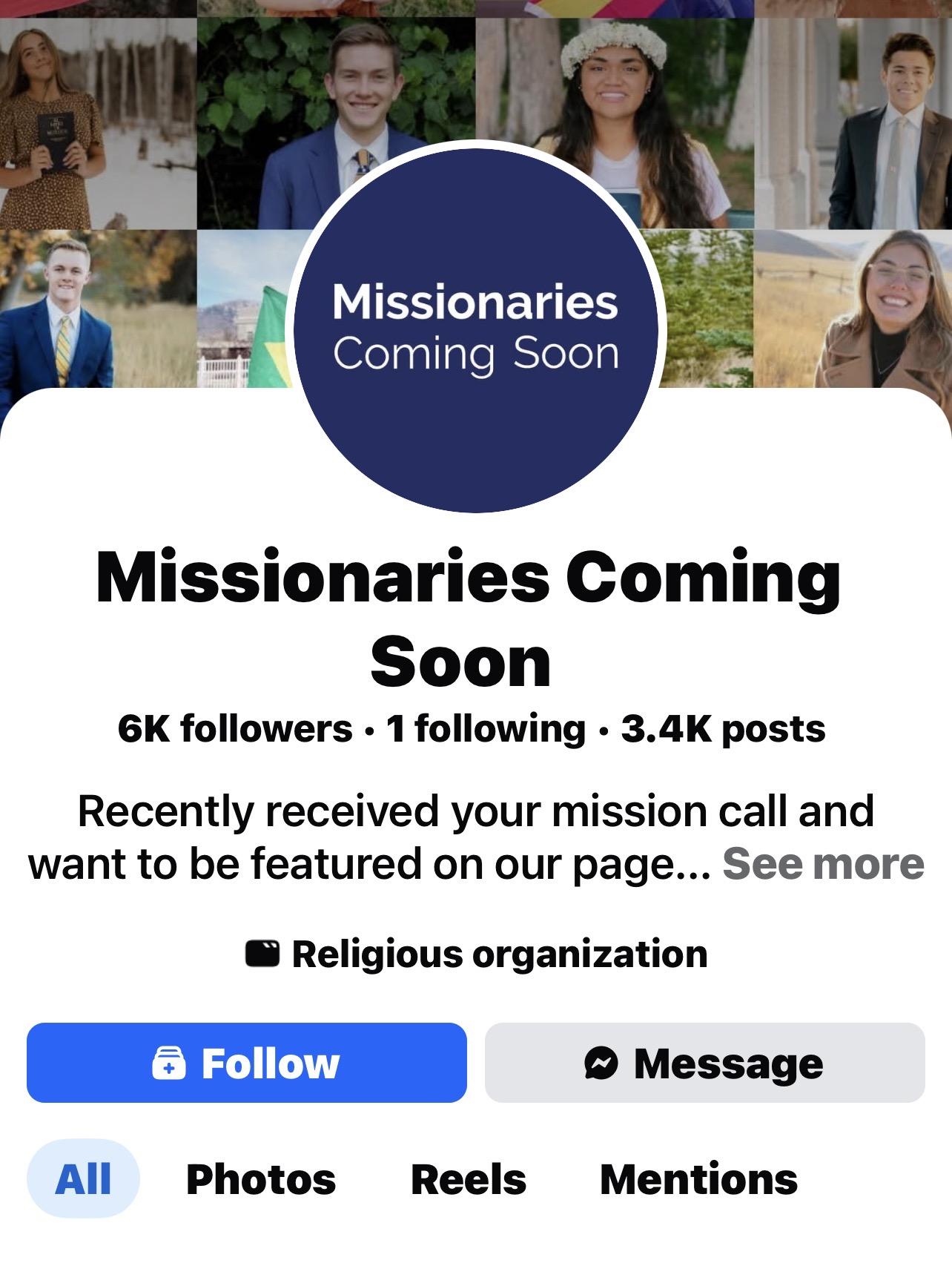
So this showed up in my FB feed. Never seen the page before. So I’m super confused here. This group uses a circle which is blue in color… I thought only the Mormon church can do that. I wonder if the church owns this page? It is possible, but then the name of the church is nowhere to be found. Someone here must be able to figure out if this is a church owned page or not. If not, I’m pretty sure they need to get sued by the church. We can’t have any confusion right??
-

Church's Policy on Surrogacy - Looking for Input
Analytics replied to smac97's topic in General Discussions
Off topic, but I found the following 43-second video the best political short video I've seen in years: There are two problems with this. First, everything that interacts with observable reality in any way is within the purview of science. Second, "the rules of physics really do rule out [revelation]." They can do whatever they want. Compartamentalization is a real thing. Putting things on the shelf is the real thing. Being unaware of some of the extremely strong yet esoteric implications of quantum field theory is a real thing. Cognitive dissonance is a real thing. Not worrying about it is a real thing. Thinking your religion is great culturally but false on a literal level is a real thing. The fact that there are Latter-day Saints in the hard sciences doesn't change what the laws of physics are and what those laws imply. No. Science and religion are in tension when religion makes truth-claims about observable reality that contradict science. That's precisely my point. The Baloney Detection Kit is about subjecting your beliefs to the crucible of scientific thinking so that you stop believing false things. If you want your religious convictions to "survive contact with ordinary life", you should do the opposite of what the Baloney Detection Kit prescribes. It isn't just for things that are fraud. It's for any new idea that could be fraud; for all "new ideas that are offered for consideration." In the words of Sagan: In the course of their training, scientists are equipped with a baloney detection kit. The kit is brought out as a matter of course whenever new ideas are offered for consideration. If the new idea survives examination by the tools in our kit, we grant it warm, although tentative, acceptance. If you’re so inclined, if you don’t want to buy baloney even when it’s reassuring to do so, there are precautions that can be taken; there’s a tried-and-true, consumer-tested method. What’s in the kit? Tools for skeptical thinking. Sagan, Carl. The Demon-Haunted World: Science as a Candle in the Dark (pp. 209-210). (Function). Kindle Edition. Tell me you haven't read The Big Picture without telling me you haven't read The Big Picture. No. It isn't a philosophical position about physicalism. It's the laws of physics that have resulted from incredibly detailed and expensive studies that were conducted over the course of decades. The verdict is unambiguous: we’ve found all of the particles that our best current technology enables us to find. Crossing symmetry assures us that, if there were any particles lurking around us that interact with ordinary matter strongly enough to make a difference to the behavior of everyday stuff, those particles should have easily been produced in experiments. But there’s nothing there. There are probably more particles yet to be found. They just won’t be relevant to our everyday world. Carroll, Sean M. . The Big Picture: On the Origins of Life, Meaning, and the Universe Itself (pp. 182-183). (Function). Kindle Edition. I understand how you think he is merely saying that science hasn't detected how our spirits interface with our bodies, but if they looked more closley in the right place, they'd figure it out. In theory that could be true, but what you are claiming is "that modern physics is profoundly wrong in a way that has so far eluded every controlled experiment ever performed." Carroll, Sean M. . The Big Picture: On the Origins of Life, Meaning, and the Universe Itself (p. 212). (Function). Kindle Edition. Of course you are free to believe that God is so powerful that he can make modern physics profoundly wrong in a way that has so far eluded every controlled experiment ever performed. Philisophically, anything is possible. But if you are going to claim that Carroll is wrong about physics, at least have the common courtesy to read his book and not merely declare that he is wrong because the results aren't intuitive to you and contradict your religious beliefs. You completely miss the point. Before the experiment was done, "it was a foregone conclusion" that psychic powers don't exist because that would break rock-solid laws of physics. Likewise, it is a foregone conclusion that spirits and revelation don't exist, because such things also break the same rock-solid laws of physics. The only reason I brought this Pinker quote up is to quote how National Academy of Science scientists such as Pinker interpret Carroll and the language they use when describing how much confidence science has in their scientific conclusions and what those conclusions imply. They use words like "foregone conclusion," "infinitesimal prior probability," "disproven the laws of physics", and "the laws of physics rule out precognition and [spirits and revelation]." I understand that you think claiming "God can do anything!" outweighs all this. But God could have an elaborate scheme going on to make it appear that the earth is round when it's really flat, couldn't He? How could scientists possibly know God isn't pulling that trick on us? Tell me you haven't read The Big Picture without telling me you haven't read The Big Picture.