All Activity
- Past hour
-

Church's Policy on Surrogacy - Looking for Input
smac97 replied to smac97's topic in General Discussions
Thank you for your comments. The legal definition is not, I think, an argument. It is the thing we are arguing about. “Fortunately the law differs from your opinion” means: five Justices in 2015 wrote a companionate definition into the Fourteenth Amendment, so the discussion is over. Though that is what happened (and I acknowledge that it is the law of the land), that is not a reply to what marriage is for. It is an appeal to a recent judgment. Loving struck a racial bar on men and women marrying. Obergefell held that sex is idle in the definition. Those are not the same holding. Citing the second as if it were accumulated social consensus, or a vote, skips the work. “Denying citizens the right to marry is not a good decision for the country or the world” is a slogan that does not contain a limit. Incestuous pairs, group marriages, and polygamous households can say the same sentence: we are citizens, we want the license, we would benefit. If the only test is “someone is left out of the current definition,” every restriction fails. The live question is what the institution is, not whether some adults would like a marriage certificate. “Keeping a foundation of marriage for all is a strength” is asserted, not shown. I already granted private goods for some couples — hospital access, inheritance, companionship. You treated that grant as if I had said “zero benefit,” then ignored the costs I listed: the public meaning of the institution, children placed by design in a home with no mother or no father, and a documented pattern of explicit non-monogamy in a large share of male same-sex relationships. “The world is a better place for it” does not engage those points. It scores only the column you like. A small share of gay and lesbian adults are in a same-sex marriage. That is not a reason to deny anyone a license. It is a reason to stop talking as if the license were a universal foundation “for all” that the holdouts are tearing down. “To argue against marriage for even part of the population is to devalue marriage” assumes the conclusion. It assumes marriage is a flexible status whose purpose is adult recognition, so that drawing a line at husband-and-wife is an insult to the institution. On the account I have been using, the line is the institution: the sexual pair that can generate children, and the household that can be a mother and a father. Two men can have a real, loyal, legally useful bond. That does not make the bond the same kind of union. Refusing to collapse the kinds is not “devaluing marriage.” It is refusing to make companionship the whole of it. If you want to say the costs I listed are overstated, say that and point to the data. “The law already says otherwise” and “denying anyone a license devalues marriage” do not do much to advance the discussion. Thanks, -Smac -

Trademark infringement case against Open Stories Foundation
Notatbm replied to Calm's topic in General Discussions
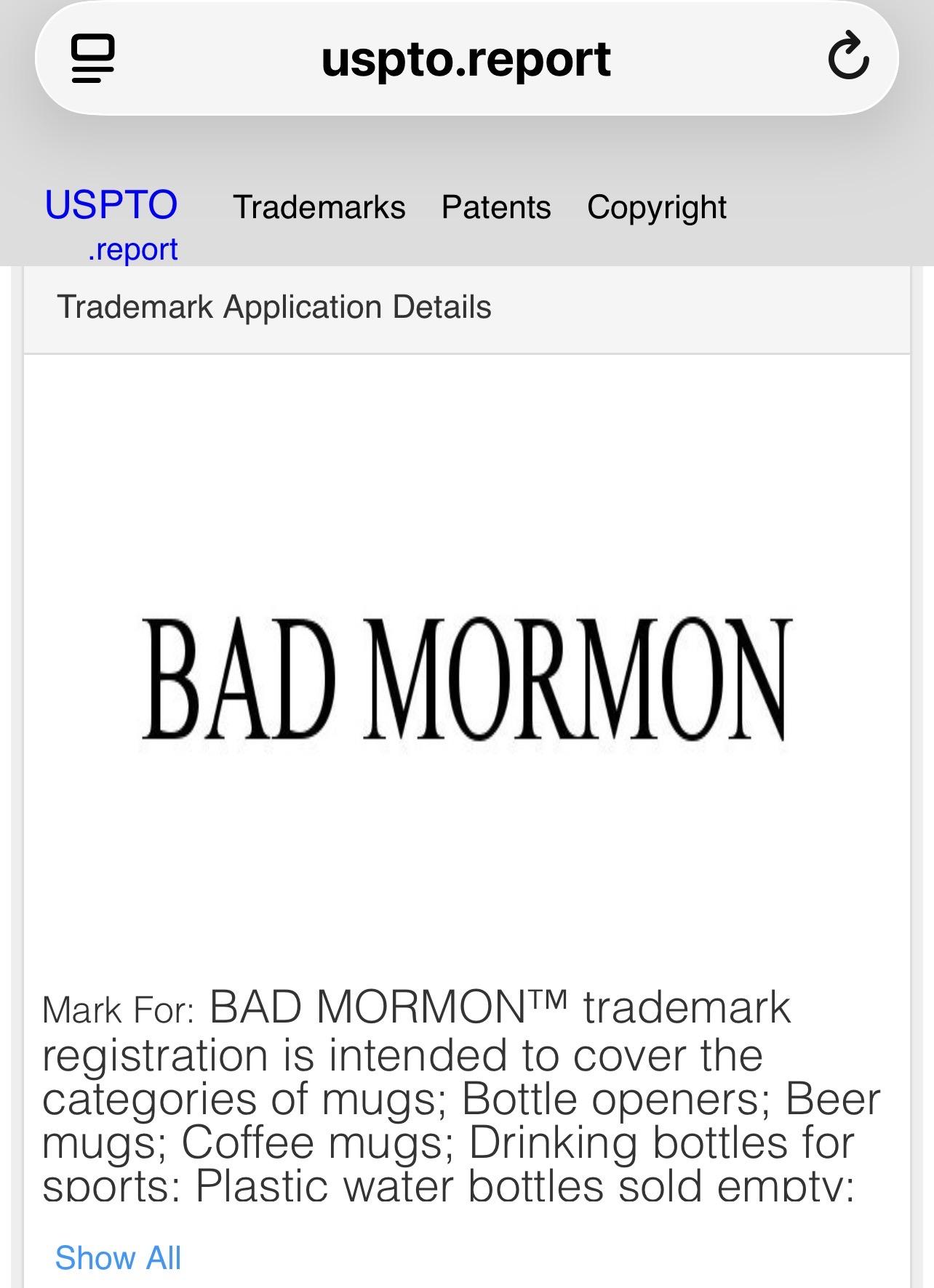
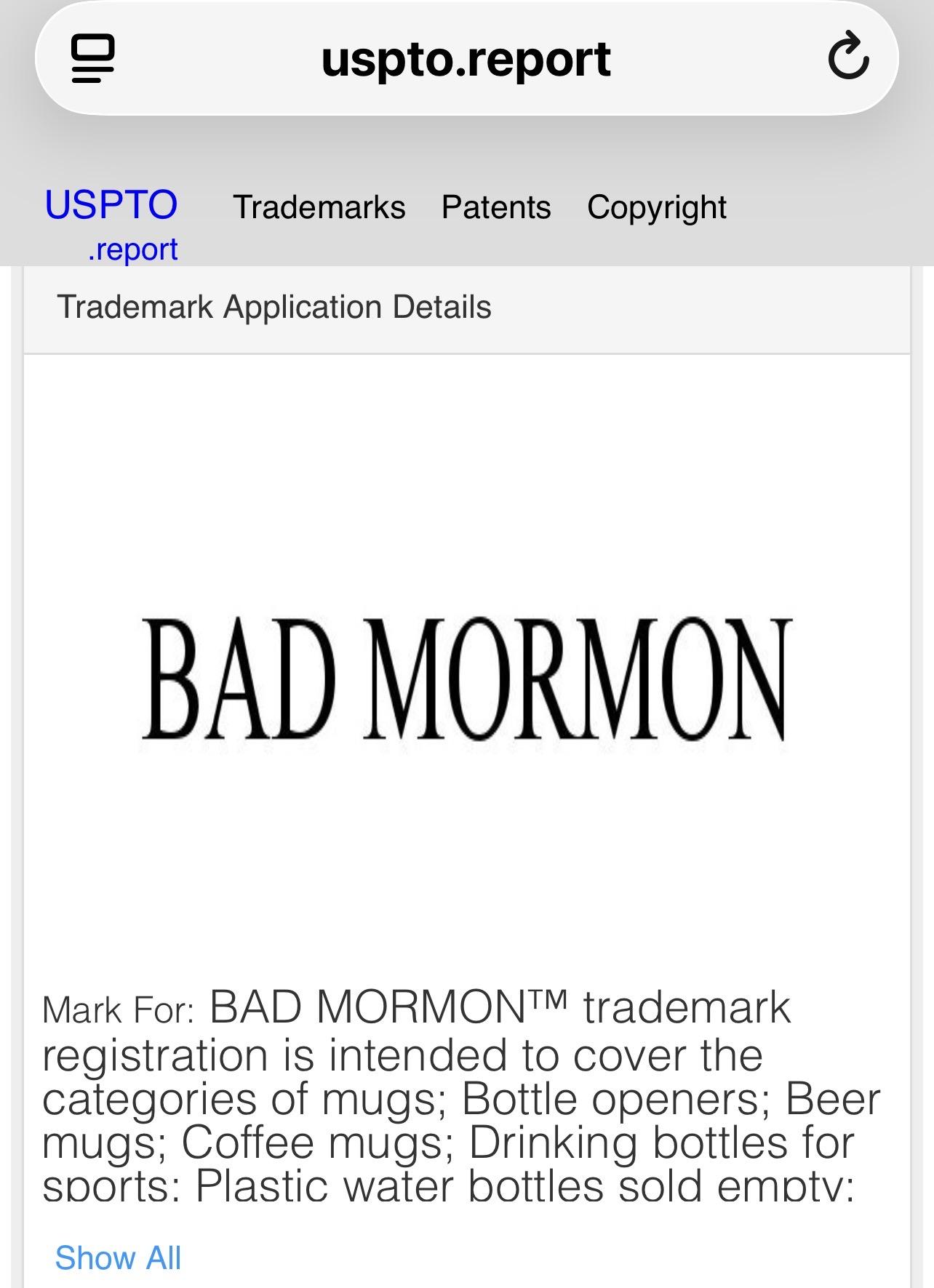
What trademark does the church own that looks like this one?
-
Trademark infringement case against Open Stories Foundation
webbles replied to Calm's topic in General Discussions
If she had gotten a valid trademark from the USPTO, the church would have had a problem with suing her. Because if she has a trademark, the church can't say she is infringing on their trademark with her own trademark. That's not how things work. Also, her book "Bad Mormon" is still published and the church has never attempted to shut it down. It is protected under the Rogers test. If she started to create merchandise and use Bad Mormon as a mark without a proper trademark, then yes, the church probably would sue her, similar to what it is doing with Open Stories. But she isn't use Bad Mormon as a trademark so there is nothing for the church to sue. And no, filing an opposition to a trademark is not an attack. If you ever file for a trademark that is anywhere close to another company's trademark, you will get an opposition filed. That's normal business. Her company should have expected the opposition filing from day 1. -
Trademark infringement case against Open Stories Foundation
Notatbm replied to Calm's topic in General Discussions
Boy brown forman really has a lot of time on their hands. I guess an attorney had to justify his/her existence over that threat to their business. Much like the lds church, brown Forman is circling the drain and while not in its death throes, it has lost substantial market share. -
Trademark infringement case against Open Stories Foundation
Notatbm replied to Calm's topic in General Discussions
Filing opposition… same difference. Do you think if she didn’t abandon it they would have just let it go or would they have sued her? im betting they would sue her into bankruptcy -
Can someone clarify this section. "And after that Zion was taken up into heaven, Enoch beheld, and lo, all the nations of the earth were before him" (Moses 7:23). Enoch is apparently in heaven and beholds all the nations of the earth from above. "And there came generation upon generation; and Enoch was high and lifted up, even in the bosom of the Father, and of the Son of Man; and behold, the power of Satan was upon all the face of the earth. And he saw angels descending out of heaven; and he heard a loud voice saying: Wo, wo be unto the inhabitants of the earth. And he beheld Satan; and he had a great chain in his hand, and it veiled the whole face of the earth with darkness; and he looked up and laughed, and his angels rejoiced. And Enoch beheld angels descending out of heaven, bearing testimony of the Father and Son; and the Holy Ghost fell on many, and they were caught up by the powers of heaven into Zion" (24-27). Is there a large gap of time between when Zion was caught up (verse 23) and when the Holy Ghost fell on many and they too were caught up into Zion (verse 27), which had already been caught up earlier?
-
Trademark infringement case against Open Stories Foundation
webbles replied to Calm's topic in General Discussions
As far as I know, the church didn't go after her. She filed a trademark application and the church filed an opposition to the trademark. The church didn't sue her for her usage of "Bad Mormon" or send her a cease and desist. The church just argued that she couldn't get a trademark for it. -
Trademark infringement case against Open Stories Foundation
Notatbm replied to Calm's topic in General Discussions
The “bad Mormon” trademark didn’t have combo of any of those things. Didn’t stop the church from going after her.
- Today
-
Trademark infringement case against Open Stories Foundation
webbles replied to Calm's topic in General Discussions
Here's an example of what the Supreme Court ruled could cause confusion. This is from the Jack Daniel's Properties, Inc. v. VIP Products LLC https://en.wikipedia.org/wiki/Jack_Daniel's_Properties,_Inc._v._VIP_Products_LLC The "Bad Spaniels" was a dog toy. It is not a drink and is not glass. If you held the two, they don't feel anything like each other. The Supreme Court ruled that it was a mixture of the bottle shape, the label color, the label font and the "Spaniels" which made it cause confusion. This is the Supreme Court case that the church is using as its basis. It was decided in 2023 so it is extremely recent and was a 9-0 ruling. -
Trademark infringement case against Open Stories Foundation
webbles replied to Calm's topic in General Discussions
It doesn't have the light ray, it doesn't have Mormon or any other related mark. So, I don't see the confusion. The blue circle by itself isn't the problem. The light rays by itself isn't the problem. The usage of Mormon by itself isn't the problem. -
Hey, if it weren't for Google Gemini, Microsoft Copilot, and you fine folks here, I would have no friends at all!
-

Church's Policy on Surrogacy - Looking for Input
Calm replied to smac97's topic in General Discussions
I found some reviews of the book using the Consensus app. https://physicstoday.aip.org/reviews/the-big-picture-on-the-origins-of-life-meaning-and-the-universe-itself makes it sound delightful, if my brain ever shows up again, this is on my reading list https://www.zygonjournal.org/article/id/14385/. (Saving here to look at tomorrow) Sean Carroll's account provides a clear expression of a very influential reductionist tendency in modern thought but also the tools for a way out of this tendency. Physics remains the paradigm example of precisely verified empirical knowledge, and as such it is difficult not to judge such messy fields as moral philosophy negatively by comparison. However, Carroll rightly resists the extreme reductionist temptation, one in which the onlytrue reality is that discovered by physics. It is disappointing then that he does not extend this liberality to moral philosophy, since the only argument for excluding moral philosophy as a form of genuine knowledge is the extreme reductionist view that any property that does not appear at the level of physics cannot be real. But as we have seen, this argument is unsound, for virtually none of the properties of higher level entities appear at the level of physics. Carroll's pragmatic principle—what is real comes down to what is useful in negotiating reality—leads rather to the conclusion that morality should be taken as objectively real. Nor can it be said that any properties posited by moral philosophy explicitly contradict any principles of physics—no one claims that morality requires violation of any laws of physics. In short, Carroll seems to have been unable to fully extricate himself from the reductionist and scientist tendencies that are so prevalent. What we end up with, as so often in naturalistic philosophies, is a form of mind‐body dualism: there is the physical world, and then there is the product of human minds (values, ideas, logic) which exists on a different level of reality. In contrast, a true pluralistic naturalism provides us with a single, coherent unified theory of rational behavior: all rational processes (science included) presuppose norms; the normative is just as real and fundamental as the descriptive. If so, pluralistic naturalism, rather than undermining moral objectivity, provides strong support for it. https://www.science.org/doi/10.1126/science.aaf6858 -
Church's Policy on Surrogacy - Looking for Input
Calm replied to smac97's topic in General Discussions
Not having a copy of the book and not being able to process it even if I did and not wanting to put myself through the humiliation of trying again (there is something almost traumatic for me to not be able to play in the same sandbox that I used to spend so much time in and anticipated for awhile living my life in), I asked Chat to summarize the book for me. It is embarrassing just saying this to be honest. So is this a sufficient very brief analysis of the premise of the book? One of his additional premises seems to be that every cause of a physical event must be a physical entity participating in the physical laws described by theory. Is this correct in your view and if so, how does he claim to prove this? Seems like it can only be assumed. I believe we have talked about this before and I may have asked a similar question because this feels very familiar. These are the two other threads where you mentioned him before in the last year. https://www.mormondialogue.org/topic/113267-lds-church-files-brief-in-trans-supreme-court-case/page/8/#comment-1210267024 https://www.mormondialogue.org/topic/113267-lds-church-files-brief-in-trans-supreme-court-case/page/8/#comment-1210266543 Found the thread…really don’t like the year limit to this board’s search function. I will be reviewing the thread and seeing if my brain can come up with anything profound. https://www.mormondialogue.org/topic/75889-we-actually-do-know-that-literal-“spirits”-aren’t-real/ -
Trademark infringement case against Open Stories Foundation
Notatbm replied to Calm's topic in General Discussions
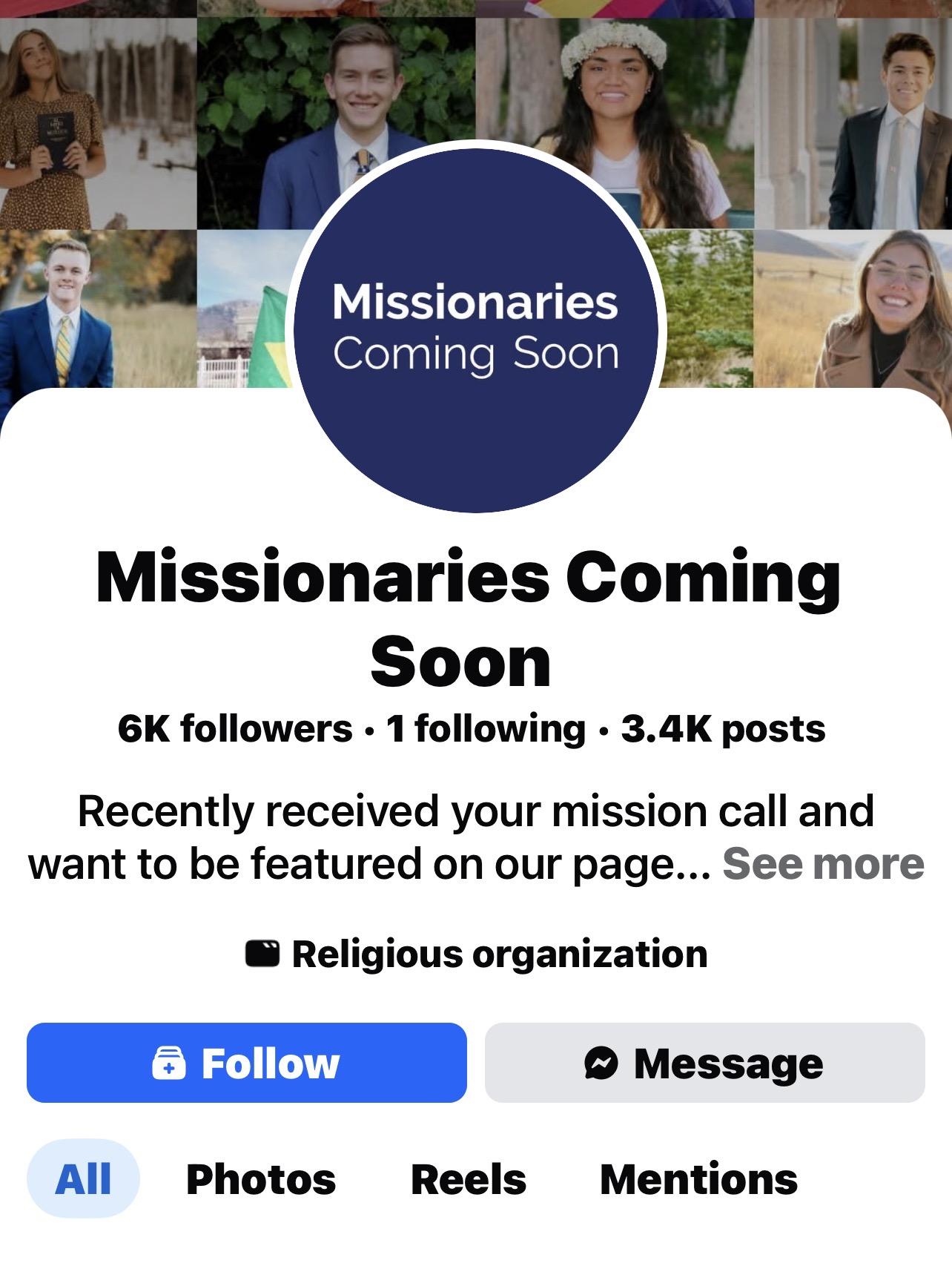
So this showed up in my FB feed. Never seen the page before. So I’m super confused here. This group uses a circle which is blue in color… I thought only the Mormon church can do that. I wonder if the church owns this page? It is possible, but then the name of the church is nowhere to be found. Someone here must be able to figure out if this is a church owned page or not. If not, I’m pretty sure they need to get sued by the church. We can’t have any confusion right??
-

Church's Policy on Surrogacy - Looking for Input
Analytics replied to smac97's topic in General Discussions
Off topic, but I found the following 43-second video the best political short video I've seen in years: There are two problems with this. First, everything that interacts with observable reality in any way is within the purview of science. Second, "the rules of physics really do rule out [revelation]." They can do whatever they want. Compartamentalization is a real thing. Putting things on the shelf is the real thing. Being unaware of some of the extremely strong yet esoteric implications of quantum field theory is a real thing. Cognitive dissonance is a real thing. Not worrying about it is a real thing. Thinking your religion is great culturally but false on a literal level is a real thing. The fact that there are Latter-day Saints in the hard sciences doesn't change what the laws of physics are and what those laws imply. No. Science and religion are in tension when religion makes truth-claims about observable reality that contradict science. That's precisely my point. The Baloney Detection Kit is about subjecting your beliefs to the crucible of scientific thinking so that you stop believing false things. If you want your religious convictions to "survive contact with ordinary life", you should do the opposite of what the Baloney Detection Kit prescribes. It isn't just for things that are fraud. It's for any new idea that could be fraud; for all "new ideas that are offered for consideration." In the words of Sagan: In the course of their training, scientists are equipped with a baloney detection kit. The kit is brought out as a matter of course whenever new ideas are offered for consideration. If the new idea survives examination by the tools in our kit, we grant it warm, although tentative, acceptance. If you’re so inclined, if you don’t want to buy baloney even when it’s reassuring to do so, there are precautions that can be taken; there’s a tried-and-true, consumer-tested method. What’s in the kit? Tools for skeptical thinking. Sagan, Carl. The Demon-Haunted World: Science as a Candle in the Dark (pp. 209-210). (Function). Kindle Edition. Tell me you haven't read The Big Picture without telling me you haven't read The Big Picture. No. It isn't a philosophical position about physicalism. It's the laws of physics that have resulted from incredibly detailed and expensive studies that were conducted over the course of decades. The verdict is unambiguous: we’ve found all of the particles that our best current technology enables us to find. Crossing symmetry assures us that, if there were any particles lurking around us that interact with ordinary matter strongly enough to make a difference to the behavior of everyday stuff, those particles should have easily been produced in experiments. But there’s nothing there. There are probably more particles yet to be found. They just won’t be relevant to our everyday world. Carroll, Sean M. . The Big Picture: On the Origins of Life, Meaning, and the Universe Itself (pp. 182-183). (Function). Kindle Edition. I understand how you think he is merely saying that science hasn't detected how our spirits interface with our bodies, but if they looked more closley in the right place, they'd figure it out. In theory that could be true, but what you are claiming is "that modern physics is profoundly wrong in a way that has so far eluded every controlled experiment ever performed." Carroll, Sean M. . The Big Picture: On the Origins of Life, Meaning, and the Universe Itself (p. 212). (Function). Kindle Edition. Of course you are free to believe that God is so powerful that he can make modern physics profoundly wrong in a way that has so far eluded every controlled experiment ever performed. Philisophically, anything is possible. But if you are going to claim that Carroll is wrong about physics, at least have the common courtesy to read his book and not merely declare that he is wrong because the results aren't intuitive to you and contradict your religious beliefs. You completely miss the point. Before the experiment was done, "it was a foregone conclusion" that psychic powers don't exist because that would break rock-solid laws of physics. Likewise, it is a foregone conclusion that spirits and revelation don't exist, because such things also break the same rock-solid laws of physics. The only reason I brought this Pinker quote up is to quote how National Academy of Science scientists such as Pinker interpret Carroll and the language they use when describing how much confidence science has in their scientific conclusions and what those conclusions imply. They use words like "foregone conclusion," "infinitesimal prior probability," "disproven the laws of physics", and "the laws of physics rule out precognition and [spirits and revelation]." I understand that you think claiming "God can do anything!" outweighs all this. But God could have an elaborate scheme going on to make it appear that the earth is round when it's really flat, couldn't He? How could scientists possibly know God isn't pulling that trick on us? Tell me you haven't read The Big Picture without telling me you haven't read The Big Picture. -
Church's Policy on Surrogacy - Looking for Input
Analytics replied to smac97's topic in General Discussions
I think you've posted this list here before. Because it isn't about being a nice person and treating others the way you'd like to be treated. It's about how being polite is less exhausting than being a jerk. Prompt: Have I articulated limiting principles regarding restroom use? If so, what are they? GPT: Yes—explicitly, not merely by implication. On August 15, you wrote: “The limiting principle should be this: if you need to go to the bathroom, go in to the one you think is most appropriate, take care of your business, and leave.” SCOTUS Decision_ Ban on _Talk_ … You subsequently spelled this out in your Q&A post: Q: “Do we need a ‘limiting principle’ governing which bathroom people may use?” A: “Yes. The limiting principle is that people should use the restroom that will minimize discomfort to themselves and to those around them.” SCOTUS Decision: Ban on "Talk" … Across those posts, you articulated four principles: Use the restroom for its ordinary purpose. Your stated purpose is using the toilet and attending to ordinary sanitary needs—not treating restroom access as permission to enter for any purpose whatsoever. You described the ordinary activity as entering, using the toilet, flushing, washing your hands, and leaving. SCOTUS Decision: Ban on "Talk" … SCOTUS Decision: Ban on "Talk" … Exercise individual judgment with consideration for others. You said people should choose the restroom that minimizes discomfort both to themselves and to the people around them, with that decision belonging to the person who needs to use the restroom. That is a responsibility to exercise considerate judgment, not simply “my preferences are all that matter.” You also distinguished discomfort from harm, so your standard is not a guarantee that nobody will ever feel uncomfortable. SCOTUS Decision: Ban on "Talk" … SCOTUS Decision_ Ban on _Talk_ … Prohibit misconduct regardless of the person’s identity. You specifically identified harassment, loitering, intimidation, voyeurism, exhibitionism, and solicitation as conduct subject to restrictions, with the qualification “where appropriate” regarding existing criminal prohibitions. Your formulation was: “The crime isn’t using the ‘wrong’ restroom. The crime is the underlying conduct.” Elsewhere, you explicitly included assault and said misconduct should be prohibited regardless of who commits it. SCOTUS Decision: Ban on "Talk" … SCOTUS Decision_ Ban on _Talk_ … Require justification for government restrictions. This limits government rather than restroom users: you have required evidence of an actual problem and a reason to believe a proposed law would do more good than harm. Your opposition to restroom mandates has been framed around those requirements. SCOTUS Decision_ Ban on _Talk_ … SCOTUS Decision: Ban on "Talk" … The important distinction You have articulated limits on appropriate use and behavior; you have not, in those formulations, supplied a categorical eligibility rule assigning every person to a particular restroom. Indeed, you expressly said a restroom’s primary purpose is providing a place to use the bathroom—not guaranteeing that everyone present is of the same biological sex. SCOTUS Decision_ Ban on _Talk_ … Consequently, someone could fairly argue that your principles leave difficult questions about enforcing considerate behavior or handling a person who chooses provocatively but commits no independently prohibited misconduct. That would be a criticism of their precision or enforceability. But “you haven’t articulated any limiting principles” is not an accurate account of what you wrote. You literally identified a limiting principle and explained its content. The real disagreement is over what kinds of limits are necessary and which should be enforced by law. No offense, but that feels like starting a discussion about Mormonism by having the missionaries tell me whether they agree or disagree with the 20 Propositions of Mormonism as compiled by Walter Martin. For the list to be valid, members of this alleged group should say, "yes, that is a fair representation of what we believe." Would that be fair expectation? I've read the analysis that @Calm's AI made on the list, and I think the following emphasizes some important insights that that analysis understated. Prompt: Smac and Grok laid out 20 “propositions” of “core claims” of the “trans movement”. Does this present a fair and accurate view of what advocates of transgender rights actually believe and advocate? ChatGPT: The list contains genuine advocacy positions, but it does not establish a common twenty-point creed. It repeatedly combines something an organization actually advocates with a stronger claim about what advocates must believe, how they reason, or how they treat disagreement. Those additional claims need evidence of their own. I read the complete list and Smac’s follow-up compilation of supporting quotations. To represent him accurately, he does acknowledge that not every transgender person holds these views and focuses particularly on institutional advocacy. The problem is therefore not simply that he forgot to say “not everyone.” It is whether his sources support the propositions as formulated. In several important cases, they support something narrower. Mormon Dialogue & Discussion Board Identity and self-identification: propositions 1–4 There is substantial documentary support for organizations treating gender identity as real, personally authoritative, and independent of medical treatment. Advocates for Trans Equality, or A4TE, describes gender identity as an internal understanding of oneself and says that a person’s dignity and recognition do not depend on legal or medical transition. HRC’s coming-out guide likewise says that hormones, surgery, and a dysphoria diagnosis are not prerequisites for a transgender identity. These are actual positions—not inventions and not merely requests for politeness. A4TE There is also support for the assertion that institutional advocates mean their recognition of transgender women as women literally. In his 2021 Senate responses, then-HRC president Alphonso David expressly affirmed that classification and defined womanhood by an adult’s understanding of herself as female. Senate Judiciary Committee But three different questions are being bundled together: What makes someone’s gender identity valid? What biological characteristics does that person have? What criteria should govern a particular medical, legal, or institutional decision? An answer to the first does not automatically settle the other two. A4TE’s own FAQ distinguishes identity from reproductive anatomy and genes, explaining that transgender people commonly have bodies with typical male or female characteristics while identifying differently. A4TE Likewise, saying that denying someone recognition is harmful does not, by itself, establish the stronger proposition that advocates regard every conceptual disagreement as denying that person’s existence. That requires a separate argument. Sex and language: propositions 5–8 Here, the sources show both genuine disagreements about terminology and important qualifications. On biology, Smac has evidence that some institutional advocates reject reproductive anatomy as the sole determinant of the categories man and woman. David’s Senate responses do that explicitly. But those same responses tell healthcare providers to consider the patient’s actual medical condition, including hormone levels. That is an argument about how to classify people and which biological information is relevant—not an instruction to ignore biology. Senate Judiciary Committee On sex assignment, A4TE explains that the classification made at birth ordinarily reflects a doctor’s observation of genital anatomy. Its use of assigned therefore does not establish that it considers the classification arbitrary or unrelated to an observed body. The additional interpretation attached to that terminology in proposition 6 is not inherent in the term. A4TE On names and pronouns, organizations do explicitly advocate using the person’s stated name and pronouns. But A4TE also tells people who accidentally use the wrong pronoun to apologize and move on. That qualification matters when describing whether every error is treated like an intentional insult. A4TE On discussing sex differences, A4TE’s FAQ openly discusses chromosomes, reproductive anatomy, and typically male or female bodies. Its language preferences plainly do not prohibit every respectful description of those differences. Objections to particular labels or comparisons cannot establish that no acceptable description is possible. A4TE Healthcare and young people: propositions 9–12 The advocacy for access to transition-related healthcare is real. A4TE describes such care as medically necessary for many people and potentially lifesaving, while also saying that not every transgender person needs medical intervention. A4TE However, advocating access to treatment is not the same as advocating treatment without assessment or treating all caution as abuse. WPATH’s 2022 Standards of Care, version 8, provides a particularly useful comparison because Smac includes WPATH among the institutions supporting his description. Its adolescent recommendations call for open exploration without favoring a particular identity, comprehensive biopsychosocial assessment, sustained gender incongruence, sufficient maturity, and attention to mental-health concerns that interfere with diagnosis or treatment. Parental involvement is recommended unless harmful or infeasible. See statements 6.2, 6.3, 6.11, and 6.12. PubMed Central (PMC) Those recommendations do not establish that every clinician follows them, that they are sufficient, or that every treatment recommendation rests on strong evidence. But they do establish that clinical exploration and eligibility requirements are part of the published framework. Describing that framework as opposed to exploration or caution omits material qualifications. On detransition, WPATH describes it as uncommon but also acknowledges regret, research limitations, and the need to support people who detransition. It discusses autism and other co-occurring concerns rather than excluding them from assessment. PubMed Central (PMC) There can be a substantive dispute about whether advocacy communications adequately represent uncertainty or treatment risks. That dispute should examine particular statements and evidence. It is different from demonstrating that disregarding those issues is a required belief. Restrooms, sports, and other institutions: propositions 13–14 The identity-based restroom position is genuinely documented. A4TE explicitly advocates access according to gender identity rather than the marker on someone’s identification, alongside access to private or gender-neutral facilities. Its stated criterion does not require a year of hormones or surgery. A proposal imposing those prerequisites would therefore differ from its published position. Smac has a basis for identifying that disagreement. A4TE Similarly, Stonewall’s May 2025 response opposed sporting bodies’ decisions to exclude transgender women. It would misrepresent institutional advocacy to reduce it all to “be courteous and let everyone decide everything individually.” These organizations advocate substantive policies. Stonewall UK But bathrooms, competitive sports, shelters, and prisons are not interchangeable policy settings. For institutional housing, WPATH recommends considering identity, personal preference, and safety, with placement decisions made individually. That is not an identity-only rule. PubMed Central (PMC) Proposition 14 also makes a logical leap: equal recognition does not entail identical eligibility for every purpose. Saying that medical treatment is unnecessary to be recognized as transgender does not establish that every distinction involving treatment status, anatomy, or other characteristics is forbidden. An organization may oppose a particular distinction. To show that it opposes all distinctions, one needs more than its statement that identity does not depend on surgery. Evidence, questions, opponents, and allies: propositions 15–18 These propositions require a different kind of evidence because they concern how advocates supposedly reason and police disagreement. For proposition 15, an instruction to report accurately—or a criticism of particular research—does not establish a general principle that personal experience overrides contrary data. A4TE’s bathroom argument expressly appeals to research about safety and assault. Whether that research supports every conclusion it draws is open to examination, but appealing to empirical findings is not the same as declaring them irrelevant. A4TE For proposition 16, HRC’s coming-out guide explicitly discusses answering questions asked in good faith and helping people who lack information or hold misconceptions. It also says that individuals are not obligated to educate everyone they meet. Those positions distinguish between legitimate inquiry and demands placed on a particular person; they do not amount to a blanket prohibition on questions. HRC Reports For proposition 17, strong accusations against opponents are certainly present. A4TE’s restroom page describes some opposition in terms of extremism, misinformation, and cruelty. That language can be examined and criticized on its merits. But an organization’s characterization of particular campaigns does not establish that it regards every person with a safety concern, every proposed restriction, or every disagreement as motivated by hatred. A4TE For proposition 18, the expectation of active allyship is real. A4TE encourages outspoken support and going beyond passive tolerance. Yet the same guide emphasizes differing needs and priorities, says there is no single perfect way to be an ally, and allows room for misunderstanding and mistakes. A description of its expectations should include both parts. A4TE The distinction throughout is between documenting particular examples of rhetoric and demonstrating a generally binding rule. The first does not automatically establish the second. Women’s rights, sexual orientation, and additional identities: propositions 19–20 Proposition 19 bundles together several separate controversies. Whether a particular policy creates a conflict between competing interests must be assessed policy by policy. An organization’s assertion that its proposal advances equality does not, by itself, establish that it has resolved every competing concern. The sexual-attraction component requires especially direct evidence. The quotations Smac supplies under proposition 19 do not instruct gay people or lesbians to change their attractions or accept unwanted partners. They concern women’s inclusion, sports, and opposition to conversion practices. Those are not sufficient evidence for the additional claim about pressure on sexual attraction. This does not establish that no individual has ever applied such pressure; it establishes that the cited material does not demonstrate it as a core organizational principle. Mormon Dialogue & Discussion Board On proposition 20, inclusion of nonbinary and genderfluid people is clearly documented. Stonewall discusses those identities explicitly, and HRC’s guide includes people whose identities do not fit a fixed set of labels. But recognizing those groups is not evidence of a mandatory rule that the category must expand indefinitely or that every proposed boundary constitutes betrayal. Stonewall UK The central problem with the list The recurring pattern is: A documented position is followed by an additional inference about what accepting that position must entail. For example, respect without surgery does not logically entail opposition to every eligibility criterion. Supporting healthcare access does not entail rejecting clinical assessment. Calling a particular argument misleading does not entail rejecting evidence. Encouraging public support does not entail requiring agreement with every organizational position. Those implications have to be established—not supplied by the wording of the proposition. The sources document an advocacy program involving identity recognition, nondiscrimination, healthcare access, inclusive facilities, and respectful treatment. They do not establish the entire package of claims about rejecting biology, caution, questions, evidence, and all limiting distinctions. Nor does someone’s support for one of those policies establish agreement with the other nineteen propositions. The appropriate unit of analysis is the specific advocate or organization, its actual statement, and the policy context—not a twenty-point set of beliefs attributed to someone because they support transgender rights. -
Church's Policy on Surrogacy - Looking for Input
Calm replied to smac97's topic in General Discussions
While the benefit to the community of children raised in stable families is obvious, do you see that benefit as the only relevant one to this discussion? If it’s not the only relevant one, is it appropriate in your view to include these other benefits, many existing in childless marriages, as part of the rationale for supporting marriage? Would you please explain why these additional benefits of marriage for the community should not be included in the discussion if you do not believe they belong. -
Church's Policy on Surrogacy - Looking for Input
Calm replied to smac97's topic in General Discussions
This seems to assume that not having a mother and father is always a negative for a child rather than something that is typically not as good as having both mother and father, but still a positive outcome for the child. Do you actually believe it is a negative (not good) or just not the ideal setting (could be good or better, but never best in that one aspect of their upbringing)? -
Church's Policy on Surrogacy - Looking for Input
Calm replied to smac97's topic in General Discussions
I don’t think there is an ideology beyond the basic assumption that gender identity is not always the same as biological sexual identity. There is too much variation in how they express this belief to pinpoint something underlying almost everyone’s positions. There is a saying among some autistics: “If you’ve seen one person with autism, you’ve seen one person with autism.” While there are shared characteristics, the combinations of present or lacking attributes is massive in number and then add in the variety of cultures…each expression is truly unique. For example, besides diabetes, my daughter and I share pretty much all of our disorders. But except for one, maybe two drugs (and the second is only because it’s subtle so I am not sure if its effect on either of us), we have never had the same reaction to drugs. What works for me is useless to her. And the reverse is true as well. So even though she has had my DNA and we share the same issues, our biology is different enough we often have opposite reactions to drugs. Once I allowed myself to go back to natural habits, we again only share a few while most are not the same. I do a lot of repetitive talking now when excited, she does not. We both rock, but she dislikes spinning. I love the feel of water surrounding me and light, rough cloth, she feels suffocated by water pressing on her and prefers smooth, heavy cloth. Our special interests are very different. I do well with checkoff lists, she can’t stand them. I suspect it’s much the same thing with those who are transgender. They are a group of people whose gender identity differs from their biological one with diverse beliefs, positions, and ideals. They may need different solutions for similar concerns. Add in the political and cultural context that is today a part of the discussion, what looks like similarities may not be when up close. -
Church's Policy on Surrogacy - Looking for Input
california boy replied to smac97's topic in General Discussions
Well fortunately legal definition of what a marriage is differs from your opinion. And the world is a better place for it. Denying citizens of the right to marry is not a good decision for the country or the world. Keeping a foundation of marriage for all is a strength both to those participating in marriage as well as society in general. To argue agains marriage for even part of the population is to devalue marriage and its importance in our legal system and the public in general. -
Church's Policy on Surrogacy - Looking for Input
smac97 replied to smac97's topic in General Discussions
Are you defining such propositions as belonging to the trans community because that is how it appears to me you are. More or less. There is no quantifiable "trans community." There are advocates and NGOs and activists and such, but it's not like a political party or a church. That said, I think most or all of the propositions are fairly clear represented in the writings of those who purport to speak on behalf of "the trans community." Okay. Again, trying to quantify an ideology of an amorphous sociopolitical movement can sometimes be like nailing jello to a wall. That is why I provided quotes from various advocacy organizations. I have heard most of these, or variations of them, lots and lots of times. I'm open to that. Some trans activists hold these propositions. A very fair point. Amorphous social groups purport to exist (the "autistic community," the "trans community," the "LGBT community," the "black community," and so on), but there is no operative gatekeeping function, so we're often left with generalities. That said, the propositions I have listed sure seem to be extensively utilized, which is why I am asking folks like Analytics whether he agrees or disagrees with each of them. Quite so. It is my conceptualization of what some/many "trans people believe," particularly the loud activist sort. I had thought it was a generally accurate recitation of basic tenets, but I am open to correction. Do you think there is an underlying ideology? If there really is a "trans community," what are its parameters in your view? Thanks, -Smac -
Church's Policy on Surrogacy - Looking for Input
Calm replied to smac97's topic in General Discussions
I also asked AI if GLAAD represented a majority of transgender people based off of what is said about it online…also quite long, but informative. The inclusion of the comparison of Smac’s list was not intended, but assumed by CHAT, but I see the observations as relevant, since not repeating the request independently. Since it was looong, I asked it to summarize: ”The 20 propositions are not simply a description of what transgender people generally believe. They are an author’s synthesis of positions associated with organizations such as GLAAD, HRC, WPATH, and Stonewall. GLAAD does represent a substantial portion of the mainstream transgender-advocacy position, particularly on self-identification, recognition of gender identity, pronouns, and opposition to restrictions on transition-related care. Surveys also show that many transgender adults hold similar views on several policy questions. However, there is no good evidence that GLAAD’s entire ideological and political framework represents a majority of transgender people. The 20 propositions also mix explicit statements from advocacy organizations with the author’s interpretations and extrapolations. So the most accurate description is: The list is an author’s synthesis of the contemporary gender-identity framework promoted by major transgender advocacy organizations—not a demonstrated summary of what the majority of transgender people believe.” -
Church's Policy on Surrogacy - Looking for Input
Calm replied to smac97's topic in General Discussions
Are you defining such propositions as belonging to the trans community because that is how it appears to me you are. If so, I would also disagree this is trans ideology as it only belongs to some in the community. This would be similar to saying radical feminism is feminist ideology meaning belonging to all feminists when it only belongs to a subset. Perhaps you could come up with a characterization of the trans activists that hold these propositions to differentiate them from the general population. If you don’t, I suspect confusion and/pr denial these propositions are trans ideology will continue since they are not held consistently enough across the trans community from what I seen and others I know who are more familiar with that community have stated. One of the best known autistic foundations (Autism Speaks) is now rejected by the majority of online autistics I have come across who talk about it because they disagree with its approach in multiple ways. Simply because an organization is well known and powerful outside the community does not always mean it speaks for the majority of those it claims to speak for. https://autisticadvocacy.org/wp-content/uploads/2017/04/AutismSpeaksFlyer2020.pdf Since you are comfortable using AI for analysis, here is its analysis of your claim the propositions are “trans ideology”: I corrected its misunderstanding it was my list and it offered this summary, which I think is useful if you don’t want to go through the whole analysis of smac’s list: ” GLAAD’s published positions: Many of the propositions in the list can be documented from GLAAD’s own materials, although some of the propositions are stronger interpretations of what GLAAD says rather than direct statements by GLAAD. GLAAD as representative of transgender people: That’s a much stronger claim and isn’t established simply because GLAAD is a prominent advocacy organization. Online trans commenters: They can provide evidence of what some highly engaged transgender people believe, but they aren’t a representative sample of transgender people. The 20-proposition list as a whole: It appears to combine documented advocacy positions with the author’s interpretations and extrapolations. So it shouldn’t automatically be treated as “what trans people believe.”” - Yesterday
-
Church's Policy on Surrogacy - Looking for Input
Calm replied to smac97's topic in General Discussions
Do you see Chat as accurate in summary of your comments? To the best of my memory, I do if you are interested. -
Church's Policy on Surrogacy - Looking for Input
smac97 replied to smac97's topic in General Discussions
We can embrace the healing power of "and." Both your cartoon and your characterization of the Church's teachings as being "the polar opposite" of scientific thought are caricatures. And the caricature continues. Science and human knowledge answer some things. Revelation answers some things. Both overlap with each other on some things. There are all sorts of Latter-day Saints in the hard sciences. They don't have to abandon their faith or check it at the lab door. You are treating a discipleship list and a lab-methods list as if both were complete theories of knowledge, and you then claim (or heavily imply) that the Latter-day Saints are obligated by their faith to rely on the former to the exclusion of the latter. That is the caricature and falsehood. Scientific inquiry and religious inquiry are in tension if and only if you have already decided that the only respectable way to know anything is Sagan-plus-Carroll naturalism. That is not a finding. It is the premise, and one I do not share. The testimony list is not a protocol for discovering whether God exists from a standing start, with every hypothesis weighted the same. It is counsel to people who already take God, Christ, and revelation as live options, and who want those convictions to survive contact with ordinary life. Alma 32 is an experiment that can fail to “swell.” Moroni 10 is a request, not a rigged verdict. “Doubt your doubts first” is pastoral triage, not a claim that religious importance manufactures or trumps truth. Using a list written for keeping a faith as if it were the Church’s official epistemology textbook is a category error. Sagan’s kit is good at what it is for: advertising, ESP papers, medical miracles, authority-by-letterhead. Independent checks, rival hypotheses, quantification, testability — we can use those on sloppy history and on fraud. They do not come with a metaphysical appendix that says “therefore only closed physical systems exist.” That is where Pinker and Carroll are doing extra work. “Infinitesimal prior probability” is not a measurement. Nobody ran a meter on revelation and got 10−3010^{-30}10−30. A prior that small is assigned by people who have already decided that current physics, read as a complete inventory of what there is, is the whole story. Carroll is explicit that a soul is incompatible with that reading of the laws. Fine. That is physicalism. It is not “the laws of physics forbade God to speak.” The laws describe how matter and fields behave if the system is closed and God is not an actor in it. Whether the system is closed is the question you are trying to settle by quoting Carroll. You cannot use the conclusion as the prior. The Bem studies are a poor analogy for the same reason. A social psychologist failing to show that undergraduates can see tomorrow’s curtain is evidence against that experimental claim. It is not a demonstration that a Creator cannot disclose something to a mind. Precognition-as-lab-trick and “God speaks” are not the same hypothesis with different branding. Collapsing them is equivocation. You can say: "I will only count third-person, repeatable, physical tests, so revelation is out from the first move." That is a rule of method. So please say that. Do not say the method discovered that revelation has an infinitesimal prior. The prior was loaded. On the “decisive distinction”: of course an inquiry that is not allowed to end in unbelief is not an inquiry. Neither I nor the Church has said that a person must keep a testimony whatever they find. I have said that “use only Sagan, and treat Carroll’s physicalism as physics” is not a neutral referee. It is one contestant. Prayer, sacrament, the Word of Wisdom, paying tithing, or keeping covenants may make someone kinder, stabler, or happier, etc. does not empirically prove a historical claim. Granted. Physics-as-complete-metaphysics does not disprove one either. If you want to argue the Restoration on texts, witnesses, anachronism, and rival origins, that is a different conversation than “Pinker cited Carroll, ipso facto spiritual communication is ESP.” Thanks, -Smac