All Activity
- Past hour
-

SCOTUS Decision: Ban on "Talk" Conversion Therapy is Unconstitutional
Calm replied to smac97's topic in General Discussions
I asked AI “respond to this claim”: “The key logical error in the original claim is treating “binary” and “spectrum” as if they must describe the same property at the same level of analysis. They don’t.” -
SCOTUS Decision: Ban on "Talk" Conversion Therapy is Unconstitutional
Calm replied to smac97's topic in General Discussions
I think this is important to consider. -
I have no clue what the time/stamp would be if it’s not attached to a screenshot already. The offending post was already screenshot and added to this thread in case he disappeared it before nemesis saw it. I don’t think he can remove his account and the other info is in my posts already. In case this gets taken seriously and they contact Nemesis, I think he needs to be aware of it first.
- Today
-

SCOTUS Decision: Ban on "Talk" Conversion Therapy is Unconstitutional
smac97 replied to smac97's topic in General Discussions
But not incongruent with an ecclesiastical title. I'm afraid you are not going to persuade me that "assigned at birth" is not only misappropriated to equivocate and obfuscate, but also that this misappropriation happens quite a lot. Clinicians may use it in the way you suggest, but everyday usage is frequently obfuscatory. "Six is binary" and "sex is a spectrum" are logically incompatible with each other. The verity of one negates the other. People use “sex” in more than one way. Sometimes they mean which reproductive class (small gametes or large). Sometimes they mean the cluster of traits that usually go with that class—hormones, genitals, build, voice, behavior. Those are related facts. They are not the same fact. Saying both sentences can be true if you switch definitions mid-argument is not scientific sophistication. That is equivocation works. The “elder” comparison actually cuts the other way. Latter-day Saints call an 18-year-old an elder as an office. Nobody then insists he is elderly, or that “old” is a spectrum that abolishes age. The title does not cancel the ordinary meaning. What I object to is the move that does cancel it: use “sex” as trait-cluster long enough to say “spectrum,” then take that as permission to deny that the person is male or female in the reproductive-class sense, or else or to treat that class as optional in sport, medicine, and law. Fuentes himself has said gametes are binary. The rest of the argument is that bodies and behavior overlap, so “human beings are not two types.” Overlap of phenotypes is expected. It does not create a third gamete or a continuous series of sexes. Ainsworth’s Nature piece is mostly about DSDs: development can go off-script. Off-script is still scripted toward one of two sexes. Complexity of the pathway is not a spectrum of endpoints. So I am not claiming “sex” can never be used loosely for sexed traits. I am claiming that when the dispute is “how many sexes are there?” or “does identity replace sex?,” the "load-bearing" meaning is the reproductive one. Calling that insistence “scientifically illiterate” only works if the trait-bundle definition has already been sworn in as the real one. That is the point at issue, not a referee’s ruling. If someone says, “Male and female are the sexes; many traits vary around those two peaks,” we agree. If they say, “Because traits vary, sex is a spectrum, so the binary is naive,” they have changed the subject and then declared victory. I can be courteous about language, but I cannot pretend those two claims are the same sentence in two dialects. I can take the weak version of that sentence. Humans name things. We decide which traits to put on a birth record. Categories are tools. None of that means gonads are a committee vote. The survey does not show that “sex is a social construct” is the scientific view of sex. It shows that in a 2024 poll of SICB instructors who answered a survey on sex-diverse, gender-inclusive teaching, 42% agreed with that wording—about 14% “absolutely,” 28% “somewhat.” The sample is small and self-selected. The authors themselves note that calling sex socially constructed “feels counter to the major definitions of sex that biologists are taught.” That is not a referendum of biology. It is a snapshot of one society’s classroom politics. What they say they mean is also thinner than the slogan. “We choose how to combine genomic, gonadal, hormonal, and morphological facts when we assign categories” is a point about classification, not about whether males and females exist. Every science draws lines (species, planet, adult). The line does not invent the thing. Midwives recording “male” from external genitalia are almost always observing the reproductive class already there. Calling that “assignment” is the paperwork theory again. The strong reading, the one that does work in these debates, is that because we draw the line, the line is optional, so identity can overwrite sex. That does not follow from “people use words.” It would follow only if there were no fact underneath the word. But there is a fact underneath the word: two gamete types, two typical developmental pathways. How we talk about edge cases does not unmake the two classes. So: internally consistent as a claim about labels? Yes. Coherent as a claim that sex is not a biological binary? No. The 42% figure is not a discovery that gonads are culture. It is evidence that a contested slogan has a constituency in one corner of academic biology. Constituency is not the same thing as the finding. We've previously had discussions about credentialism and scientism. The Academy is not exactly covering itself in glory these days as pertaining to Third Rail topics, particularly those as viciously enforced as trans ideology (where else do people get to not only baselessly declare those with principles arguments to be "bigots" but do so in public, and have it be a nice big virtue signal?). A committee can stipulate a definition for the pages of its report. That is not the same thing as discovering what a woman is. The National Academies text you quote is explicit about what it is doing. It says the terms are used differently by context, that this “may cause confusion,” and that in that report “women” will include anyone who identifies as a woman or girl, “regardless of biological sex traits.” That is a scope rule for a women’s-health document, not a finding that identity is sex. The same glossary still defines female by genitalia, internal organs, or XX without SRY. They split the words because they know the identity definition and the sex definition are not the same thing. Calling it “just a definition” does not make it immune to criticism. Definitions can be circular, empty, or unfit for the work they are asked to do. “A woman is anyone who identifies as one” is circular: it uses woman to explain woman. It cannot tell you who has a uterus, who should be in a female drug trial, or who is protected by a women’s-sports rule. An 18-year-old “elder” is an office. Nobody then uses that title to deny that “old” means aged. The identity definition is being used to replace the sexed meaning of woman in law and medicine, not to sit beside it as a church office sits beside ordinary English. So I am not saying a report is linguistically illegal. I am saying this definition does not capture the class “adult human female,” and that publishing it in an academic consensus study does not make the substitution true. If the modest claim is “this committee chose inclusive wording for funding and outreach,” fine. But if the claim is “therefore a woman is anyone who says so,” that is still the tenet, and a glossary entry is not an argument for it. CDC Guidelines "say" this? Now? Are you sure about that? I do not think anyone claims the cells “magically transform.” That is your paraphrase of my objection, not my objection. The dispute is whether a male who identifies as a woman is a woman—that is, an adult female human—or whether “woman” has been retasked to mean “person with a female identity.” Those are different claims. Only one of them needs magic. The other needs a new dictionary. “Trans women are women” is a ideological definition, not a neutral one that floats above argument. It is the conclusion. It asserts that the identity is membership in the class. Calling it “just a definition” is how you avoid defending that assertion. The CDC sentence is the same move in public-health prose: “transgender women are women who were assigned male sex at birth.” In the next breath those guidelines note that most have not had genital surgery and may retain a functional penis, because anatomy still matters for disease. The agency is using "identity" language and sexed medicine in the same paragraph. That is not a demonstration that they are the same thing. It is a demonstration that the wording and the biology have come apart. Dictionaries follow usage. When institutions repeat “trans women are women,” lexicographers add a sense. Merriam-Webster’s primary adjective for female is still “of, relating to, or being the sex that typically has the capacity to bear young or produce eggs.” A later sense about gender identity is an add-on, not the discovery that eggs were a social role all along. Updating a glossary does not rewrite gametes. What people who say the slogan are claiming, when it is doing any work, is this: for bathrooms, sports, prisons, prizes, and the word “she,” treat this male as a woman. They do not need to claim a new karyotype. They need you to treat the identity as sufficient. That is exactly the load-bearing tenet. I can be polite about names. I cannot agree that courtesy has changed the sex, or that a CDC clause and a revised dictionary entry make “trans women are women” into something other than a contested (and radical) redefinition. Thanks, -Smac -
Picking up where I left off with @theplains... As a preliminary matter, I appreciate both your participation and your extensive knowledge and research on these matters. Perhaps I have misunderstood, and if so I apologize. In your post you quoted then-Elder Ezra T. Benson, who - in speaking about the ban - quoted Joseph Smith: "The Prophet Joseph Smith understood this principle when he said, 'the curse is not yet taken off from the sons of Canaan, neither will be until it is affected by as great a power as caused it to come.'" You then said: "This teaching clearly shows the ban was caused by God and that it would only be revoked by as great a power as caused it to come (meaning by God, not by earthly men)." Because you had just quoted Benson quoting Joseph, I thought that by "this teaching" you were referring to Joseph Smith's comment, which you characterized as "clearly show{ing} the band was caused by God" (presumably through Joseph Smith, whom you had just finished quoting (through Benson), and therefore that the caused-by-God-through-Joseph-Smith ban "would only be revoked" by the same "power as caused" the ban, namely, "by God." Did I misunderstand you? Yes, we can count the "few" documented ones on one hand and still have a fingers left over: See also here: Well, we still run into the problem of whether it actually was "doctrine." There is no record in the archives of the Church of any revelation on this matter. Do we agree on that? If so, is is possible that that there was no such revelation, and that opinions and conjecture on the ban (including from Joseph Smith) became characterized as "doctrine" despite the lack of any known revelatory provenance for it? I think you will have a hard time accusing the Brethren of "trying to bury some of its church history," particularly given Richard L. Bushman's comments. From a 2022 post cataloguing the Church's efforts to present a candid telling of its history: I think a church trying to "hide" its history would not spend such enormous amounts of time, money and effort to publish to the world, for free, the foregoing resourced about its history. I'm not sure I understand what this quote is intended to show. Could you elaborate? See above. Early LDS leaders viewed it as a directive from God. Generally, yes. But the question remains: Might it be that the ban was not revelatory, but that the removal of it was? That the ban "was not revelatory," at least in a prima facia case sort of way, is indicated by the absence of any known revelation establishing it (though we also have pretty good supplemental evidences as to its origins, such as the 1852 address to the Utah Territorial Legislature). Yes, this seems to be true. Perhaps the leaders of the Church, unsure as to the actual origins of the ban, but not quite willing to disregard it as mere "policy," felt that "a revelation from God was needed." I don't think we can say "this is not true." I think it is accurate to say that we cannot establish any revelatory provenance for the ban from the Church's records. The above characterization therefor works for me. That was certainly a part of what prompted him. How do you know what Pres. Kimball "specifically" chose to omit from his remarks? Also, given that the ban was directed at "those of {sub-Saharan African}-descent," did he really need to specifically "mention" them? IMO, on the Lord's timetable. See my above quotes re: Pres. McKay ("I have prayed and prayed and prayed, but there has been no answer" ... "I'm badgered constantly about giving the priesthood to the Negro. I've inquired of the Lord repeatedly. The last time I did it was late last night. I was told, with no discussion, not to bring the subject up with the Lord again; that the time will come, but it will not be my time, and to leave the subject alone."). I agree. But I don't see how that creates a "therefore we know that the priesthood ban was instituted by God"-style argument. That does not seem to follow. The sin of Adam in the Garden of Eden is taught in several LDS Church publications. Here are just a few: [1] Chapter 45 of the seminary manual (Religion 211–212 - New Testament Student Manual). "Jesus Christ is the Only Begotten Son of God the Eternal Father. He is our Creator. He is our Teacher. He is our Savior. His atonement paid for the sin of Adam and won victory over death, assuring resurrection and immortality for all men". [2] October 1979 General Conference talk by President Marion G. Romney, recorded in the November Ensign article "Faith in the Lord Jesus Christ". "It [the gospel plan] anticipated the need for a Savior to win the victory over death, atone for the sin of Adam, which brought death, and provide the means whereby men, through repentance, may receive forgiveness for personal sins and be readmitted into the presence of God". Satan led Adam and Eve astray. In a sense, yes. But the discussion here is whether the leaders of the Church have led members "astray." I don't think they have. By "good", I assume you mean "good" from a moral perspective. I think that is generally what Joseph Smith was going for, yes. Okay. But the issue here is whether Latter-day Saint leaders have done this, and/or if the Lord will allow it. I think the answer to both inquiries is "No." Well, I think we need to see this in context: Right. But none of these leaders in other faith traditions is referenced in the excerpt from Pres. Woodruff's addresses which seem to be the source of this "astray" concept: Nobody in the Church has said that leaders in Islamic, Hindu and JW faith traditions will never lead their adherents "astray." So the "astray" thing seems a lot more limited. Am I missing something? Could you elaborate? Thanks, -Smac
-

New meeting house renovations with the idea of focusing on Christ.
Duncan replied to Tacenda's topic in General Discussions
I think its the Aberdeen Scotland Stake centre that has a wheelchair ramp right underneath the pulpit so if they build a sacrament table there they'd somehow have to move the ramp. I don't know why it was built like that -
 Exactly!!! The incongruity of an 18-year old kid from Utah being an old man or the leader of a tribe is incongruous with obvious reality, the completely normal thing to do is assume that isn’t what the speaker is trying to imply. The same heuristics are in play with the words we are talking about here. For example: ...therefore the speaker is almost certainly using definitions of these words other than the ones that lead to the factually incoherent, incoherent, and incongruous conclusions I originally came to, so I have to figure out what the speaker meant. Going through your examples: “Assigned at birth” is a well-defined medical term and means exactly what the National Academy says it means. the “factually and linguistically incoherent” part is what you (uncharitably) assume other imply. “Sex is a spectrum”. This is absolutely, positively, a coherent scientific view of sex. For example, Professor Augstin Fuentes of Princeton University wrote an article entitled Here’s Why Human Sex Is Not Binary in Scientific American, or Sex Redefined: The Idea of 2 Sexes Is Overly Simplistic that was originally published in Nature and republished in in Scientific American. Fuentes wrote: So if we are going to make a good-faith effort to understand what people are saying, if they say “sex is binary” they are probably referring to gametes. If they say “sex is a spectrum” they are probably talking about the “range of biological and behavioral patterns related to sex biology that overlap and diverge." So while from a logical standpoint the statements “sex is binary” and “sex is a spectrum” contradict each other, this viewpoint is naive and scientifically illiterate. Both sentences are true because they use slightly different definitions of the word “sex.” If you insist on believing sex only refers to how organisms make gametes and that it cannot refer to the complexity inherent in sexual phenotypes, then you are being just as obstinate as the anti-Mormon who insists “elder” cannot refer to an 18-year old kid because referring to such a person as an “elder” is factually and linguistically incoherent. "Sex is a social construct.” I understand how this could sound nonsensical, but that doesn’t mean it isn’t a serious, scientific, internally consist viewpoint. In a 2024 survey, 42% of biologists agree that yes, sex is socially constructed. What they mean by that isn’t that gonads aren’t real. Rather, they mean humans choose how to characterize and combine genomic, gonadal, hormonal, morphological, and other biological components when assigning sex categories. "A woman is anyone who 'identifies' as one.” A 2025 National Academies Consensus Study Report uses this definition: "Women: The terms “female” and “woman” are used differently according to context and perspective, which may cause confusion. In this report, the definition of women goes beyond the sex and gender binary and includes all people who identify as a woman or girl, solely or in addition to other gender identities and regardless of biological sex traits. This inclusive definition recognizes individuals who have been or may be affected by a set of biological and/or social variables that influence women differently than men across the life course." This isn’t a claim. It is a definition. Just because this definition contradicts another definition doesn't mean it is factually and linguistically incoherent, any more than the fact that 18 year-old elders not being old means that that definition is factually and linguistically incoherent. "Trans women are women.” Again, this is a definition, not a claim. This one is used repeatedly in mainstream science. For example, CDC Guidelines say, “transgender women are women who were assigned male sex at birth." Note that according to the dictionary, definition 1 of woman is “an adult female person,” and that the first definition of “female” is “having or relating to a gender identity that corresponds to a complex, variable set of social and cultural roles, traits, and behaviors assigned to people of the sex that typically produces egg cells." You seem to think that if somebody says “I am a woman because I identify as such” means that they are claiming that by identifying as a woman, the cells in their bodies magically transform into something else. That viewpoint is incoherent, and it isn’t what they are actually claiming.
 -
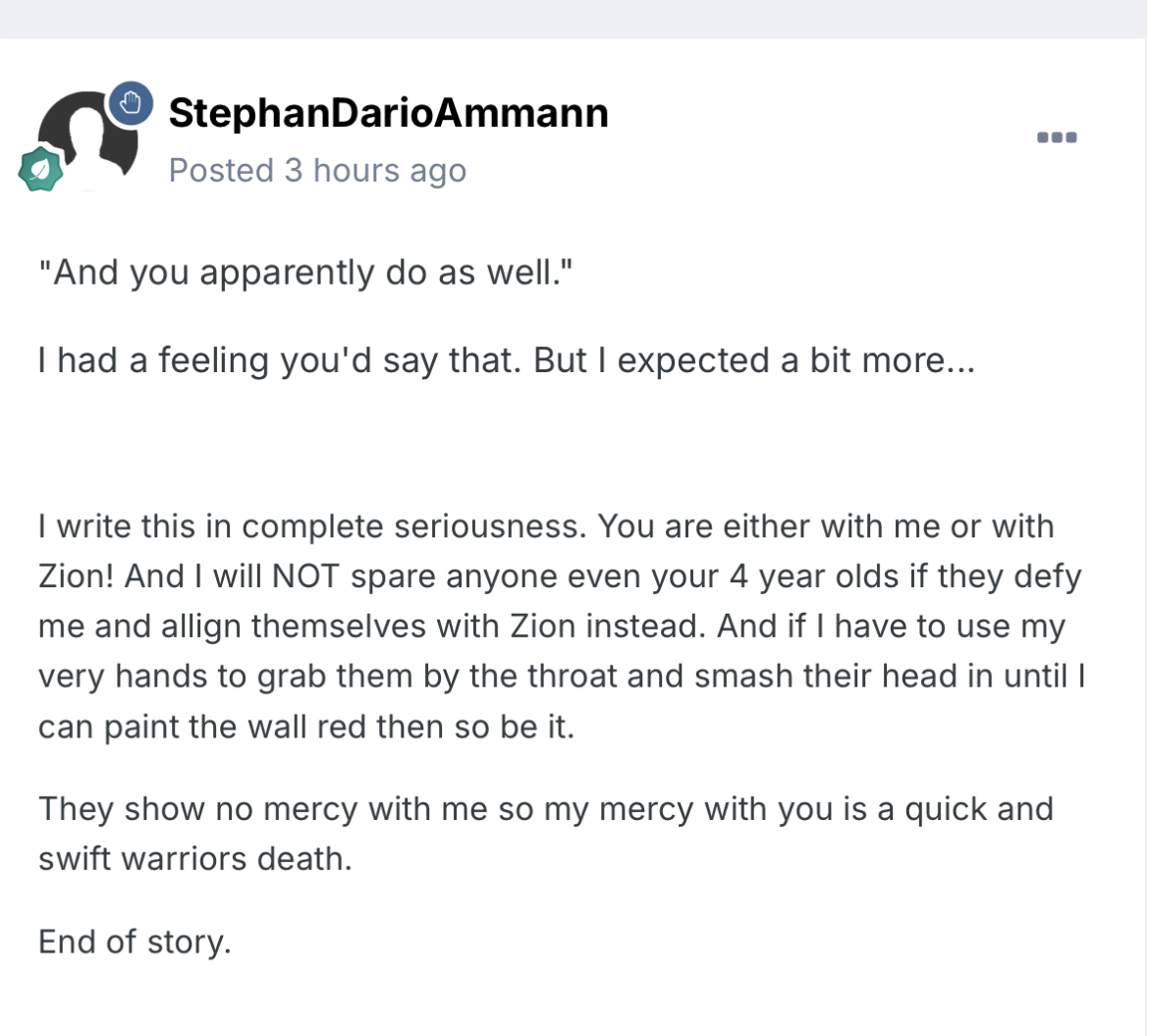
FBI Tips for US and international threats. Submit details and screenshots at tips.fbi.gov. The FBI handles international cyber threats, hate crimes, and violent threats online, liaising directly with foreign law enforcement (like the German Bundeskriminalamt) when necessary. Make sure to have solid records in case the post gets taken down. Screenshot the exact threat, the account handle (StephanDarioAmmann), the other alias (OrangeNero), profile page, and time/date stamp. File a Tip because the statement involved explicit threats of lethal violence against children. I can't right now. My device doesn't take snapshots.
-
SCOTUS Decision: Ban on "Talk" Conversion Therapy is Unconstitutional
smac97 replied to smac97's topic in General Discussions
Subjective It surely is. I agree with Roger that there is not any particular "uniform list of trans ideological doctrines." The movement is, after all, pretty amorphous. That said, I think most or all of the items in the list I provided would be recognized by most people as widely accepted tenets/axioms amongst trans advocacy groups, trans persons, "allies," and so on. Thanks, -Smac - Yesterday
-
SCOTUS Decision: Ban on "Talk" Conversion Therapy is Unconstitutional
smac97 replied to smac97's topic in General Discussions
Huh. Well, here again is my list of "tenets" which are substantiated, most fairly extensively, on various "trans advocacy" websites: I submit that most or all of the "tenets" I listed are widely-shared and acknowledged by "trans" advocates. You apparently disagree, calling almost all of them "hostile anti-trans propaganda." I'm okay with having a difference of opinion here. Huh. Apart from the bolded part (which is a verbatim quote), your link does not seem to say what you say it says. What part of it rebuts Tenet 1? My list was "of claims that function as load-bearing principles in much of contemporary 'trans' advocacy." Not sure how you turned that into a list of "requirement{s} for allyship." As for whether statements "resembling" Tenet 2 are out there, here's the Human Rights Campaign: The "tenet" in my list: "Identity is sex (or replaces sex for social/legal purposes). 'Trans women are women' / 'trans men are men' is treated as a literal truth, not a courtesy or a political slogan." The HRC website: "When we say women, that word always includes trans women. There’s no ifs, ands or buts about it." National Women's Law Center: Happy Pride. Don’t Be a TERF. "It bears repeating: Trans Women Are Women." Are you sure this isn't a widely-held sentiment in the trans community? Are you sure this isn't a fairly fundamental precept in terms of ideology and advocacy and agenda? Huh. So if it's not on the A4TE website, it's not a principle. And yet, just a few hours ago you wrote: In your view, is A4TE the "governing body" that gets to determine what does and does not count to "function as load-bearing principles in much of contemporary 'trans' advocacy?" If yes, then you just undermined your own point in the space of a few hours. If no, then whether or not A4TE agrees with a tenet is not really relevant because, to quote a guy: "There is no catechism, governing body, or agreed philosophical system called trans ideology." Sure seems like it. I've seen numerous social media posts/videos where a "trans" person equates denial of their "gender identity" with claiming they don't "exist." Perhaps one of the better known examples: See also here: There it is. Asking questions is "transphobic." Asking questions or expressing skepticism or disagreement = "denying that trans people exist and pretending not to know that they exist" and "you’re denying that trans people exist." I think this tenet is rather well-attested. According to you, "There is no catechism, governing body, or agreed philosophical system called trans ideology." I agree But that being the case, whether a tenet appears on A4TE’s allyship requirements doesn't really matter, does it? My list was "of claims that function as load-bearing principles in much of contemporary 'trans' advocacy." Not sure how you turned that into a list of "allyship requirements." According to you, "There is no catechism, governing body, or agreed philosophical system called trans ideology." I agree But that being the case, whether a tenet appears on A4TE’s allyship requirements doesn't really matter, does it? My list was "of claims that function as load-bearing principles in much of contemporary 'trans' advocacy." Not sure how you turned that into a list of "allyship standard{s}." See above. By your own reckoning, A4TE is not authoritative, so what its website says or doesn't say about "allyship requirements" is not really relevant to my list of "claims that function as load-bearing principles in much of contemporary 'trans' advocacy." I don't. Particularly given that most of those "load-bearing principles" are quite well-attested to on other trans advocacy websites. From a previous post: HRC. GLAAD. WPATH. GLSEN. These organizations sure seem to presuppose most or all of the tenets I included in my list. WPATH is perhaps the most noteworthy, since it comes closes to being "authoritative" (it purports to set standards of medical care, was heavily involved in setting public health policy during the Biden Administration, etc.). I thought the list of tenets was relatively and mostly even-handed: I guess reasonable minds can disagree. Thanks, -Smac -
Did you see when he said, "You are Arians from Persia... You claimed europe when the ice subsided", isn't that actually an anti-European, anti-white statement? A "we were here first" Afrocentric-Indigenous Nationalist attempt to argue that Europe was originally populated exclusively by non-white peoples, and that modern white Europeans are "invaders". Or online trolls on unmoderated platforms routinely absorb scraps of fringe pseudo-history and conspiracy theories. They remix these concepts simply to shock and provoke. But when someone's statements rapidly escalate to threats of violence against 4-year-olds, the primary driver is often severe psychological paranoia or psychosis rather than being part of a coherent ideology. You could be right. The narrative that Persian invaders who stole Europe from someone else after the ice age is relying on old Nazi propaganda to make their seemingly anti-white point.
-
SCOTUS Decision: Ban on "Talk" Conversion Therapy is Unconstitutional
smac97 replied to smac97's topic in General Discussions
I think most people already familiar with Christianity understand that "Elder" in a religious context is an ecclesiastical title, not one denoting age. And since the incongruity of the title to the age of the young man bearing it is both immediate and obvious (and, for some, kind of humorous), there really isn't much by way of a "job" for you to "get straight," wherein you "figure out which definition" is in play. Similarly, when I speak of my step-aunt, Sister Margaret (a Catholic nun), I think most people know that "Sister" is an ecclesiastical title, and not familial. Nothing to "figure out," really. Similarly, when I speak of "Father Mulcahy" on M*A*S*H, I think most people know that is an ecclesiastical title, and not familial. Again, nothing to "figure out." In contrast, "gender identity," "gender expression" and even "gender" by itself have become somewhat difficult and confusing terms, wherein they can genuinely mean different things to different people in different contexts, and in ways that are neither immediate nor apparent. For example, "gender" is sometimes used as a coterminous synonym for "sex," and at other times, as something like "internal sense of themselves" (whatever that means). And that "internal sense" can then be congruent with sex, incongruent, or "intersex" or "nonbinary" or "intergender" or any of the many dozens of potential meanings of "gender identity." So there is where you might have a "job" to "figure out which definition" is being used. And good luck with it. Yes, I think that is totally different. Again, "Elder" has a variety of meanings, some about age, some about status, some about ecclesiastical roles: 3. of or relating to former times; earlier. noun a person who is older or higher in rank than oneself. an aged person. an influential member of a tribe or community, often a chief or ruler; a superior. a presbyter. (in certain Protestant churches) a lay member who is a governing officer, often assisting the pastor in services. Mormon Church. a member of the Melchizedek priesthood. noun any tree or shrub belonging to the genus Sambucus, of the honeysuckle family, having pinnate leaves, clusters of white flowers, and red or black, berrylike fruit. adjective 1. born earlier; senior Compare older 2. (in piquet and similar card games) denoting or relating to the nondealer (the elder hand ), who has certain advantages in the play 3. archaic prior in rank, position, or office of a previous time; former noun an older person; one's senior anthropol a senior member of a tribe who has influence or authority (in certain Protestant Churches) a lay office having teaching, pastoral, or administrative functions another word for presbyter noun Also called: elderberry. any of various caprifoliaceous shrubs or small trees of the genus Sambucus, having clusters of small white flowers and red, purple, or black berry-like fruits any of various unrelated plants, such as box elder and marsh elder So "Elder" can mean an older or higher-ranked person, or a senior member of a tribe, or a Protestant ecclesiastical title, or a Latter-day Saint ecclesiastical title, or a tree, or a shrub, or a berry. When someone sees a 19-year old with a name tag reading "Elder Jones," even if they are not familiar with the Church, they can immediately exclude some of these meanings: Older or higher-ranked person? Nope. Senior member of tribe? Nope. Tree? Nope. Shrub? Nope. Berry? Nope. That leaves "Protestant ecclesiastical title" or "Latter-day Saint ecclesiastical title." The Church's missionaries have been out there for a while, so it's getting harder and harder to suggest that people are not familiar with Latter-day Saint missionaries carrying an ecclesiastical title of "Elder." In contrast, "Gender Identity" is entirely subjective, has many dozens of potential meanings, and those meanings are completely up to the individual. So yes, I think people can readily be less at ease about what "gender identity" means as compared to missionary "Elders." Well, no. I don't "impose" any definition onto the word used as a title for male Latter-day Saint missionaries. It's right there in the dictionary. It's not "imposed." The relevant and applicable definition (the ecclesiastical title: "Mormon Church. a member of the Melchizedek priesthood") is immediately understood, rather than "a person who is older or higher in rank" or a tree or a shrub or a berry. I think you are feigning confusion. I acknowledge the need to understand another person's conceptual framework. Here is a list of definitions/meanings (Healthline.com, so likely not overtly politically partisan) for "Gender Identity and Expression": From Healthline’s “68 Terms That Describe Gender Identity and Expression”: 68 Terms That Describe Gender Identity and Expression And here we go: AFAB — Assigned female at birth; label based on observed sex traits at birth. Agender — Identifies as having no gender. Aliagender — A stated gender outside existing male/female/nonbinary boxes. AMAB — Assigned male at birth. Androgyne — Identity or look mixing or neutralizing masculine and feminine. Aporagender — A specific gender said to be neither man, woman, nor a blend of those. Bigender — Two genders, at once or in turn. Binarism — Treating gender as only two opposite classes. Body dysphoria — Distress about sexed body traits. Boi — Boyish presentation or identity; used in some LGBTQ communities of color. Butch — Masculine presentation or identity, often in lesbian/queer use. Cisgender — Identity matches sex recorded at birth. Cishet — Cisgender and heterosexual. Cisnormativity — Treating alignment of identity and birth sex as the default. Cissexism — Bias against people who are not cisgender. Demiboy — Partly identifies as a boy/man/masculine. Demigender — Partial attachment to a gender (umbrella for demiboy/demigirl). Demigirl — Partly identifies as a girl/woman/feminine. Dyadic — Sex traits that fit typical male or female; not a gender identity. Feminine-of-center — Identity leaning feminine, with or without “woman.” Feminine-presenting — Appearance or manner read as feminine. Femme — Feminine identity or expression. Female-to-male (FTM) — Older term for some trans men / transmasculine people. Gender apathetic — Indifferent to gender labels. Gender binary — The two-class man/woman scheme. Gender dysphoria — Distress from mismatch of identity and sex, or from how others treat the body. Gender expansive — Umbrella for people who reject usual gender norms. Gender expression — How gender is shown (clothes, manner, etc.). Gender identity — Inner sense of being a man, woman, both, neither, etc. Gender-neutral pronouns — Pronouns other than he/she (they, ze/hir, etc.). Gender nonconforming — Expression that breaks stereotypes for one’s sex or perceived sex. Gender normative — Traits that match social expectations. Gender presentation — External display of gender. Gender questioning — Exploring identity or expression. Gender roles — Social scripts attached to men and women. Gender variant — Identity or expression off the social norm. Genderfluid — Identity that shifts over time or context. Gender**** — Presentation meant to break gender rules. Genderqueer — Not exclusively man or woman. Gendervoid — Sense of gender as absent. Graygender — Weak or ambivalent attachment to gender. Intergender — Between or mixing man and woman. Intersex — Sex-development variation; not a gender identity. Masculine-of-center — Identity leaning masculine. Masculine-presenting — Appearance read as masculine. Maverique — A gender claimed as independent of man, woman, or neuter. Misgender — Using sexed language that does not match the requested identity. Male-to-female (MTF) — Older term for some trans women / transfeminine people. Multi-gender — More than one gender identity. Neutrois — Neutral or null gender (overlaps nonbinary/agender). Nonbinary — Umbrella: not exclusively man or woman. Novigender — A gender said to be inexpressible in existing words. Omnigender — Many or all genders. Pangender — All or many genders at once or over time. Polygender — Multiple genders at once or over time. Sex — Classification as male, female, or intersex by biological traits. Sex assigned at birth — The birth record of sex; Healthline treats it as not determining gender. Social dysphoria — Distress from how others perceive one’s gender or body. Soft butch — Milder masculine/butch presentation. Stone butch — Stronger butch presentation (term also has a specific sexual-history use). Third gender — A class neither man nor woman; often tied to particular cultures. Transfeminine — Feminine identity in someone whose birth sex was male. Transgender / trans — Umbrella: identity differs from sex recorded at birth. Transmasculine — Masculine identity in someone whose birth sex was female. Transitioning — Social, legal, or medical steps to present as the identified sex. Transsexual — Older/clinical term; often implies medical change. Trigender — Three genders, at once or in turn. Two-spirit — Some Native North American term for certain sex/gender-variant social roles; not a generic synonym for transgender. As you can see, "gender identity" and "gender expression" can mean very different things to different people in different contexts and at different times. It's rather difficult, then, for an individual to reflexively know "another person's conceptual framework" when the term being used is an amorphous neologism. Thanks, -Smac -
Of the 20 load-bearing principles you listed, the following are false: 1,2,4,5,6,8,9,10,11,12,13,14,15,16,17,18,19,20 The only ones that are basically true are 3 (your gender identity is valid on its own) and 7 (you should use people’s preferred pronouns). My basis for this was comparing your hostile anti-trans propaganda list to the web page “Supporting Transgender People" on the transequality.org website. It is striking how what they are actually asking for is so different than what you claim they are asking for. I asked GPT to compare your list to what is on that website and it came up with this: If we use Advocates for Trans Equality (A4TE / transequality.org) as the benchmark, the redline is pretty dramatic. One caveat: A4TE itself says there is “no one way to be a ‘perfect’ ally”, so strictly speaking it does not present a doctrinal entrance exam. But its Supporting Transgender People page is explicitly a guide to allyship, so it gives us a reasonable test: does Grok’s proposition actually appear as something an ally is expected to believe or do?(Trans Equality) Here is Grok’s list with everything unsupported by that standard struck out. I’ve left unstruck only the portions that substantially correspond to A4TE’s actual guidance. Here is a descriptive list of claims that function as load-bearing principles in much of contemporary “trans” advocacy — especially the institutional/activist version that treats dissent as bigotry or “denial of existence.” Not every trans person holds all of them. The point is which ones are treated as non-negotiable in that framework. Core identity claims Gender identity is real, innate, and authoritative. A person’s stated identity is the primary fact about whether they are a man, woman, both, or neither. A4TE instead says: You do not have to understand someone’s identity to respect it. It does not require an ally to believe gender identity is innate or metaphysically authoritative. (Trans Equality) Identity is sex (or replaces sex for social/legal purposes). “Trans women are women” / “trans men are men” is treated as a literal truth, not a courtesy or a political slogan. Nothing resembling this appears as a requirement for allyship. Self-identification is sufficient. No medical diagnosis, surgery, hormones, or even consistent presentation is required for the identity to be valid. This one contains a genuine A4TE principle. A4TE explicitly says there is no single right way to be transgender and that a transgender person’s identity does not depend upon medical transition, legal changes, or changes in appearance. (Trans Equality) Denial of the identity is a denial of the person. Disagreeing with the identity claim is framed as saying the person “doesn’t exist,” not as disputing a proposition. Nothing resembling this is required. Sex, biology, and language Sex is a spectrum, a social construct, or at least not a strict binary relevant to policy. Chromosomes, gametes, and reproductive anatomy are treated as crude, incomplete, or bigoted ways to classify people. None of this appears in A4TE’s allyship requirements. “Assigned sex at birth” is the preferred description of sex, implying a bureaucratic label rather than an observed reproductive category. Not an allyship requirement. Preferred pronouns and names are morally mandatory. Use the name, pronouns, and language a transgender person uses for themselves. Using sex-based pronouns is “misgendering”; using a prior name is “deadnaming.” Both are treated as harms comparable to slurs. This is one of the clearest things that actually survives. A4TE tells allies to follow the person’s lead regarding language, ask politely about pronouns when necessary, and apologize and move on after mistakes. It does not say pronoun mistakes are equivalent to slurs. (Trans Equality) There is no polite way to state the sex distinction. “Biological male/female,” “natal sex,” and similar terms are often classified as hate speech or dogwhistles. Not there. Medical and youth claims Gender dysphoria is validated by affirmation, not primarily explored as a possible misattribution of other distress. “Watchful waiting” or exploratory therapy is frequently labeled conversion therapy. Not part of this allyship standard. Medical transition (blockers, hormones, surgery) is healthcare, and withholding it is violence. Access is framed as lifesaving; gatekeeping is framed as cruelty. Not required. The page acknowledges that some transgender people medically transition and others do not; it does not require these medical propositions. (Trans Equality) Minors can have a stable, knowable transgender identity that justifies social and often medical transition. Parental or clinical caution is cast as abuse or bigotry. Not there. Desistance, detransition, and comorbidity (autism, trauma, same-sex attraction, social contagion) are minimized, treated as rare, or blamed on stigma rather than on the affirmation model. Not there. Social and institutional claims Single-sex spaces, sports, prisons, and shelters must follow identity, not sex. People should be allowed to use bathrooms and other gendered facilities consistent with their gender identity. Exclusion of males who identify as women is discrimination. There is a substantive policy position here, but Grok enormously broadens it. A4TE explicitly advocates restroom access according to gender identity. Its ally page does not establish a universal principle that sports, prisons, shelters, and every other sex-separated institution must therefore operate according to the identical rule. (Trans Equality) Any line among “trans women” is itself bigotry. Distinguishing social-only from medically transitioned, or pre-op from post-op, is “transmedicalism” or “dividing the community.” A4TE does say that medical transition is not a prerequisite for someone’s transgender identity. It does not say every distinction among transgender people is bigotry. (Trans Equality) Lived experience outranks data when studies, crime patterns, or fairness in sport cut against the identity rule. Nothing like this appears. Questions are a form of harm. Asking for definitions (“what is a woman?”), evidence, or tradeoffs is treated as bad-faith or as endangering trans people. In fact, A4TE explicitly distinguishes inappropriate intrusive questions from legitimate ones. Its advice is essentially to ask whether you actually need intimate information and whether you would consider the same question appropriate if directed at yourself. That is a rule of ordinary courtesy, not “questions are harmful.” (Trans Equality) Opposition is explained as animus. The admissible motives are hatred, disgust, or religion; safety, fairness, child protection, and definitional accuracy are discounted. Not there. Political enforcement Allies must affirm publicly. Neutrality (“I don’t care what adults do privately”) is often not enough; failure to repeat the slogans is coded as hostility. A4TE does encourage allies to speak publicly in support of transgender people, challenge anti-trans remarks and jokes, support people experiencing discrimination, and learn about policies affecting transgender people. But it does not impose a requirement to repeat ideological slogans or characterize failure to do so as hostility. Indeed, when discussing political advocacy, it says to help change policies “if you’re comfortable with it.” (Trans Equality) Conflicts with women’s rights and gay rights are denied or inverted. Sex-based rights are reframed as bigotry; same-sex attraction is pressured toward “attraction to gender identity.” Nothing remotely like this appears as a condition of allyship. The category must expand, not contract. Nonbinary, genderfluid, xenogender, and similar identities are folded into the same moral protection as transsexualism; limiting the category is betrayal. A4TE recognizes diversity within the transgender community and directs readers to resources about nonbinary people. It does not articulate Grok’s supposed principle that the category “must expand,” mention xenogenders here, or call limiting the category “betrayal.” (Trans Equality) After running Grok's twenty alleged “load-bearing principles” through an actual mainstream transgender advocacy organization's guide to how to be an ally, I think the result is revealing. What survives is basically: Respect transgender people's identities even if you don't fully understand them. Don't require medical transition or stereotypical appearance before recognizing someone as transgender. Use people's requested names, pronouns, and terminology. Respect their privacy. Oppose discrimination. Speak supportively when appropriate. Support gender-identity-based restroom access and some other inclusive policies. A4TE also encourages allies to educate themselves, avoid invasive questions about surgery or genitalia, protect people's privacy about their transgender status, reconsider unnecessary gender fields on forms, and advocate nondiscrimination protections. (Trans Equality) What emphatically doesn't survive is most of the supposedly “load-bearing ideology”: that sex is a social construct; reproductive biology is bigoted; identity literally is biological sex; disagreement denies somebody's existence; withholding transition is violence; questions are harmful; lived experience outranks data; opponents are motivated by animus; women's and gay rights must be subordinated; xenogender must be affirmed; and so forth. That comparison makes the problem with Grok's original answer unusually clear. It did not identify the minimum principles of trans allyship and then describe them charitably. It assembled maximalist claims, hostile interpretations, disputed policy positions, and accusations about activist behavior, and labeled the resulting package the “load-bearing principles” of trans advocacy. That is almost a textbook example of a strawman.
-
Let me get this straight. When you say an 18-year-old kid is an “Elder,” it is my job as the listener to figure out which definition you are using and understand what you mean. But if somebody else says, “I am a woman because that is my gender identity,” that’s totally different: you have no corresponding responsibility to understand what they mean. Instead, you can impose your definition onto their words and then criticize them for the nonsense that results. Do I have that right? Because if you aren’t willing even to acknowledge a responsibility to understand another person's conceptual framework before criticizing what they are saying, I’m not sure there is much point in continuing the conversation.
-
You do know that the whole character arc of that movie is Kirk realizing that this prejudice of his is wrong and that he needs to change? I abhor a lot of fans of Star Trek who are so media illiterate that they don’t realize they are the very people Star Trek is warning us against becoming and that these people are the problem and why we can’t have a more pleasant society.
-
Therefore you saw we should be just as violent and cruel to others because ‘they started it’. Vile stuff ya weirdo.
-
White supremacy and a bunch of anti-semitism. Lovely. And a kind of ancestral essentialism where all white people did something because a few of their ancestors (who were the ancestors of virtually everyone else on the planet too) did something. And a lot of bad history and taxonomy and giving dinosaur sapience for some reason. Weird. And wrong.
-
New meeting house renovations with the idea of focusing on Christ.
Calm replied to Tacenda's topic in General Discussions
Someone suggested this may be the root of the speculation: https://www.churchofjesuschrist.org/study/manual/leadership-instruction-october-2023/summary-how-meetinghouses?lang=eng “ We have been commanded to gather together often to remember Jesus and strengthen each other in Him: “I give unto you … a commandment that you assemble yourselves together, and organize yourselves, and prepare yourselves, and sanctify yourselves” (Doctrine and Covenants 88:74). Meetinghouses provide opportunities for receiving ordinances, teaching and ministering one to another (see 3 Nephi 26:19; Moroni 6:5–6), and welcoming friends. They serve multiple functions: Worship and ordinances Teaching Activities Administration Ongoing efforts are making meetinghouses more Christ centered and inviting. Some of these efforts include: Adapting to local culture and environment. Choosing meetinghouse art that is Christ centered and inclusive. Incorporating policy adjustments in the General Handbook for use of meetinghouses outside of Sunday meetings. We are considering opportunities to improve the focus on the Savior and ordinances and provide a more joyful experience for members and friends. These opportunities include: Flexible and adapted designs for new construction. Adjustments to existing buildings.” Someone else described this YouTuber as the LDS version of the National Enquirer, so accuracy is unlikely to be high if so. -
SCOTUS Decision: Ban on "Talk" Conversion Therapy is Unconstitutional
Calm replied to smac97's topic in General Discussions
Subjective -
Local to who, Germany?
-
Please show your fiancée this thread so she knows who she is marrying and has a true choice if she is not aware of this side of you already. screenshot saved just in case
-
This is an explicit, violent threat of extremism child murder. This post should be reported to local law enforcement authorities immediately, as statements involving explicit harm to children and targeted violence are unlawful threats.
-
SCOTUS Decision: Ban on "Talk" Conversion Therapy is Unconstitutional
smac97 replied to smac97's topic in General Discussions
I have previously asked, and now ask again: I am quite willing to listen to what you have to say. Which items in the list of "tenets" of trans ideology I previously provided do you feel are inaccurately characterized as such? Which items in the list of "tenets" of trans ideology I previously provided do you feel are not widely accepted by these folks? As for LLMs and political bias, seems like your preferred on - ChatGPT - has its own issues: AI chatbots face major backlash over left-wing bias: ‘Can no longer be considered neutral and cannot be trusted’ In any event, I think all Grok did was compile most of tenets I would have (I have addressed many of this in threads on this board). Good luck departing from those tenets - and publicly saying so - while staying in the good graces of trans advocates, both the groups and the self-appointed online and social media guys. That there is no governing body to definitively establish "tenets" of trans ideology is one thing; to say that no generally-accepted tenets exist at all is, I think, incorrect. Okay. Still hope to see you identify the "tenets" in my list which, in your view, are not fairly characterized and/or are not widely accepted by advocates of "trans" issues/ideology. Your list overlaps with mine only at the edges. Most of it is a different position: liberal courtesy plus “don’t be cruel,” not the set of largely asserted and controverted axioms that I listed and which I see played out all the time (and I documented numerous examples of trans advocacy groups using them). The overlap: Item 1 (the experience is real) and item 2 (ordinary civil protection) are compatible with almost any serious view, including mine. Item 4 (sex and identity are distinguishable) rejects “identity is sex.” Item 5 (policy case by case) rejects “identity wins in every space.” Item 6 (medicine is empirical) is a rejection of my list’s “affirmation is non-negotiable / questions are harm” tenets. So relative to my list of tenets, this "steelman" keeps the humanitarian floor and drops the metaphysical and institutional big ticket claims. Again, I have documented numerous instances of trans advocacy organizations asserting and/or presupposing the tenets in my list. As for reasonableness, 2, 4, 5, and 6 in your list are reasonable as a minimum if “ally” only means “don’t abuse people and don’t pretend biology vanished.” Frankly, I don't think most folks in the "trans" community would accept this minimal commitment, particularly if coupled with a rejection of the tenets in my list. Item 1 is reasonable if “take the experience seriously” means the distress and the self-report exist, not that the self-report is the last word on sex. Again, good luck getting that milquetoast item endorsed by other "trans" allies and such. Item 3 is the hinge. “Usually call her a woman” is courtesy. In practice that courtesy is how “trans women are women” gets treated as the default in every room until someone names a sexed rule. The item tries to wall that off (“does not require believing biology changed”). I think this works as etiquette, but it becomes your tenet #2 the moment "courtesy" is demanded in sports, prisons, medicine, or law. 1 can slide into your tenet #4 if “take it seriously” means “do not contradict the identity claim.” As written, it does not have to. 5 is the honest item—and the one activist frameworks usually will not accept. A person who means 5 is not an “ally” in the HRC/GLAAD sense. They are a liberal who will lose the room the first time they say “not in women’s sports” or "Hey, deep down we all know that 'trans women' are not really women" or "sex is a binary, and is not something that can be changed so that person in one category can 'transition' into the other" or "In the end, I think we need to put *some* parameters on what does and does not count as a 'trans woman.'" In sum, your list is a steelman of a moderate position that I think comes nowhere near being acceptable by most "trans advocacy" organizations and self-appointed "allies." It overlaps with my list of tenets a bit, but also contradicts quite a few. I am quite willing to publicly say whether I think my list is a decent summary of fairly widespread tenets of trans advocacy. I am curious if you will reject any of those tenets. I don't think my list is "maximalist." I think it reflects widely-held tenets, as evidenced by the post in which I documented examples of most of those tenets from "trans advocacy" sources. I never called or characterized the list as a "creed" (this, in your view, is ChatGPT exhibiting apolitical views)? And what's with this "smuggling" stuff. I posted the list for the world to see and invited feedback on it. I didn't say they were "minimum propositions," but rather that they are widely-held propositions, both by trans advocacy organizations and individual "allies." I mean, good luck getting away with going to, say, a "Trans Pride" rally or some such and saying any of the following: Re: Tenet 1 (Gender identity is real, innate, and authoritative. A person’s stated identity is the primary fact about whether they are a man, woman, both, or neither): "I am a 'trans' ally. However, I think we need to set aside the notion that a person's 'stated identity' is determinative of whether that person is a man or a woman or neither. Biological sex determines that." Re: Tenet 2 (Identity is sex (or replaces sex for social/legal purposes)). “Trans women are women” / “trans men are men” is treated as a literal truth, not a courtesy or a political slogan. “I am a 'trans' ally. However, deep down we all know that 'trans women' are not really women, but are instead men who have taken cosmetic, medical and sartorial measures to deliberately appear and 'identify' as women. "Trans women are women" only in an entirely figurative/suggestive sense, that's all." Re: Tenet 3 (Self-identification is sufficient). No medical diagnosis, surgery, hormones, or even consistent presentation is required for the identity to be valid. "I am a 'trans' ally. However, there must, in the end, be some sort of barebones criteria to qualify as 'a woman.' Subjective identity is unworkable because it's untestable and unfalsifiable. Those two former NBA players have effectively destroyed the idea that being a "trans woman" can be based solely by self-identification.'" I compliment @california boy and @SeekingUnderstanding for being willing to come to this board and present/endorse a "Steps A-C" proposal which differentiates "trans women" who meet specified criteria (such that they can use women's bathrooms) and those who do not (and so are to be excluded from women's bathrooms). This is a really small venue though. I would be more impressed and surprised if CB presented his proposal in writing and widely disseminated it. See also public declarations denying that "sex is a 'spectrum' and a 'social construct.'" I'm okay with that. I posted the list, and then documented numerous examples of these "tenets" being presented by trans advocacy groups. Candidly, I think "moderate propositions" are there, but they are not nearly as widely-held and endorsed as the list I provided. In other words, the "absolutist" and other extreme tenets seem to be largely assumed and axiomatic in the trans community. Frankly, I am astonished. By your metric I am a trans ally. "Transgender people are real people describing a real experience," I affirm this, with some clarification (along the lines of "but that experience, however strongly felt, cannot override biological reality. A man cannot 'become' a woman by 'identifying as one, nor can anyone migrate from one category in the sexual binary to the other"). "and in both our personal interactions and our laws we should try to treat them with dignity, courtesy, and fairness while dealing honestly with biological reality and legitimate competing interests." I affirm this, with some clarification ("Such 'honest dealing' must include a kind, but still candid and direct, rejection of incongruent-with-reality notions such as 'Trans Women are Women' (they are not women, and acting or pretending to act as if they are is furtherance of falsehood and delusion), 'a "woman" is anyone who identifies as one' (this is a circular and nonsensical definition, as 'woman' means, and has always meant, 'adult human female,' which necessarily excludes men - including 'trans women' - from that definition"), '"sex" is a spectrum' or '"sex" is a social construct' ("sex" is a biological reality, not a subjective identity, not a spectrum, not a social construct)). Thanks, -Smac -

Isaiah’s "Denial" Verses, Incomparability and the Divine Council
Pyreaux replied to Pyreaux's topic in General Discussions
Again, outdated. Bible Hub is useful for quick interlinear word lookups and comparisons, but their other sections like its commentaries or concordances rely heavily on public-domain works from the 1800s (such as the original Strong’s Concordance published in 1890). James Strong did not have access to the massive archaeological and linguistic discoveries that revolutionized modern Old Testament scholarship today. The Ugaritic Texts (1929) proved beyond doubt that terms like adat El (assembly of El) and bene elim (sons of the gods) in the Bible was taken directly from the language of other older Semitic cultures, all of which are always referring to a divine council of real gods. Thus, in Psalm 82 and Psalm 89, the elohim are in the clouds (shaḥaq), presiding over nations, because they never were "human judges". The Dead Sea Scrolls (1947) proved the Qumran manuscripts preserved older Hebrew readings, like the bene Elohim in Deuteronomy 32, that had been erased in the later Masoretic Texts after the advent of Christianity in 70 AD, to hide from Christian that the sons of God were divine. If God has no divine sons, Jesus couldn't be one either. And because old lexicographers lacked these Near Eastern texts, they frequently forced word usages into categories that fit their own theology, creating a whole new, artificial definition for elohim as "human judges." Sorry, but modern scholarship has moved on. Today, Hebrew scholars, regardless of whether they are Evangelical, Jewish, Latter-day Saint, or secular agree that the "human judges" translation of elohim in Psalm 82 and Exodus 21/22 is linguistically unviable. Category #2 (Heavenly Beings) is Category #4 (Demons) & #5 (Pagan Gods). You listed Deuteronomy 32:17 under Category #4 ("demons / not deities"). But look at what Deuteronomy 32:17 actually says "They sacrificed unto demons [shedim], not to God; to gods [elohim] whom they knew not..." When the Bible explicitly calls Baal and Chemosh elohim, on what authority do you have to turn around a reclassify them as "not deities"? The Bible says they are elohim; you are overriding the text to say, "No, they aren't." The Galatians 4:8 proof-text is pointing out that whatever gods he meant, either idols made of wood/stone, or imperial rulers claiming divinity, do not possess a divine nature, not that other divine entities do not exist or lack real divine authority over their lands Elyon gave to them. The exception proves the rule. Moses is explicitly stated to be placed in the position of elohim to Pharaoh ("See, I have made thee a god to Pharaoh"). The text specifically framed this as a functional delegation to a good human. You are imposing your new definition of "deity" onto ancient Hebrew terminology and then declaring anything that doesn't fit your invented modern definition isn't a "true god." By saying the Divine Council members are "real spiritual beings, but not deities," you are introducing a category that does not exist in the Hebrew Bible. Yahweh, Baal and the bene elohim (sons of God) are all elohim. The Bible does not reserve the word elohim only for Yahweh and then use it "metaphorically" for everyone else. Your non-Biblical definition that an entity must be equal to other Gods like Yahweh to be a "true deity," means then true polytheism never existed in human history. After all, in Greek, Canaanite, and Norse mythology, Apollo, Baal, Thor were lower gods subordinate to a higher god, Zeus, El, Odin. By your definition, ancient Canaanites never worshipped "other gods" they just worshipped "other real beings that weren't real deities." That is historically and linguistically unviable. If the Bible places the bene Elim (sons of the gods) in ba-shaḥaq, in heaven; Are you claiming either human figures or demons reside in the heavenly vaults and are ruling the nations? -
SCOTUS Decision: Ban on "Talk" Conversion Therapy is Unconstitutional
smac97 replied to smac97's topic in General Discussions
I felt the list was fairly accurate. And most of the items on the list were readily available from "trans advocacy" groups. From this post: These advocacy groups lay out the ideological presuppositions, and self-identified "allies" go around enforcing them by, inter alia, vilifying people who do not agree with those presuppositions (hasty and unsubstantiated leaps into "Bigot!" accusations are a good example of this). That said, I am quite willing to listen to what you have to say. Which items in the list of "tenets" of trans ideology I previously provided do you feel are inaccurately characterized as such? I agree that there is not any particular "uniform list of trans ideological doctrines." The movement is, after all, pretty amorphous. That said, I think most or all of the items in the list I provided would be recognized by most people as widely accepted tenets/axioms amongst trans advocacy groups, trans persons, "allies," and so on. But again, I am quite willing to listen to what you have to say. Which items in the list of "tenets" of trans ideology I previously provided do you feel are not widely accepted by these folks? When I have used the word “woman” that way, I was using it as a gender category rather than as a synonym for adult human biological female. You are redefining, in an manner, "woman" by including men within it. Ideologically-driven, ad hoc redefinition of basic terms is, in my view, a departure from "empirical reality." In my view, when you do this you are fervently refusing to understand their words, their conceptual framework, and the nuances of their point. When I do this I am declining to acquiesce to the radical redefinition of "woman" to include men in its meaning. If I fervently believe that I am the son of Elon Musk, I am factually incorrect about that. I may try to twist and turn to redefine terms or otherwise present some sort of "conceptual framework" and "nuances" to justify my belief, but doing so is a departure form "empirical reality." I am not the son of Elon Musk, and no amount of subjective feeling or equivocation or redefinition or nuance can change that. Again, you have frequently characterized biological men as "women." In my view, the notion that a man can "become" a woman by "identifying" as one is a per se departure from "empirical reality," and no amount of subjective feeling or equivocation or redefinition or nuance, or accusations of "bigotry" can change that. Sure. But to the extent they express the idea that a man can "become" a woman by "identifying" as one, such expressions are a departure from "empirical reality." Uncle Teddy in Arsenic & Old Lace is a long-recognized character, but nobody expects the audience to think he actually is Teddy Roosevelt. "Elder" has a variety of definitions, some pertaining to chronological age and others to ecclesiastical titles: Thus, there is no radical, ad hoc redefinition here. But there sure is one when you affirm that a man can "become" a woman by "identifying" as one. That claim is a departure from "empirical reality." I disagree with you on this one. George Box said all models are wrong, but some are useful. The sexual binary is a model. In many contexts it is an extremely useful one, but when dealing with the biology of real-world people, it is less universally useful than many people imagine, and certainly isn’t the ultimate truth of what it means to be a human being. Empirical reality is that sex is "the biological components, including anatomical and physiological traits, largely related to sexual reproduction. Not all components align for all people." I take the Box point seriously, but I think it is being asked to do work it cannot do. “All models are wrong, but some are useful” is a warning about statistical approximations of complex systems. It is not a license to treat every real classification as optional, which is what you appear to be attempting. Sex is not a subjective, convenient story we tell about bodies. In anisogamous species, including humans, there are two gamete types: small (sperm) and large (ova). That is the empirical binary. Organisms are organized around one or the other pathway. “Not all components align for all people” is true of developmental variation, injury, and medical intervention. It does not create a third gamete, a third reproductive class, or a spectrum of sexes. It describes incomplete, atypical, or medically altered expression within the binary. Your denial of the sexual binary, then, is ideological, not rational, and is therefore a per se departure from "empirical reality." The National Academies language you quote works against you, as it still anchors sex in “biological components… largely related to sexual reproduction.” That is the binary. The hedge about alignment is a recognition of disorders of sex development and of trait mismatch, not a finding that sex is non-binary. A person with CAIS is not a third sex; they are an XY individual whose body cannot use androgens. The classification remains male in the reproductive sense even when the phenotype is atypical. So when I say rejection of the sexual binary is a departure from "empirical reality," I mean this: the binary is not a rough average we can set aside when it is socially inconvenient or ideologically mandated. It is the reproductive architecture of the species. Models can be refined. They do not get to deny the existence of the two gamete classes that define the system. If the claim is only that some traits vary and some people need careful clinical description, we agree. If the claim is that sex itself is therefore not binary, that is the step I cannot take. Usefulness and truth are not opposites here. The binary is both. And because I think it is clear that we disagree, I find your denial/rejection of the sexual binary to be a per se departure from "empirical reality." Right. I acknowledge that. I also note, however, that "assigned at birth" has sometimes been misappropriated by some ideologues to characterize biological sex as something chosen, not observed, and is therefore subjective and/or arbitrary. When these idealogues do this, they use “assigned at birth” to recast sex as a label someone applied, not a trait someone observed. A midwife recording “male” or “female” is almost always naming the reproductive class already present. The "assigned at birth" is used to suggest that the midwife's act - an administrative/clerical annotation - is the origin of sex, such that a later "gender identity" incongruent with biological sex can be framed as the real fact and the natal record as merely a guess that can be corrected. In other words the phrase The work the wording does: move sex from biology to paperwork, then treat disagreement with the new paperwork as denying the person rather than disputing a classification. Such misappropriated usage is, in my view, a departure from "empirical reality." I don’t think it is my job to gate-keep the definition of words and to agree or disagree with definitions. But it is your job to endorse a position that necessarily involves a radical redefinition? If so, you are being selective in what you will and will not do in terms of lexical usage. That selectivity is arbitrary and ad hoc and borne of ideological obligation, and is a departure from "empirical reality." You have affirmed, many many times, that a man can "become" a woman by "identifying" as one. You have repeatedly used and ratified a radical, ad hoc, ideologically-driven redefinition of "woman," which I think constitutes a departure of "empirical reality,." I quite disagree. I think redefinition and equivocation are two of the most potent and frequently-used tools in the "trans advocacy" toolbox. "Assigned at birth." "Sex is a spectrum." "Sex is a social construct." "A woman is anyone who 'identifies' as one." "Trans women are women." And so on. These are factually and linguistically incoherent claims, but anyone who disagrees with them at all is denounced as a "bigot." AFAICS, you have endorsed these terms in ways that are necessarily redefinitional, ad hoc, ideological, equivocating, and obfuscatory, and I find such usage to be a departure from "empirical reality." And that sure is a strange phenomenon. Can "Stefoknee Wolscht," a biological male in his 50s, call himself a perpetual six-year-old girl? Can a 5'9" white guy "identify" as a six-foot-tall Chinese woman? Can Eva Tiamat Medusa "identify" as a dragon? Can Naia Ōkami "identify" as a wolf? The answer to all of these questions is "Subjectively and in their own worldview, yes; otherwise, no. To suggest otherwise would be to depart from 'empirical reality.'" Meanwhile, Is Mr. Wolscht actually a perpetual six-year-old girl? No. Is the 5'9" white guy who "identifies" as a six-foot-tall Chinese woman actually a six-foot-tall Chinese woman? No. Is Eva Tiamat Medusa actually a dragon? No. Is Naia Okami actually a wolf? No. Does society in general go along with the incongruent-with-reality "identities" of these people? No. Nevertheless, there are substantial numbers of people in society who somehow manage to affirm and ratify that notion that although a person cannot become something they are not despite "identifying" as it (a dragon, a wolf, etc.), a man can "become" a sex he is not - a "woman" - by "identifying" as one. I have yet to see a coherent explanation for why claims to an "identity" of a dragon or a wolf are not treated as congruent with reality, but claims by a man to an "identity" of a woman is treated as congruent with reality. At this point, the standard rejoinders I see are "Gender/sex and species/age are different" (never explained, just asserted), or equivocation ("gender identity" is separate from "sex," while elsewhere conflating them (such that "woman" can refer to sex or "gender identity" or both)) or "Bigot!" Wolscht and Medusa and Okami are all claiming "identities" which are incongruent with reality and biological fact. You have repeatedly endorsed claims that a man can "become" a woman by "identifying" as one, which is also incongruent with reality and biological fact. You attempt to overcome or mitigate that incongruency by resorting to ideological and ad hoc equivocatons and redefinitions. I find that to be a departure from "empirical reality." I find the foregoing to be incompatible with your numerous ratifications elsewhere that a man can "become" a woman by "identifying" as one. I think that claim requires its adherents to treat biological sex as "unreal" and "different that what it really is" (that is, malleable, subjective, changeable, on a spectrum and not a binary, etc.). I find that treatment to be unreasoned and factually inaccurate and arbitrary and ad hoc, and therefore a departure from "empirical reality." Okay. Uncle Teddy from Arsenic & Old Lace was not born to Martha Stewart Bulloch Theodore Roosevelt Sr. on October 27, 1858. Uncle Teddy is not really Teddy Roosevelt, and nobody in society believes that he is. Family members and others humor his delusion, but that's about it. But somehow, some segments of our society have found it workable in their minds to go along with an incongruent-with-reality claim that a man can "become" a woman by "identifying" as one. No other "identity" claim (wolf, dragon, whatever) is treated as it is legitimate and real, but this "gender identity" thing is. I find that notion to be incompatible with "empirical reality." I'm not in a position to endorse anything on this. I’m a finance expert, not a doctor. And Ketanji Brown-Jackson could not define "woman" because she's not a doctor either. In truth, she dodged the question because she did not want to answer it. Evasion and equivocation are, sadly, hallmarks of those who want to defend, or not run afoul of, trans ideology. The ideas being presented here, such as there being a "gender identity" component to "female" (such that a male who "identifies" as a woman is female) is ideological and ad hoc and incompatible with "empirical reality." Just because you think something is incoherent doesn't mean it really is. A dictionary definition which folds "male" into the definition of "female" is facially incoherent and a departure from "empirical reality." I quite agree. People with DSDs exist. But we all know that all the talk about "trans" stuff is not about people with DSDs, but rather about people who are unequivocally male but "identify" as a woman, or vice versa. I can accept most of the first half of this paragraph. Chromosomes, hormones, gonads, genitals, and secondary traits do not line up the same way in every body. Some of those traits vary in degree. A few people sit far from the typical male or female cluster. That is real, and it is why medicine needs more than a cartoon. The mistake is treating that variation as if it were the definition of sex. “Spectrum” and “bimodal” describe how traits are distributed. Sex names which reproductive class an organism is organized toward: small gametes (male) or large gametes (female). There is no third gamete and no sliding scale between sperm and ova. The two clusters exist because there are two developmental programs. Variation around the clusters does not turn the programs into a continuum or "spectrum" of sexes. A tall woman is not “more male.” A man with low testosterone is not “partly female.” A person with a DSD is not a third sex; they have a developmental difference within one of the two pathways, or a mix of traits that still does not create a new reproductive class. “Not every feature is perfectly binary” is true. “Therefore sex is not binary” does not follow. So I can use the trait language when we are talking about labs, anatomy, or medical care. I will not use it to retire male and female as the only two sexes. The insightful part is that bodies vary. The overreach and departure from "empirical reality" is concluding that the categories themselves are only a rough sketch. Latter-day Saint beliefs are, in the main, not empirically testable. I am quite willing to believe in things that are real, part of "reality," but not empirically so. I cannot prove that my wife loves me, but I believe that love to be as real as anything in my life can be. I can take the thought experiment in good faith, though it takes some real work. In the most de minimis sense, could the First Presidency receive a revelation that George Patton really had experienced 8 prior incarnations prior to his Patton one (e.g., a soldier with Alexander the Great, a soldier fighting Parthians for Rome, a viking, etc.)? "In principle, this could happen, right?" I suppose so, (AoF 1:9 - “We believe all that God has revealed, all that He does now reveal, and we believe that He will yet reveal many great and important things pertaining to the Kingdom of God.”), but I find it so implausible and farfetched that I have difficulty taking it seriously. So it is with your theoretical. Nevertheless, let's give it a go. I do not doubt that a faithful member can suffer that distress, or that a prophet can receive revelation about a person’s soul (though frankly, I doubt there has ever been a situation remotely like the theoretical one you describe). But I still think the hypothetical smuggles in a conclusion the Church has not taught. The Family Proclamation says gender is an essential characteristic of premortal, mortal, and eternal identity. The Church has since said that in that sentence gender means biological sex at birth. Counseling materials add that our bodies are patterned after the likeness of our spirits. That is the opposite of “the spirit is one sex and the body is the other, and we just failed to notice.” Feelings of incongruence are acknowledged, but they are not treated as evidence that the spirit is female in a male body. The Church takes no official position on the cause of those feelings. It does take a position on what sex is for ordinances, classes, and covenants: the body. So “in principle, a prophet could reveal a female spirit in a male body” is not a small step from present doctrine. It would be a new claim that spirit-sex and body-sex can come apart in an otherwise typical male. Genetic defects and DSDs are real. They are not the same thing as an intact male body plus an inner conviction. Treating every case of dysphoria as a “defective body hiding a female spirit” is the theory being tested, not a premise we already share. Even if I grant the scene—Elder Uchtdorf, a blessing, a statement that this person’s spirit is female—I would still separate three questions: Did God speak comfort to that person? I am not the judge of their prayer. Is that person a woman in the sense the word has in biology, marriage, and the mortal church? No. The body is male. Priesthood, temple, bathrooms, sports, and “daughter of God” in the embodied sense follow the body. Current handbook practice already does. How should I treat them? With the same duty I owe anyone in pain: kindness, no mockery, no demand that they perform a political script. Kindness is not the same as agreeing that they are a woman. If a future prophet actually received and published such a revelation, members would have to weigh it the way we weigh any claimed addition to the order of the Church: with the First Presidency and Twelve, in harmony with what is already revealed, not as a private interview that rewrites the categories for everyone else. I would not pretend a press release from a message board is that process. So my answer to your last two questions is: I would not deny their inner life or their standing before God. I would still say they are a man, and I would still insist that the sex-based parts of church and civic life follow the body. The hypothetical asks me to treat a revelation about a spirit as if it changed the sex of the body. That is the step I cannot take on the doctrine we actually have. Thanks, -Smac