
All Activity
- Past hour
-
.thumb.png.a8fec09ea72f7f63225be68234db1073.png)
A thread for sharing Carol Lynn Pearson poems
AnchoredinChrist replied to AnchoredinChrist's topic in Social Hall
I happen to like her efforts regarding Heavenly Mother, and of doctrinal polygamy being harmful. I'm less familiar with her as a poet/performer. She ascribed to a different narrative of Mormon polygamy history than I do, so I diverged from her on that point. - Today
-

The caricature: Mormons wishing to "get their own planet"?
Stargazer replied to theplains's topic in General Discussions
I realize that the Greek word τέλειός (as "fully developed") has the flavour of anti-platonism because it flies in the face of one of those favourite concepts of post-apostolic Christian philosophies, aseity (from Latin a "from" and se "self", plus -ity) (self-existence, self-causation, self-causality and autocausality), which is the property by which a being exists of and from itself. As a part of this belief, an aseitous God is said to be incapable of changing (see Hebrews 13:8). Changing implies development, and so to describe God as "fully developed" implies that He somehow improved Himself. Since God was, and is, and is to be the Absolute Perfection, there is no need to change: he is αὐτουσία (unchanged, says Gregory of Nyssa), or as Thomas Aquinas puts it: actus purus (Latin for 'Pure Actuality' or 'Pure Act' referring to the absolute perfection of God); and ipsum esse subsistens (being itself subsisting). But nevertheless, Matthew uses τέλειός to describe God. Heresy! Personally, I find interpreting "Jesus Christ the same yesterday, and to day, and for ever" [Hebrews 13:8] as aseity to be a philosophic eisegesis of the nature of God. And from this we also get the Impassability of God. God has no body, parts, or passions -- meaning He cannot love, hate, or even get angry. Yet deus irae is all over the scriptures. I suppose you've heard the phrase "the philosophies of men, mingled with scripture." Well, it's all over your theology. -
 ToniJay joined the community
 -
I've had that happen to me enough times that if I'm going to write a tome instead of a brief note, I write it in Notepad or Notepad++, and only when complete do I then copy/paste it into MDDB. In the past I have occasionally written some really smashing posts (my own assessment) only to have them fall into the bit bucket. Very frustrating.
-
I have done it myself for stuff online and known others who have as well, in one case I know it was changed based on the input, can’t remember in other cases. Doing so resulted in my being part of a survey group (covered something unrelated, but obviously it showed they appreciated rather than ignored my input).
-
Talking about me, perchance? 🤪
-
Given the apparent eagerness (based on investment) of the government to prosecute, seems like it’s a good assumption that the charges would not have stood up and that is why they weren’t filled.
-
Is there anything the church does or does not do that cannot be criticized by you as some sort of cover-up or nefarious attempt to [insert dastardly act of dishonesty]? And since you seem to know so much, just how many times have church leaders covered up a gun incident at a church building? Can you list some of them? Or is this one of those "studies show" or "experts say" kind of deals?
-
In my recent stint as stake clerk we had a bishop who was receiving FO support for his family. The SP was not in the chain of approval for the payments (that was completed at the bishopric level), but every payment was specially reported in the monthly stake finance report. There was also a notation in the report that there needed to be documentation of the stake president's approval for the FO support. Kind of what it sounds like to me, too.
-
The caricature: Mormons wishing to "get their own planet"?
Stargazer replied to theplains's topic in General Discussions
I didn't forget it. I was simply asking what you thought He meant about the "many mansions." Trying to teach me LDS theology? You're wrong, in any case. Not about the telestial, but about the terrestrial. In the revelation known as The Vision, aka D&C 76, the Terrestrial Kingdom and the qualifications for entry are described from verse 71 to 80. In pertinent part, verse 77 states: "These are they who receive of the presence of the Son, but not of the fulness of the Father." And neither was I claiming to fully understand the specifics of Christ's statement. Or were you trying to strawman me? As I said, I was asking what you thought He meant by it. Did you watch that video I posted (not created by an LDS content creator, btw)? It discussed the meaning of the term translated by the KJV translators as "mansion," indicating that we understand the English term "mansion" differently from how they understood it in the 17th Century. And then, there's the Koine Greek word μοναὶ which doesn't mean "mansion" in 21st C. English, but "room". If I were to say what I understand by μοναὶ, it would be that it's a very fancy room indeed. How fancy? Considering Revelation 3:20, it might be a banquet hall suitable for a sit-down meal with the glorified Savior. -
The Plaza Live case is an ideal case study about whether the new law was necessary: 1. The state's own investigators said the show was raunchy and suggestive, but that there was no genital exposure, no physical sexual interaction with audience members, and no lewd acts. In other words, this was a marginal case. 2. It wasn't marketed as being family friendly, and only three minors were there. 3. They successfully prosecuted this under the old laws--the venue had to pay a $5,000 administrative penalty, and promise that it would forbid people under the age of 18 from attending in the future, even with parental approval. From your source: "Although the complaint asserted that the Plaza Live broke decency laws, prosecutors have not filed criminal charges. The state is handling the case as a license-compliance matter." It appears that whether the charges in Plaza Live would have stood up in a criminal context (rather than an administrative one) was never determined. Would you agree with that? I could not immediately find any published cases where the older statute - Fla. Stat. § 847.013 - was applied to adult live performances. I previously noted that there are some substantial differences between the two statutes. As for whether their overlap or non-overlap defines whether the new statute is "necessary," I think that's really hard to assess. Whether a statute that is more narrowly crafted towards adult live performances (and which has different parameters and applications) is "necessary" seems to have a good amount of "value judgment" aromas coming off it. In any event, both are misdemeanors. Thanks, -Smac
-
I do also have to elaborate, the conditions of the plan of redemption require repentance to be reclaimed from spiritual death. Without repentance, man will suffer the second death. Helaman 14:15-18, Alma 42:12-13, Alma 12:15-18, 32
-
The LDS Church continues to teach in its seminary manuals that a dark skin color was the sign of the curse. 1) "Some people have mistakenly thought that the dark skin placed upon the Lamanites was the curse. President Joseph Fielding Smith (1876–1972) explained that the dark skin was not the curse: "The dark skin was placed upon the Lamanites so that they could be distinguished from the Nephites and to keep the two peoples from mixing. The dark skin was the sign of the curse [not the curse itself]. The curse was the withdrawal of the Spirit of the Lord" (Religion 121–122 - Book of Mormon Student Manual, 2018, chapter 8). This is interesting. Your quote here is from Chapter 8 of the Church's 2018 Student Manual, which quotes an excerpt from Pres. Joseph Fielding Smith's "Answers to Gospel Questions." This same passage was quoted two years later in the Come Follow Me manual: Significantly, the Church publicly apologized for this, calling it an error (Deseret News) : See also LDS Living and KSL News. And also here (Millennial Star Blog). Ben Spackman quite helpfully weighed in as well: Inerrancy among Church Employees about Church Materials I even called them out on avoiding the central issues, which received no response. One of them said (quoting from a screenshot), Let’s set aside the traditional misunderstanding of the “steadying the ark” story. Let’s set aside the fact that Elder Stevenson demonstrates below that in this case, the ark did need steadying, as Curriculum, Correlation, and review failed to do its job— or more likely, simply saw nothing wrong with what had been written. Let’s set aside that manuals themselves invite feedback and constructive criticism via an email address. (Seriously, open any printed manual and look. I myself was one of those back in fall who was made aware of the problems with the printed manual, and privately raised my voice.) No, the problem is that while S&I may venerate these manuals because of their mythic view of the review process, it does not appear that such intensive Apostolic review actually corresponds to reality. (Even if it were, it would not guarantee the correctness of the material.) From the Deseret News on January 20, here is an Apostle speaking about this issue, my italics. A search of the Church's website indicates that the quote still appears in two places (neither which is the Come Follow Me manual) : The URLs for these two: https://www.churchofjesuschrist.org/study/manual/book-of-mormon-student-manual-2018/chapter-8-2-nephi-4-8?lang=eng https://www.churchofjesuschrist.org/study/manual/book-of-mormon-seminary-teacher-manual-2013/2-nephi/lesson-27?lang=eng Note that these manuals were published in 2018 and 2013, respectively, so both came out prior to the 2020 retraction/apology by Elder Stevenson as noted above. So, in Elder Stevenson’s words, this was a mistake in the manual, which escaped the attention of Church leaders. His words do not lend support to the view of these two S&I employees that the printed published manuals must be treated as the infallible word of God because they have been closely reviewed by Apostles. Nor does the printed history support it. Example 1, manuals change, sometimes 180 degrees. Ben's comments about expectations of infallible church manuals are, in my view, very worthwhile. I encourage you to read his entire post. I surmise - but cannot confirm - that the Church's historical retention of manuals (such as those published prior to 2020) may well include quotes which have since been set aside. Either that or the Church has only been made aware of the quote existing in the 2020 manual, and so has simply overlooked these other sources (from 2013 and 2018). In any event, let's go back to your critique that the Church "continues to teach in its seminary manuals" the very quote for which an apostle in the Church very publicly apologized, and which he explicitly said had been "mistakenly included in the printed version of the manual," and which quote he said - again, publicly - the Church had asked members to "disregard." Given what I have now presented to you, do you think your statement is accurate? Or would you consider re-visiting it? Okay. Could you then explain why you are claiming that the Church "continues to teach in its seminary manuals" items which were addressed in 2020 by Elder Stevenson in 2020 and removed from the current (2024) version? There's more to it than that. See the FAIR article titled, "What Does the Book of Mormon Mean by "Skin of Blackness"? "2 Skousen, Analysis of Textual Variants, 4–2:897, appears to follow the suggestion that there was a physical change in skin color. Discussing the change of white to pure in 2 Nephi 6:30 for the 1840 edition, he notes: "Of course, the 1840 change of white to pure avoids . . . the need to interpret the remnant of the Nephites as being dark skinned. In other words, the editing change to pure may represent a conscious attempt at avoiding what was perceived as a difficult reading (the Nephites as being dark skinned), which therefore explains why the change from white to pure was made here—and only here—in 2 Nephi 30:6. There has never been any attempt to emend any of the passages that directly comment on the dark skin of the Lamanites." Skousen's argument for the reason for the editorial change is persuasive. It persuades, however, that the reader's understanding of the text related to a change in pigmentation. It does not discuss the point made in this commentary of the text's use of skin as a metaphor rather than as a literal description". Despite the esthetic reword in later Book of Mormon versions, Alma 3:6-8 remains to lend support to the real intent of 2 Nephi 30:6. What do you feel is "the real intent of 2 Nephi 30:6"? The FAIR article you cite was written by Brant Gardner. An eminently erudite and sharp scholar, one of our best. But they were not taught as theories in the past. Perhaps not. But the issue has been corrected for some years now. Not sure about that. See above. Could you elaborate? Is the Church allowed, in your view, to correct past errors? Are all past errors instances of the Church "leading people astray"? What are your thoughts about Ben Spackman's comments about "infallible" manuals (or, errors leading some to consider manuals to be infallible)? For obvious reasons. Fortunately his and teachings by others are still available. Yes. That availability is a fulfillment of Mormon 9:32: The leaders of the Church are not perfect, nor are those responsible for overseeing the contents of its manuals. Mistakes happen. Those comments constitute false teaching. Well, perhaps, and perhaps not. Could you elaborate on the significance of this issue for you? Thanks, -Smac
-
The caricature: Mormons wishing to "get their own planet"?
Stargazer replied to theplains's topic in General Discussions
Or so you assert. In that entire paragraph, verses 43 to 48, Jesus exhorts His followers to love everyone unconditionally, friend or foe, because the Father loves them all unconditionally. He's exhorting all of US to do so, just like the Father does. And then He concludes by commanding us to be perfect in this unconditional love, just like the Father is! If we are incapable of it, how can He possibly pose this to us as a command, when there is no possible way for us to do it, like the Father? And if it is possible for us to match the Father in unconditional love, then why can't we match him in other ways as well? All by the Grace of the Lord Jesus Christ, of course. Or is Christ's Grace limited in its capability? Consider the Greek word that the KJV translators render as "perfect" in Matthew 5:48. It is τέλειός. Bible-Hub renders this word as "fully developed." And the same word is used for both us and Heavenly Father. Heavenly Father is certainly "fully developed." And apparently Jesus expects us to become so as well. Can we match the Father's full development? No? He commands it, though! Obviously He can't expect this of us at this time. Being "fully developed" clearly takes time; it's not an overnight thing. Which is why Theosis is a gradual thing, and the graduality is rooted in scripture. You have to ignore a good bit of the New Testament to avoid this interpretation. Ignore the following, or see if you can eisegete them away. I know you can't accept them at face value. This is because your theology is pre-loaded to discount them due to the preferential reverence for Nicaea and the classical Trinity. Well, what if the Trinity is a myth? "Behold, I stand at the door, and knock: if any man hear my voice, and open the door, I will come in to him, and will sup with him, and he with me. To him that overcometh will I grant to sit with me in my throne, even as I also overcame, and am set down with my Father in his throne." [Rev 3:20,21] "He that overcometh shall inherit all things; and I will be his God, and he shall be my son." [Rev 21:7] "If we suffer, we shall also reign with him: if we deny him, he also will deny us:" [2 Tim. 2:12] "The Spirit itself beareth witness with our spirit, that we are the children of God: And if children, then heirs; heirs of God, and joint-heirs with Christ; if so be that we suffer with him, that we may be also glorified together." [Rom. 8:16,17] "Wherefore thou art no more a servant, but a son; and if a son, then an heir of God through Christ." [Gal. 4:7] "Beloved, now are we the sons of God, and it doth not yet appear what we shall be: but we know that, when he shall appear, we shall be like him; for we shall see him as he is." [1 John 3:2] "Whereby are given unto us exceeding great and precious promises: that by these ye might be partakers of the divine nature, having escaped the corruption that is in the world through lust." [2 Peter 1:4] The heir of a baron will be a baron. The heir of duke will be a duke. The heir of a king will be a king. Need I go on? You have to ignore a good bit of the Patristic Fathers to avoid this, too. St. Athanasius of Alexandria, in his work "On the Incarnation" wrote: "God became man so that man might become God”. He was not alone. He was emphasizing that through Christ’s incarnation, death, and resurrection, humans are offered the possibility of eternal life and moral transformation, becoming like God in virtue and holiness. Church Fathers like Irenaeus, Clement of Alexandria, and Gregory of Nyssa also affirmed that Christ assumed human nature so that humanity could be elevated to a divine likeness. Today's interpreters of these former-day Christians are quick to assert that these men couldn't possibly mean that humans could become like God in essence, or ontologically. But of the four, only Gregory of Nyssa wrote post-Nicaea. So how do the interpreters think they can get away with reframing these Ante-Nicene fathers as Nicene? Well, maybe these men didn't mean that humans could be like God ontologically. But their writings don't deny the possibility, and in discounting the facial value of what those men wrote, the post-Nicene interpreters seem to be whistling past the graveyard, hoping that they really didn't mean what they seem to have meant. Edited to add: in respect of that last paragraph I do have to say that these men were definitely already entrapped by platonism and other philosophies, so it's probably completely accurate that they didn't really mean like God ontologically. Where's an apostle when you really need one? Oh, that's right. They're all dead. Apostasy complete. Here's a question I would like you to answer: Is God incapable of transforming say, the Apostle Peter, into something that is ontologically like Himself, even if of lower rank to Him? Is it something beyond His power? - Yesterday
-
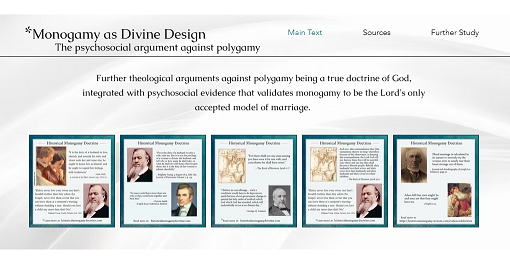
I was perusing the 'Another attack on monogamy' thread and it seemed to me from the responses that the website Monogamy as Divine Design hasn't been shared on this forum. It contains a lot of secular research done showing psychological and societal harms of polygamy and how all that can be related to early Mormon polygamy and I think it to be worth the read so I'll just link it here: http://historicalmonogamy.wixsite.com/divinedesign It's the "sister" website of Historical Monogamy Doctrine: http://historicalmonogamy.wixsite.com/evidenceofdoctrine Historical Monogamy Doctrine is the first website and argues doctrinally against polygamy having been commanded by God or practiced by Joseph Smith (and I suppose is intended to be read first -- it's also the Mormon history narrative that I myself align with.) And Monogamy as Divine Design continues the argument that polygamy isn't of God, mostly from the psychosocial angle -- even though its message is Mormon-polygamy-focused I think its info contains a lot of relevance when talking about secular non-monogamy ideas.
-
I find it’s a good idea to refresh the page before writing a post and if a long post, copy it before hitting submit just in case the “are you a robot” or other spam blocker function kicks in because it’s been too long since the last verification of my sentience. Refreshing doesn’t always work, but seems to catch most of them.
-
The Plaza Live case is an ideal case study about whether the new law was necessary: The state's own investigators said the show was raunchy and suggestive, but that there was no genital exposure, no physical sexual interaction with audience members, and no lewd acts. In other words, this was a marginal case. It wasn't marketed as being family friendly, and only three minors were there. They successfully prosecuted this under the old laws--the venue had to pay a $5,000 administrative penalty, and promise that it would forbid people under the age of 18 from attending in the future, even with parental approval. You've successfully argued that in general, there are situations when new laws might be necessary, but you haven't explained why this law was necessary, and have ignored the fact that for these types of events, the old laws were working as intended.
-
Analytics just ran into the same issue when responding to a post of mine in this thread. Looks like the board is glitchy today. Take your time. Thanks, -Smac
-
I don’t understand. Analytics’ example showed a drag show being investigated under the earlier statue, Yes. That other statute was a less-than-ideal fit, but it's what was on the books at the time. Because an investigation is at the front end of a legal process, and may or may not culminate in a conviction, and I think the new statute was not in place at the time (I'm open to correction on that point). Thanks, -Smac
-
I don’t understand. Analytics’ example showed a drag show being investigated under the earlier statue, Why wouldn’t that demonstrate sufficiency in covering drag shows?
-
Okay. "The evidence that a minor suffers serious, lasting harm from a single or occasional vodka tonic is weak." And yet we still have a categorical prohibition against minors imbibing. Ah. How would this play out in the real world? Would you agree with the following statement? In the absence of legal constraints, children and/or their parents are at liberty to attend sexually explicit adult live performances, and so run the risk of "chronic exposure, exposure combined with abuse, or exposure to pornographic material." Claude apparently did not tell you that the "judges" referenced here are those who dissented. The actual decision held: "The Supreme Court of Florida’s definition of 'lewd' eliminates any overbreadth, and the use of the phrase 'age of the child present' does not render the Act unconstitutionally vague." That's the bummer thing about AI. It's not ready for primetime when it comes to substantive legal analysis. Two thoughts: First, the new statute seems to have harder definitional edges in many respects. Second, yes, the legislature can chill or prohibit a "disfavored expressive category" as long as it does so within the confines of the Constitution. And the 8th Circuit held that this is what Florida has done. I'm not persuaded that the statute was preemptive. I've previously provided ample citations to situations in which children have been exposed to explicitly sexual adult live performances. I'm reasonably confident there were instances of this in Florida. The statute, then, could be seen as remedial rather than preemptive. Either way, though, it is a legitimate legislative exercise. There is no principle of law that says that a legislature must sit on its hands and wait for a substantial number of harmful events to occur before it can take steps to mitigate or prohibit those events from happening. I agree with this. Sure. But the constitutional question was asked and answered by the 8th Circuit. Yes, parental rights are not absolute. Florida, like every state, has long imposed significant limits on parental authority. A few ordinary examples: Parents cannot consent to their child having sex with an adult. Age-of-consent and child-sex-offense laws categorically disable both the minor’s agreement and any parental attempt to authorize it. Parents cannot authorize female genital mutilation or most non-therapeutic sterilizations of minors. Parents can lose custody or have their rights terminated for abuse, neglect, or abandonment under Chapter 39; the state may intervene even over parental objection when a child’s safety is at stake. Compulsory education laws and certain vaccination/school-entry requirements constrain parental choice. Child labor laws limit the hours and types of work parents may permit. Parents cannot refuse life-saving medical treatment in many circumstances without the state being able to intervene. The Florida Parents’ Bill of Rights itself (Chapter 1014) explicitly states that it does not authorize a parent to engage in unlawful conduct or to abuse or neglect a child, and it does not apply to parental decisions that would end life. In short, parental rights in Florida have never been "near-absolute." They are fundamental but bounded by the child’s welfare and by specific statutory prohibitions. Pointing to limits on taking children to sexually explicit adult performances, or to restrictions on certain medical pathways for minors, does not uniquely contradict a previously “near-absolute” regime—because no such regime existed. The real debate is which limits are justified and whether they are applied consistently, not whether the state suddenly invented constraints on parental authority. I agree with this. I think it's a given. The "not as bad as" fallacy again. And I would like to see that literature. "That asymmetry is defensible only if one thinks religion is constitutionally special." Is there any question about religion being "constitutionally special"? Also, just because an action is taken under the rubric of "religion" does not protect it from state intervention. I am not aware that "Hooters, beauty pageants, and cheerleading routines" involve Nudity Sexual conduct Sexual excitement Specific sexual activities (as defined under Florida law) Lewd conduct Lewd exposure of prosthetic or imitation genitals or breasts I think this presupposes, rather than demonstrates, ulterior motives. Thanks, -Smac
-
I wrote a fairly long response to this, and it was somehow deleted by the editor when I tried to post it. Rather than trying to retype everything, I offer the following synthesis of all of these related issues. I worked hard to make an unbiased prompt that addresses the real issues, I think Claude's analysis is spot-on. I'll put the prompt in a quote box and Claude's response in the main body so that you can more easily respond to it if you wish. Claude Fable 5 High This is one of the genuinely hard problems in liberal constitutionalism, and the honest answer is that the principle can be applied consistently — but rarely is, and the mechanisms courts use to manage it are imperfect compromises rather than clean solutions. The empirical baseline. The evidence that a minor suffers serious, lasting harm from a single or occasional exposure to sexualized content at a live performance is weak. The research literature on harm to children from sexual content concerns chronic exposure, exposure combined with abuse, or exposure to pornographic material — not brief encounters with adult-themed entertainment. Courts have noticed this. In HM Florida-ORL v. Griffin, the litigation over Florida's SB 1438, judges observed that Florida already had obscenity statutes covering material harmful to minors, and that the new law's vaguer standard ("lewd conduct" in "adult live performances") added little except uncertainty. That gap — between existing narrowly drawn law and new broadly drawn law — is itself evidence about legislative purpose. When a state passes a redundant statute with softer definitional edges, the plausible function is not closing a protection gap but chilling a disfavored expressive category. When is preemptive legislation legitimate? The defensible framework requires three things: harm that is serious, harm that is empirically probable rather than speculative, and means that are narrowly tailored. Obscenity-as-to-minors doctrine (Ginsberg v. New York) already satisfies this for genuinely explicit material. The strongest case for the Florida-style approach is that legislatures may act on reasonable predictive judgment without waiting for longitudinal studies, that community standards about what children should see are legitimately majoritarian within constitutional limits, and that parents who bring children to such events don't extinguish the state's independent interest in child welfare (we don't let parents take children to strip clubs). That argument deserves to be taken seriously; it is not mere pretext in every mouth that utters it. The counterargument: when the asserted harm is speculative and the restricted activity is expressive, the First Amendment deliberately raises the evidentiary bar — precisely because "protecting children" is history's most versatile justification for censorship (comic books, rock lyrics, video games, Brown v. Entertainment Merchants being the canonical rebuke). The parental-rights asymmetry. The criticism of DeSantis-era policy has real force and should be stated precisely: parental rights were invoked as near-absolute against school curricula, library books, and medical decisions the state disfavored, but were overridden when parents affirmatively chose to bring children to drag events or sought gender-related care. A consistent parental-rights theory cannot do both. The fair defense is that no one holds parental rights as absolute — everyone accepts a floor (abuse, neglect) — so the disagreement is really about where the floor sits, and Florida voters located sexualized performance below it. But that defense concedes the deeper point: "parental rights" was functioning as a rhetorical vehicle for substantive value preferences, not as a neutral procedural principle. That's a legitimate way to do democratic politics, but it should be named as such. The religion parallel. Your consistency test bites hard. There is a serious clinical literature on religious trauma — shame-based purity teaching, fear of damnation, high-control environments — arguably better developed than the literature on drag-show exposure. If the state may override parental judgment based on contested predictions of psychological harm from cultural content, nothing internal to that principle protects intensive religious formation. What actually protects it is doctrinal and political: Wisconsin v. Yoder and free-exercise jurisprudence give religious child-rearing heightened constitutional armor that secular expression lacks, and religious majorities hold political power that drag performers do not. That asymmetry is defensible only if one thinks religion is constitutionally special (the Founders did); it is not defensible as an application of a neutral harm principle. The limiting principle. The best available one is procedural rather than substantive: the state may act preemptively only where (1) the harm is concrete and supported by evidence meeting a burden proportional to the liberty restricted; (2) the statute is precise enough that enforcement discretion cannot track viewpoint; and (3) the law is content-neutral in application — meaning a legislature genuinely worried about sexualized content must regulate Hooters, beauty pageants, and cheerleading routines by the same standard it applies to drag. Selective application is the tell. A child-protection law survives the consistency test; a culture-war law fails it visibly. The uncomfortable residue: this framework would also constrain interventions progressives might favor against religious environments, and it permits some genuinely harmful things in both categories to continue. Liberal neutrality buys pluralism at the price of tolerating harms it cannot prove to a demanding standard. Those who find that price too high — on either side — are rejecting liberal constitutionalism itself, which is a coherent position, but one that should be defended openly rather than smuggled in under "protecting children."
-
 Excusing your customary jabs, because I'm trying to agree you, we shouldn't avoid publicity. It's called the copycat protocal. We stay quiet thinking if a single act of vandalism, arson and apparently nonleathel gun incidents is widely reported, it can inspire "copycats." The theory is publicity gives another individual who is already predisposed to hostility an idea, a method, and a target. However, I posted it because I feel different. When it is a rare, freak occurrence, there might be a need to worry about copycats hearing about it. But when it is constant (endemic), the use of the copycat protocol only prevents us from exposing the inciters to deserved shame. The media's continued use of the "don't give them fame" rule might not be protecting against new crime but protecting the hate group or ideology itself. These radicals may not care about the criminal's arrest or fame, but I think they do care about the narrative turned on them in the eyes of "decent people." If the crimes are only reported vaguely, the original rhetoric by people that created the climate of hatred is never brought to trial in the court of public opinion.
 -
The Economist (June 2024) : Research into trans medicine has been manipulated A Grok summary: Journal of Sex & Marital Therapy (January 2023) : The Myth of “Reliable Research” in Pediatric Gender Medicine: A critical evaluation of the Dutch Studies—and research that has followed A Grok summary: Harvard Journal of Law & Public Policy (June 2025) : The Façade of Medical Consensus: How Medical Associations Prioritize Politics Over Science A Grok summary: Thanks, -Smac
-
Your acting as if public screening R rated movies doesn't exist. Not quite. I am saying the comparison to R-rate movies does not really work here. Florida Statute § 847.013: Prohibits knowingly exhibiting, selling, renting, or-providing paid admission for minors to view motion pictures, shows, or representations depicting nudity, sexual conduct, sexual excitement, or abuse that is "harmful to minors". Violations are generally first-degree misdemeanors punishable by up to one year in jail. Florida Statute § 847.012: Criminalizes selling, renting, loaning, or distributing materials defined as harmful to minors to a child under 18. I think this is an example of the "not as bad as" fallacy, or the "fallacy of relative privation" or "appeal to worse problems" or the "starving children in Africa" argument. It happens when someone tries to dismiss a problem or complaint just because a worse problem exists somewhere else. You seem to be suggesting that until and unless I first express concern about this or that other social ill, it is not legitimate for me to speak about the one under discussion here. I respectfully do not agree with that proposition. Thanks, -Smac
-
My original post was based on a news item, for which I provided a link. That news item quoted Gov. DeSantis, but it also stated: "Critics have argued the measure could be used to crack down on certain drag performances and chill free expression." Overall, I thought the article did a good job of clinically describing the news item at hand. This misconstrues both the legal background of this case and what this particular law actually changes in Florida. Could you elaborate? What am I misconstruing? I was not parroting Gov. DeSantis. I was expressing my own viewpoint, which happens to be similar to his. Existing laws in Florida include: Fla. Stat. § 847.013 — Exposing minors to harmful shows and exhibitions Fla. Stat. § 800.04(7) — Lewd or lascivious exhibition before a person under sixteen Fla. Stat. § 847.011(4) — Obscene live performances Fla. Stat. § 847.0133 — Showing obscene material to a minor Fla. Stat. § 800.03 — Exposure of sexual organs Fla. Stat. § 847.012 — Harmful material distributed to minors Fla. Stat. § 827.071 — Sexual performances by children and child pornography Fla. Stat. § 796.07 — Places operated for “lewdness” Fla. Stat. § 823.05 — Public nuisances involving lewdness or illegal conduct Fla. Stat. § 877.03 — Disorderly conduct and breach of the peace ... I would say the closest real-world parallel to Fla. Stat. § 827.11 — Exposing children to an adult live performance is Fla. Stat. § 847.013 — Exposing minors to harmful shows and exhibitions. Okay. Thank you for this list, and for the comparison between 827.11 and 847.013. I asked Grok to compare the two: What are your thoughts about this? Do you think the earlier statute was sufficient to cover drag shows? Way back in the day I clerked for a judge in Tacoma who heard an interesting criminal case about a guy manufacturing meth. He had been pulled over in his truck, the bed of which was full of boxes containing jars filled with alcohol and a white sludge at the bottom, which turned out to be powdered Sudafed tablets. My recollection is that everyone, including the criminal defense attorney, agreed that the only possible purpose for having jars full of alcohol with powdered Sudafed was to make meth, which is a controlled substance. However, the criminal statute in place at the time only criminalized the production of a controlled substance, which had not yet happened (since there was no meth or other controlled substances in the truck, just a bunch of pseudoephedrine, which is not a controlled substance). The criminal defense attorney argued that the statute - as worded - only criminalized the completion of "production," not interim steps are are incrementally headed that way. He also contrasted Washington's statute with Idaho's, which did criminalize both "production" and "taking a substantial step towards the production" of controlled substances. The judge agreed with the criminal defense attorney and dismissed the case. The prosecutor was not happy, but the judge noted that criminal statutes are often refined by these sorts of developments, which eventually filter up to the legislature so that they can fill in the gaps. Another example: Years ago I worked with a criminal defense attorney in Utah. He came back from a hearing and said that he had succeeded in getting serious criminal charges against my client dismissed. The criminal statute in question was sort of complex, but basically criminalized physical contact between an adult's mouth, genitals or hands with any part of a minor's genitals or anus. However, there was one combination that the legislature had left out, namely, an adults mouth to a minor's anus. This was precisely what the police had charged the defendant, and the statute did not criminalize it, so the defendant effectively got away with it. It is my understanding that in both instances the state legislatures have either amended existing statutes or enacted new ones to address the foregoing "gaps" in what the criminal statutes cover. I think something similar happened in Florida. I think what is illegitimate and imaginary is Ron DeSantis's claim, which you parrotted, that this particular law shouldn't even be controversial, and the implication that his political oponents are against "limiting minors access to sxualized events." I'm not sure I understand your position. Do you think the statute is controversial or not? I don’t have an absolute rule. I can imagine sufficiently extreme sexual conduct where the state would be justified in overriding parental consent. Fair enough. Can you allow for principled departure from your position on this? Is it possible and reasonable that citizens and their legislative representatives might prefer to not limited constraints to only "sufficiently extreme sexual conduct"? I would be interested in hearing what you feel these "real questions" are. But isn't this what the legislative process is for? To make judgment calls about "whether Florida's existing laws" were sufficient to address whether children should be allowed to view highly sexualized live adult performances? As for "whether § 827.11 makes Florida a better place to live and raise a family," I think it does. You (apparently?) do not. Again, isn't that what the legislative process does all the time? Just as I don't think Florida needs redundant laws, I don't think other states need them, either. Okay. I think we just disagree about redundancy, as I think the statutes overlap but still have some material differences. Criminal statutes are regularly created or refined to address more particularized behaviors. I don't think anyone has made "the suggestion that, before § 827.11, Florida was helpless to protect children from sexually inappropriate live entertainment." Again, criminal statutes are amended or created all the time to more specifically address particularized behaviors. As noted above, § 827.11 seems to cover ground that other statutes did not, or did not cover with clarity and concision. I believe the importance of a topic like this should depend, at least in part, on how much actual harm it causes individuals and society. Okay. Is it possible that exposing children to highly sexualized live adult performances causes "actual harm" to individuals and/or society? Do you think legislatures and societies are obligated to wait until "actual harm" accrues and becomes a very serious problem before taking steps to legislative mitigate it? Can it be reasonable and appropriate for legislatures to take reasonable preemptive steps to avoid the "actual harm" before it actually harms society and individuals? I have previously posted a number of news items about children being exposed to highly sexualized behaviors at drag shows, "Pride" parades, and so on. A sampling: SF Cop Says Nudity Around Kids is OK at Pride Parade Graphic “Pride” Parades Attacking the Innocence of Children San Francisco Pride Parade features public nudity around kids, 'Fetish Zone' with urine Why drag queen performances are not appropriate for children Yes, kink belongs at Pride. And I want my kids to see it. Don't Look Away: These Are the 'Family-Friendly' Pride Events the Left Is Pushing On Kids Prepping Kids for a Pride Parade Journalist Witnesses Naked Men Playing with Kids at Pride Children as Sex Objects: Why NYC Gay Pride Parade Is Being Called a 'Celebration of Pedophilia' DC Pride parade marked by depravity, grooming of children despite ‘family friendly’ billing Pride Parade Clips Show Shocking and Bizarre Moments — with Children in Attendance Pride Month Jumps the Shark Yale Professor Wants Your Kids To See Sex At Pride Parades So They’re Not ‘Homophobes’ Dallas Club Investigated After Drag Show for Kids Why Drag Events for Kids Are Inappropriate—And Actually Work Against the LGBT Community Children to experience sexual content at "Drag the kids to pride" (video included) Not for children! A lot of the events in the foregoing links involve quite a bit more than “a hip thrust or two” or “bare-chested men who wouldn’t have been out of place at a Madonna concert.” What "made-up" incidents are you referring to here? We have had all sorts of discussions about bishops who have abused children while acting in that capacity. Given the size of the Church, the number of actual incidents is statistically tiny, but does that mean that the Church can therefore safely disregard the issue, take not remedial efforts to mitigate risks, etc.? Also, is it ever appropriate for a legislature to anticipate, and preemptively take steps to curb or avoid, "widespread threats to children" before they actually materialize? Also, is it possible that the legislature in Florida decided that the exposure of children to highly sexualized adult live performances was sufficiently "widespread" as to warrant a statutory response? I think this is an example of the "not as bad as" fallacy, or the "fallacy of relative privation" or "appeal to worse problems" or the "starving children in Africa" argument. It happens when someone tries to dismiss a problem or complaint just because a worse problem exists somewhere else. Well, yes. Legislators may well be incentivized to pass laws that they think will please their constituencies. We live in a pluralistic society, so there are differences of opinions. Some people may indeed have "beliefs and cultures" in which it is acceptable to expose children to highly sexualized live adult performances (if you would like to identify these, feel free). Other people, meanwhile, have "beliefs and cultures" which find that unacceptable. We generally let the democratic process govern such differences. That said, the result is that legislatures pass laws to be enforced by the State and by law enforcement. Previously you said that the new statute was unnecessary/redundant because preexisting statutes were already sufficient to address the issue. Do you characterize those statutes as "tak{ing} away parents rights"? Here you seem to be saying that the statute amounts to "new exercises of state power," which would seem to suggest that the new statute is not "redundant" after all (since its effect is "new"). Could you clarify? What is it that you think is "really going on here"? I appreciate your input. Thanks, -Smac


