halconero
-
Posts
2,705 -
Joined
-
Last visited
Everything posted by halconero
-

Pres. Oaks: "...a Heavenly Mother or Mothers"
halconero replied to ZealouslyStriving's topic in General Discussions
I don't typically delve into prospective (or in this case, cyclical) speculation, but I lean towards a hypothesis for eternal progression nested within Multiverse theory. Specifically, Max Tegmark's Level IV: Ultimate Ensemble hypothesis. Intelligences are fundamental informational/mathematical structures with no end nor beginning. However, these structures do not have the ability, on their own, to observe their eternal existence. They must observe reality to comprehend their own existence and the existence of others, i.e., experience mortality. Within this ensembles of possibilities, one must not only exist at the meta-level as a theoretical bundle of information, but exist within a reality to begin to comprehend oneself. Thankfully, loving, caring beings exist at the meta-level who not only have the ability to know themselves and know others, but desire the same for others. They heat or reheat a reality, or eternity, (see the Greene or Steinhard-Turok models of creation), giving form to intelligences. Put another way, they become their parents, giving them the ability to observe their existence. Yes, the above sounds like crazy talk, but it's simply my attempt at a fun thought experiment that seeks to reconcile seemingly contradictory truth's like the eternal nature of God with a God who experiences mortality, along with Joseph Smith's ideas around a plurality of eternities (this idea began to emerge towards the end of his life and never got fleshed out), or the course of the Lord being one eternal round. Anyway:
-
Pres. Oaks: "...a Heavenly Mother or Mothers"
halconero replied to ZealouslyStriving's topic in General Discussions
Tangential, but a part of Church history I think gets misconstrued is Brigham Young's relative tolerance for exegesis on the scriptures or the uncanonized sayings/writings of Joseph Smith. I could use the term "doctrinal speculation," but I think that understates the amount of time, reasoning, and even scientific experimentation that President Young and his colleagues put into discovering and asserting what they believed to be true principles. Take one look at Elder Pratt's small, but significant contributions to math (he's cited on several wikipedia pages), and you can draw a reasonable line to how he approached theology. Gary James Bergera makes a decent case that the conflict between Orson Pratt and Brigham Young was (a) not as bitter or spiteful as some portray it as, and (b) had much more to do with President Young's position of dynamic revelation (living revelation supersedes past revelation) versus Elder Pratt's adherence to the written canon and past revelation. We've tended towards institutional consistency among the public views of the First Presidency and the Quorum of the Twelve, which I sustain and support for a variety of reasons, but it still makes me smile to see moments like this where members of the First Presidency and Twelve open the doors to revelatory or textual exegesis just a wee bit. -
Church of Jesus Christ sees record growth in global membership
halconero replied to InCognitus's topic in In The News
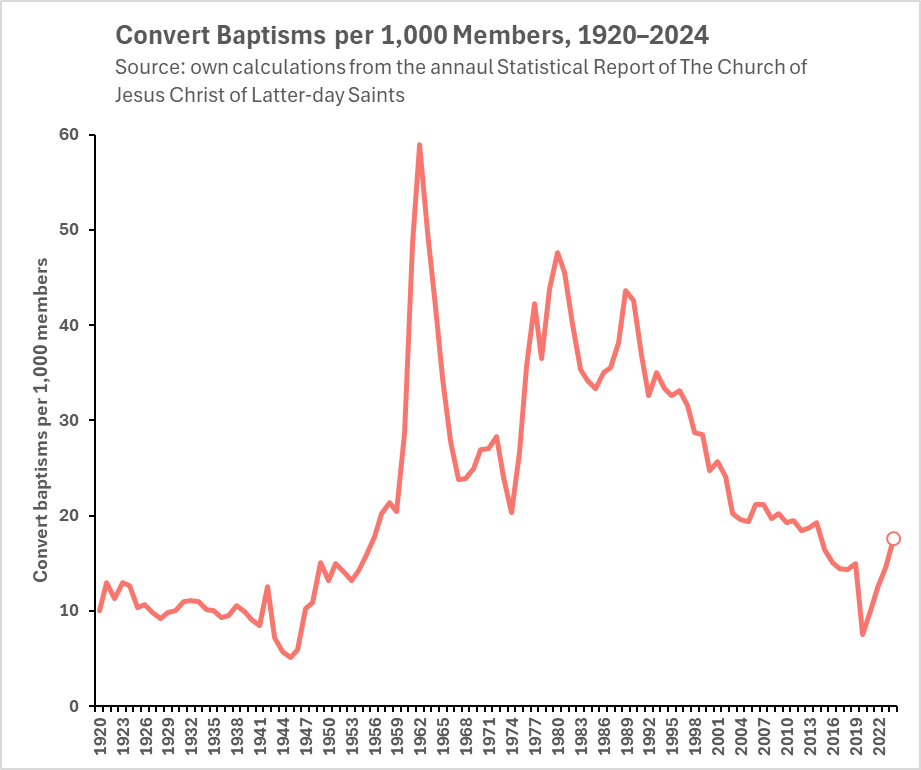
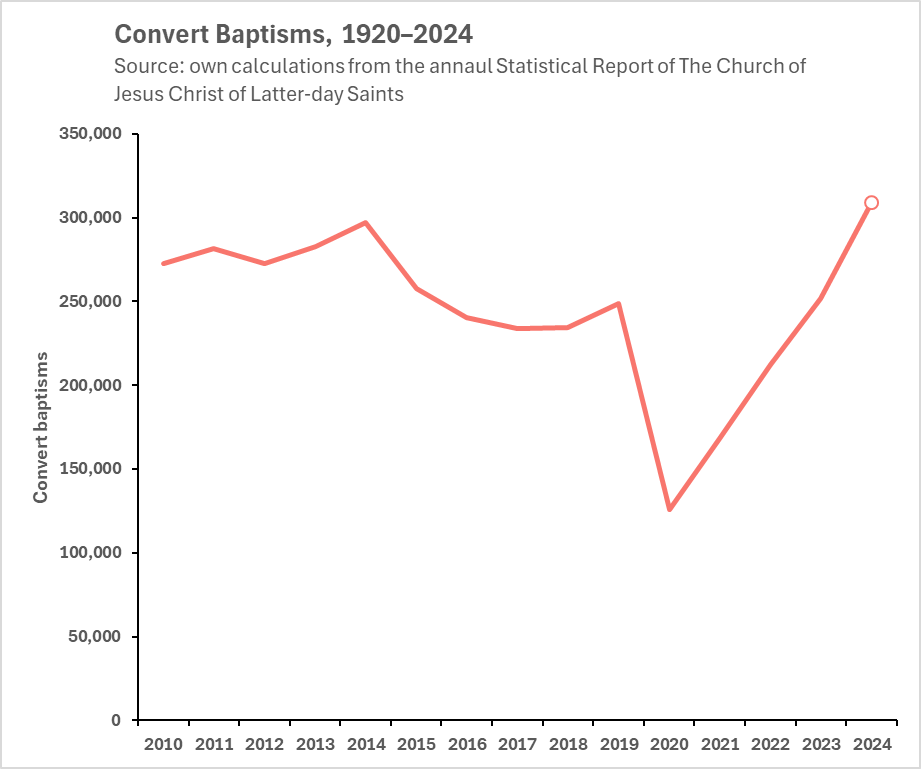
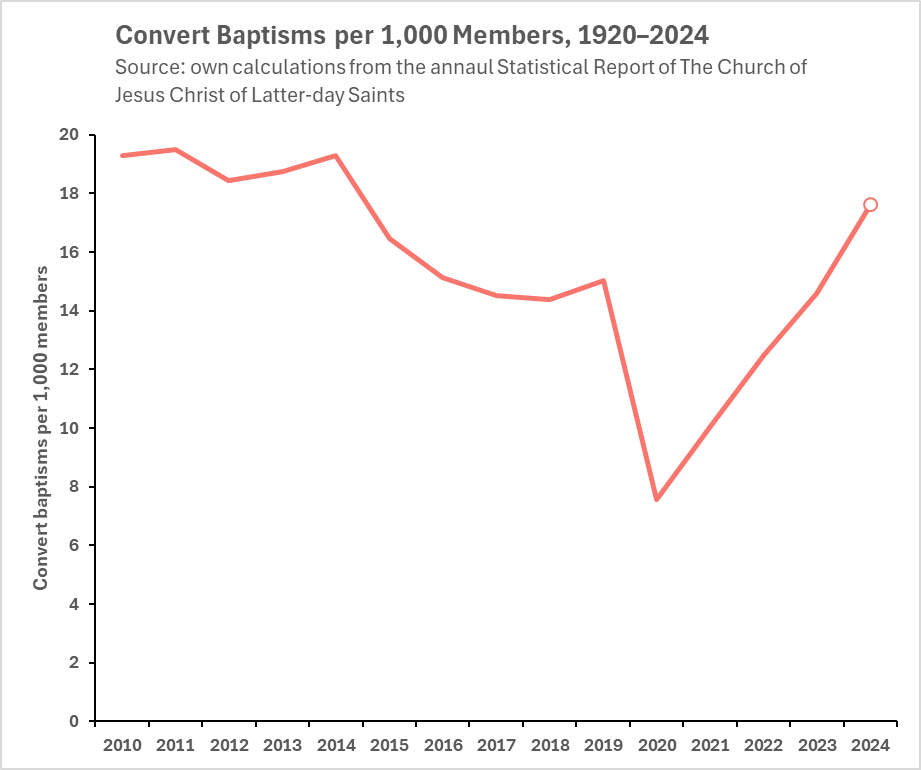
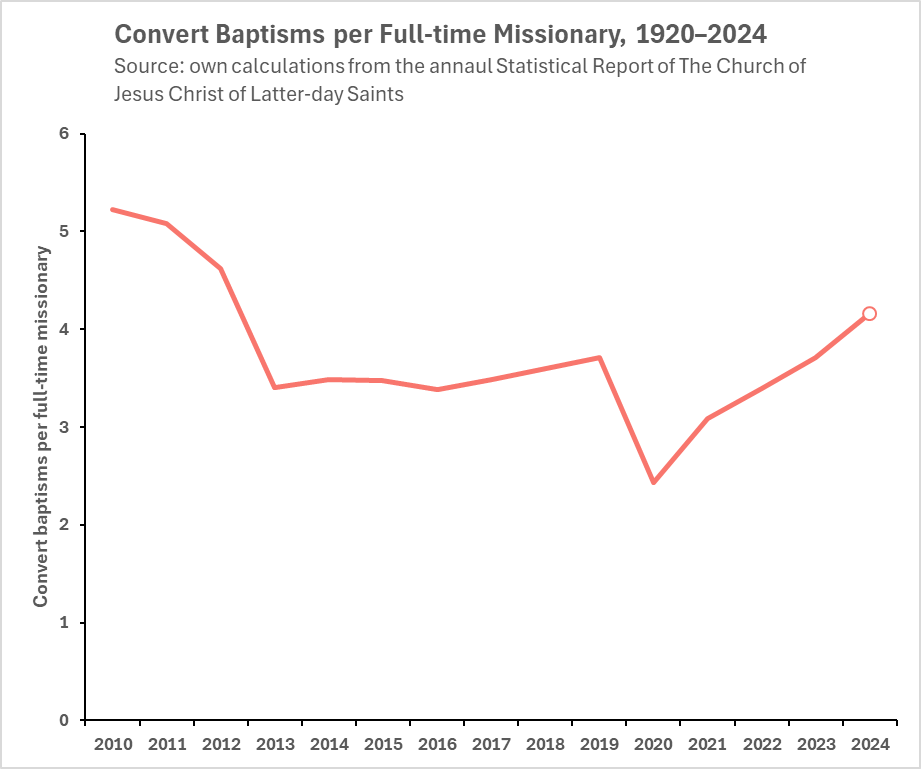
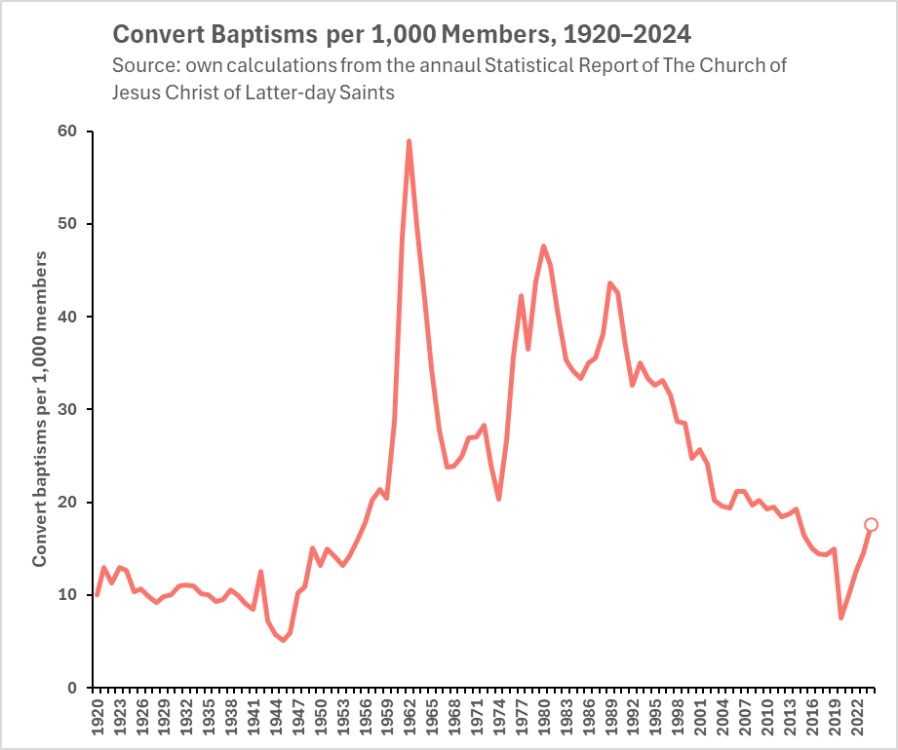
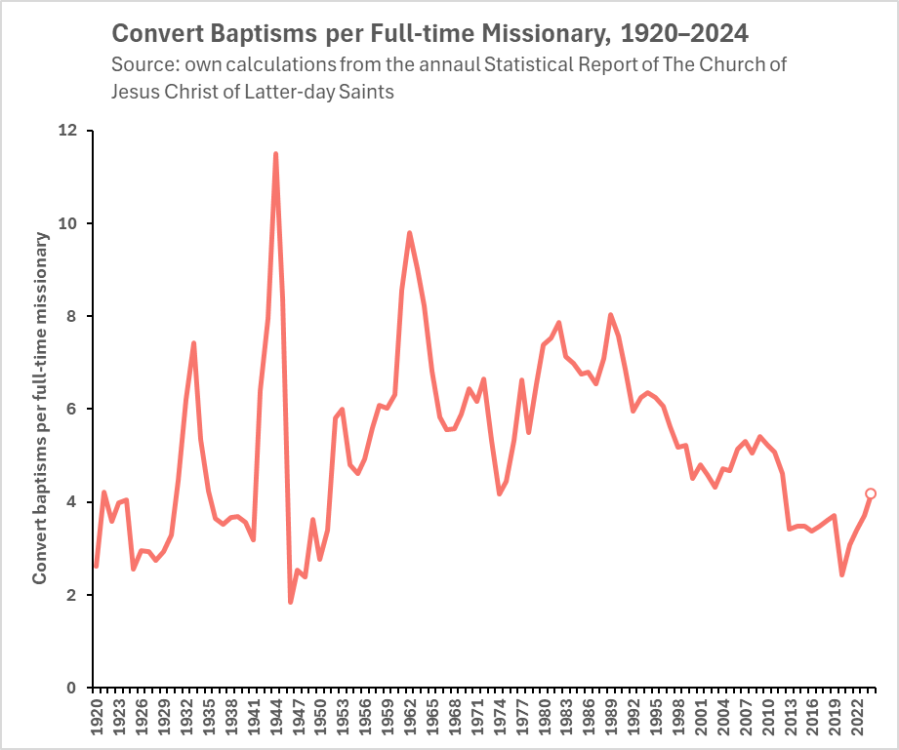
Note, the above graph for total converts in absolute numbers (i.e., not the rate) doesn't conflict with the Deseret News article. The figures use calendar year data, while the data cited by Elder Cook uses midyear data. This isn't obfuscation on either part: using midyear estimates (typically July 1 to June 30) is very common among national and international statistics agencies: the United States, UK, Canada, Australia, New Zealand, Sweden, EU, and UN all use the midyear point as the their annual population count. For various reasons the midyear estimate yields better denominators for annual population changes than a start- or end-year snapshot, dampens seasonal swings in population, and tends to align well with close of the accounting period, which matters given the interplay between demographic and fiscal policy. There's also some institutional inertia: we use midyear estimates because that's what we've done forever and we need to use some sort of international standard, so whatever has been around the longest wins. -
Church of Jesus Christ sees record growth in global membership
halconero replied to InCognitus's topic in In The News
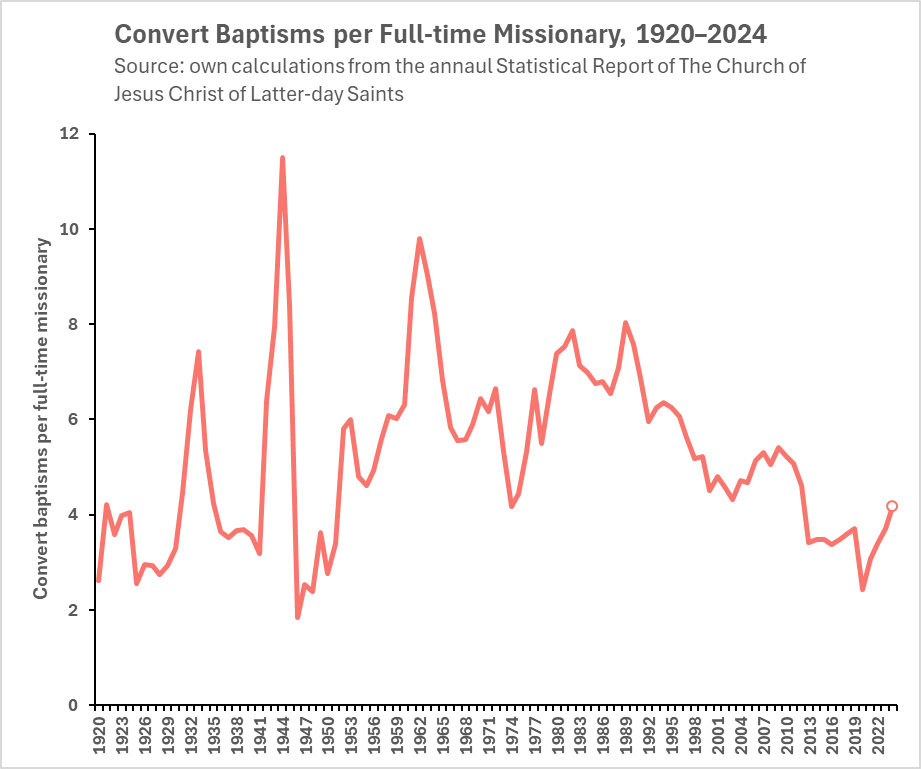
Yes, see below: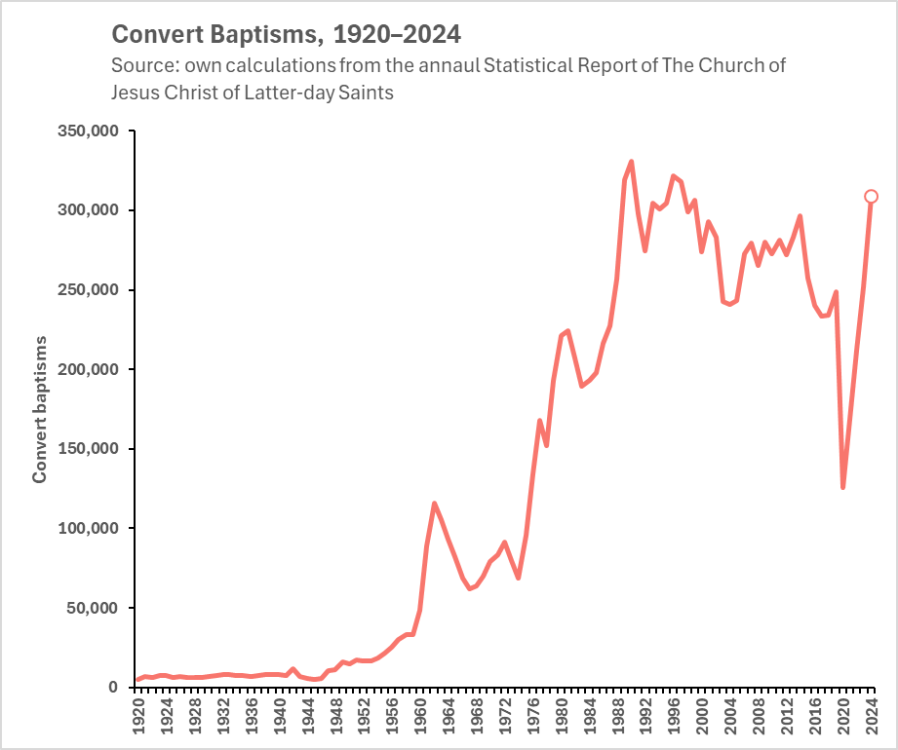
-
Church of Jesus Christ sees record growth in global membership
halconero replied to InCognitus's topic in In The News
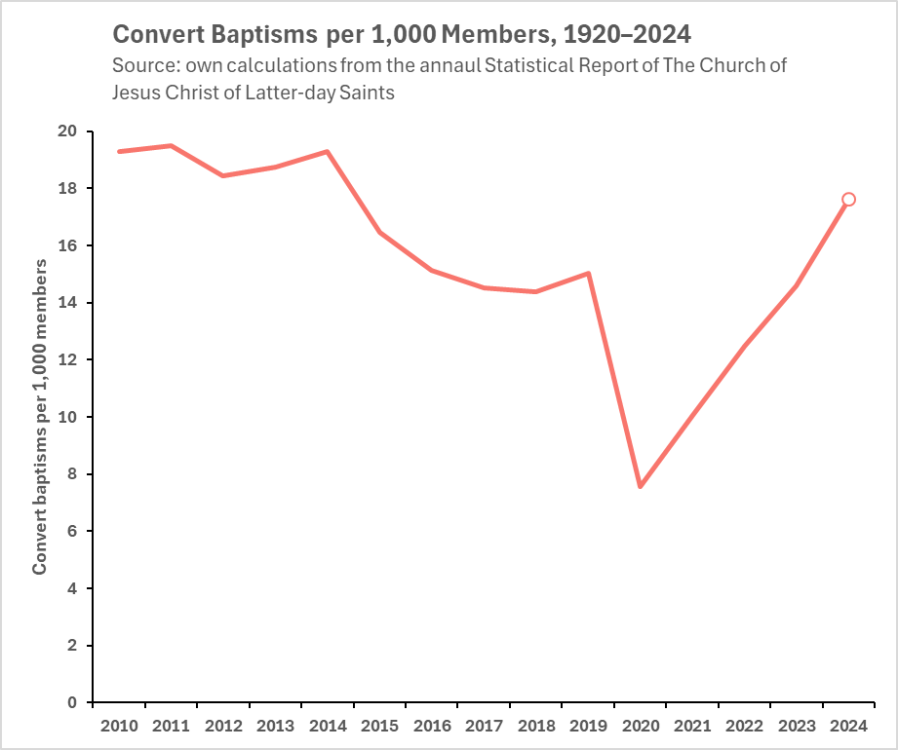
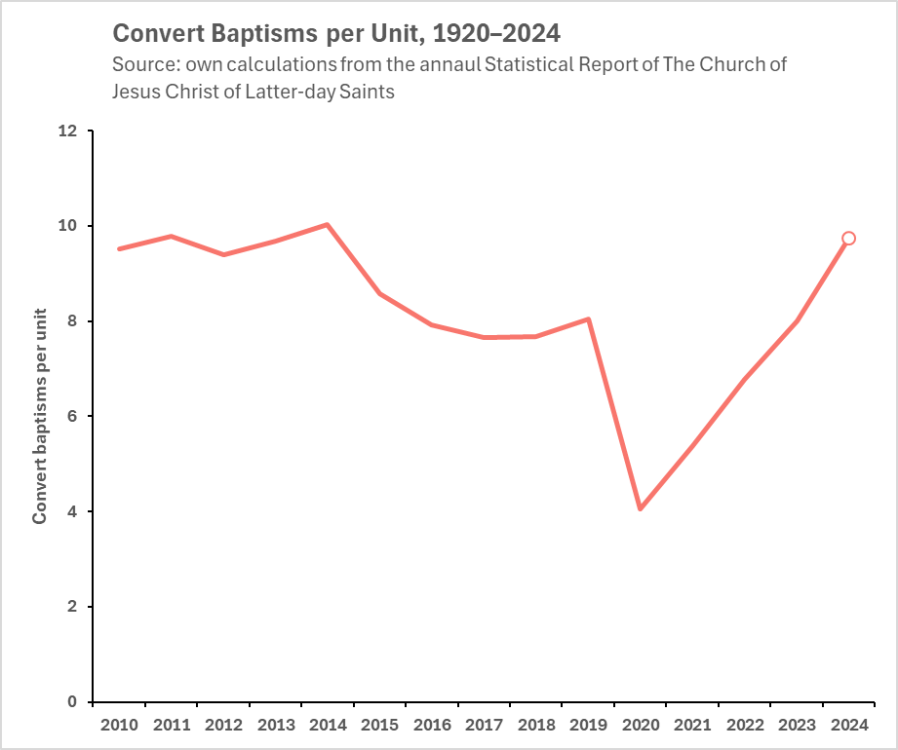
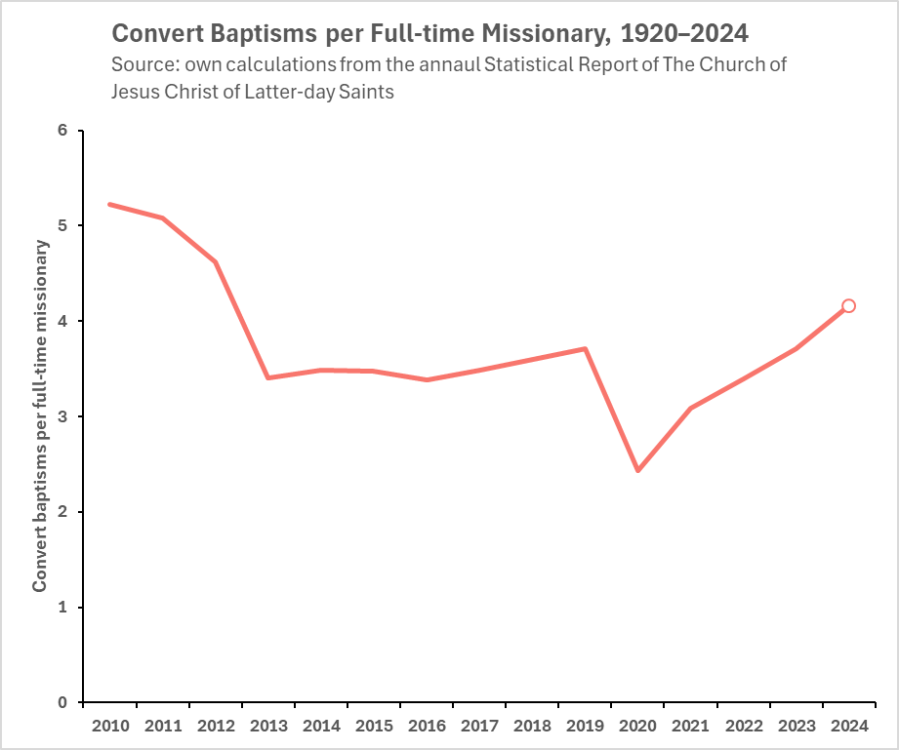
Baptisms by calendar year, in both absolute terms and several per capita metrics. I'm happy to extend out the time period, but changes in growth over the past 15 years are of particular interest to me.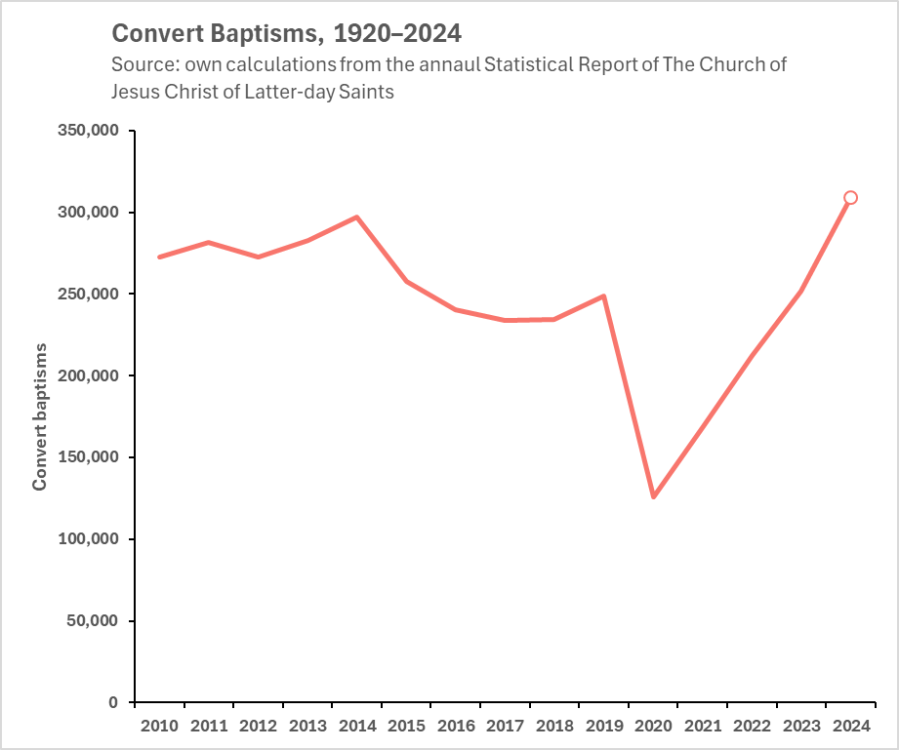
-
China Raids Christian 'House' Churches in Beijing
halconero replied to Pyreaux's topic in In The News
The situation for Chinese members living in the PRC is tough. I happen to know far more about this than I should due to my parents living in China for several years. Taiwanese members can choose to attend expat branches or national ones, with the caveat that once they choose, they can't switch. My parents happened to know a couple in their local expat branch that had other family members attending the national branch, and were able to periodically get vague details and news there. Without elaborating too much, I think people would be surprised at the size and organization of the Church in China. I'm not talking about major numbers, but it is surprisingly more "typical" than you might expect when it comes to opportunities for Chinese members to engage in the Gospel with regards to patriarchal blessings, meetings, going abroad to serve missions, etc. That is while staying within the confines of Chinese law. What is different is the extent to which members are under surveillance. My parents told me of one particular incident where Chinese members were planning an activity via WeChat and were subsequently told in no uncertain terms that the branch would be banned if they followed through. The activity itself was rather banal, but there was one obvious tension point (which I won't elaborate on) that likely flagged it. -
This came up in Elders Quorum a month or so ago. One brother pointed out that "daily transgression and daily repentance" function as a noun phrase: a group of words that functions grammatically as a single noun or subject. Put another way, daily transgression and daily repentance are joined together as a single idea. This is an oversimplification, and risks turning our relationship to God into an accounting exercise, but for illustrative purposes let's say that transgression puts us in a spiritual deficit of -1. Repentance nets out this deficit with a +1 and returns us to a sum status of 0. If we do this day after day, we persist in a state of spiritual stagnation. Not only that, but Joseph Smith states that we're actually displeasing God through such a pattern of living, suggesting that we're actually worsening our position in relation to Him. Now, let's compare that with President Nelson's remarks in which he used the phrase "daily repentance." Emphasis mine: Also: I bolded the above because, in both cases where "daily repentance" is mentioned, they proceed the subject of getting on, walking, or staying on the "covenant path." President Nelson discusses this concept in greater detail throughout his talk, and outlines a pattern of spiritual momentum focused on learning of and becoming as the Saviour. Put it all together, I don't think Presidents Nelson and Smith are discussing the same patterns of behaviour. The latter focuses on a spiritual stagnation leading to degradation; someone treating a spiritual turn towards God as a trifling nod in His direction. By contrast, President Nelson outlines a pattern of deeper and greater spiritual holiness, recognizing that we periodically falter, but always seeking to move forward and work with the Saviour to fulfill our full potential as sons and daughters of both Him and our Heavenly Father.